
Tinting the full surface of your front windshield is illegal in all 50 states. That’s the short answer. But the full picture is more specific than most people realize.
Every state does allow a small tinted strip at the top of the windshield. That strip sits above a marking called the AS-1 line, and below it, your glass must stay clear. Millions of drivers don’t know that line exists until they’re holding a citation.
This guide breaks down exactly what windshield tinting is legal, which states draw the line where, what the real fines are, and which medical exemptions actually hold up. No filler. No guessing.
Is It Illegal to Tint Your Front Windshield
Yes, tinting the full driving surface of the front windshield is illegal in every U.S. state. There are no exceptions for regular passenger vehicles, regardless of how light the film is.
That said, every state permits some tinting on the windshield. The legal zone is the top strip, typically above the AS-1 line or within the top 4 to 6 inches of the glass. Below that boundary, the windshield must remain clear.
Here is where most drivers get tripped up. The terms “windshield tint” and “front window tint” are not interchangeable. The windshield is the large pane directly in front of you. The front side windows are the smaller glass panels to your left and right. These have separate rules in every state, and they are often darker than what’s allowed on the windshield.
Confusing the two is one of the most common reasons drivers receive citations. A tint shop that says “windshield tint is legal in your state” may only be referring to that small top strip.
Quick Facts:
- Full windshield tinting is illegal in all 50 states
- Most states allow a non-reflective strip on the top 4 to 6 inches only
- The legal boundary is the AS-1 line etched into your windshield glass
- Fines range from $50 to several hundred dollars depending on state and offense number
- Some states offer broader windshield tinting via a medical exemption process only
Is It Legal to Tint Your Windshield
Windshield tinting is legal, but only within a strictly defined zone. Every state draws a hard line at how far down the tint can extend.
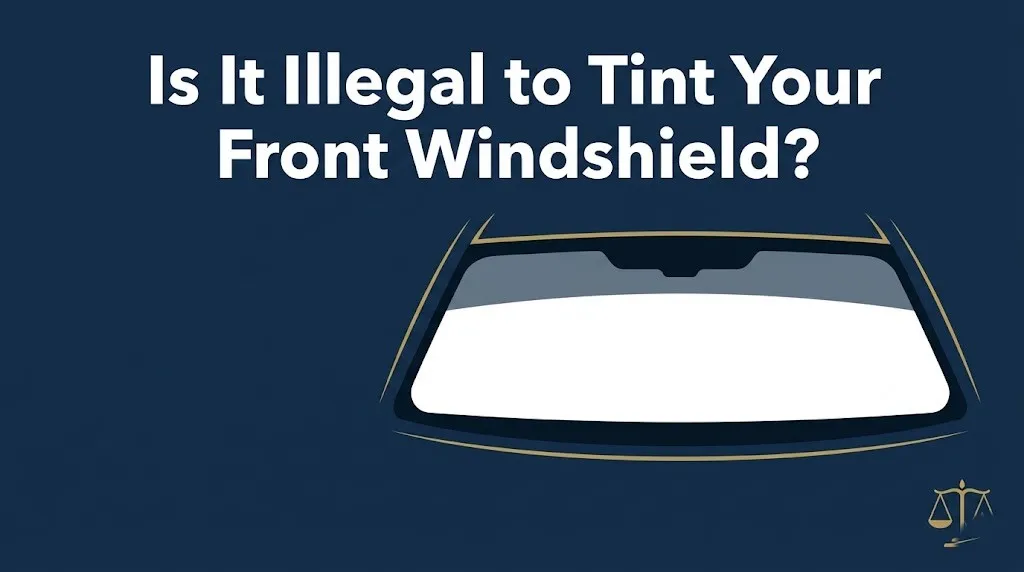
The permitted strip sits above the AS-1 line, a marking etched near the top edge of most vehicle windshields. That strip is typically 4 to 6 inches deep from the top of the glass. Below the line, you are required to let full light through.
States also set rules for how dark even that top strip can be. Many require non-reflective film only. Others add specific VLT requirements. VLT stands for Visible Light Transmission, the percentage of light that passes through the film and glass combined. A lower VLT number means a darker tint. A 25% VLT film blocks 75% of incoming light.
| Window Area | Legal Tint Allowed | Typical Rule |
|---|---|---|
| Full windshield surface | No, in all 50 states | Illegal for standard vehicles |
| Above AS-1 line (top strip) | Yes, in most states | Non-reflective strip only |
| Front side windows | Varies by state | 25% to 70% VLT required |
| Rear side windows | Varies by state | Often any darkness permitted |
| Rear window | Most permissive | Few restrictions in most states |
The strip exception is where most drivers misread the law. If an installer says windshield tint is legal in your state, confirm they mean the top strip. Not the entire pane.
Is It Legal to Have Tint on Front Windshield
Tint on the front windshield is legal in a limited form in most states. The permitted area is the non-reflective strip above the AS-1 line. That is the only zone most states allow.
Even within that permitted strip, rules apply. Most states ban reflective or mirrored films anywhere on the windshield. Many also ban specific colors. Texas, for example, prohibits red, amber, and blue tint colors on windshields under Texas Administrative Code Title 37, Part 1, Rule 21.3.
Clear UV-blocking films are treated differently. In Texas, a clear, untinted UV film may be applied to the entire windshield without a medical exemption, provided it transmits full visible light. The moment that film adds visible darkness, it is classified as tint and subject to all standard restrictions.
What Is Generally Allowed on the Front Windshield:
- Non-reflective tint strip above the AS-1 line (typically 4 to 6 inches from top)
- Clear UV-filtering film on the full windshield in some states
- Manufacturer-installed factory glazing meeting Federal Motor Vehicle Safety Standard No. 205
- Tinting with a valid, state-issued medical exemption certificate
What Is Generally Not Allowed:
- Any tint applied below the AS-1 line on the main driving surface
- Reflective, mirrored, or metallic-finish films anywhere on the windshield
- Restricted tint colors such as red, blue, or amber in many states
- Layered films that drop combined VLT below the legal threshold
Key Takeaway: The front windshield has a strict legal zone in every state. The top strip is the only area open to tinting. Everything below the AS-1 line must stay clear. Even that top strip carries its own darkness and reflectivity limits.
Is It Illegal to Tint Your Windshield in Texas
In Texas, windshield tinting is legal above the manufacturer’s AS-1 line or the top 5 inches of the windshield, whichever sits closer to the top. Below that boundary, any tint is prohibited.
The film applied to that top strip must meet two thresholds under Texas Administrative Code Title 37, Part 1, Rule 21.3. First, it must allow at least 25% light transmission. Second, its luminous reflectance must not exceed 25%. Tint colors red, amber, and blue are prohibited on windshields entirely.
Texas is notably distinct on one point. A clear, untinted UV film can be applied to the entire front windshield without any medical exemption required. That film must remain fully transparent. If it introduces visible darkening, it falls under standard tint rules.
Texas tinting law was enacted in 2009. Film manufacturers must certify their products meet state standards before selling them in Texas. Licensed installers are required to place a compliance sticker between the film and glass on the driver’s side window as proof of certification.
| Texas Windshield Tint Rule | Detail |
|---|---|
| Legal tint zone | Above AS-1 line or top 5 inches |
| Minimum VLT | 25% |
| Maximum reflectance | 25% |
| Banned colors | Red, amber, blue |
| Clear UV film on full windshield | Allowed without exemption |
| Medical exemption | Available |
| Governing statute | Texas Administrative Code Title 37, Part 1, Rule 21.3 |
Texas front side windows require at least 25% VLT. That is more permissive than California’s 70% requirement. But the windshield rule stays fixed at the top-strip zone regardless.
Is It Illegal to Tint Your Windshield in Florida
In Florida, windshield tinting is legal only above the manufacturer’s AS-1 line. The film must be non-reflective and must not exceed 25% reflectivity. Below the AS-1 line, windshield tinting is illegal under Florida Statute 316.2953.
Florida’s front side windows are among the more permissive in the country. They allow a minimum of 28% VLT, letting drivers go significantly darker on those side panels than states like California. But the windshield stays restricted to the top strip regardless of what the side windows allow.
Florida Statute 316.29545 establishes a medical exemption pathway. Drivers with qualifying conditions, including lupus, autoimmune disorders, or physician-verified photosensitivity, can apply to the Florida Department of Motor Vehicles for a medical exemption certificate. That certificate permits darker tint on the windshield, side windows, and rear windows beyond the standard legal limits. Documentation must be kept in the vehicle at all times.
Florida Windshield Tint Summary:
- Legal zone: Above AS-1 line only
- Required film type: Non-reflective
- Maximum reflectivity: 25%
- Below AS-1 line: Prohibited under Florida Statute 316.2953
- Medical exemption: Available under Florida Statute 316.29545
- Front side window minimum: 28% VLT
Florida’s intense year-round sun makes this question more pressing for drivers there than in most other states. Law enforcement can use handheld tint meters roadside to verify VLT. A non-compliant reading typically results in a fine and a mandatory removal order.
Is It Illegal to Tint Your Windshield in California
In California, windshield tinting is restricted to the top 4 inches of the glass. That strip must be non-reflective. Below the 4-inch mark, no tinting of any kind is legal on the windshield.
California Vehicle Code Section 26708 is the governing statute. Under CVC 26708, no material may be placed on the windshield that reduces the driver’s clear view. The 4-inch top strip is the only exception written into that law. California also prohibits any tint that exceeds the reflectivity of standard factory glass.
The state’s front side windows require at least 70% VLT, one of the strictest thresholds in the country. California allows medical exemptions for conditions such as photosensitivity, lupus, and certain skin cancers. These exemptions run through the California Department of Motor Vehicles and must be documented in writing and carried in the vehicle.
| California Windshield Tint Rule | Detail |
|---|---|
| Legal tint zone | Top 4 inches only |
| Required film type | Non-reflective |
| Reflectivity limit | No more than standard factory glass |
| Front side window VLT | 70% minimum |
| Governing statute | California Vehicle Code Section 26708 |
| Medical exemption | Available through California DMV |
| Penalty | Varies by county; fix-it ticket standard |
California enforces tint laws actively. Law enforcement in high-traffic corridors use digital tint meters as standard equipment. Getting caught with tint below the 4-inch mark carries real financial consequences, not just a verbal warning.
Key Takeaway: Texas, Florida, and California each permit only the top windshield strip. California’s zone is the most restrictive at 4 inches. Texas allows up to 5 inches with a 25% VLT minimum. Florida ties its zone to the AS-1 line with a non-reflective requirement.
Is It Legal to Tint Your Windshield in Illinois
In Illinois, windshield tinting is legal on the top 6 inches only. That strip must use non-reflective film. Below the 6-inch mark, any tinting is prohibited under Illinois Vehicle Code Chapter 12, Article V.
Illinois is stricter about side windows than many drivers expect. For sedans, front side windows must allow at least 35% VLT. SUVs and vans operate under slightly different rules, with front side windows requiring 50% VLT in certain configurations depending on rear window tinting.
Violations in Illinois carry real financial weight. A first-time windshield tint offense is a petty offense with a fine of $50 to $500. Repeat violations escalate to a Class C misdemeanor, carrying fines from $100 to $500 and points added to the driver’s record.
Illinois allows medical exemptions for qualifying conditions. Eligible conditions include lupus, albinism, and disseminated superficial actinic porokeratosis, though other conditions may also qualify with proper physician documentation. The process requires a certified physician’s statement. A special tinted window license plate is then issued through the Illinois Secretary of State. The exemption must be renewed every 4 years.
Illinois Windshield Tint Summary:
- Legal tint zone: Top 6 inches, non-reflective film only
- Below 6 inches: Prohibited under Illinois Vehicle Code Chapter 12, Article V
- First violation: Petty offense, $50 to $500 fine
- Repeat violation: Class C misdemeanor, $100 to $500 fine plus driving record points
- Medical exemption: Available through Illinois Secretary of State
- Reflective or mirrored tint: Banned on all windows statewide
If rear windows are tinted, Illinois law also requires dual side mirrors. That is an easy secondary violation that surprises drivers who only researched the windshield rule.
Is It Legal to Tint Your Windshield in Ohio
In Ohio, windshield tinting follows the standard pattern. A non-reflective strip above the AS-1 line is permitted. Below that line, the windshield must remain clear.
Ohio’s front side windows must allow more than 50% VLT for standard passenger vehicles. Rear side windows and the rear window carry no darkness restriction for multipurpose vehicles, including SUVs and minivans. Sedans face more consistent rules across all windows.
Ohio does not currently recognize medical exemptions for window tinting. That separates it from states like Texas, Florida, California, and Illinois, all of which have active exemption programs. Drivers in Ohio with medical conditions requiring sun protection have no state-approved pathway for darker windshield tinting.
Penalty amounts in Ohio are not set at the state level for this violation. Local jurisdictions determine the exact fine. This means two drivers caught in different Ohio counties for the same offense can face different fine amounts.
| Ohio Windshield Tint Rule | Detail |
|---|---|
| Legal tint zone | Above AS-1 line only |
| Required film type | Non-reflective |
| Front side window minimum | More than 50% VLT |
| Rear windows (multipurpose vehicles) | No restriction |
| Medical exemption | Not currently available |
| Penalty | Determined by local jurisdiction |
Think of Ohio’s approach as straight down the middle. Not as restrictive as California. Not as permissive as Texas. The key point for any Ohio driver: a non-reflective top strip is fine, but anything below the AS-1 line puts you in citation territory.
Is It Legal to Tint Your Windshield in Arizona
In Arizona, a non-reflective tint strip above the manufacturer’s AS-1 line is permitted on the front windshield. Below the AS-1 line, windshield tinting is prohibited under Arizona Revised Statutes Section 28-959.01, which has been in force since 1994.
Arizona’s front side windows must allow more than 33% VLT. That’s more permissive than California’s 70% threshold. Rear side windows and the rear window carry no darkness restrictions. Arizona’s desert climate, with extreme heat and intense sun, makes rear and side window flexibility especially practical for local drivers.
Arizona allows medical exemptions through the Arizona Department of Transportation’s Medical Review Program. The process requires a signed physician letter stating the medical necessity for darker tint. That letter must be submitted to ADOT’s Medical Review Program. Medical waivers in Arizona allow darker tinting on side windows and may permit altered tint colors. Documentation must travel with the vehicle.
Arizona Windshield Tint Rules:
- Legal zone: Above AS-1 line only
- Film type: Non-reflective
- Front side window minimum: 33% VLT
- Rear windows: No darkness restriction
- Maximum reflectivity (front and back side windows): 35%
- Medical exemption: Available through ADOT Medical Review Program
- Governing statute: Arizona Revised Statutes Section 28-959.01
Arizona’s enforcement is consistent. Front windshield tinting below the AS-1 line gets cited, and the lack of a fixed statewide fine amount does not mean the penalty is light.
Key Takeaway: Illinois, Ohio, and Arizona all restrict windshield tinting to the top strip. Illinois allows 6 inches. Ohio and Arizona tie their zones to the AS-1 marker. Ohio has no medical exemption program. Arizona and Illinois both do.
What Is the AS-1 Line for Windshield Tint
The AS-1 line is a small marking etched or printed into the upper edge of most vehicle windshields. It typically appears as part of the manufacturer’s certification block, usually found in one of the top corners of the glass. The AS designation comes from the American National Standards Institute’s classification for automotive safety glazing.
This line is the legal boundary for windshield tinting. Most state laws state that tint is permitted “above the AS-1 line.” If your car has the marking, that’s where the legal zone ends. Below it, you’re in prohibited territory regardless of how light the film is.
If no AS-1 line is visible, states default to a fixed measurement. Texas defaults to 5 inches from the top. Illinois defaults to 6 inches. California defaults to 4 inches. These measurements run parallel to the top edge of the windshield across its full width.
The zone above the AS-1 line exists for a practical reason. It lines up with the vehicle’s sun visor position. Tinting that upper strip reduces glare without blocking the driver’s critical forward sightlines. Think of it like the brim of a baseball cap. It cuts the sun without blocking where you’re going.
Why the AS-1 Line Matters Practically:
- It is the boundary law enforcement looks at when assessing windshield tint legality
- Tint that creeps below the line is citable regardless of its VLT percentage
- Installers must identify your specific vehicle’s AS-1 line before cutting film
- If your windshield has no visible marking, your state’s inch measurement applies
- Different windshield designs can place the line higher or lower, so measuring matters
The AS-1 line is the most overlooked concept in tint law. Most drivers who receive citations for windshield tinting had no idea the line existed before the stop.
Windshield Tint Penalties and Fines by State
Penalties for illegal windshield tint range from small fines to failed vehicle inspections to driving record points. The exact consequences depend on your state, whether it’s a first offense, and whether local jurisdictions set their own penalty scale.
Most states treat a first tint violation as an infraction or petty offense. The result is typically a fine and a corrective order. Fix-it tickets are common, giving drivers a set window, often 30 to 60 days, to remove or replace the non-compliant film. Ignoring that deadline escalates the penalty into a more serious charge.
Modern enforcement removes most of the old guesswork. Law enforcement in many states now carries digital tint meters as standard equipment. A reading takes seconds. The device measures VLT through the glass and produces a number the officer can cite directly on the ticket.
| State | First Offense Fine | Repeat Offense | Additional Consequences |
|---|---|---|---|
| Illinois | $50 to $500 | Class C misdemeanor, $100 to $500 | Points added to driving record |
| California | Varies by county | Higher fine | Fix-it ticket required |
| Texas | Typically $25 to $200 | Increased fine | Failed annual inspection |
| Florida | Varies | Increased fine | Mandatory tint removal order |
| Arizona | Varies by jurisdiction | Increased fine | Fix-it ticket standard |
| Ohio | Set by local court | Higher local fine | Corrective order |
| New York | Up to $150 | Higher fine | Aggressive roadside enforcement |
Beyond the immediate fines, illegal tint can create problems that aren’t obvious at the stop. Some auto insurance carriers classify illegal vehicle modifications, including non-compliant tint, as grounds to reduce or deny a claim if that modification contributed to an accident. Failed vehicle inspections block registration renewal in states that require annual checks. In states with comparative fault rules, illegal tint that reduced your visibility can factor into a civil liability assessment after a crash.
Key Penalty Triggers:
- VLT below the state minimum on the windshield or side windows
- Any tint applied below the AS-1 line on the main windshield surface
- Reflective or mirrored film on front windows
- Restricted tint colors such as red, blue, or amber in many states
- Missing required compliance sticker where state law mandates one
Medical Exemptions for Windshield Tint
Medical exemptions allow drivers with qualifying conditions to apply darker tint beyond the standard legal limits. Most states that offer these exemptions require physician documentation and some form of state-issued certificate. The documentation must be kept in the vehicle whenever it is driven.
Qualifying conditions vary by state. Common examples include lupus, albinism, porphyria, disseminated superficial actinic porokeratosis, and severe photosensitivity disorders. Several states include catch-all language that allows any condition a licensed physician certifies as requiring reduced sun exposure to qualify.
The exemption process is formal. It is not a doctor’s note you hand to an officer. You submit a physician’s certification, complete state-specific forms, and receive either a special plate, a compliance sticker, or a written certificate from your state’s motor vehicle agency. Physicians cannot legally submit false statements for these exemptions.
| State | Exemption Available | Issuing Authority | Certificate Renewal |
|---|---|---|---|
| Texas | Yes | Texas DPS | Tied to medical condition |
| Florida | Yes | Florida DMV | Tied to medical condition |
| California | Yes | California DMV | Varies |
| Illinois | Yes | Illinois Secretary of State | Every 4 years |
| Arizona | Yes | ADOT Medical Review Program | Not specified |
| Ohio | No | Not applicable | Not applicable |
A few nuances worth knowing: in some states, the exemption follows the person rather than the vehicle. Idaho, for example, issues exemptions to individuals, meaning any vehicle that person regularly travels in can carry the darker tint. Illinois issues special license plates tied to the vehicle. Florida’s exemption certificate references the specific medical condition and remains valid as long as that condition persists.
Ohio stands out here. It has no medical exemption program for window tinting at all. A driver in Ohio with a severe sun-sensitivity condition has no legal pathway to darker windshield tinting beyond the standard AS-1 line strip.
Key Takeaway: Medical exemptions exist in most major states but differ in scope, application process, and renewal requirements. Always carry exemption documentation in the vehicle. Ohio has no exemption pathway for tinting.
What Happens If You Get Caught with Illegal Windshield Tint
Getting stopped for illegal windshield tint typically starts with an officer who noticed your glass looked too dark or your tint extended too far down the windshield. The encounter has a predictable pattern in most states.
The officer will likely apply a tint meter to the glass on the spot. The meter reads your VLT through the film in a few seconds. If your reading falls below the legal threshold, or if the tint extends past the AS-1 line regardless of darkness, you will receive a citation. There is very little room to argue with a digital reading.
Depending on the state, you’ll receive either a standard fine or a fix-it ticket. A fix-it ticket sets a deadline, often 30 to 60 days, to remove the non-compliant film and return to a law enforcement agency or inspection station for verification. Once you prove compliance, the ticket is dismissed or the fine is reduced. Ignoring that deadline converts the ticket into a more serious charge with higher penalties.
Possible Outcomes After a Stop:
- Standard fine issued at the traffic stop
- Fix-it ticket with a correction deadline set by the state or local court
- Mandatory tint removal ordered by citation or court
- Failed annual vehicle inspection in states with inspection requirements
- Points added to your driving record in states like Illinois
- Class C misdemeanor charge for repeat violations in states like Illinois
- Increased civil liability exposure if tint is shown to have reduced visibility in an accident
One outcome most drivers never anticipate: a civil consequence. If you are involved in a crash and your windshield tint is later shown to have reduced your visibility or reaction time, that finding can be used against you in a negligence claim. In states that apply comparative fault, your share of liability in a civil suit could increase.
The financial chain reaction from one tint ticket can go far beyond the initial fine.
Front Windshield Tint Myths vs Facts
A lot of what circulates online about windshield tint is based on half-truths or outdated assumptions. These are the ones that cause the most citations.
Myth: Any light-shade tint on the windshield is legal. Fact: No state allows tinting below the AS-1 line, regardless of how light the film is. A 70% VLT film applied below the legal zone is still illegal. Location matters as much as darkness.
Myth: Ceramic tint is always legal because it looks nearly invisible. Fact: Ceramic film blocks infrared heat while remaining visually close to clear. But some ceramic films still reduce VLT slightly. If that reduction drops you below state thresholds, you can still be cited. Officers test with meters, not with their eyes.
Myth: If the tint was on the car when I bought it, it’s legal. Fact: Factory glazing meets Federal Motor Vehicle Safety Standard No. 205. But aftermarket tint added by a previous owner may not comply with your state’s current rules. You are responsible for your vehicle’s tint regardless of who installed it.
Myth: Law enforcement can’t really tell without a meter. Fact: Digital tint meters are now standard equipment for traffic enforcement in many states. There is no reasonable bet that dark tint will go unnoticed. The “they probably won’t pull me over” logic fails routinely.
Myth: A tinted strip at the top is always legal everywhere. Fact: States set their own VLT and reflectivity limits even for the top strip. Texas requires at least 25% VLT in that zone. California restricts reflectivity to factory-glass levels. Crossing a state line with a strip that was legal at home may put you in violation immediately.
Myth: Medical exemptions work as a blanket pass for any tint anywhere on the windshield. Fact: Most exemptions expand what darkness is allowed. They do not eliminate placement restrictions entirely. The AS-1 line rule or a modified version of it still applies in most states even with an active medical exemption.
How to Stay Legal with Windshield Tint
Staying legal with windshield tint means knowing your state’s specific rules before installation, not after. General knowledge is not enough. You need the exact VLT limit, the legal zone measurement, and the reflectivity cap for your specific state.
Step one is locating the AS-1 line on your windshield. Most vehicles built since the 1990s have this marking visible in the top corner of the glass. If you can’t locate it, measure from the top edge of the glass using your state’s default distance. California is 4 inches. Texas is 5 inches. Illinois is 6 inches. Measure parallel to the top edge across the full width.
Step two is selecting the right installer. A licensed, reputable installer will know your state’s current rules in detail. Ask upfront whether they are familiar with the windshield-specific regulations, not just the side and rear window rules. Request the VLT rating of any film in writing before installation. Keep that document in your glove box.
A Compliance Checklist Before Installation:
- Locate or measure the AS-1 line on your specific windshield
- Confirm your state’s exact VLT limit for the top strip
- Confirm whether your state prohibits reflective or metallic films
- Check whether clear UV film is treated as tint in your state
- Get written documentation of the film’s VLT from the installer
- If you travel across state lines regularly, verify the rules for those states too
- If you have a medical exemption, carry the certificate whenever you drive
One practical analogy: tint law is like a speed limit. The limit is real whether or not you see a sign. Ignorance of the specific number doesn’t protect you when the meter reads over.
Laws can change. A rule that held last year may have been tightened this year in your state. Verifying your state’s current DMV or DOT standards before installing any windshield film is the only way to be sure.
Frequently Asked Questions
Is it illegal to tint your front windshield completely?
Yes, tinting the full surface of the front windshield is illegal in all 50 states. Every state restricts tinting to the top strip above the AS-1 line. Below that line, the windshield must remain completely clear for driver visibility.
Can I get a ticket for windshield tint even if the tint looks light?
Yes. Officers use tint meters that measure VLT regardless of how the film appears to the naked eye. Even a visually light tint applied below the AS-1 line is still an illegal placement. Location and darkness are both separate violation triggers, and either one alone can result in a citation.
Does a medical exemption let me tint my entire windshield?
Not in most states. Medical exemptions typically expand what darkness is permitted, not where tint can be placed. Most states with active exemption programs still require the film to stay above or near the AS-1 line zone. Ohio has no medical exemption program for tinting at all, and Ohio drivers cannot receive a waiver regardless of medical condition.
What is the difference between windshield tint and front side window tint?
The windshield is the large front glass panel the driver looks through directly. Front side windows are the smaller panels to the driver’s left and the passenger’s right. These two areas have separate legal rules in every state, with side windows generally allowed to be significantly darker than the windshield.
Can I apply a clear UV film to my entire windshield legally?
In some states, yes. Texas specifically allows a clear, untinted UV-blocking film on the full front windshield without requiring a medical exemption. The film must transmit full visible light and must not add any visible darkening to the glass. State policies on clear UV films vary, so checking your specific state’s current rules before installation is the safest approach.
This guide covers the laws across the most-searched states, the AS-1 line boundary that most articles skip, and the medical exemption specifics that apply to real drivers with real conditions.
If you drive across state lines often, the rules change at every border. Knowing what’s legal where you drive, not just where you live, is what keeps you on the right side of a tint meter.






