
Yes, cheating on your spouse is still illegal in 11 US states as of 2026. In three of those states, it’s not just a minor infraction. It’s a felony.
Most people assume adultery is just a personal matter between two people. That’s not accurate in every state. Some Americans can face criminal charges, prison time, or steep fines just for having an affair.
The laws vary drastically depending on where you live. What’s legal in California can land someone in criminal court in Michigan. This article breaks down exactly where adultery is a crime, what the penalties look like, and how cheating can affect a divorce even in states where it’s not criminal.
Is It Illegal to Cheat on Your Spouse?
Adultery remains a crime in some states, and depending on the jurisdiction, cheating on a spouse can be classified as a misdemeanor or even a felony. That said, prosecutions are genuinely rare.
The federal government has never made adultery a criminal offense. There is no national law against it. The rules are set entirely at the state level, which is why the answer looks completely different depending on which side of a state line you live on.
Think of it like jaywalking laws. Technically on the books in many places, almost never enforced, but still real. The difference with adultery is that in a handful of states, the potential penalties are serious enough to matter.
Prosecutors use their professional discretion to decide what charges to file. Part of this discretion involves evaluating whether prosecution will further public welfare and represents a good use of public resources. Because adultery is largely a private matter, most prosecutors pass.
Still, the law is the law. And in some situations, especially divorce proceedings or military cases, the legal status of adultery matters a lot.
Is It Illegal to Cheat on Your Spouse in 2026?
As of 2025, the states that still criminalize adultery are Alabama, Arizona, Florida, Georgia, Illinois, Kansas, Michigan, Mississippi, Oklahoma, South Carolina, and Wisconsin. That’s 11 states where cheating is technically a crime on the books right now.
The number has shrunk significantly over the past decade. Colorado repealed its law in 2013, New Hampshire in 2014, Massachusetts in 2018, Utah in 2019, Idaho in 2022, Minnesota in 2023, and New York in 2024.
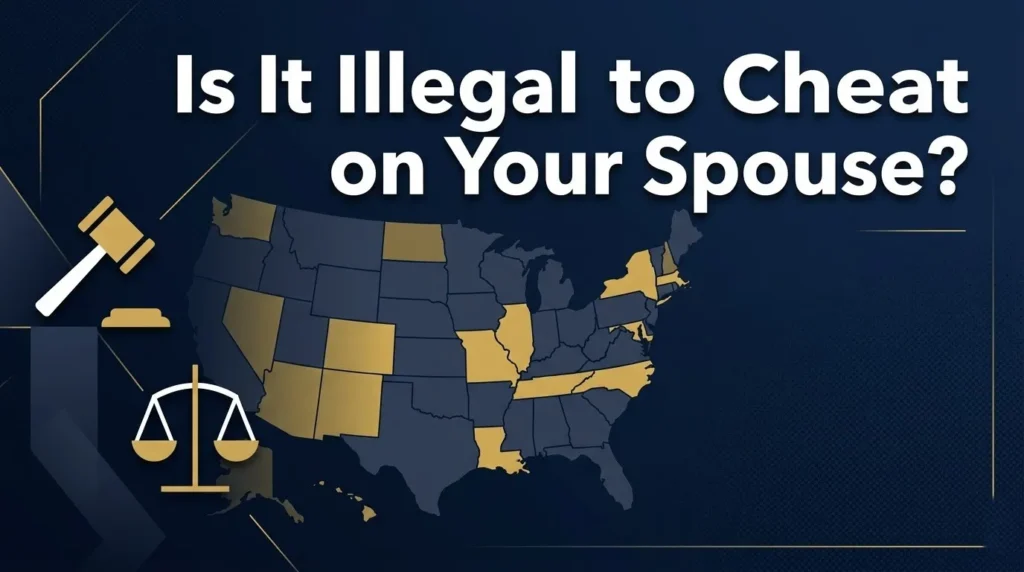
The trend is clear. States are moving away from criminalizing consensual adult behavior. Even though the adultery laws survived in some states, they are almost meaningless fossils. Hardly anybody is ever arrested or punished.
But “almost never enforced” is not the same as “legally safe.” If you live in one of the 11 states listed above, the criminal statute still exists and can technically be applied.
Quick Facts: Adultery Laws in 2026
- 11 states still criminalize adultery
- 3 of those classify it as a felony
- Federal law does not criminalize adultery
- Most repeals happened between 2013 and 2024
What States Is It Illegal to Cheat on Your Spouse?
Three states, Michigan, Oklahoma, and Wisconsin, classify adultery as a felony, while the remainder treat it as a misdemeanor.
Here is the full breakdown of every state where adultery is still a crime, along with the specific penalty classification:
| State | Classification | Max Penalty |
|---|---|---|
| Michigan | Felony | Up to 5 years prison, $5,000 fine |
| Oklahoma | Felony | Up to 5 years prison, $500 fine |
| Wisconsin | Class I Felony | Jail or intermediate sanction |
| Illinois | Class A Misdemeanor | Up to 1 year jail, $2,500 fine |
| Georgia | Misdemeanor | Standard misdemeanor penalties |
| Alabama | Class B Misdemeanor | Fine and potential jail time |
| Arizona | Class 3 Misdemeanor | Fine and potential jail time |
| Florida | Misdemeanor | $500 fine |
| Kansas | Class C Misdemeanor | Up to 1 month jail, $500 fine |
| Mississippi | Misdemeanor | Fine and potential jail time |
| South Carolina | Misdemeanor | Up to 1 year jail, $500 fine |
The states not on this list treat adultery as a purely civil matter, meaning no criminal charges, no arrest record, and no jail time risk.
Can You Go to Jail for Cheating on Your Spouse?
Yes, in theory you can go to jail for adultery. In practice, it is extraordinarily rare.
Under the Michigan Penal Code, adultery is punishable by up to five years of imprisonment and a fine of up to $5,000, while Oklahoma law punishes adultery by up to five years of imprisonment and a fine of up to $500.
In criminal cases, it’s up to the prosecutor to file the criminal charges and prove the crime beyond a reasonable doubt. The non-offending or innocent spouse may be a witness or supply evidence, but they don’t file the criminal charges nor are they in charge of the case.
Even in states with adultery laws, prosecutors have to decide whether the case is worth pursuing. Most don’t. Their offices are dealing with violent crime, drug offenses, and property crime. A consensual affair rarely makes the priority list.
A criminal record, even for a misdemeanor, can appear on background checks and may create difficulties with employment, particularly in professions that require security clearances or professional licensing. That’s a real consequence even without a jail sentence.
Key Takeaway: Jail time for adultery is technically possible in 11 states, but actual prosecution is extremely rare. The bigger real-world risk is the impact on divorce proceedings, not criminal court.
Is It Illegal to Cheat on Your Spouse in Texas?
Texas does not treat adultery as a crime but considers it a violation of certain civil laws. The adulterous spouse won’t go to jail or earn a criminal record, but they won’t go scot-free either.
Texas is a state where adultery carries no criminal penalty. No arrest, no misdemeanor, no felony charge. You can cheat on your spouse in Texas without facing a single moment in criminal court.
Texas allows fault-based divorces, where adultery can affect the outcome including property division and alimony. The court may award a larger portion of marital assets to the non-adulterous spouse, and can reject a request for alimony from the spouse who committed adultery.
Adultery is not a factor that prevents the cheating spouse from receiving child custody or visitation rights unless the affair directly harmed the children’s wellbeing.
So in Texas, the risk isn’t jail. It’s a worse divorce outcome. That’s still a significant consequence worth understanding.
Is It Illegal to Cheat on Your Spouse in Michigan?
Under Michigan law: “Adultery is the sexual intercourse of 2 persons, either of whom is married to a third person. Any person who shall commit adultery shall be guilty of a felony; and when the crime is committed between a married woman and a man who is unmarried, the man shall be guilty of adultery, and liable to the same punishment.” (Mich. Comp. Laws §§ 750.29, 750.30)
Michigan has one of the harshest adultery laws in the country. It is a felony, full stop. Michigan treats adultery as a major crime that brings jail sentences.
What makes Michigan especially notable is that the law can apply to the unmarried affair partner too. If you’re single and sleep with someone who’s married in Michigan, you could theoretically face a felony charge.
The penalty is up to five years in prison and a fine of up to $5,000. Prosecutions are still very rare, but the statute carries real weight. It can affect professional licensing, background checks, and security clearances even if no prison time is served.
Is It Illegal to Cheat on Your Spouse in California?
No. Cheating on your spouse is not a crime in California. There is no adultery statute in the state’s criminal code.
California follows no-fault divorce rules, which ignore whether marriage partners cheated on each other. Adultery does not impact the results of property division, child custody, or child and spousal support.
California is about as hands-off as a state gets on this issue. The courts don’t want to hear about who cheated on whom. They divide assets based on what’s fair, not who was faithful.
This approach reflects a broader legal philosophy: government should stay out of the bedroom. California made that call decades ago, and it has not moved backward.
If you live in California and your spouse cheats, your options are limited to divorce proceedings. Criminal charges are simply not on the table.
Is It Illegal to Cheat on Your Spouse in Florida?
Proving adultery is no longer a factor in obtaining a divorce in Florida, which is a no-fault divorce state. But adultery is still technically a crime in Florida under Fla. Stat. § 798.01.
Florida’s law targets “open and notorious” adultery specifically. This means the law applies when a couple is openly living together as if married, not just a single affair. A one-time incident is less likely to qualify under the statute than an ongoing, publicly visible relationship.
The penalty is a second-degree misdemeanor with a fine of $500. Prosecutions are almost unheard of.
If your spouse’s adultery contributed to the breakdown of your marriage, the circumstances of the infidelity may be relevant in divorce proceedings as you petition the court regarding the division of marital property, child custody, and alimony. Florida courts can weigh adultery when awarding alimony, especially if marital assets were spent on the affair.
Is It Illegal to Cheat on Your Spouse in Illinois?
Yes. Adultery is illegal in Illinois under Section 11-35 of the Illinois Criminal Code. It is considered a Class A misdemeanor offense, punishable by up to one year in jail and a fine of up to $2,500.
Illinois is one of the tougher misdemeanor states. A Class A misdemeanor is the most serious misdemeanor classification available. That’s the same level as minor assault or theft under $500 in many states.
Despite the serious classification, actual charges for adultery in Illinois are almost never filed. The statute is old and hasn’t been actively enforced in modern times.
Still, because it’s a Class A misdemeanor, a conviction in Illinois could show up on criminal background checks. That’s meaningful for anyone in licensed professions, government roles, or jobs requiring security clearances.
Key Takeaway: Illinois, Michigan, and Oklahoma have some of the strictest adultery laws still active in 2026. Living in these states means the legal exposure is real, even if enforcement is rare.
Is It Illegal to Cheat on Your Spouse in Arizona?
Yes, adultery is illegal in Arizona. Under Ariz. Rev. Stat. § 13-1408, sex with someone other than your spouse is a Class 3 misdemeanor, punishable by up to a month in jail and a fine of up to $500.
Arizona’s classification is on the lighter end of the misdemeanor scale. A Class 3 misdemeanor carries less potential jail time than Illinois or South Carolina’s statutes.
Arizona is also a no-fault divorce state, meaning the courts won’t factor cheating into property division or custody decisions in most cases. The criminal statute exists, but divorce courts generally ignore who was unfaithful.
The gap between what the criminal code says and what actually happens in practice is wide in Arizona. Prosecutors almost never file adultery charges. The statute functions more as a dormant moral relic than an active enforcement tool.
Is It Illegal to Cheat on Your Spouse in New York?
New York repealed its adultery law as part of recent legislative action. New York repealed its criminal adultery law in 2024.
Before 2024, adultery was a Class B misdemeanor in New York, punishable by up to 90 days in jail and a $500 fine. The law dated to 1907 and was considered an embarrassing legal relic by most legal scholars.
Only about a dozen people had ever been charged with the crime in New York history, and only a few were actually punished. The law was effectively dead for decades before the repeal made it official.
As of 2026, cheating on your spouse in New York carries zero criminal penalty. It’s a purely civil matter handled through divorce proceedings.
Is It Illegal to Cheat on Your Spouse in Georgia?
Georgia law states: “A married person commits the offense of adultery when he voluntarily has sexual intercourse with a person other than his spouse and, upon conviction thereof, shall be punished as for a misdemeanor.” (Ga. Code § 16-6-19)
Georgia treats adultery as a standard misdemeanor. The statute doesn’t specify a fine amount, but standard Georgia misdemeanors can carry up to 12 months in jail and a $1,000 fine.
Georgia also allows fault-based divorce. If adultery is proven, the offending spouse may be barred from receiving alimony under Georgia Code § 19-6-1.
That alimony bar is one of the more concrete consequences in Georgia. It’s not just theoretical. A spouse who cheated and then tries to claim spousal support in a Georgia divorce can be legally blocked from receiving it.
Is It Illegal to Cheat on Someone Who Is Married?
This depends heavily on the state. In most places, only the married person can be charged with adultery. But a few states go further.
In Oklahoma, it’s a crime not only for the married person but also for the other person involved, even if that person is single. Michigan’s statute also applies to the unmarried affair partner in some circumstances.
Wisconsin’s adultery statute covers: (1) a married person who has sexual intercourse with a person not the married person’s spouse; or (2) a person who has sexual intercourse with a person who is married to another. (Wis. Stat. § 944.16)
So in Wisconsin, Michigan, and Oklahoma, being single is not a legal shield. If the person you sleep with is married, you can potentially face the same charges as the married party.
| State | Can the Single Party Be Charged? |
|---|---|
| Michigan | Yes, under certain circumstances |
| Oklahoma | Yes |
| Wisconsin | Yes |
| Georgia | Generally no |
| Illinois | Generally no |
| Florida | Generally no |
Most states focus criminal liability on the married spouse only. These three are the notable exceptions.
Cheating in the Military: UCMJ and Article 134
Adultery in the military is addressed under Article 134 of the UCMJ, also known as the “General Article,” which covers prohibited conduct that is prejudicial to good order and discipline in the armed forces.
This is a completely separate system from civilian law. A service member can be based in California, where adultery is not a crime, and still face military charges for the same behavior.
Article 134 states that the maximum punishment is a Dishonorable Discharge, forfeiture of all pay and allowances, and confinement for one year.
With changes implemented by the Military Justice Act, the UCMJ no longer uses the term “adultery” but refers to “extramarital sexual conduct,” which includes a broader definition of sexual activities beyond just intercourse. This update reflects a gender-neutral stance and acknowledges same-sex marriages.
The practical impact is enormous. A service member found guilty doesn’t just risk jail. They risk losing their career, their pension, their housing benefits, and their reputation. A dishonorable discharge follows someone for life on background checks.
The only 100 percent safe course of action under the UCMJ is to wait until a state court has granted a final decree of divorce, thereby making the service member legally single again.
Key Takeaway: Military members face adultery consequences under federal military law regardless of which state they live in. The UCMJ operates independently of civilian adultery statutes.
Does Cheating Affect Your Divorce Settlement?
Yes, in many states cheating can directly affect your divorce outcome. The extent depends on whether you live in a fault-based or no-fault divorce state.
In pure no-fault states like California, marital misconduct is generally irrelevant to the division of property or awarding of alimony. The focus is on an equitable split of assets, regardless of who was to blame for the marriage ending.
In fault-based states, the picture looks very different. In many other states, a spouse can file for divorce on fault grounds, with adultery being a primary one. A Texas judge may award a disproportionately larger share of the marital estate to the non-cheating spouse.
If you continue to live with your spouse after discovering their infidelity, you may be considered to have forgiven, or condoned, the infidelity. This could potentially undermine any claims based on the behavior.
That “condonation” doctrine is a concept most people don’t know about. Staying in the marriage after discovering an affair can legally undercut your ability to use that affair in divorce proceedings later.
| Divorce System | Adultery Impact on Property | Adultery Impact on Alimony |
|---|---|---|
| No-Fault States | Generally none | Generally none |
| Fault-Based States | Can shift asset distribution | Can bar or reduce alimony |
| Military Divorce | Varies by state + UCMJ | Can affect military benefits |
Adultery and Alimony: How Cheating Impacts Spousal Support
Adultery’s biggest legal impact in most states is on alimony, not criminal charges.
Florida courts may consider the adultery of either spouse and any resulting economic impact when awarding alimony. Any money spent or gifts given as part of an adulterous affair represents a dissipation of marital assets.
Georgia goes further. A spouse who committed adultery can be entirely barred from receiving alimony under Georgia law. Texas courts can reject alimony requests from cheating spouses. South Carolina judges factor in adultery as one of several alimony considerations.
A few states, such as North Carolina, still allow civil lawsuits for alienation of affection, where a spouse can sue the third party involved in the affair. North Carolina is one of the last states where an innocent spouse can take the affair partner to civil court and sue for damages.
That’s a rarely used but very real legal tool. Alienation of affection suits in North Carolina have resulted in jury awards of hundreds of thousands of dollars. It’s not just about divorce. It’s about holding the third party financially accountable too.
Key Takeaway: Even in states where adultery isn’t a crime, it can significantly affect alimony awards, property division, and in North Carolina, civil lawsuits against the affair partner directly.
Frequently Asked Questions
Is cheating on your spouse a crime in the US?
As of 2025, the states that still criminalize adultery are Alabama, Arizona, Florida, Georgia, Illinois, Kansas, Michigan, Mississippi, Oklahoma, South Carolina, and Wisconsin. Federal law does not criminalize adultery. Outside those 11 states, cheating on your spouse carries no criminal penalty.
Which states treat adultery as a felony?
Three states, Michigan, Oklahoma, and Wisconsin, classify adultery as a felony. Michigan’s penalty reaches up to five years in prison and a $5,000 fine. Oklahoma and Wisconsin both carry serious felony-level consequences as well.
Can you actually be arrested for cheating on your spouse?
Technically yes, in the 11 states where adultery is still a crime. Despite few actual arrests, these legal rules about adultery directly impact how family property is divided during divorce proceedings. Real-world arrests for adultery are extremely rare, but the legal risk exists on paper.
Does adultery affect child custody in a divorce?
In most states, adultery has little to no direct effect on child custody decisions. Adultery is not a factor that prevents the cheating spouse from receiving child custody or visitation rights unless the adultery directly affected the children’s well-being. Courts focus on the best interests of the child, not the moral conduct of the parents.
What is the difference between criminal adultery and civil adultery consequences?
Criminal adultery means the state can charge you with a crime, resulting in fines or jail time. Civil consequences mean adultery can affect your divorce outcome, including alimony, property division, and in rare states, lawsuits from the innocent spouse. The one area where adultery is still actively prosecuted as a crime is within the US military under Article 134 of the UCMJ.
The legal landscape around adultery in 2026 is uneven and often misunderstood. Most Americans live in states where cheating carries no criminal penalty, but 11 states still have laws on the books, and the consequences in divorce court can be serious everywhere.
Bookmark this article. The state-by-state breakdown and penalty tables here are the most direct resource available when this question comes up, whether for yourself or someone you know.






