
Driving is legally permitted only before impairment begins to affect your ability to safely operate a vehicle. For alcohol, the standard legal threshold in 49 states is a blood alcohol concentration of 0.08%, but the question of which stage of impairment is it legal to drive is more complicated than a single number.
That one number hides a lot. Some states use lower thresholds. Under-21 drivers face near-zero limits. Commercial drivers get a tighter cut-off. And drug impairment has an entirely different legal framework with no universal BAC equivalent.
Most people believe they are fine to drive as long as they feel okay. That feeling is itself a product of impairment. Alcohol reduces your ability to assess your own impairment before it reduces your ability to drive.
This article covers every relevant threshold, how states differ, what the law actually says about drugs and prescription medications, and where the real legal line sits in 2026.
At Which Stage of Impairment Is It Legal to Drive?
Driving is legally permitted only at Stage 1 of alcohol impairment, commonly called subclinical impairment, where BAC is below 0.08% in most states and driving ability shows no measurable legal deficit. Once impairment reaches Stage 2 and beyond, legal exposure begins.
The staged impairment model recognized by traffic safety researchers divides alcohol effects into seven stages based on BAC range. The legal question is not really about stages in a clinical sense. It is about where each state draws its legal line.
In 49 US states, that line is 0.08% BAC. In Utah, that line dropped to 0.05% in 2018, making Utah the strictest alcohol-specific driving state in the country. Below those thresholds, driving is not automatically illegal. Above them, it is.
But “not automatically illegal” is not the same as “clearly legal.” Some states enforce an “impaired to the slightest degree” standard, which can create legal risk even below 0.08%. The legal stage where driving becomes illegal depends on your state, your driver category, and the substance involved.
Quick Facts:
- Standard legal BAC limit: 0.08% in 49 states
- Utah legal BAC limit: 0.05% since 2018
- Under-21 BAC limit: 0.00% to 0.02% depending on state
- Commercial driver BAC limit: 0.04% in all states
- Drug impairment: No universal legal threshold; varies by substance and state
What BAC Level Is Legal to Drive?
The legal BAC level for driving is 0.08% in 49 states and 0.05% in Utah. These are the “per se” legal limits, meaning that meeting or exceeding them is automatically illegal, regardless of how the driver appears or feels.
Per se means “by itself.” A BAC at or above the legal limit is enough for a DUI charge without any additional evidence of impaired driving behavior. You do not need to fail a field sobriety test. The number alone is the offense.
Below the legal limit, driving is not automatically illegal. However, officers can still charge you with DUI if they observe impaired driving behavior and gather supporting evidence. A BAC of 0.07% with slurred speech, erratic driving, and failed field sobriety tests can still produce a DUI charge in many states.
The BAC limit is a floor for automatic illegality, not a ceiling for legal safety. Some drivers are impaired below 0.08% due to body weight, medication interactions, fatigue, or low alcohol tolerance. The law focuses on the measurable number, but officers assess the full picture.
| Driver Category | Legal BAC Limit | Applies In |
|---|---|---|
| Standard adult driver | 0.08% | 49 states |
| Standard adult driver | 0.05% | Utah only |
| Commercial driver (CDL) | 0.04% | All 50 states |
| Under 21 driver | 0.00% to 0.02% | All 50 states (varies) |
| Repeat DUI offenders | 0.04% in some states | Select states |
Stages of Alcohol Impairment and Driving
Alcohol impairment progresses through seven recognized stages, and driving becomes measurably dangerous well before the legal BAC limit in most states. The legal threshold and the safety threshold are not the same.
The seven stages are: subclinical (0.01% to 0.05% BAC), euphoria (0.03% to 0.12%), excitement (0.09% to 0.25%), confusion (0.18% to 0.30%), stupor (0.25% to 0.40%), coma (0.35% to 0.50%), and death (above 0.45%). Most DUI laws focus on the euphoria-to-excitement transition around 0.08%.
At 0.05% BAC, research shows reduced coordination, impaired judgment, and slower reaction time. These effects are real and measurable even though 0.05% is below the legal limit in 49 states. Utah’s 0.05% law was built on exactly this research.
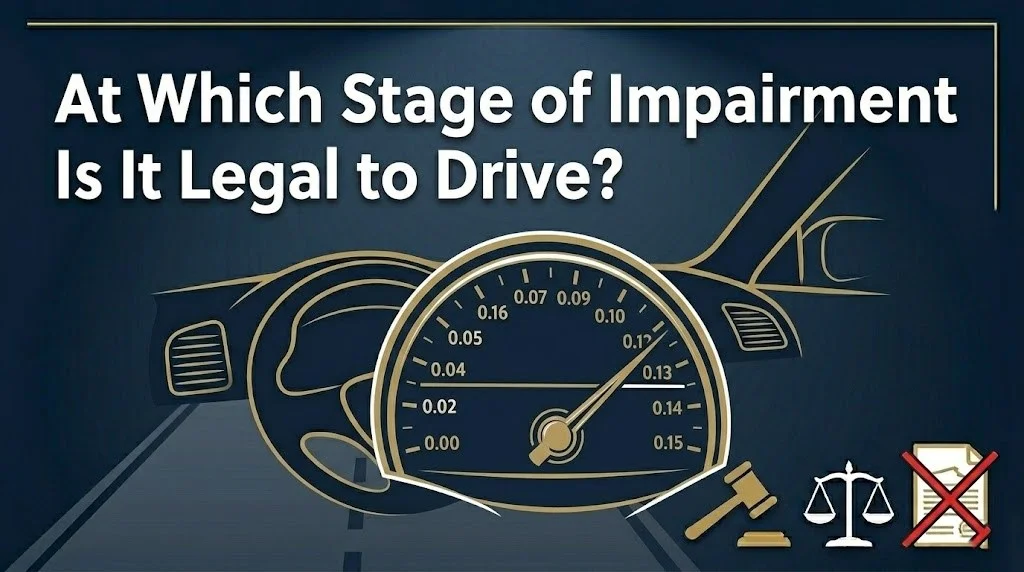
At 0.08% BAC, the effects include significantly impaired muscle coordination, slower reaction time, and reduced ability to detect danger. NHTSA research has consistently shown that crash risk roughly doubles at 0.08% compared to zero BAC.
Impairment Stages and Legal Status:
| BAC Range | Stage | Key Effects | Legal Status (49 States) |
|---|---|---|---|
| 0.01% to 0.05% | Subclinical | Mild relaxation, slight reaction delay | Legal to drive |
| 0.03% to 0.08% | Euphoria | Impaired judgment, reduced coordination | Legal but risky |
| 0.05% | Utah threshold | Measurable impairment begins | Illegal in Utah |
| 0.08% | Excitement begins | Significantly impaired coordination | Illegal in 49 states |
| 0.09% to 0.25% | Excitement | Blurred vision, serious impairment | Clearly illegal everywhere |
| 0.18% to 0.30% | Confusion | Disorientation, staggering | Aggravated DUI territory |
Key Takeaway: The legal driving stage ends at 0.08% BAC in most states, but measurable driving impairment begins at 0.05% BAC, which is why Utah moved its threshold lower and the NTSB has recommended all states follow.
What Is the Legal BAC Limit in All 50 States?
The legal BAC limit is 0.08% in 49 US states and 0.05% in Utah. Every state adopted the 0.08% standard after Congress tied federal highway funding to that threshold through Title 23 USC Section 163 in 2000.
Utah’s legislature lowered the state limit to 0.05% effective December 30, 2018. Utah was the first state to go below 0.08%. No other state had matched that standard as of early 2026, though the National Transportation Safety Board has recommended all states lower their limits to 0.05%.
The 0.08% federal pressure point was significant. Before 2000, some states had limits as high as 0.10%. Federal funding requirements standardized the floor but did not prevent states from going lower, as Utah demonstrated.
| State | Standard BAC Limit | Year Standardized |
|---|---|---|
| Utah | 0.05% | 2018 |
| All other 49 states | 0.08% | 2000 to 2004 (federal mandate period) |
| All states (CDL) | 0.04% | Federal FMCSA standard |
| All states (under 21) | 0.00% to 0.02% | State zero-tolerance laws |
Note: All states comply with the 0.08% federal floor. Utah is the only state currently operating below that standard for standard adult drivers.
Is 0.05 BAC Legal to Drive?
A BAC of 0.05% is legal to drive in 49 US states but illegal in Utah. Utah is the only state where 0.05% BAC triggers an automatic DUI charge under per se law.
In every other state, 0.05% BAC falls below the 0.08% per se threshold. That means the number alone cannot produce a DUI conviction. However, 0.05% is not risk-free from a legal standpoint in those 49 states.
Officers who observe impaired driving behavior, conduct field sobriety tests, and find a driver at 0.05% BAC can still pursue a non-per se DUI charge. They would need additional evidence of actual impairment, but the charge is possible in most states even without hitting the per se limit.
The NTSB’s 2013 recommendation to lower all state limits to 0.05% was based on research showing measurable impairment begins well before 0.08%. Utah acted on that recommendation. Other states have introduced legislation but have not passed it as of 2026.
0.05% BAC Legal Status by Driver Category:
- Standard adult driver in Utah: Illegal, per se DUI
- Standard adult driver in other 49 states: Legal by the number alone, but behavior-based DUI still possible
- Commercial driver anywhere: Illegal, 0.04% is the federal CDL limit
- Under-21 driver anywhere: Illegal, zero-tolerance laws apply
What Happens at 0.08 BAC While Driving?
At 0.08% BAC, a driver experiences significantly impaired muscle coordination, reduced reaction time, difficulty detecting danger, and impaired judgment about speed and distance. This is the legal per se limit in 49 states precisely because the impairment at this level is well-documented.
Research from NHTSA shows that crash risk approximately doubles at 0.08% BAC compared to a sober driver. At this level, a person typically shows reduced ability to perform two tasks simultaneously, which is critical for driving, since operating a vehicle requires constant multitasking.
For a 160-pound person, 0.08% BAC corresponds roughly to three to four standard drinks consumed over two hours. Body weight, sex, food consumption, and metabolism all affect how quickly someone reaches this level. The math is not precise enough to rely on before driving.
An officer who pulls over a driver at exactly 0.08% BAC in most states has all they need for a per se DUI charge. The driver can be arrested, booked, and charged based on the chemical test result alone.
Effects at 0.08% BAC:
- Muscle coordination clearly impaired
- Reaction time measurably slower
- Short-term memory affected
- Speed and distance judgment reduced
- Ability to concentrate on multiple tasks significantly diminished
- Self-assessment of impairment itself impaired
What Is Impaired to the Slightest Degree?
“Impaired to the slightest degree” is a legal standard used in some states, most notably Arizona, that allows DUI conviction even when a driver’s BAC is below 0.08%. It is one of the most aggressive DUI legal standards in the country.
Arizona Revised Statutes Section 28-1381(A)(1) makes it illegal to drive while impaired to the slightest degree by alcohol, drugs, or any combination. This means a driver at 0.04% BAC, showing observable impairment, can be convicted of DUI in Arizona without reaching the per se limit.
This standard shifts the legal analysis from the number to the behavior. An officer who observes slurred speech, poor coordination, and erratic driving can build a DUI case even if the chemical test comes back below 0.08%. The BAC is evidence, but it is not the only evidence.
Other states that apply similar behavioral impairment standards alongside their per se limits include Nevada, Alaska, and several others. In those states, the 0.08% number is the easy case. Below 0.08%, impaired behavior plus any measurable BAC can still support a charge.
| State | Per Se Limit | “Slightest Degree” or Equivalent Standard | Notes |
|---|---|---|---|
| Arizona | 0.08% | Yes, ARS 28-1381(A)(1) | Most aggressive enforcement |
| Nevada | 0.08% | Yes, behavioral standard applies | Below 0.08% DUI possible |
| Alaska | 0.08% | Yes, any impairment standard | Broad DUI statute |
| California | 0.08% | Yes, CVC 23152(a) covers impairment | Dual-track prosecution |
| Utah | 0.05% | Yes, behavioral standard also exists | Strictest combined standard |
Key Takeaway: In states with “impaired to the slightest degree” laws, the 0.08% per se limit is not a safe harbor. Observable impairment combined with any measurable BAC can produce a DUI charge.
Is It Legal to Drive With Any Alcohol in Your System?
For standard adult drivers in 48 states, driving with some alcohol in your system is technically legal as long as BAC remains below 0.08%. In Utah, the threshold is 0.05%. For commercial drivers, it is 0.04%. For drivers under 21, it is effectively zero.
The phrase “any alcohol in your system” is where people get confused. The law does not prohibit all alcohol in the bloodstream for standard adult drivers. It sets a threshold below which driving is permitted by the BAC number alone.
But “permitted by the number” is a narrow legal concept. Officers can still act on observed behavior. A driver at 0.06% BAC who is driving erratically has less legal protection than a sober driver. The BAC prevents an automatic conviction but does not prevent arrest, investigation, or a behavior-based DUI charge.
Zero-alcohol requirements exist for specific categories. Many state probation orders and ignition interlock programs require absolute zero BAC to operate the vehicle at all. Drivers on ignition interlock programs effectively face a zero-tolerance standard regardless of their license status.
Who Faces Zero-Tolerance for Alcohol While Driving:
- Drivers under 21 in all 50 states
- Drivers on DUI-related probation in most states
- Drivers required to use ignition interlock devices
- Commercial drivers operating commercial vehicles
- School bus drivers and drivers transporting hazardous materials
Zero Tolerance DUI Laws
Zero tolerance DUI laws make it illegal for drivers under 21 to operate a vehicle with any measurable BAC. Every US state has a zero tolerance law for underage drivers, though the specific threshold varies from 0.00% to 0.02%.
The federal government required states to adopt zero tolerance laws for under-21 drivers as a condition of highway funding under the 1995 National Highway Systems Designation Act. All states complied by 1998. Zero tolerance laws apply specifically to the 21-and-under age group and set a legal threshold far below the adult standard.
Some states set the threshold at exactly 0.00%, meaning any detectable alcohol triggers the law. Others set it at 0.01% or 0.02% to account for trace amounts from mouthwash, certain foods, or testing margin of error. The legal consequence is typically a civil license suspension rather than a full criminal DUI charge, though criminal charges are possible above certain BAC levels.
| State | Under-21 BAC Threshold | Consequence |
|---|---|---|
| California | 0.01% | License suspension up to 1 year |
| Texas | 0.00% | Criminal DUI charge possible |
| Florida | 0.02% | License suspension, possible DUI |
| New York | 0.02% | License suspension, DWAI possible |
| Illinois | 0.00% | Zero tolerance, license suspension |
| Michigan | 0.02% | Civil infraction plus license action |
| Georgia | 0.02% | DUI per se for under-21 drivers |
What Is the Legal Driving Limit for Under 21?
The legal driving BAC limit for drivers under 21 ranges from 0.00% to 0.02% depending on the state. Every state applies a threshold significantly lower than the standard 0.08% adult limit under federal zero tolerance requirements.
Underage drivers face a dual legal framework. At BAC levels below the adult per se limit but above the zero tolerance threshold, they typically face a civil license suspension rather than a criminal DUI charge. But at BAC levels above 0.08%, underage drivers face the same criminal DUI charges as adults, plus the additional zero tolerance violation.
The consequences for under-21 zero tolerance violations often include license suspension ranging from 90 days to one year, mandatory alcohol education programs, and potential increases in insurance premiums. Criminal DUI charges add fines, possible jail time, and a permanent record depending on the state.
Parents and young drivers should understand that the zero tolerance standard applies to operating any vehicle, not just passenger cars. Motorcycles, boats in some states, and even riding lawn mowers on public roads can trigger zero tolerance enforcement in certain jurisdictions.
Under-21 DUI Consequences Overview:
- License suspension: 90 days to 1 year for first zero tolerance offense
- Mandatory alcohol education or treatment programs in most states
- Insurance premium increases averaging 80% to 100% after underage DUI
- Criminal DUI charges at BAC above the adult per se threshold
- Possible impact on college admissions, financial aid, and employment
Commercial Driver BAC Limit
The commercial driver BAC limit is 0.04% in all 50 states. This is set by the Federal Motor Carrier Safety Administration and applies to any driver operating a commercial motor vehicle, regardless of state.
The 0.04% limit is exactly half the standard adult limit. Federal regulations apply this threshold to any driver holding a commercial driver’s license who is operating a vehicle that requires a CDL, including semi-trucks, buses, and large commercial vehicles. The stricter standard reflects the additional danger posed by large commercial vehicles.
CDL holders face an additional complication. If a commercial driver is found at or above 0.04% BAC while operating a commercial vehicle, they face disqualification of their CDL, not just a standard DUI charge. A first offense CDL disqualification is one year. For certain violations, like operating a vehicle carrying hazardous materials, the disqualification jumps to three years.
A CDL driver can also be charged with DUI under the standard 0.08% limit when driving a personal, non-commercial vehicle. The 0.04% limit applies only when operating a commercial vehicle. Off-duty driving in a personal car is subject to the standard state limit.
Commercial Driver BAC Rules:
| Situation | BAC Limit | Consequence |
|---|---|---|
| Operating a commercial vehicle | 0.04% | CDL disqualification plus DUI charge |
| Operating hazmat commercial vehicle | 0.04% | 3-year CDL disqualification |
| Second commercial vehicle DUI | 0.04% | Lifetime CDL disqualification |
| Driving personal vehicle (off-duty) | 0.08% (or state limit) | Standard DUI charge |
| CDL holder under 21 | 0.00% to 0.02% | Zero tolerance applies |
Key Takeaway: Commercial drivers face a 0.04% BAC limit when operating commercial vehicles, and violations trigger CDL disqualification that can permanently end a commercial driving career.
How Many Drinks Before You Are Legally Impaired?
The number of drinks that puts you at or above the legal BAC limit depends on your body weight, sex, the type of drink, and how fast you consumed them. There is no fixed number that applies to all people.
A useful rough guide is the Widmark formula, which traffic safety researchers use to estimate BAC from drinks consumed. For a 160-pound male, approximately three to four standard drinks in two hours typically produces a BAC around 0.08%. For a 120-pound female, two to three standard drinks in two hours can reach the same level.
A standard drink is defined as 14 grams of pure alcohol. That equals 12 ounces of regular beer at 5% ABV, 5 ounces of wine at 12% ABV, or 1.5 ounces of distilled spirits at 40% ABV. Craft beers, oversized cocktails, and wine poured in large glasses frequently exceed one standard drink per serving.
The practical problem with this math is that most people cannot accurately count their own drinks, gauge serving sizes, or account for their individual metabolism. Relying on drink counting to stay below a legal limit is unreliable.
Approximate Drinks to Reach 0.08% BAC:
| Body Weight | Standard Drinks (2 Hours) | Estimated BAC |
|---|---|---|
| 120 lbs | 2 to 3 drinks | ~0.08% to 0.10% |
| 150 lbs | 3 drinks | ~0.07% to 0.09% |
| 180 lbs | 3 to 4 drinks | ~0.07% to 0.09% |
| 200 lbs | 4 drinks | ~0.07% to 0.08% |
Note: These are rough estimates only. Individual metabolism, food intake, and drink strength significantly affect actual BAC.
DUI BAC Levels by State
DUI BAC levels by state follow one of three tiers: 0.08% for standard adult drivers in 49 states, 0.05% in Utah, and 0.04% for commercial drivers everywhere. The structure is more uniform than people expect, with variation appearing in special categories rather than general adult limits.
What does vary meaningfully by state is the penalty structure once you cross the legal threshold. A first-offense DUI at 0.08% in California carries different consequences than a first-offense DUI in Virginia, even though both states share the same 0.08% legal limit.
States also set aggravated DUI thresholds, which trigger enhanced penalties at higher BAC levels. Many states define aggravated DUI at 0.15% or 0.16% BAC. Some states, like Arizona, set it at 0.15%. Illinois and Colorado use 0.16%. These enhanced thresholds bring mandatory minimum jail time, higher fines, and mandatory ignition interlock requirements.
| State | Standard Limit | Aggravated DUI Threshold | First Offense Fine Range |
|---|---|---|---|
| Utah | 0.05% | 0.16% | $700 to $1,800 |
| California | 0.08% | 0.15% (unofficial) | $390 to $1,000+ |
| Texas | 0.08% | 0.15% | $2,000 to $10,000 |
| Florida | 0.08% | 0.15% | $500 to $1,000 |
| Virginia | 0.08% | 0.15% | $250 to $2,500 |
| Arizona | 0.08% | 0.15% (extreme DUI) | $1,500 to $2,750 |
| Illinois | 0.08% | 0.16% | $500 to $2,500 |
| New York | 0.08% | 0.18% (aggravated DWI) | $500 to $1,000 |
Marijuana Impairment Driving Laws
Marijuana impairment driving laws vary dramatically by state because, unlike alcohol, there is no universally accepted THC blood level that corresponds to a specific level of driving impairment. This makes marijuana DUI law one of the most contested areas in traffic law.
Several states have adopted per se THC limits in blood. Colorado Revised Statutes 42-4-1301 presumes impairment at 5 nanograms per milliliter of THC in blood. Washington State uses the same 5 ng/mL standard. Montana and Nevada have per se THC limits as well.
Most states do not use a per se THC standard. Instead, they rely on Drug Recognition Expert officers, field sobriety tests, and blood test results as evidence of behavioral impairment. In those states, DUID (Driving Under the Influence of Drugs) can be charged even without a specific THC number, based on observed behavior.
The challenge with THC as a legal standard is that it stays in the bloodstream long after impairment ends. Regular cannabis users can show elevated THC levels without being actively impaired at the time of the test. Courts in several states have acknowledged this problem, making marijuana DUI cases more complex to prosecute and defend than alcohol DUI cases.
Marijuana DUI Legal Standards by State:
| State | Per Se THC Limit | Standard Used | Notes |
|---|---|---|---|
| Colorado | 5 ng/mL | Per se presumption | CRS 42-4-1301 |
| Washington | 5 ng/mL | Per se limit | RCW 46.61.502 |
| Montana | 5 ng/mL | Per se limit | Montana Code 61-8-1002 |
| Nevada | 2 ng/mL | Per se limit | Stricter than most |
| California | None | Behavioral impairment | No per se THC law |
| Texas | None | Behavioral impairment | No per se THC law |
| Florida | None | Behavioral impairment | No per se THC law |
Can Prescription Drugs Make Driving Illegal?
Yes, driving while impaired by prescription drugs is illegal in all 50 states, even if the drugs were legally prescribed by a doctor. The legality of the prescription does not affect the illegality of driving while impaired by it.
Most states address this under their general DUI or DUID statutes. California Vehicle Code 23152(f) makes it illegal to drive under the influence of any drug, including prescription medications. Texas Penal Code 49.04 uses similar broad language covering any substance that impairs. The prescription is irrelevant to the charge.
Prescription drugs most commonly associated with impaired driving cases include opioid pain medications like oxycodone and hydrocodone, benzodiazepines like Xanax and Valium, sleep aids like Ambien, and antihistamines. All carry FDA warnings about driving impairment. Those warnings carry legal weight when used in court.
Unlike alcohol, prescription drug impairment has no standardized blood level test that officers can administer at the roadside. Drug Recognition Experts use a 12-step evaluation protocol to document impairment. Blood tests are then used to confirm the presence of specific drugs. The combination of behavioral observation and blood test results forms the prosecution’s evidence.
Prescription Drug Impairment: Legal Framework:
- All states prohibit driving while impaired by any substance, including legal prescriptions
- No per se blood level exists for most prescription drugs
- Drug Recognition Expert testimony is the primary enforcement tool
- FDA warnings on medications are admissible evidence in DUI drug cases
- Implied consent laws require drivers to submit to chemical testing for drugs, not just alcohol
- Prescription as a defense does not work; impairment is the legal standard
Key Takeaway: Legal prescription drugs can produce an illegal driving charge if they impair your driving ability. The law focuses on impairment, not on whether the substance was legally obtained.
What BAC Is Too Impaired to Drive Safely?
Research consistently shows that driving impairment begins at BAC levels as low as 0.02%, well below the legal limit in most states. The safety threshold and the legal threshold are not the same number.
At 0.02% BAC, studies show some decline in visual function and reduced ability to perform two tasks simultaneously. At 0.04% BAC, concentration becomes harder and reaction time slows measurably. At 0.06% BAC, NHTSA research documents impaired driving performance, reduced alertness, and worse decision-making. All of this happens before the legal 0.08% limit.
The legal limit represents the point where lawmakers drew a line that balances enforcement practicality, scientific evidence, and public policy. It does not represent the point where a driver first becomes unsafe. Safety researchers and NHTSA are clear that the safest BAC for driving is 0.00%.
The practical answer is that any measurable BAC above 0.00% begins affecting some aspect of driving performance. The severity escalates with each increment. The law sets a threshold for prosecution. Physics sets the actual impairment curve, and it starts lower.
BAC Safety vs. Legal Status:
| BAC Level | Safety Status | Legal Status (Most States) |
|---|---|---|
| 0.00% | Safest | Legal |
| 0.02% | Measurable impairment begins | Legal (adult standard drivers) |
| 0.04% | Reaction time slowing | Legal for adults, illegal for CDL |
| 0.05% | Coordination reduced | Legal in 49 states, illegal in Utah |
| 0.07% | Significant impairment | Legal by BAC, behavior DUI possible |
| 0.08% | Clearly impaired | Illegal in 49 states, per se DUI |
| 0.10%+ | Severely impaired | Illegal everywhere, enhanced penalties |
Frequently Asked Questions
At what BAC level does driving become illegal in the US?
Driving becomes automatically illegal at 0.08% BAC in 49 states and at 0.05% BAC in Utah.
These are the “per se” limits, meaning the BAC number alone is enough for a DUI charge.
Below these limits, driving is not automatically illegal, but observed impairment can still support a charge in most states.
Commercial drivers face a lower limit of 0.04%, and drivers under 21 face near-zero thresholds in every state.
Can you drive after having just one drink?
One standard drink typically produces a BAC of roughly 0.02% to 0.04% in most adults, which is below the legal per se limit in all states.
That does not mean one drink has no effect. Research shows measurable changes in driving performance begin at 0.02% BAC.
Whether one drink keeps you below the legal limit depends on your body weight, sex, metabolism, and how quickly you consumed the drink.
The safest answer is that any alcohol affects driving, and the legal limit is not the same as the safe limit.
Is 0.05 BAC legal to drive in any state?
A BAC of 0.05% is legal to drive in 49 states but illegal in Utah.
Utah lowered its per se DUI limit from 0.08% to 0.05% effective December 30, 2018.
In other states, 0.05% is below the per se limit, but officers can still pursue a DUI charge based on observed impaired driving behavior.
No other US state had matched Utah’s 0.05% standard as of early 2026.
Are drug impairment driving laws the same as alcohol laws?
No, drug impairment driving laws differ significantly from alcohol DUI laws.
Alcohol has a universally recognized per se BAC standard. Most drugs, including marijuana, do not have equivalent standardized thresholds across all states.
Some states have per se THC limits for marijuana. Most states use behavioral observation by Drug Recognition Experts combined with blood tests for other substances.
Prescription drug impairment is illegal in all states even when the drug was legally prescribed.
What happens if you refuse a breathalyzer test during a traffic stop?
Refusing a breathalyzer test triggers implied consent law penalties in all 50 states.
Implied consent means that by holding a driver’s license, you have agreed to submit to chemical testing when lawfully requested by an officer.
Refusal typically results in automatic license suspension ranging from 90 days to one year for a first offense, separate from any DUI charge.
In some states, refusal can be used as evidence against you in a DUI prosecution.
Closing
The legal stage of impairment for driving is defined by BAC thresholds that vary by state, driver category, and substance. Knowing exactly where that line sits in your state, and understanding that the legal line is not the safety line, is information every driver should have.
Bookmark this article and share it with anyone who has ever wondered how much is too much before getting behind the wheel. The law in 2026 is clear, and understanding it protects both drivers and everyone else on the road.






