
Raccoon ownership is legal in approximately 16 to 20 US states, most of which require a wildlife possession permit before you can keep one as a pet. The remaining states either ban raccoons outright or have no legal mechanism for private ownership at all.
Most people assume that raccoon ownership is either universally legal or universally banned. Both assumptions are wrong. The reality is a patchwork of state-specific rules, permit systems, and outright prohibitions that vary more than almost any other exotic pet category.
One important fact most people miss: even in states that allow raccoon ownership, keeping a wild-caught raccoon is almost always illegal. Legal raccoon ownership in permitting states requires a captive-bred animal from a licensed source.
This article covers every major angle for 2026: which states permit raccoon ownership, which ban it, how permits work, what federal law says, penalties for illegal ownership, and the legal complications around bites, vaccines, and interstate travel.
States Where It Is Legal to Own a Raccoon
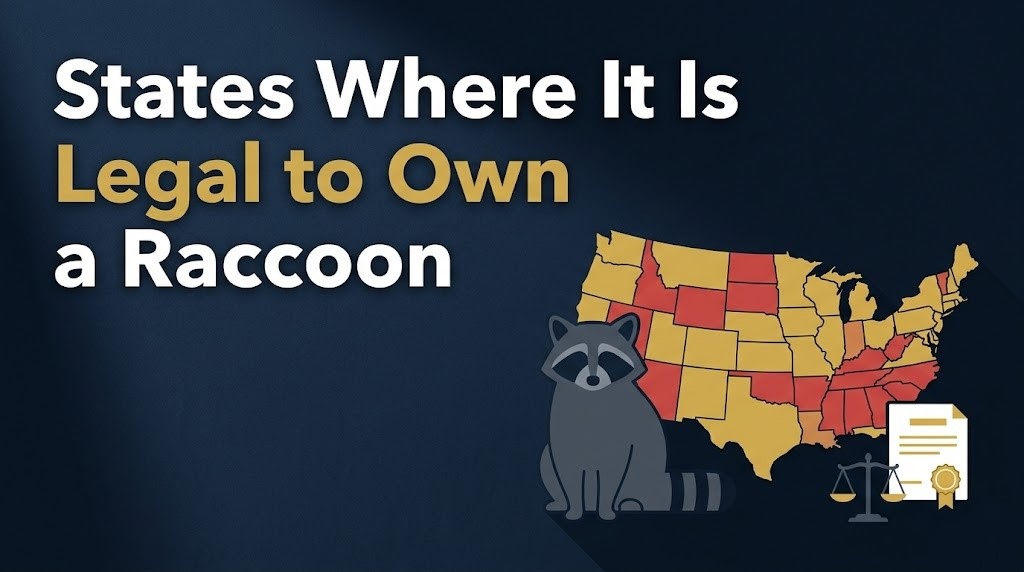
Raccoon ownership is legal, with a permit, in approximately 16 to 20 US states as of 2026, including Arkansas, Delaware, Florida, Indiana, Michigan, Nebraska, Oklahoma, Rhode Island, South Carolina, Tennessee, Texas, West Virginia, Wisconsin, and Wyoming. The exact number fluctuates as states update their wildlife regulations.
The states that permit raccoon ownership typically classify the raccoon as a fur-bearing animal or as an exotic animal subject to a wildlife possession permit system. The permit system varies by state: some states issue permits freely to any adult who applies, while others require inspections, enclosure standards verification, and proof of a captive-bred source animal.
Arkansas is frequently cited as one of the most permissive states for raccoon ownership. Arkansas Code 20-19-101 and related wildlife regulations allow residents to keep raccoons as pets without a special wildlife possession permit, provided the animal was obtained legally from a licensed source. That level of permissiveness is unusual among the states that allow ownership at all.
States With Legal Raccoon Ownership (2026 Status):
| State | Legal Status | Permit Required | Key Condition |
|---|---|---|---|
| Arkansas | Legal | No (for captive-bred) | Legal source required |
| Delaware | Legal with permit | Yes | Wildlife possession license |
| Florida | Legal with permit | Yes | Class III wildlife permit |
| Indiana | Legal with permit | Yes | Exotic animal permit |
| Michigan | Legal with permit | Yes | DNR possession permit |
| Nebraska | Legal with permit | Yes | Wildlife permit |
| Oklahoma | Legal with permit | Yes | Furbearer possession permit |
| Rhode Island | Legal with permit | Yes | DEM wildlife permit |
| South Carolina | Legal with permit | Yes | Permit from SCDNR |
| Texas | Legal with permit | Yes | Fur-bearing animal permit from TPWD |
| West Virginia | Legal with permit | Yes | DNR captive wildlife permit |
| Wisconsin | Legal with permit | Yes | DNR permit required |
| Wyoming | Legal with permit | Yes | G&F captive wildlife permit |
| Tennessee | Legal with permit | Yes | TWRA captive wildlife permit |
| North Carolina | Legal with permit | Yes | Wildlife possession permit |
Permit costs vary widely, from nominal fees under $20 in some states to annual fees over $100 in others. Most permit states also impose enclosure size and construction standards that owners must meet before or shortly after acquiring the animal.
Which States Is It Legal to Own a Raccoon
The states where it is currently legal to own a raccoon as of 2026 include Arkansas, Delaware, Florida, Indiana, Michigan, Nebraska, North Carolina, Oklahoma, Rhode Island, South Carolina, Tennessee, Texas, West Virginia, Wisconsin, and Wyoming. Several additional states fall into a gray area where ownership is neither explicitly permitted nor explicitly prohibited.
The gray area states are worth understanding. Some states simply have no specific law addressing raccoon ownership, leaving residents uncertain about whether they are legally permitted. In those states, ownership may be technically legal by omission, but local county and city ordinances can still prohibit it, and wildlife agencies may classify raccoons as wild animals subject to general wildlife possession restrictions.
States like Mississippi, Louisiana, and Alabama have laws that regulate fur-bearing animals but apply those regulations inconsistently to pet ownership. Checking directly with the state’s Department of Natural Resources or Fish and Wildlife agency is the only reliable way to confirm current legal status in these gray-area states.
Geographic Pattern of Raccoon-Legal States:
The permitting states cluster heavily in the South, Midwest, and Mountain West. That geographic pattern reflects regional attitudes toward wildlife ownership, hunting culture, and the historical treatment of raccoons as fur-bearing game animals rather than exotic pets requiring strict control.
New England, the Pacific Coast, and the urban Northeast are where the strictest bans concentrate. That pattern also makes intuitive sense: densely populated states with more active animal rights advocacy and concerns about zoonotic disease transmission have moved toward stricter prohibition.
Key Takeaway: Approximately 15 to 20 states permit raccoon ownership with a permit in 2026. The permitting states are concentrated in the South, Midwest, and Mountain West. Even in permitting states, the raccoon must come from a legal captive-bred source.
States Where Raccoons Are Legal Pets 2026
As of 2026, the states where raccoons are clearly legal as pets with proper permitting are Arkansas, Delaware, Florida, Indiana, Michigan, Nebraska, North Carolina, Oklahoma, Rhode Island, South Carolina, Tennessee, Texas, West Virginia, Wisconsin, and Wyoming. No state allows raccoon ownership without any conditions at all, though Arkansas comes closest with its relatively informal permitting framework.
The legal framework in most permitting states treats raccoons as “captive wildlife” or “exotic animals” rather than as conventional companion animals like dogs and cats. That classification matters because it determines which agency regulates ownership (typically the state DNR or Fish and Wildlife agency rather than the agriculture department), what standards apply, and what happens if the animal escapes or injures someone.
Raccoon ownership in permitting states typically comes with specific ongoing obligations. Most states require annual permit renewal. Many require that the raccoon be examined by a licensed veterinarian at least once per year. Some states require the owner to report the death of the raccoon to the issuing agency. These are not suggestions; they are conditions of the permit, and violating them can result in permit revocation and confiscation of the animal.
Ongoing Obligations in Typical Raccoon-Permitting States:
- Annual permit renewal with updated documentation
- Annual or biannual veterinary examination record
- Enclosure standards compliance (minimum size and construction specifications)
- Notification of animal’s death, escape, or transfer within a specified timeframe
- Prohibition on breeding unless a separate breeding permit is obtained
- Source documentation: proof the raccoon was captive-bred and legally obtained
- Some states require microchipping of the animal
Florida’s Class III wildlife permit system is one of the more detailed examples. Florida requires applicants to demonstrate knowledge of the species’ care requirements and maintain enclosures meeting specific FWC standards. Florida also mandates that permit holders have access to a veterinarian familiar with exotic animals.
Do You Need a Permit to Own a Raccoon
Yes, a permit is required to own a raccoon in almost every state that allows ownership at all. The sole notable exception is Arkansas, where the permit requirement for privately kept raccoons obtained from legal sources is minimal compared to other permitting states. In every other state that allows raccoon ownership, a formal wildlife possession or exotic animal permit is required before the animal enters your home.
Applying without a permit and acquiring a raccoon first is a common mistake. In most permitting states, the permit must be issued before you acquire the animal. Obtaining the raccoon first and then applying for the permit after the fact does not legalize retroactive possession. The animal’s presence without a valid permit is a violation from the moment you acquire it.
Permit applications generally require the applicant to provide personal identification, a description of the enclosure, proof of a legal source for the animal, and in some states, a fee and a written exam or orientation about the species. Processing times vary from a few days to several months depending on the state agency’s workload and the complexity of the permit category.
Permit Application Requirements in Selected States:
| State | Application To | Fee Range | Processing Time | Enclosure Inspection |
|---|---|---|---|---|
| Florida | FWC | $50 to $150 | 2 to 8 weeks | Yes |
| Texas | TPWD | $48 to $252 | 2 to 6 weeks | No (self-certification) |
| Michigan | DNR | $15 to $65 | 2 to 4 weeks | Yes (sometimes) |
| Wisconsin | DNR | $35 to $85 | 3 to 6 weeks | Possible |
| West Virginia | DNR | $10 to $50 | 2 to 4 weeks | No |
| Indiana | DNR | $10 to $25 | 2 to 4 weeks | No |
These fee ranges and processing times are general estimates based on published state agency fee schedules. Specific fees change with budget cycles and should be confirmed directly with the relevant state agency before applying.
How to Get a Permit to Own a Raccoon
Getting a permit to own a raccoon requires applying to your state’s wildlife or natural resources agency before acquiring the animal, providing documentation of a legal captive-bred source, demonstrating adequate housing conditions, paying the required fee, and waiting for formal permit approval. The specific process varies by state but follows this general sequence in most permitting jurisdictions.
Step one is confirming that your state allows raccoon ownership at all and identifying the correct agency. In Florida, that is the Florida Fish and Wildlife Conservation Commission (FWC). In Texas, it is Texas Parks and Wildlife Department (TPWD). In Michigan, it is the Michigan DNR. Applying to the wrong agency wastes time and does not create any legal standing.
Step two is identifying a licensed source for the raccoon before completing the permit application. Most states require you to name the source breeder or facility on the permit application. Reputable captive-bred raccoon breeders are federally licensed by USDA APHIS as exotic animal dealers. You cannot legally obtain a raccoon from the wild in any state that has a permit system; the animal must come from a licensed captive breeding operation.
Step-by-Step Permit Process (General Framework):
- Confirm raccoon ownership is legal in your state
- Contact your state DNR or Fish and Wildlife agency for current permit requirements
- Identify a USDA APHIS-licensed raccoon breeder in your state or a state that allows transport to yours
- Complete the state permit application, including enclosure specifications and source documentation
- Pay the required permit fee
- Pass any required knowledge test or orientation (if your state requires it)
- Await permit approval before acquiring the animal
- Receive the raccoon from the licensed breeder with documentation of its captive-bred status
- Renew the permit annually as required by your state
Skipping any step in this process creates legal exposure. The most common mistake is acquiring the animal from a neighbor, a rescue, or the wild rather than from a licensed breeder. Animals obtained from non-licensed sources cannot be retroactively legalized in most states.
States Where It Is Illegal to Own a Raccoon
Raccoon ownership is illegal in California, New York, Georgia, Hawaii, Colorado, Massachusetts, Vermont, Kentucky, Maryland, and New Jersey, among others. These states either explicitly prohibit raccoon ownership in their wildlife codes or classify raccoons as prohibited exotic animals without any permit pathway for private ownership.
Hawaii has the most absolute prohibition of any state. Hawaii’s Department of Land and Natural Resources bans virtually all non-native wildlife from private ownership, and the raccoon is not native to Hawaii. The state’s island ecosystem sensitivity drives some of the strictest exotic animal laws in the country.
California’s prohibition is found in the California Code of Regulations Title 14, which designates raccoons as a species that may not be imported, transported, or possessed without a specific scientific or educational permit. Private pet ownership does not qualify for that exception. California also aggressively enforces its exotic animal laws, making illegal raccoon ownership a significant legal risk in that state.
States With Clear Raccoon Ownership Bans:
| State | Legal Basis | Private Ownership Exception | Penalty Risk |
|---|---|---|---|
| California | CA Code of Regulations Title 14 | None (no pet exception) | High |
| New York | NY Environmental Conservation Law | None | High |
| Georgia | Georgia DNR Wildlife Rules | None | High |
| Hawaii | HAR Chapter 4-71 | None | Very high |
| Colorado | CRS 33-6-113 | None | Moderate to high |
| Massachusetts | 321 CMR wildlife regulations | None | Moderate |
| Vermont | VSA Title 10 wildlife rules | None | Moderate |
| Kentucky | KRS 150.280 | None | Moderate |
| Maryland | MD Natural Resources Article | None for pets | Moderate |
Possession of a raccoon in a ban state does not become legal simply because the owner had a permit from another state. State bans apply within the state’s borders regardless of what documentation the owner holds from elsewhere.
Is It Illegal to Own a Raccoon in California
Yes, owning a raccoon as a pet is illegal in California. California Code of Regulations Title 14, Section 671 classifies raccoons as a restricted species that cannot be imported, transported, or possessed for private pet purposes. No pet ownership exception exists under California law.
California’s restricted species list is one of the most expansive in the country. The state’s rationale for including raccoons combines disease risk (raccoons are a primary rabies vector species in many regions), ecological risk (concerns about escaped animals establishing feral populations), and animal welfare concerns.
California enforces its exotic animal laws actively through the California Department of Fish and Wildlife (CDFW). Violations can result in immediate seizure of the animal, civil fines, and in cases involving commercial activity or trafficking, criminal charges under California Fish and Game Code provisions.
California Raccoon Ownership Facts:
- Governing regulation: CA Code of Regulations Title 14, Section 671
- Classification: Restricted species; no private pet exception
- Enforcement agency: California Department of Fish and Wildlife (CDFW)
- Civil penalty: Up to $10,000 per violation for restricted species possession
- Criminal exposure: Misdemeanor to felony depending on circumstances
- No grandfather clause for animals previously owned in other states
A California resident who moves from Arkansas, where raccoon ownership is legal, to California cannot continue to keep their raccoon legally. The animal must be surrendered to a licensed facility, rehomed to a state where it is legal, or placed with a licensed wildlife rehabilitator.
Is It Illegal to Own a Raccoon in New York
Yes, owning a raccoon as a pet is illegal in New York under New York Environmental Conservation Law (ECL) Section 11-0511, which prohibits the possession of wild animals as pets. Raccoons are native wild animals in New York and are specifically covered by this prohibition.
New York’s prohibition is part of a broader framework that reflects the state’s position that native wild animals should not be kept as pets regardless of their captive-bred status. The state does not recognize the captive-breeding distinction for raccoons the way some southern and midwestern states do.
New York State Department of Environmental Conservation (DEC) enforces this prohibition. Violations can result in civil fines, criminal misdemeanor charges, and seizure of the animal. New York City additionally has its own local animal possession ordinances that independently prohibit raccoon ownership within city limits.
New York Raccoon Law Quick Facts:
- Governing statute: NY ECL Section 11-0511
- Enforcement agency: NY DEC
- Civil penalty: Up to $500 per violation for first offense
- Criminal charge: Class B misdemeanor possible for repeat or commercial violations
- Local ordinance: NYC also independently prohibits raccoon ownership
- Exception: Licensed wildlife rehabilitators only; no pet exception
Key Takeaway: California and New York both ban raccoon ownership with no pet exception, enforce their bans actively, and impose meaningful civil and criminal penalties. Moving to either state with an existing pet raccoon requires surrendering or relocating the animal.
Is It Legal to Own a Raccoon in Texas
Yes, owning a raccoon is legal in Texas with a valid Fur-Bearing Animal Propagation License issued by the Texas Parks and Wildlife Department (TPWD). Texas classifies raccoons as fur-bearing animals, and the propagation permit allows private ownership for personal use.
Texas’s approach is practical and grounded in the state’s agricultural and hunting traditions. The fur-bearing animal classification means raccoon ownership in Texas is regulated similarly to how some other states regulate rabbits or mink. The permitting framework is established and functional, and TPWD processes applications routinely.
Texas requires that the raccoon be legally obtained from a licensed source. Wild-caught raccoons cannot be kept as pets in Texas even with a propagation license. The license application requires the owner to identify the source of the animal, describe the housing situation, and pay the applicable fee, which ranges from approximately $48 for a standard propagation license to higher fees for commercial operations.
Texas Raccoon Ownership Details:
- Permit type: Fur-Bearing Animal Propagation License
- Issuing agency: Texas Parks and Wildlife Department (TPWD)
- Application fee: Approximately $48 to $252 depending on scale
- Source requirement: Must be captive-bred from a licensed source
- Wild-caught allowed: No
- Enclosure requirements: Adequate housing per TPWD standards
- Breeding: Allowed under propagation license
- Renewal: Annual
Texas does not require a pre-acquisition inspection of the enclosure in most cases, relying on self-certification by the applicant. However, TPWD has authority to inspect permitted facilities and can revoke licenses for non-compliance.
Is It Legal to Own a Raccoon in Florida
Yes, owning a raccoon is legal in Florida with a Class III Wildlife License issued by the Florida Fish and Wildlife Conservation Commission (FWC). Raccoons are classified as Class III wildlife in Florida, the lowest-risk classification, which applies to animals not considered inherently dangerous to people.
Florida’s Class III licensing process requires applicants to demonstrate knowledge of the species’ care requirements, have appropriate housing ready, and obtain the raccoon from a legal source. Florida does not allow wild-caught raccoons to be kept as pets. The source must be a licensed Class III captive wildlife breeder registered with FWC.
Florida is notable as one of the most active states for legal raccoon pet ownership because of its large population, warm climate suitable for outdoor enclosures, and a functioning network of licensed captive wildlife breeders. FWC processes Class III permit applications regularly and provides published standards for enclosures and care.
Florida Raccoon Ownership Key Details:
- Permit type: Class III Wildlife License
- Issuing agency: Florida Fish and Wildlife Conservation Commission (FWC)
- Application fee: Approximately $50 to $150 depending on permit type
- Knowledge requirement: Applicant must demonstrate species knowledge
- Enclosure standards: Published by FWC; minimum size and construction specifications
- Source requirement: Licensed Class III captive breeder in Florida
- Annual renewal: Yes, required
- Breeding: Requires separate Class III breeder permit
Florida’s Class III permit process is more formalized than Texas’s propagation license but less restrictive than some northern states. The published standards give applicants a clear roadmap for compliance, which makes the process more accessible for first-time raccoon owners.
Federal Law on Owning a Raccoon
Federal law does not ban raccoon ownership for private individuals, but it does regulate the commercial breeding, sale, and interstate transport of raccoons through the Animal Welfare Act (AWA) and the Lacey Act. Private pet ownership without any commercial element sits primarily under state jurisdiction, not federal law.
The Lacey Act (16 U.S.C. 3371) is the primary federal law that can affect raccoon owners. It prohibits importing, exporting, transporting, selling, receiving, acquiring, or purchasing wildlife in violation of any state or foreign law. Transporting a raccoon across state lines from a state where it is legal to a state where it is illegal is a federal Lacey Act violation, not just a state offense.
The Animal Welfare Act applies to commercial dealers and breeders of raccoons, specifically those licensed as USDA Class B dealers or exotic animal sellers. Private pet owners who purchased a raccoon for personal enjoyment and do not sell, breed commercially, or transport for sale are generally not subject to AWA licensing requirements.
Federal Law Summary for Raccoon Owners:
| Federal Law | Applies To | What It Regulates |
|---|---|---|
| Lacey Act (16 U.S.C. 3371) | All persons | Prohibits interstate transport into ban states |
| Animal Welfare Act (7 U.S.C. 2131) | Commercial breeders and dealers | Licensing, housing, care standards for sellers |
| CDC regulations (42 CFR Part 71) | Importers | Restricts importation of raccoons from abroad |
| USDA APHIS | Licensed dealers | Inspection and compliance for commercial operations |
The CDC has separate authority under 42 CFR Part 71 regarding the importation of animals from other countries. Raccoons imported from outside the US face CDC import restrictions related to rabies risk. Domestically captive-bred raccoons are not subject to these import rules, but any raccoon transported across an international border into the US must comply with CDC import requirements.
Can You Keep a Wild Raccoon as a Pet
No, you cannot legally keep a wild raccoon as a pet in any US state. Every state, including those that permit captive-bred raccoon ownership with a permit, prohibits keeping a wild-caught raccoon as a personal pet. The distinction between captive-bred and wild-caught is fundamental to all raccoon ownership law in the US.
The prohibition on wild-caught raccoons reflects several legal concerns. Wild raccoons are classified as wildlife under all state wildlife codes, and wildlife possession generally requires proof that the animal was not taken from the wild without authorization. Additionally, wild-caught raccoons pose a significantly higher disease transmission risk, particularly for rabies and raccoon roundworm (Baylisascaris procyonis), than captive-bred animals raised in controlled environments.
Someone who finds an injured raccoon and wants to rehabilitate it faces a specific legal framework. Wildlife rehabilitation, including the temporary care of injured raccoons, requires a state wildlife rehabilitation permit. These permits are separate from captive wildlife possession permits and authorize temporary care only, not permanent retention as a pet.
Wild Raccoon Scenarios and Legal Status:
| Scenario | Legal? | What You Should Do |
|---|---|---|
| Finding injured adult raccoon and keeping it | No in all states | Contact licensed wildlife rehabilitator |
| Raising an orphaned raccoon baby and keeping it | No without permit | Contact wildlife rehabilitator |
| Trapping a nuisance raccoon and keeping it | No in all states | Release or contact animal control |
| Receiving a wild raccoon from a neighbor | No | Report to state wildlife agency |
| Keeping a wild raccoon temporarily for rehabilitation | Only with rehab permit | Apply for wildlife rehab permit |
Wildlife rehabilitators who are permitted to care for injured raccoons are not permitted to keep those animals permanently as pets. The goal of wildlife rehabilitation is release back into the wild whenever medically possible.
What Happens If You Own a Raccoon Illegally
If you own a raccoon illegally, the most common outcomes are confiscation of the animal, a civil fine, and in more serious cases, a misdemeanor or felony criminal charge. The severity of the response depends on the state, whether commercial activity was involved, and whether the discovery resulted from a complaint or a proactive enforcement action.
Law enforcement typically learns about illegal raccoon ownership through neighbor complaints, veterinary reports, or social media posts by owners. Animal control officers and wildlife agents have authority to enter property and seize animals when they have reasonable cause to believe wildlife laws are being violated.
Once an animal is seized, the owner has limited legal recourse to recover it. Hearings are available in most states, but the burden is on the owner to prove they had a legal right to possess the animal. Without valid permit documentation and proof of legal acquisition, that burden is nearly impossible to meet. Seized animals are typically transferred to licensed wildlife facilities or rehabilitators.
What Happens After Discovery of Illegal Raccoon Ownership:
- Animal control or wildlife agency receives complaint or discovers the animal
- Officer assesses the situation and verifies permit status
- If no valid permit exists, officer may immediately seize the animal
- Owner is issued a citation for illegal wildlife possession
- A hearing date is set where the owner can contest the seizure
- Without documentation of legal acquisition and valid permit, seizure is upheld
- Criminal charges may be filed separately from the civil citation
- Owner may be banned from future wildlife possession in some states
The raccoon itself does not return to the wild in most cases. Wild-naive captive animals that have been pets often cannot survive release, so seized pet raccoons typically go to licensed sanctuaries or educational facilities.
Penalties for Owning a Raccoon Illegally
Penalties for owning a raccoon illegally range from a civil fine of a few hundred dollars in less enforcement-active states to a felony charge with fines up to $10,000 and imprisonment in states like California that take wildlife violations seriously. The penalty level depends heavily on the state and whether commercial activity, multiple animals, or prior violations were involved.
In Florida, possessing Class III wildlife without a permit is a first-degree misdemeanor under Florida Statute 379.401, punishable by up to one year in jail and a $1,000 fine. In California, possession of a restricted species like a raccoon can result in a civil penalty up to $10,000 under Fish and Game Code Section 2118, with criminal misdemeanor or felony charges available for egregious cases.
New York treats illegal raccoon possession as a violation of ECL Section 11-0511, which carries a civil penalty up to $500 for a first offense and up to $2,500 for subsequent violations. New York can also pursue Class B misdemeanor criminal charges where the circumstances warrant.
Penalty Comparison by State:
| State | Violation Classification | Fine Range | Criminal Exposure |
|---|---|---|---|
| California | Restricted species possession | Up to $10,000 civil | Misdemeanor to felony |
| Florida | Class III wildlife without permit | Up to $1,000 | First-degree misdemeanor |
| New York | Wild animal possession | $500 to $2,500 | Class B misdemeanor possible |
| Georgia | Illegal wildlife possession | $500 to $5,000 | Misdemeanor |
| Colorado | Unlawful possession of wildlife | $500 to $5,000 | Class 2 misdemeanor |
| Texas (violation) | Fur-bearing animal without license | $500 to $4,000 | Class C to A misdemeanor |
Forfeiture of the animal is a standard consequence in all states. In states where the raccoon owner had other permits or licenses (hunting, trapping, or business licenses), those can be revoked as a collateral consequence of the wildlife possession violation.
Moving States with a Pet Raccoon
Moving from a state where raccoon ownership is legal to a state where it is banned creates an immediate legal problem: the ban state applies its prohibition from the moment you and your raccoon cross the border. No grandfather clause protects the animal in the destination state based on its legal status in your previous state.
This is one of the most practically important legal issues for raccoon owners, and none of the competing articles address it. A raccoon owner moving from Texas to California with a TPWD-licensed raccoon does not become legal in California. The moment that animal enters California, the owner is in violation of California’s restricted species law.
The options for a raccoon owner relocating to a ban state are narrow. Rehoming the raccoon to someone in the current (legal) state before the move is the cleanest legal solution. Donating the raccoon to a licensed wildlife facility in the current state is another option. Interstate transport to a third state where ownership is legal is possible but requires compliance with Lacey Act requirements and the destination state’s permit system.
Options for Raccoon Owners Moving to Ban States:
- Rehome the raccoon to a qualified owner in the current legal state before moving
- Transfer the raccoon to a licensed wildlife sanctuary or educational facility in the current state
- Arrange transfer to a qualified owner in another permitting state (Lacey Act compliance required for interstate transport)
- Surrender the raccoon to the state wildlife agency of the current state before the move
Attempting to conceal the raccoon in the destination state and continue ownership without a permit is illegal from day one. Discovery through a veterinary visit, neighbor complaint, or social media post leads to seizure and potential prosecution.
Raccoon Rabies Vaccination and Bite Liability Law
No USDA-approved rabies vaccine exists for raccoons, which creates a serious legal complication in every state that allows raccoon ownership. If a pet raccoon bites a person, health authorities typically treat the animal as unvaccinated for rabies purposes, which can lead to mandatory euthanasia of the animal for brain tissue testing.
This is the single most important practical legal issue raccoon owners face, and it is almost never addressed by competing content. Raccoon owners who believe their annual veterinary visits protect them from this scenario are mistaken. Veterinarians can administer rabies vaccines to raccoons off-label, meaning outside the vaccine’s approved use, but those vaccines are not recognized by public health authorities as providing verified protection because they have not been tested in raccoons under the same protocols as for dogs and cats.
Raccoon owners also face significant civil liability when their animal bites another person. In states that apply strict liability for animal bites, the raccoon owner is liable for damages regardless of whether the owner knew the animal was dangerous. California Civil Code 3342 and similar statutes in many states hold owners strictly liable for dog bites. While raccoons are not dogs, state personal injury law can reach raccoon bite cases through negligence theories or specific exotic animal liability frameworks.
Raccoon Bite Legal Consequences:
| Consequence | Triggered By | Outcome |
|---|---|---|
| Rabies testing | Any bite to a human | Animal euthanized for brain tissue test in most states |
| Health department quarantine order | Bite report | 10-day observation or euthanasia depending on state |
| Civil liability to bite victim | Bite occurs | Owner liable for medical costs and damages |
| Criminal liability | If negligence was gross | Possible in some states |
| Permit revocation | Bite incident reported | Possible in permitting states |
The lack of an approved rabies vaccine means that raccoon owners should understand, before acquiring the animal, that a bite incident may result in the mandatory destruction of their pet regardless of how well-cared-for or healthy the animal appears to be.
Frequently Asked Questions
Which states is it legal to own a raccoon?
Raccoon ownership is legal with a permit in approximately 15 to 20 states, including Arkansas, Delaware, Florida, Indiana, Michigan, Nebraska, Oklahoma, Rhode Island, South Carolina, Tennessee, Texas, West Virginia, Wisconsin, Wyoming, and North Carolina.
Most of these states require a wildlife possession or exotic animal permit before the raccoon is acquired.
Arkansas is the most permissive state, requiring minimal formal permitting for captive-bred raccoons obtained from legal sources.
In all permitting states, the raccoon must come from a licensed captive breeder, not from the wild.
Do you need a permit to own a raccoon in the US?
Yes, a permit is required in almost every state that allows raccoon ownership.
The only exception is Arkansas, where the requirement is minimal for captive-bred raccoons from legal sources.
In most permitting states, the permit application must be submitted and approved before the animal is acquired.
Acquiring a raccoon before obtaining the permit does not legalize possession in most states.
Is it legal to keep a wild raccoon you found as a pet?
No, keeping a wild raccoon as a pet is illegal in all 50 US states.
Every state with a raccoon ownership permit system requires the animal to be captive-bred from a licensed source.
Wild-caught raccoons cannot be converted to legal pet status through any permit process.
If you find an injured or orphaned raccoon, the legal option is to contact a licensed wildlife rehabilitator.
What happens if you own a raccoon in a state where it is illegal?
If you own a raccoon in a ban state, the animal will likely be confiscated when discovered.
Civil fines range from $500 in New York to $10,000 in California for restricted species possession.
Criminal misdemeanor or felony charges are possible depending on the state and circumstances.
Moving from a legal state to a ban state does not create any grace period or grandfather protection for the animal.
What are the risks of owning a pet raccoon legally?
The biggest legal risk of legal raccoon ownership is the bite liability scenario.
No USDA-approved rabies vaccine exists for raccoons, meaning any bite to a human typically results in mandatory euthanasia of the animal for rabies brain tissue testing.
Owners are also civilly liable for any injury their raccoon causes to another person.
Permit violations, including failure to renew annually or maintain enclosure standards, can result in permit revocation and confiscation of the animal.
Closing
The raccoon ownership question has a clear answer once you know your state: legal with a permit in roughly 16 to 20 states, banned outright in most of the rest. The permit process is manageable in most permitting states, but the rabies vaccine gap and the bite liability rules are complications that every prospective owner needs to understand before acquiring the animal.
Bookmark this page if you are researching raccoon ownership for yourself or someone else. The state laws in this area shift as agencies update their wildlife regulations, and checking back in 2026 with current state agency guidance before making any decisions is the smartest starting point.






