
Parking on your lawn is illegal in most US cities, and the reason comes down to local zoning codes, not some vague rule someone made up. Millions of homeowners find this out the hard way every year when a code enforcement officer leaves a notice on their door.
This is not just about aesthetics. Cities and counties have written specific laws that treat your grass as an unpaved, unauthorized parking surface. Violating those laws can trigger fines, liens on your property, or even a towed vehicle.
This article breaks down exactly why these laws exist, how they vary by state and city, what the penalties look like in 2026, and the specific situations where parking on grass is actually allowed.
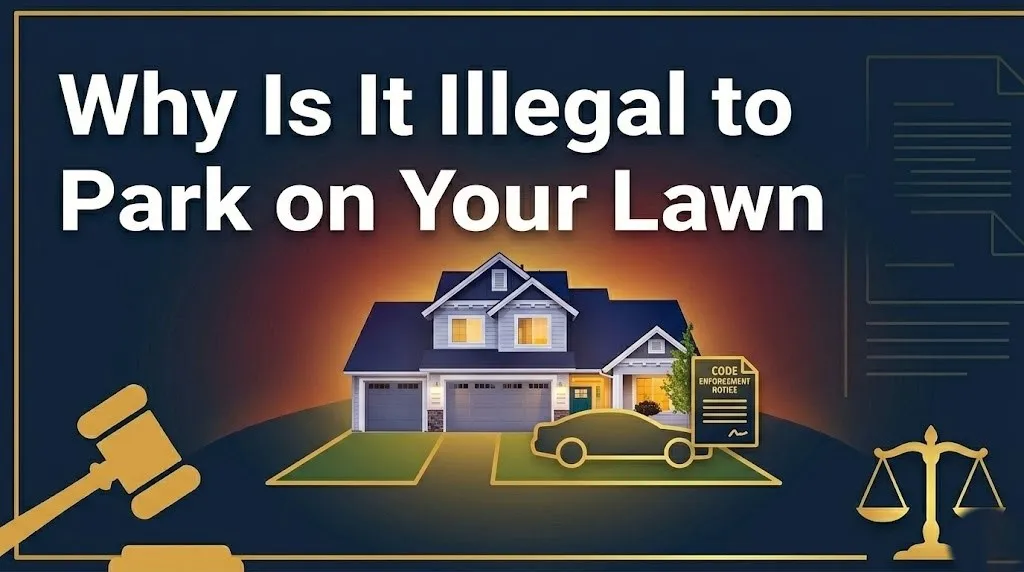
Why Is It Illegal to Park on Your Lawn
Most cities make it illegal to park on your lawn because local zoning and property maintenance codes classify grass as an unpaved, non-approved parking surface. The legal authority comes from municipal ordinances, not federal law.
The core argument cities use is simple: your lawn is not a designated parking area. Approved parking surfaces in residential zones typically must be paved, graveled, or constructed from a material that does not absorb and release vehicle fluids into the ground. Grass does none of those things.
Three main legal frameworks drive these restrictions:
- Zoning codes: Define where vehicles may be stored or parked on residential property.
- Property maintenance codes: Set standards for how property must look and function.
- Stormwater ordinances: Restrict parking on permeable surfaces like grass to protect water systems.
Cities also point to visual blight and neighborhood property values. When one resident consistently parks on their lawn, it affects the surrounding neighborhood’s character. Local governments have the legal authority to regulate that under their general police power.
The law does not care that it is your property. Ownership does not grant unlimited use rights. Every piece of residential property sits inside a web of local codes that govern what you can and cannot do with it.
Quick Facts:
- Lawn parking is governed by local ordinance, not federal or state law in most cases.
- Most municipalities classify grass as a non-approved parking surface.
- Violations are typically civil, not criminal.
- Fines can accrue daily until the violation is corrected.
Is It Illegal to Park on Your Front Lawn
Parking on your front lawn is illegal in most US cities, and front yards face stricter restrictions than side or rear yards. Many ordinances specifically target the front yard because it is the most visible from the street.
Cities treat the front yard differently for a clear reason: it faces a public road. Local governments have historically regulated the visible face of residential properties more aggressively than private rear spaces. This goes back decades of zoning theory around “street-facing” property standards.
In cities like Charlotte, North Carolina, and Orlando, Florida, front yard parking bans are explicit in the municipal code. Orlando’s Code Chapter 58 addresses parking on unpaved surfaces and specifically targets front yard violations. Charlotte’s Code of Ordinances Section 15-234 restricts parking or storing vehicles on grass or other unpaved surfaces in residential areas.
The front yard distinction matters practically:
| Yard Location | Typical Restriction Level | Common Exception |
|---|---|---|
| Front yard | Strictest; often outright banned | Paved pad or approved surface |
| Side yard | Moderate; varies by city | Behind front building line |
| Rear yard | Least strict; often allowed | Must meet setback requirements |
| Driveway extension | Usually allowed | Must be paved or approved material |
If you park on the front lawn even once and a neighbor complains, you can receive a citation that same day. Code enforcement in most cities responds to complaints quickly when the violation is visible from a public street.
Lawn Parking Laws by State
Lawn parking laws in the US are set at the city and county level, not the state level, which means the rules vary dramatically depending on where you live. There is no single federal or state statute in most states that bans lawn parking across the board.
A few states do give local governments broad authority through enabling legislation that makes these ordinances easier to pass and enforce. Florida, for example, gives municipalities strong zoning authority under Chapter 166 of the Florida Statutes, which allows cities to regulate vehicle parking on private property as part of their land development codes.
California cities often enforce lawn parking bans through stormwater management programs tied to the state’s National Pollutant Discharge Elimination System (NPDES) permits. Those permits require cities to reduce pollutants in runoff, and lawn parking is one identified source.
| State | Law Origin | Specific Authority | Notes |
|---|---|---|---|
| Florida | Municipal codes | Florida Statute Ch. 166 | Cities have broad authority; violations common |
| California | Municipal + NPDES stormwater | State Water Board programs | Environmental enforcement angle |
| Texas | City ordinances | Home rule city authority | Houston, Dallas have specific codes |
| North Carolina | Municipal codes | General Statute 160D-702 | Strong zoning authority for cities |
| Ohio | Municipal and township codes | Ohio Revised Code 519 | Townships can regulate storage |
| Georgia | City ordinances | State zoning enabling act | Atlanta has explicit lawn parking ban |
| Virginia | Municipal codes | Code of Virginia 15.2-2280 | Local zoning broad powers |
| Arizona | City ordinances | ARS 9-462 | Phoenix, Tucson regulate separately |
The practical takeaway: even if your state has no statewide ban, your city almost certainly does. Checking your specific city’s municipal code is the only reliable way to know exactly what applies to your address.
City Ordinances Against Parking on Grass
Hundreds of American cities have written specific ordinances that ban parking on grass, and many have been strengthened between 2020 and 2026 as code enforcement budgets expanded. The ordinance text typically describes the prohibited surface, the prohibited vehicle type, and the penalty.
Think of it like a speed limit sign. The state gives cities the power to set the limit. The city sets it. Then local officers enforce it. Lawn parking works the same way. Your city council passed the rule. Code enforcement carries it out.
Some of the most specific city ordinances include:
- Orlando, FL: Chapter 58 of the Code of Ordinances prohibits parking any vehicle on any grass, turf, or unpaved surface in residential zoning districts.
- Charlotte, NC: Section 15-234 bans parking or storing vehicles on grass or other unpaved areas and allows fines starting at $100 per day.
- Atlanta, GA: City Code Section 150-176 specifically targets vehicles parked on lawns in residential areas, with fines and required removal.
- Houston, TX: Chapter 26 of the Code of Ordinances addresses vehicle storage on private property and includes grass surface restrictions.
- Columbus, OH: City Code 545.09 prohibits the parking of vehicles on any surface other than a paved, gravel, or other hard surface in residential zones.
Cities that added or strengthened ordinances between 2023 and 2026 often did so after stormwater complaints or after residents submitted formal petitions through neighborhood improvement programs.
Key Takeaway: Lawn parking bans are real, specific, and written into local law. Ignorance of your city’s code is not a valid defense when a citation arrives.
Environmental Reasons Cities Ban Lawn Parking
Cities ban lawn parking partly because of documented environmental damage caused by vehicles sitting on grass, and this environmental argument has strengthened enforcement since 2020. It is not just about how the neighborhood looks.
When a car sits on grass, several things happen. The weight compacts the soil beneath the tires, reducing the ground’s ability to absorb rainfall. That leads to more runoff. Runoff carries oil, coolant, and brake fluid from the vehicle directly into the ground or into storm drains.
Cities operating under NPDES stormwater permits must limit pollutants in their drainage systems. The EPA’s stormwater programs require municipalities to actively reduce pollution sources. Lawn parking is one identified source in many municipal stormwater management plans.
Three specific environmental harms cities cite in their ordinances and stormwater plans:
- Soil compaction: Repeated vehicle weight kills grass and prevents rain absorption.
- Chemical contamination: Leaked fluids from vehicles seep directly into the soil and groundwater.
- Increased runoff: Compacted, dead lawn areas shed water like pavement, overloading storm drains.
Some cities in California and Washington have made the environmental argument the primary legal basis for their lawn parking restrictions. This approach ties the ordinance to broader environmental compliance requirements, making them harder to challenge legally.
In those jurisdictions, even a single instance of parking on a wet lawn during a rain event can trigger a stormwater ordinance complaint, not just a property maintenance violation.
Zoning Code Vehicle Parking Rules
Zoning codes define exactly where vehicles are allowed to be parked or stored on residential property, and most residential zoning classifications include parking surface requirements. This is the structural legal framework behind most lawn parking bans.
Zoning is not just about what you build. It governs land use in ways that include where you park, how many vehicles you can have, and what surface those vehicles must rest on. Residential zoning categories typically use labels like R-1, R-2, or SF-1 to classify single-family neighborhoods.
Within those zoning categories, parking provisions usually specify:
- Vehicles must be parked on paved, concrete, gravel, or other approved hard surfaces.
- No vehicle may be parked within a required front yard setback on anything other than a designated driveway.
- Inoperable or unlicensed vehicles must be in an enclosed structure or removed.
- The number of permitted vehicles per lot may be capped.
| Zoning Provision | What It Means | Who It Affects |
|---|---|---|
| Approved surface requirement | Car must sit on pavement or gravel | All residential property owners |
| Front yard setback rule | No parking in front yard except driveway | Corner lots and front-facing homes |
| Inoperable vehicle rule | Non-running cars cannot sit outside | Homeowners with project cars |
| Vehicle count limit | Only 2 to 4 vehicles allowed per lot | Multi-vehicle households |
| Enclosed storage rule | Boats, RVs must be stored in structures or behind fence | RV and boat owners |
Zoning codes are public documents. Every city and county posts them online through their planning or zoning department. You can look up your specific parcel and find the exact rules that apply to your address without going to city hall.
Fines for Parking on Your Lawn
Fines for parking on your lawn range from $50 to $500 per violation in most US cities, with some jurisdictions stacking daily fines that quickly exceed $1,000 if the violation is not corrected. The amount depends on your city’s ordinance and whether it is a first offense.
Many cities use a notice-first approach. You receive a written warning giving you 10 to 30 days to correct the violation. If you do not move the vehicle or pave the area, a fine is issued. After that, daily fines may accrue.
Some cities skip the warning entirely if the violation is a repeat offense or was reported by a neighbor as a nuisance.
| City | Base Fine | Daily Fine | Warning Period |
|---|---|---|---|
| Orlando, FL | $100 | $100/day after 30 days | 30-day notice required |
| Charlotte, NC | $100 | $100/day | 10-day notice first offense |
| Atlanta, GA | $150 | $150/day | Warning letter first |
| Columbus, OH | $100 | Varies | 30-day correction period |
| Phoenix, AZ | $250 | Up to $250/day | 10-day notice |
| Houston, TX | $75 to $500 | Accrues after deadline | Varies by district |
Cities can also place a lien on your property if fines go unpaid. That lien attaches to your home’s title, which affects your ability to sell or refinance. This is not a hypothetical. It is a documented outcome in cities across Florida, Georgia, and North Carolina.
Key Takeaway: A single lawn parking fine can grow into a property lien if ignored. The daily accrual structure makes these violations expensive very fast.
Code Enforcement Lawn Parking Violation
A code enforcement lawn parking violation is processed as a civil matter in most cities, not a criminal charge. Code enforcement officers have the authority to issue citations, take photographs, and document ongoing violations.
The process typically works like this. A neighbor files a complaint, or an officer spots the violation during a patrol. The officer documents the vehicle, its location on the grass, and the date. A notice is mailed or posted on the property.
Once the deadline in the notice passes, the case escalates:
- First notice: Correction required within 10 to 30 days.
- Second notice: Fine issued if not corrected.
- Ongoing violation: Daily fines begin.
- Unpaid fines: Referred to collections or placed as a lien.
- Extreme cases: Vehicle towed at owner’s expense.
Code enforcement cannot typically enter your property without permission or a court order. They can observe and photograph from a public street or sidewalk. That observation is enough to issue a valid citation.
Contesting a code enforcement citation usually happens through a local code enforcement board or a magistrate hearing. You have the right to appear, present your case, and argue that the violation did not occur or has been corrected. Many first-time violations are dismissed or reduced at those hearings if you show up and demonstrate the car has been moved.
HOA Rules About Parking on Lawn
HOA rules about parking on your lawn are often stricter than city ordinances, and an HOA can enforce those rules even if your city never issues a citation. The legal authority for HOA enforcement comes from the CC&Rs (Covenants, Conditions, and Restrictions) recorded against your property.
When you buy a home in an HOA community, you agree to those CC&Rs. They are binding contracts. Lawn parking is one of the most commonly prohibited activities in HOA documents, often listed alongside rules about boat storage, vehicle color, and parking guest vehicles on the street.
HOAs enforce their rules through:
- Written violation notices sent by certified mail.
- Fines starting at $25 to $100 per violation.
- Escalating fines for repeat violations.
- Suspension of community amenity access.
- Legal action through civil court for chronic violations.
The HOA does not need your city to issue a citation first. They operate on their own enforcement timeline. You can receive an HOA fine for lawn parking on a Saturday when no city officer ever drove by.
Quick Facts:
- HOA fines for lawn parking typically range from $25 to $250 per incident.
- Repeat violations often trigger accelerating fine schedules.
- Unpaid HOA fines can become liens on your property.
- HOA enforcement timelines vary: some give 5 days, others give 30.
Can HOA Fine You for Parking on Grass
Yes, an HOA can absolutely fine you for parking on grass, and they have done so in every state that allows HOA formation. The fine is enforceable as a contract matter, not just a courtesy request.
Courts in Florida, Texas, Arizona, California, and North Carolina have consistently upheld HOA fines for parking violations when the CC&Rs clearly prohibit the behavior. The key legal test is whether the prohibition was disclosed in the governing documents before you purchased the home.
If you received a copy of the CC&Rs at closing and they included a lawn parking ban, that provision is enforceable. Claiming you did not read the documents is not a defense in civil court.
HOA fines work differently from city fines in one important way: the HOA board has discretion. They can waive a fine for a first-time offense. They can also choose not to waive it. The decision is theirs unless you can show the fine was applied selectively or in violation of the HOA’s own procedures.
Some states have laws that cap HOA fines or require a specific hearing process before fines become liens. Florida’s HOA Act (Chapter 720, Florida Statutes) requires that homeowners receive at least 14 days notice and an opportunity to appear before the board before a fine is levied. California’s Davis-Stirling Act has similar protections. Knowing your state’s HOA statute can make the difference in a dispute.
Key Takeaway: HOA lawn parking fines are legally enforceable contracts, not suggestions. Your state’s HOA law may give you procedural rights before a fine becomes a lien.
Parking on Your Own Property Laws
Parking on your own property does not give you unlimited legal protection, and this surprises a lot of people. Property rights in the US have never included the right to do absolutely anything you want on your land.
The legal concept here is called the “police power” of local government. Cities and counties use that power to regulate land use for the health, safety, and general welfare of the community. Parking regulations fall squarely within that power, and courts have upheld those regulations against property rights challenges for over a century.
Owning your home means you own the right to use it within the law. You cannot run a commercial trucking operation from your residential lot, even if you own it outright. The same logic applies to parking: you cannot use your front lawn as an overflow parking lot, even if it is your grass.
That said, your property rights do matter when a violation is unclear or the ordinance is vague. If a code enforcement officer cites you for something that is not clearly prohibited in the written ordinance, you have standing to challenge that citation. The city must show the law, not just an officer’s interpretation of it.
Three property rights defenses people try and their outcomes:
| Defense Attempt | Legal Outcome | Why It Fails or Succeeds |
|---|---|---|
| “It’s my property” | Fails | Police power overrides private use rights |
| “Ordinance is too vague” | Sometimes succeeds | Court will review the ordinance text |
| “Enforcement was selective” | Sometimes succeeds | Must prove others violated without citation |
| “No ordinance in my municipality” | Succeeds if true | City must prove ordinance exists and applies |
| “Vehicle is on driveway extension” | Succeeds if surface is approved | Surface type matters, not just location |
When Is It Legal to Park on Your Lawn
Parking on your lawn is legal in certain specific situations, and understanding those exceptions can save you from an unnecessary citation. The legality depends on your municipality’s specific code language, your zoning classification, and the nature of the parking.
Rural areas are the clearest exception. In unincorporated county land with no municipal ordinance, there is often no prohibition on lawn parking at all. If you live outside city limits and your county has not passed a vehicle parking ordinance, you are generally free to park wherever on your own property.
Other situations where lawn parking may be legal:
- Temporary events: Many ordinances exempt lawn parking during parties, funerals, or gatherings lasting fewer than 24 or 48 hours.
- Rural zoning: Agricultural (A) or rural (R) zoning classifications often have no parking surface requirements.
- Approved surfaces: If you pour a concrete pad, install pavers, or lay gravel on your lawn area, it may become a legal parking surface.
- Behind the front building line: Some ordinances only restrict parking in front of your home. Parking beside or behind it may be allowed.
- No existing ordinance: Some smaller municipalities simply have not passed a lawn parking ban. In those places, it remains legal.
If you are unsure, a quick call to your city’s planning or code enforcement department will tell you whether a specific ordinance applies to your address. Most departments will answer that question without requiring you to file a formal request.
Inoperable Vehicle on Lawn Law
An inoperable vehicle on your lawn triggers its own set of laws, separate from regular parking ordinances, and the penalties are often steeper. Most municipalities treat inoperable or unregistered vehicles as a nuisance, not just a parking issue.
“Inoperable” typically means the vehicle cannot be driven under its own power, lacks current registration, or has been stripped of major components like wheels or an engine. Most city codes define the term explicitly. Some include vehicles with flat tires, broken windshields, or body damage that makes them non-roadworthy.
The legal concern with inoperable vehicles goes beyond aesthetics:
- They may leak fluids (oil, transmission fluid, coolant) into the soil.
- They attract rodents and insects.
- They lower neighboring property values.
- They may indicate an abandoned vehicle, which triggers separate state-level rules.
Most states have abandoned vehicle statutes that give local governments authority to tag and tow vehicles that have been sitting in one location without moving for a set number of days, typically 72 hours on public property and 30 or more days on private property.
| State | Inoperable Vehicle Rule | Private Property Timeline | Penalty |
|---|---|---|---|
| Florida | Must be enclosed or removed | 30 days notice before tow | Tow + storage fees |
| California | Must not be visible from street | City notice required | $250+ fine, possible tow |
| Texas | Wrecked, junked, or inoperable ban | 10-day notice | Fine + tow at owner expense |
| Ohio | “Junk vehicle” ordinance | 10-day correction notice | Fine + tow |
| Georgia | Nuisance vehicle law | 30-day notice | Fine, lien, or tow |
If you have a project car that cannot run, your safest option in any city is to store it in a garage or enclosed structure. Leaving it on the lawn, even temporarily, risks a citation.
RV Parking on Lawn Laws
RV parking on your lawn faces some of the strictest residential restrictions in the country, and most cities that ban regular lawn parking apply even tighter rules to RVs, boats, and commercial vehicles. The size and visual impact of these vehicles make them a frequent complaint target.
RVs are classified differently than passenger vehicles in most zoning codes. They may be categorized as “recreational vehicles,” “oversized vehicles,” or “commercial-style vehicles,” each triggering different sections of the code.
Common restrictions on RV parking in residential areas:
- Cannot be parked in the front yard at all.
- Must be stored in a garage, carport, or behind the front building line.
- May require a specific RV storage permit from the city.
- Cannot be used as a dwelling unit while parked on residential property.
- Must not extend beyond the property line onto a sidewalk or street.
| City | RV Front Yard Rule | Side/Rear Yard Rule | Storage Permit Required |
|---|---|---|---|
| Phoenix, AZ | Prohibited | Allowed with screening | No |
| Orlando, FL | Prohibited | Allowed; must be behind building line | No |
| Charlotte, NC | Prohibited | Allowed if not visible from street | No |
| Seattle, WA | Prohibited | Allowed up to 72 hours without permit | City permit available |
| Houston, TX | Prohibited | Allowed with conditions | No |
Some cities allow temporary exceptions for loading and unloading, typically 24 to 72 hours. If you are packing for a trip or returning from one, you generally have a short window to legally leave the RV in the driveway or yard.
Key Takeaway: RVs face stricter yard parking restrictions than regular vehicles in most cities. Storing one on your lawn without checking local codes is a reliable way to collect a citation.
How to Fight a Lawn Parking Citation
Fighting a lawn parking citation is possible, and people succeed when they have a clear factual or legal basis for the challenge. Going into a hearing without preparation almost always results in the fine being upheld.
Start by reading the citation carefully. It should name the specific ordinance section violated. Pull that ordinance from your city’s code. Read every word. Compare the ordinance text to your actual situation. Gaps between what the law says and what the officer cited you for are your best argument.
Common successful defenses:
- The vehicle was on an approved surface: If your driveway extends onto what looks like your lawn but is gravel or pavers, that may meet the ordinance’s surface requirements.
- The ordinance does not apply to your zoning district: Some lawn parking bans only cover specific residential zones.
- The citation lacked required elements: Missing information on the citation can sometimes void it.
- Selective enforcement: If your neighbor parks on their lawn without being cited, and you can document it, selective enforcement may be a valid challenge.
- Correction before hearing: Many cities dismiss or reduce fines if you moved the vehicle before the hearing date.
The hearing process:
- Request a hearing within the deadline on your citation (usually 10 to 30 days).
- Gather evidence: photos, city ordinance text, property survey if helpful.
- Appear at the scheduled hearing before the code enforcement board or magistrate.
- Present your argument clearly and calmly.
- If you lose, ask about payment plans or appeal options.
Most first-time violations at a hearing result in a reduced fine or dismissal if the vehicle has been moved and no ongoing pattern exists.
Temporary Parking on Grass Rules
Temporary parking on grass is treated differently from ongoing or regular parking in most city codes, and many ordinances include explicit short-term exemptions. Whether you can park on the lawn for a few hours during a party or overnight during a visit depends entirely on your city’s specific language.
Some ordinances ban all grass parking, full stop, regardless of duration. Others define a violation as parking that is “continuous” or “regular” and exempt short-term uses. The distinction matters because it determines whether a single afternoon on the grass constitutes a violation.
How cities typically define temporary:
| City Approach | Definition of Temporary | Duration Allowed |
|---|---|---|
| Strict ban | No exceptions; any grass parking is a violation | Zero |
| Event exception | Guests at a specific event | 24 to 48 hours |
| Continuous use rule | Violation only if parked repeatedly | More than 72 hours without moving |
| Nuisance standard | Violation if it causes visible damage to lawn | Subjective; officer discretion |
| Permit system | Temporary permit available for events | Varies by city |
If your city has a complaint-driven enforcement model, a single short instance of lawn parking may never trigger a citation unless a neighbor complains. But if your city does active patrols, even a few hours on the grass can result in a notice.
The safest approach for a one-time event: park guests on a paved street, in a nearby lot, or ask your city’s code enforcement office in advance whether a short-term exemption applies to your situation. That call takes five minutes and can prevent a fine that takes two hours to fight.
Understanding your city’s exact ordinance language is the only way to know for certain whether “temporary” gives you legal cover.
Frequently Asked Questions
Is parking on your lawn illegal everywhere in the US?
No, parking on your lawn is not illegal everywhere in the US.
The rules come from local city and county ordinances, not federal or state law.
Rural areas and unincorporated counties without specific ordinances often have no ban at all.
You need to check your specific city’s municipal code to know what applies to your address.
How much is the fine for parking on your lawn?
Fines for parking on your lawn typically range from $50 to $500 per violation.
Many cities also add daily fines that accrue until the violation is corrected.
Cities like Charlotte, NC and Phoenix, AZ issue fines starting at $100 with up to $100 to $250 per day for ongoing violations.
Unpaid fines can become property liens in states like Florida and Georgia.
Can your HOA make you move your car off the lawn?
Yes, your HOA can legally require you to move your car off the lawn if the CC&Rs prohibit lawn parking.
HOA rules are binding contracts you agreed to when you purchased the home.
Courts in Florida, Texas, Arizona, and California consistently uphold HOA parking violation fines.
Your state’s HOA statute may give you the right to a hearing before any fine becomes a lien.
Is it illegal to park an inoperable car on your lawn?
In most US cities, parking an inoperable vehicle on your lawn is illegal and carries additional penalties beyond regular parking violations.
Most ordinances define inoperable as non-running, unregistered, or missing major components.
Cities like Houston, Atlanta, and Columbus have specific “junk vehicle” ordinances that allow fining and towing after a notice period.
Storing a project car or non-running vehicle in a garage is the only reliable way to avoid these citations.
Can you park on your lawn if you have no driveway?
Having no driveway does not exempt you from lawn parking bans in most cities.
Many ordinances require that you use street parking if no approved surface is available on your property.
Some cities allow property owners to apply for a permit to install a gravel or paved pad as a legal alternative to a driveway.
If you have no driveway and no approved surface, street parking is typically your legal default option.
Lawn parking laws exist at every level of local government, and they carry real financial consequences. Whether the issue is your city’s zoning code, your HOA’s CC&Rs, an inoperable vehicle in your yard, or a temporary exception for guests, the details of your specific ordinance always govern.
Bookmark this page if you are dealing with a citation or just want to stay ahead of your local rules. The specific ordinance section, your zoning district, and whether your surface is approved are the three things that will determine your outcome in 2026.






