
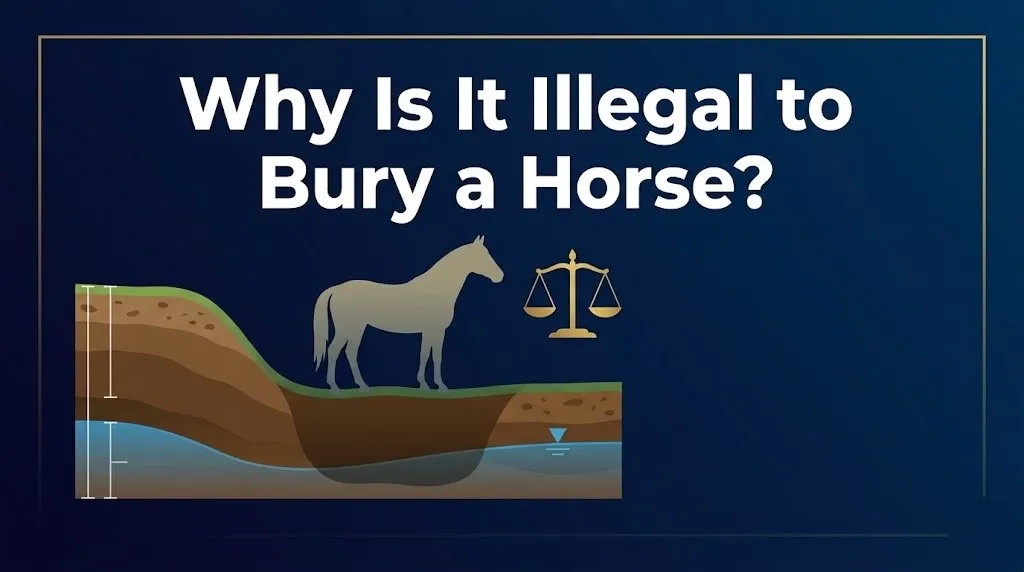
It’s illegal to bury a horse in most U.S. states because a decomposing 1,000-pound animal can poison groundwater, spread disease, and contaminate soil for years. That’s why is it illegal to bury a horse ranks as one of the most common questions horse owners search for online.
Here’s what catches most people off guard: even if you own hundreds of acres, your state probably still regulates how, where, and whether you can put a horse in the ground. Some states ban it outright. Others allow it with strict permits, depth rules, and setback distances from water sources.
A horse that was euthanized with barbiturates poses an even bigger problem. Those drugs don’t break down in the soil. They can kill scavengers, pets, and wildlife that dig near the burial site.
This article covers the real legal reasons behind horse burial bans, the rules in every major state as of 2026, what penalties you could face, and every legal alternative available to you right now.
Why Is It Illegal to Bury a Horse
Burying a horse is illegal in many states because of the serious environmental and public health risks that come with putting a large animal carcass underground. This isn’t a rule that exists to punish grieving horse owners. It’s rooted in science and public safety.
An average horse weighs between 900 and 1,200 pounds. When that much organic material decomposes underground, it releases nitrogen, phosphorus, bacteria, and potentially harmful pathogens into the surrounding soil. If that burial is anywhere near a water table, well, or stream, those contaminants can reach drinking water supplies.
State legislatures passed dead animal disposal laws specifically because large livestock burials were linked to disease outbreaks and groundwater contamination incidents throughout the 20th century. States like California and New York tightened their rules after documented cases of contamination.
There’s also the veterinary drug problem. Most horses are euthanized using pentobarbital or other barbiturates. These chemicals remain active in the carcass long after death. Animals that scavenge a buried horse can be fatally poisoned.
- Groundwater contamination from decomposition byproducts
- Soil pollution lasting years or decades
- Risk of spreading equine diseases like anthrax
- Secondary poisoning of wildlife and domestic pets from euthanasia drugs
- Attraction of predators and scavengers to shallow burial sites
State departments of agriculture and environmental quality boards enforce these laws. The bans exist to protect water, land, and community health.
Is It Illegal to Bury a Horse on Your Property
Yes, in most U.S. states, burying a horse on your property is either completely prohibited or tightly regulated through permit and setback requirements. Owning the land does not give you automatic permission to bury large livestock.
Many horse owners assume that private property rights include the right to bury animals anywhere on their land. That assumption is wrong in the majority of states. Environmental regulations and local zoning codes override general property rights when public health or natural resources are at stake.
Some states allow on-property burial only if you meet every condition on a long list. Those conditions typically include minimum acreage, burial depth, distance from water sources, distance from property lines, and sometimes soil type testing.
| Requirement Type | Common Minimum Standard |
|---|---|
| Burial depth | 3 to 4 feet of soil cover above the carcass |
| Distance from wells | 100 to 300 feet |
| Distance from waterways | 100 to 200 feet |
| Distance from property lines | 50 to 100 feet |
| Time after death | Burial within 24 to 72 hours |
A handful of rural states in the West and Midwest take a more relaxed approach. But even in those places, county-level rules might add restrictions that the state doesn’t impose. You need to check both state and local regulations before breaking ground.
Can You Bury a Horse in Your Backyard
No, you almost certainly cannot bury a horse in your backyard in 2026. Backyard burial of large animals is prohibited or impractical in virtually every residential setting across the United States.
The word “backyard” implies a residential lot, and residential zoning districts almost universally prohibit the burial of large animal carcasses. Even in states that allow on-farm horse burial, those permissions apply to agricultural-zoned properties with sufficient acreage, not to suburban or urban backyards.
Think about the math. A proper horse burial requires a hole roughly 7 to 8 feet deep and 8 to 10 feet long. You need heavy equipment to dig that kind of grave. Most residential yards don’t have the space, the soil depth, or the distance from neighboring wells and homes to meet legal requirements.
Local ordinances in cities and towns add another layer of prohibition. Most municipal codes classify large animal carcasses as a public nuisance if buried within town limits. Code enforcement officers can order the carcass removed at the property owner’s expense.
- Residential zoning laws prohibit large animal burial in nearly all cities and suburbs
- Lot size is too small to meet setback requirements
- Heavy equipment access is limited on residential properties
- Neighbors can file complaints, triggering code enforcement action
- Soil depth in many yards is insufficient for legal burial depth
If you live in a rural area on agricultural land, your options may be different. But a standard backyard? That’s off the table in every practical sense.
Horse Burial Laws by State
Horse burial laws vary dramatically from state to state, and the differences can determine whether you face zero issues or a significant fine. There is no single federal law governing horse burial on private property. Each state sets its own rules.
Some states ban all on-site large animal burial. Others permit it with conditions. A few leave it largely unregulated at the state level, pushing the decisions down to counties and municipalities. The table below shows the general approach in several major horse-owning states as of 2026.
| State | On-Property Burial Allowed? | Key Conditions | Governing Agency |
|---|---|---|---|
| California | No (most counties) | Must use licensed disposal service | CA Dept. of Food and Agriculture |
| Texas | Yes (with conditions) | Depth, setback, and timing rules apply | TX Commission on Environmental Quality |
| Florida | Restricted | Permits required in many counties | FL Dept. of Agriculture |
| New York | Restricted | Must follow Dept. of Ag guidelines | NY Dept. of Agriculture and Markets |
| Ohio | Yes (with conditions) | 4 ft. cover, setbacks from water | OH Dept. of Agriculture |
| Colorado | Yes (rural areas) | County rules vary widely | CO Dept. of Agriculture |
| Virginia | Yes (with conditions) | Must follow state disposal regs | VA Dept. of Agriculture |
| Pennsylvania | Restricted | Must bury within 48 hours, follow setbacks | PA Dept. of Agriculture |
You should contact your state’s department of agriculture before making any plans. Calling your county extension office is another reliable way to get local guidance. These rules change, and some states updated their regulations as recently as 2024 and 2025.
Key Takeaway: Horse burial legality depends entirely on your state and county. There is no blanket federal rule, and assumptions based on property ownership alone will get you in trouble.
State Laws on Burying Horses
State laws on burying horses are driven by two concerns: protecting groundwater and preventing the spread of livestock diseases. Every state approaches these concerns a little differently, but the underlying logic is consistent.
In states with large agricultural economies, the rules tend to be more detailed. Texas, for example, allows burial of livestock on private land but requires specific setback distances from wells, waterways, and neighboring property. The Texas Commission on Environmental Quality has published guidelines that address burial depth and timing.
New York takes a stricter approach. The state’s Agriculture and Markets Law includes provisions for dead animal disposal that limit burial options and encourage the use of rendering or composting services. Violating these provisions can result in fines.
California’s situation is especially tight. Most counties in California prohibit burial of large animal carcasses on private property entirely. Horse owners are directed to contact licensed rendering services, and some counties require veterinary verification before disposal.
In the Midwest, states like Ohio and Indiana allow on-farm burial but with clear depth and distance rules. Colorado’s regulations are set more at the county level, meaning two neighboring counties could have very different rules.
- Western states tend to be more permissive in rural, unincorporated areas
- Northeastern states lean toward stricter regulation and permitting
- Southern states fall in the middle, often allowing burial with conditions
- County-level rules can override or add to state regulations
- Disease outbreaks or environmental incidents can trigger emergency rule changes
The safest step is always to call before you dig. Your state veterinarian’s office or county extension agent can give you current, location-specific guidance in minutes.
Is It Legal to Bury a Horse in Texas
Yes, it is generally legal to bury a horse in Texas on private property, but you must follow the state’s disposal requirements. Texas is one of the more permissive states for on-farm livestock burial.
The Texas Health and Safety Code and the Texas Commission on Environmental Quality (TCEQ) govern dead animal disposal. Under these rules, you can bury a horse on your land if you meet certain conditions. The burial must happen within a reasonable time after death, typically within 24 to 72 hours.
You must also maintain minimum distances from water sources. The carcass should be buried far enough from any well, creek, river, or pond to prevent contamination. Common guidance suggests at least 150 feet from any water source and 50 feet from property lines.
| Texas Burial Requirement | Standard |
|---|---|
| Burial timing | Within 24 to 72 hours of death |
| Depth of cover | At least 3 feet of soil over the carcass |
| Distance from water | 150+ feet from wells, streams, ponds |
| Distance from property line | 50+ feet |
| Euthanized animals | Additional restrictions may apply at county level |
Texas counties can add their own rules. Some counties near major cities or sensitive watersheds may impose stricter requirements or require notification before burial. Always check with your county before proceeding.
If your horse was euthanized with barbiturates, the rules get more complicated. Some Texas counties recommend against burying euthanized animals due to the risk of secondary poisoning. Rendering or cremation may be required in those cases.
Can You Bury a Horse in Florida
Burying a horse in Florida is restricted and often requires a permit or compliance with specific county-level rules. Florida’s warm climate and high water table make groundwater contamination a major concern.
The Florida Department of Agriculture and Consumer Services, along with the Florida Administrative Code (Chapter 5C-25), regulates the disposal of dead livestock in the state. These rules set standards for burial depth, distance from water, and timing.
Florida’s biggest challenge is its water table. In much of South and Central Florida, the water table sits just a few feet below the surface. Burying a 1,000-pound animal in that kind of soil is a direct path to groundwater contamination. That’s why many Florida counties either prohibit burial outright or require an environmental review before granting permission.
- Most South Florida counties prohibit on-site horse burial due to high water tables
- North Florida counties with sandy, well-drained soils may allow burial with conditions
- The carcass must typically be covered with at least 3 feet of soil
- Burial must occur within 24 hours in warm weather to prevent odor and disease
- Some counties require notification to the county health department
If you own a horse in Florida, your best starting point is your county’s animal services office. They can tell you whether burial is an option in your specific location or whether you need to arrange rendering or cremation. Don’t assume that a large property exempts you from the rules.
Key Takeaway: Florida’s high water table makes horse burial risky and illegal in many counties. North Florida landowners with well-drained soil have the best chance of qualifying, but county approval is almost always required.
Can You Bury a Horse on Private Land
Owning private land does not automatically give you the right to bury a horse on it. The legality depends on your state, your county, your soil type, your proximity to water, and sometimes the cause of the horse’s death.
This is one of the biggest misconceptions in horse ownership. People hear “it’s my property” and assume they can do what they want with it. But environmental and public health laws place limits on how private land can be used, especially when that use could affect neighboring properties or shared water resources.
Even in states that generally allow on-farm burial, you still have to meet specific conditions. Those conditions exist because your property doesn’t exist in a vacuum. Groundwater flows under property lines. Soil contamination can migrate. Disease can spread to neighboring livestock.
Here are the typical conditions that apply even on large private parcels:
- The property must be zoned agricultural, not residential or commercial
- You must meet minimum acreage requirements in some states
- The burial site must pass setback tests for wells, waterways, and property boundaries
- You may need to notify the state veterinarian or county agriculture office
- Euthanized animals may be excluded from burial permission
Some states also require you to document the burial location. This protects future property buyers from accidentally building over a contaminated burial site. In a handful of states, failure to disclose a large animal burial during a property sale could create legal liability.
The bottom line: private land offers more options than a residential lot, but it never gives you blanket permission. Check your state and county rules first.
Environmental Reasons You Can’t Bury a Horse
The environmental case against burying a horse is straightforward and backed by real science. A decomposing horse releases contaminants that can damage soil, water, and local ecosystems for years.
A horse carcass weighing 1,000 pounds or more contains massive amounts of organic material. As it breaks down, it generates nitrogen compounds, phosphorus, ammonia, bacteria, and other byproducts. In shallow burials or areas with sandy soil, these substances leach into the groundwater.
Groundwater contamination is the primary concern. Rural properties often rely on private wells for drinking water. A horse burial too close to a well can introduce harmful bacteria like E. coli and Clostridium into the water supply. These bacteria cause serious illness in humans and other animals.
Soil contamination is the second major issue. The decomposition of a large animal alters the soil chemistry in the immediate area. That soil becomes nutrient-loaded in an unnatural way, which can affect plant growth and attract pests.
| Environmental Risk | Cause | Duration |
|---|---|---|
| Groundwater contamination | Leaching of nitrogen, bacteria, pathogens | Months to years |
| Soil chemistry disruption | Excess nitrogen, phosphorus, ammonia | Years to decades |
| Secondary poisoning (euthanized horses) | Barbiturates persist in tissue | Months |
| Scavenger attraction | Shallow burial, odor | Weeks to months |
| Disease transmission | Pathogens surviving in soil (e.g., anthrax spores) | Decades or longer |
Euthanasia drugs add a dangerous layer. Pentobarbital, the drug most commonly used to euthanize horses, does not break down quickly in soil. Dogs, coyotes, vultures, and other scavengers that access the carcass can be fatally poisoned. This has been documented repeatedly across the country.
These aren’t theoretical risks. They’re the documented reasons state and federal agencies wrote the rules they did.
Horse Burial Depth Requirements
Most states that allow horse burial require a minimum of 3 to 4 feet of soil cover above the top of the carcass. This means the total hole depth needs to be roughly 7 to 8 feet to accommodate the size of a horse.
Depth requirements exist for three practical reasons. First, deeper burial reduces the chance that scavengers will dig up the carcass. Second, more soil cover means better filtration of decomposition byproducts before they reach groundwater. Third, deeper burial reduces odor, which can become a serious nuisance and a code violation.
The actual depth you need to dig depends on the size of your horse and the specific rules in your jurisdiction. A draft horse weighing 1,800 pounds obviously needs a larger and deeper grave than a pony.
| Horse Size | Approximate Grave Depth Needed | Approximate Grave Length |
|---|---|---|
| Pony (under 600 lbs) | 5 to 6 feet | 5 to 6 feet |
| Average horse (1,000 lbs) | 7 to 8 feet | 8 to 9 feet |
| Draft horse (1,500+ lbs) | 8 to 10 feet | 9 to 11 feet |
In areas with shallow bedrock or high water tables, meeting these depth requirements may be physically impossible. That’s one reason Florida and parts of the Southeast have stricter burial bans. You simply can’t dig deep enough without hitting water.
Heavy equipment is almost always necessary. A standard shovel won’t get the job done for a full-size horse grave. Most horse owners hire a backhoe operator, which adds cost and logistical complexity, especially if the death was unexpected.
Key Takeaway: Horse burial depth isn’t just a guideline. It’s a legal requirement in most states, and failing to meet it can result in fines and forced exhumation.
Horse Burial Setback Requirements from Water
Setback requirements dictate how far a horse burial must be from wells, streams, rivers, ponds, and other water sources. These distances range from 100 to 300 feet depending on your state and county.
Water setbacks are the single most important condition in horse burial regulations. They exist because groundwater and surface water are the primary pathways for contamination from a decomposing carcass. Even a properly deep burial can contaminate water if the grave is too close to a water source.
Here are the typical setback distances enforced across several states:
| Water Source Type | Common Required Setback Distance |
|---|---|
| Private drinking well | 150 to 300 feet |
| Public water supply | 300+ feet |
| Streams, creeks, rivers | 100 to 200 feet |
| Ponds and lakes | 100 to 200 feet |
| Drainage ditches | 50 to 100 feet |
| Neighboring property well | 150 to 300 feet |
Note that these setbacks apply not just to your own water sources but to your neighbors’ wells and nearby public waterways. You may have enough acreage to meet the distance from your own well but still violate the setback from a neighbor’s well or a stream that runs along your property line.
Some states also require setbacks from roads, occupied buildings, and property boundaries. These rules aim to prevent odor complaints and protect the broader community.
If your property can’t meet the setback requirements, burial is not an option regardless of how much land you own. In that situation, rendering, cremation, or composting are your legal alternatives.
Penalties for Illegally Burying a Horse
Penalties for burying a horse illegally can include fines ranging from a few hundred dollars to several thousand dollars, plus the cost of exhuming and properly disposing of the carcass. In rare cases, criminal charges are possible.
The specific penalty depends on your state, the severity of the violation, and whether the illegal burial caused environmental damage. A first-time violation in a rural area might result in a warning or a modest fine. But if the burial contaminated a water source or was near a populated area, the consequences escalate quickly.
| Penalty Type | Typical Range |
|---|---|
| Civil fine (first offense) | $100 to $1,000 |
| Civil fine (repeat offense) | $1,000 to $5,000+ |
| Exhumation and proper disposal costs | $500 to $3,000 |
| Environmental remediation (if water contaminated) | $5,000 to $50,000+ |
| Criminal misdemeanor charge | Possible in some states |
Beyond fines, you could face an order to exhume the carcass at your own expense. That process is unpleasant, expensive, and sometimes requires hiring a licensed hazardous waste contractor, especially if euthanasia drugs were involved.
Environmental damage adds another layer of liability. If an illegal burial contaminates a neighbor’s well or a public water source, you could face a civil lawsuit for damages on top of the regulatory penalties. Water contamination cases can run into tens of thousands of dollars.
Some states classify illegal animal disposal as a misdemeanor offense. A conviction could appear on your criminal record and carry penalties beyond fines, including probation.
What Happens If You Bury a Horse Illegally
If you bury a horse illegally, you can expect a complaint-driven investigation, potential fines, a mandatory exhumation order, and possible environmental testing of nearby soil and water. The process is unpleasant and expensive.
Most illegal horse burials come to light through neighbor complaints. The smell of a decomposing large animal is hard to hide, especially in warm weather. Once a complaint is filed, your local health department or animal control agency will investigate.
Here’s the typical sequence of events after an illegal burial is discovered:
- A neighbor, mail carrier, or passerby reports an odor or observed burial
- County code enforcement or the health department investigates
- An inspector visits your property and documents the violation
- You receive a notice of violation with a deadline to correct the issue
- You’re ordered to exhume the carcass and dispose of it legally
- Fines are assessed based on state and local violation schedules
- If water contamination is suspected, soil and water testing is ordered at your expense
The exhumation process is the worst part. Digging up a partially decomposed horse carcass requires heavy equipment, personal protective gear, and licensed transport to a rendering or landfill facility. The total cost can easily exceed $2,000 to $5,000.
If the horse was euthanized, the exhumation becomes a potential hazmat situation. Barbiturates in the tissue can pose a risk to the workers handling the remains, which drives costs even higher.
The lesson is simple: the cost of doing it legally from the start is always less than the cost of doing it illegally and getting caught.
Key Takeaway: Getting caught burying a horse illegally triggers a chain of events that costs far more than legal disposal would have. Exhumation, fines, and environmental testing can total thousands of dollars.
Alternatives to Burying a Horse
Several legal alternatives to horse burial exist in every state, and most are more practical than digging a massive grave. The most common options are rendering, cremation, composting, and landfill disposal.
Rendering is the most widely used method. A rendering service picks up the carcass and processes it into usable byproducts like bone meal and tallow. It’s typically the least expensive option, costing between $75 and $300 depending on your location and the pickup distance. Most rendering companies offer 24-hour pickup service.
Cremation is available for horse owners who want a more respectful option. Equine cremation facilities exist in most states, though they’re less common in rural areas. The cost ranges from $600 to $3,000 depending on whether you choose communal or private cremation.
Composting is gaining popularity and is now legal in a growing number of states. Large animal composting involves placing the carcass in a bin or pile with carbon-rich materials like wood chips. Over several months, the carcass decomposes safely. Some state universities offer guidance on this method.
Landfill disposal is permitted in some states. Licensed landfills that accept animal carcasses will take horses for a fee, typically $100 to $500. Not all landfills accept large animals, so you need to call ahead.
| Disposal Method | Typical Cost | Turnaround Time | Availability |
|---|---|---|---|
| Rendering | $75 to $300 | Same day or next day | Widely available |
| Cremation (communal) | $600 to $1,200 | 1 to 2 weeks | Available in most states |
| Cremation (private) | $1,500 to $3,000 | 1 to 2 weeks | Limited availability |
| Composting | $50 to $200 (materials) | 3 to 6 months | Growing availability |
| Licensed landfill | $100 to $500 | Same day | Varies by state |
Your veterinarian or county extension office can connect you with local services. Many horse owners don’t realize these options exist until they need them, so it’s worth researching providers in your area before an emergency.
Horse Cremation vs Burial
Horse cremation is legal everywhere in the United States, while burial is restricted or banned in most states. That legal distinction makes cremation the safer choice for horse owners who want to handle their animal’s remains with care.
Cremation also eliminates every environmental concern that makes burial problematic. There’s no groundwater risk, no soil contamination, and no danger of secondary poisoning from euthanasia drugs. The process reduces the carcass to sterite ash that can be safely scattered, kept in an urn, or disposed of in any way the owner chooses.
The trade-off is cost. Burial, where it’s legal, is essentially free if you own heavy equipment or know someone who does. Cremation costs real money, ranging from $600 for communal cremation to $3,000 or more for a private session.
| Factor | Burial | Cremation |
|---|---|---|
| Legal in all states? | No | Yes |
| Environmental risk | High | None |
| Cost | Free to $500 (equipment rental) | $600 to $3,000 |
| Euthanasia drug concern | Yes, major risk | Eliminated by heat |
| Remains returned to owner | No | Yes (private cremation) |
| Time required | Same day | 1 to 2 weeks |
For horse owners who value having remains returned, private cremation is the only option. Communal cremation, where multiple animals are processed together, is cheaper but doesn’t allow for individual ash return.
One practical note: not every area has an equine cremation facility nearby. Rural horse owners in some western states may need to transport the carcass 100 miles or more. Planning ahead and identifying your nearest facility is worth doing before the need arises.
How to Legally Dispose of a Dead Horse
To legally dispose of a dead horse in 2026, contact your state’s department of agriculture or your county extension office for current rules in your specific location. They will direct you to approved disposal methods.
The first thing you should do after a horse dies is call your veterinarian. They can confirm the cause of death, document whether euthanasia drugs were used, and often connect you with local disposal services. If your vet euthanized the horse, they may already have a relationship with a rendering company.
Here’s a step-by-step process that works in most states:
- Contact your veterinarian to confirm death and document the cause
- Call your county extension office or state agriculture department for local disposal rules
- Choose an approved method: rendering, cremation, composting, or licensed landfill
- Arrange pickup or transport within the timeline required by your state (usually 24 to 72 hours)
- Keep any documentation or receipts in case of future property or regulatory questions
If burial is legal in your area and you want to pursue it, you still need to follow every condition: depth, setbacks, timing, and soil requirements. Don’t skip any steps. A well-meaning but improperly executed burial can lead to the same penalties as a deliberately illegal one.
Planning ahead is the smartest move any horse owner can make. Identify your local rendering service, equine cremation facility, and county contact before you ever need them. When a horse dies, you’re grieving and under time pressure. Having a plan removes the guesswork from a difficult day.
Key Takeaway: Legal horse disposal starts with a phone call to your vet or county extension office. Every state has approved options, and knowing yours before an emergency saves time, money, and legal headaches.
Frequently Asked Questions
Can I bury my horse if I own 100 acres?
Owning 100 acres does not automatically allow you to bury a horse.
Your state and county must permit on-property burial, and you must meet depth, setback, and timing requirements.
Large acreage makes it easier to meet setback distances, but the legal permission still depends on your jurisdiction’s rules.
How deep do you have to bury a horse legally?
Most states require at least 3 to 4 feet of soil cover above the top of the carcass.
For an average-size horse, this means digging a hole 7 to 8 feet deep.
The exact requirement varies by state, so check your local regulations before digging.
Is it illegal to bury a euthanized horse?
In many states, yes, burying a euthanized horse carries extra restrictions or is prohibited entirely.
Pentobarbital and other euthanasia drugs remain active in the carcass and can poison scavengers.
Some counties that allow natural-death burial still ban burial of chemically euthanized animals.
Rendering or cremation is the recommended option for euthanized horses.
What is the cheapest legal way to dispose of a horse?
Rendering is typically the cheapest option, costing between $75 and $300 for pickup and processing.
On-farm composting can cost even less if you already have wood chips and equipment.
Both methods are legal in most states and eliminate the environmental risks of burial.
Do any states allow backyard horse burial with no permit?
No state allows “backyard” horse burial in a residential setting without restrictions.
A few rural states allow on-farm burial on agricultural land without a specific permit, but depth and setback rules still apply.
The term “backyard” generally implies a residential property, and residential zones prohibit large animal burial in essentially every jurisdiction.
This guide gives you the full picture on horse burial laws across the United States as of 2026. Bookmark it so you have the information ready when you need it.
State rules change, and county regulations can shift from year to year. Staying informed protects you from fines and keeps your property safe for the long term.






