
Passing on the right is legal in every US state under specific conditions, but breaking the rules can cost you hundreds in fines and points on your license. The question of when is it legal to pass on the right comes up constantly because the answer changes depending on your state, the type of road, and the situation.
Here’s a fact that surprises many drivers: passing on the right is perfectly legal on most multi-lane highways across the country. The old “always pass on the left” rule is a simplification. It doesn’t tell the full story.
Most states follow a version of the Uniform Vehicle Code, which allows right-side passing when the road has two or more lanes going the same direction. But two-lane roads and shoulders? That’s where it gets tricky, and where tickets happen.
This guide covers exactly when right-side passing is allowed in 2026, which states restrict it, what the penalties look like, and how to avoid a traffic ticket you didn’t see coming.
When Is It Legal to Pass on the Right
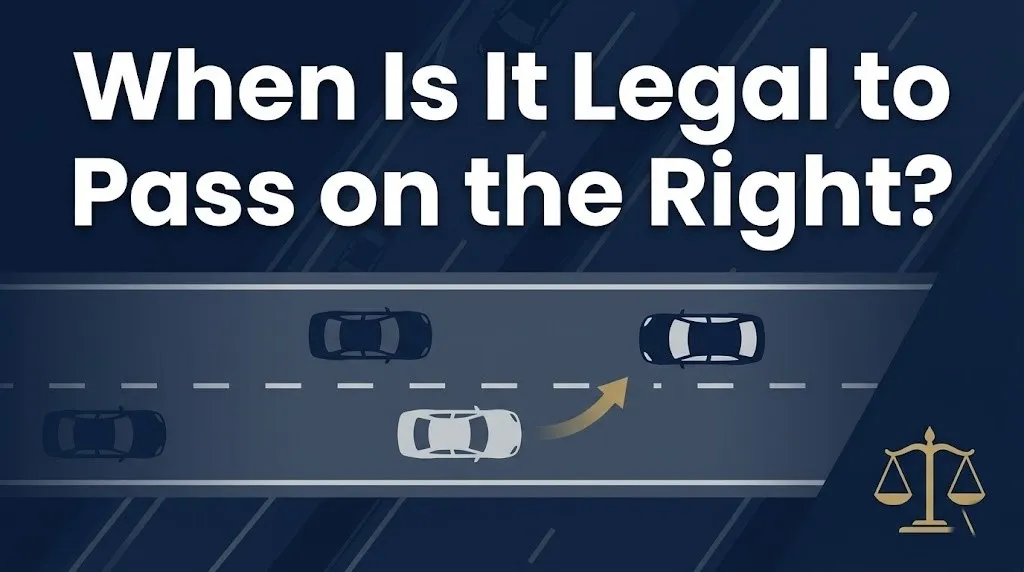
Passing on the right is legal when the road ahead of you is wide enough for two or more lanes of traffic moving in your direction and the pavement is unobstructed. Every state permits it under at least some conditions.
The most common situations where right-side passing is allowed include:
- The vehicle ahead is making or about to make a left turn
- You’re on a road with two or more marked lanes going the same way
- You’re on a one-way street with multiple lanes
- Traffic flow allows safe movement without leaving the paved roadway
Think of it like a grocery store checkout line. If the lane next to you is open and clear, you’re allowed to move into it and proceed. You don’t have to wait behind someone who’s stopped.
The key condition across nearly all states is safety. You can’t swerve onto a shoulder or unpaved surface to get around someone. The road itself must have enough room for two vehicles side by side within marked or understood lanes.
| Condition | Right-Side Passing Allowed? |
|---|---|
| Multi-lane road, same direction | Yes, in all 50 states |
| Vehicle ahead turning left | Yes, in all 50 states |
| One-way street with multiple lanes | Yes, in all 50 states |
| Two-lane road, no extra lane | No, in nearly all states |
| Unpaved shoulder | No, in nearly all states |
Is It Illegal to Pass on the Right
Passing on the right is not automatically illegal. It becomes illegal when you do it under the wrong conditions, such as driving off the paved roadway, using the shoulder, or passing on a two-lane road without a designated second lane.
Many drivers believe there’s a blanket ban against right-side passing. That belief is wrong. The law in every state allows it in at least some circumstances. The confusion comes from driver’s education courses that teach the general rule of “pass on the left” without explaining the exceptions.
What makes right-side passing illegal typically involves three factors:
- Leaving the paved road surface to pass
- Passing on the right where there is only one lane going your direction
- Passing in a way that creates an unsafe condition
A 2023 NHTSA report found that improper passing contributes to roughly 4% of all fatal crashes. The danger isn’t about which side you pass on. It’s about whether you do it safely and legally.
The bottom line: passing on the right is legal in specific situations and illegal in others. The road layout and your state’s traffic code determine which one applies.
When Can You Legally Pass on the Right
You can legally pass on the right when the vehicle ahead is turning left, when you’re on a multi-lane road, or when you’re traveling on a one-way street with room for two or more lines of traffic.
Most state statutes list these exact scenarios. They trace back to Section 11-304 of the Uniform Vehicle Code, which has been adopted in full or in modified form by the majority of US states. That section permits right-side overtaking when the roadway is “of sufficient width for two or more lines of vehicles.”
Here’s a breakdown of the three most widely recognized legal scenarios:
Scenario 1: Left-turning vehicle. If the car ahead signals a left turn or is clearly positioned to make one, you may pass on the right. You must stay on the paved portion of the road.
Scenario 2: Multi-lane highway or road. Roads with two or more lanes going your direction allow passing on either side. This includes most interstate highways and major urban roads.
Scenario 3: One-way streets. On a one-way street with enough width for two lanes of traffic, you can pass on the right. Some states require the lanes to be marked, while others just require sufficient width.
The common thread is that right-side passing must be done safely and on a paved surface. You can’t cut through a bike lane, a parking lane, or a gravel shoulder to get around someone.
Passing on the Right Law
Passing on the right law in the United States is governed by individual state traffic codes, most of which are based on the Uniform Vehicle Code Section 11-304. There is no single federal law that controls right-side passing rules.
Each state writes its own version of the passing law, but the core structure is remarkably similar. The typical state statute says passing on the right is permitted only under specific conditions and only when it can be done safely.
| Legal Element | What Most State Laws Require |
|---|---|
| Road width | Must accommodate two or more lines of traffic |
| Surface | Must be paved and unobstructed |
| Safety | Movement must be made safely |
| Left-turn exception | Passing allowed when lead vehicle turns left |
| One-way street rule | Passing on right allowed if road is wide enough |
| Shoulder use | Prohibited in most states |
State legislatures review and sometimes update these laws. As of 2026, no state has moved to ban right-side passing entirely. The trend has been toward clarifying existing rules rather than creating new restrictions.
One thing that trips up drivers is the phrase “sufficient width.” Some states define this as two marked lanes. Others leave it up to the officer’s judgment. If there’s any doubt about whether the road qualifies, the safest legal move is to wait and pass on the left.
Key Takeaway: Passing on the right is legal in all 50 states under specific conditions, primarily on multi-lane roads, one-way streets, and when the vehicle ahead is turning left. The road must be paved and wide enough for safe side-by-side travel.
Can You Pass on the Right on a Highway
Yes, you can pass on the right on a highway in every US state, as long as the highway has two or more lanes going in your direction. This is one of the most universally accepted exceptions to the “pass on the left” rule.
Interstate highways and most state highways have at least two travel lanes in each direction, separated by a median or barrier. On these roads, right-side passing happens constantly. Every time you move from the left lane to the right lane to get around a slower vehicle, you’re technically passing on the right.
State traffic laws account for this. California Vehicle Code 21755 explicitly allows passing on the right on a highway “with unobstructed pavement of sufficient width for two or more lines of moving vehicles.” Texas Transportation Code 545.057 has nearly identical language.
Here’s where highway passing gets legally gray:
- Using the emergency shoulder to pass: Illegal in every state
- Passing a vehicle that’s merging from an on-ramp: Legal if you stay in your lane
- Weaving across multiple lanes rapidly: Could result in a reckless driving charge
Highway passing on the right is legal and routine. The problem arises when drivers leave the travel lanes or create dangerous conditions while doing it. A good rule: if you can pass without changing out of a legitimate travel lane, you’re almost certainly in the clear.
Passing on the Right on a Multi-Lane Road
Passing on the right on a multi-lane road is legal in all 50 states. Any road with two or more lanes moving in the same direction qualifies as a multi-lane road for the purposes of right-side passing laws.
This covers a wide range of roads beyond highways. Urban boulevards, divided parkways, and many suburban arterial roads have multiple lanes. On all of these, you’re legally allowed to travel in the right lane at a faster speed than the vehicle in the left lane.
There’s an important distinction here. On a multi-lane road, you don’t even need to change lanes to “pass on the right.” If you’re already in the right lane and the left-lane driver is going slower, you pass them simply by maintaining your own speed. That’s completely legal.
Things to remember about multi-lane right-side passing:
- You must stay within a marked or understood travel lane
- You cannot use a turn-only lane to pass through traffic
- You cannot use a bike lane as a passing lane
- Your speed must not exceed the posted limit
Some states, like New Jersey (N.J.S.A. 39:4-85), require the right-side pass to be made “in safety.” That phrase gives officers discretion. If your pass was technically in a legal lane but reckless in execution, you could still face a citation.
Multi-lane roads are the easiest scenario for legal right-side passing. The lanes exist for this purpose.
Is It Legal to Pass on the Right on a Two-Lane Road
Passing on the right on a two-lane road is generally illegal unless the vehicle ahead is making a left turn and there is enough paved road for you to get by safely. This is the strictest passing scenario in US traffic law.
A two-lane road means one lane in each direction. There’s no extra lane to move into on the right side. To pass on the right, you’d have to use the shoulder, a parking area, or an unpaved surface. Nearly every state prohibits that.
| Two-Lane Road Scenario | Legal? |
|---|---|
| Vehicle ahead is turning left, paved space exists on right | Yes, in most states |
| Vehicle ahead is slow, no left turn signal, only shoulder available | No |
| Vehicle ahead is stopped, gravel shoulder is the only option | No |
| Road briefly widens to two lanes in your direction | Yes, treated as multi-lane |
The left-turn exception works like this: if you’re behind a car that’s signaling left and there’s enough paved roadway to the right of that vehicle for you to safely go around it, you may pass. You can’t drive onto grass, dirt, or gravel to do this.
Some rural roads have paved shoulders wide enough that drivers treat them as passing lanes. In most states, this is still illegal. The shoulder is reserved for emergencies, not for traffic flow. Getting caught using it to pass can result in a fine ranging from $100 to $300, depending on the state.
Key Takeaway: On two-lane roads, right-side passing is only legal when the lead vehicle is turning left and paved space exists to pass safely. Using the shoulder or leaving the road surface to pass is illegal in virtually every state.
Right Side Passing Rules on the Shoulder
Using the shoulder to pass on the right is illegal in nearly every US state. Shoulders are designated for emergencies, disabled vehicles, and law enforcement stops, not for passing.
This rule catches many drivers off guard, especially in heavy traffic. It might feel logical to scoot along the shoulder to get around a stopped or slow vehicle. But the law in almost every jurisdiction treats this as a violation.
Specific state examples:
- Florida (F.S. 316.085): Prohibits passing on the right unless conditions allow safe movement on a paved portion of the highway, explicitly excluding shoulders
- Pennsylvania (75 Pa.C.S. 3304): Bans driving on the shoulder to pass
- Virginia (Va. Code 46.2-841): Only allows right-side passing on sufficient paved roadway, not shoulders
A few narrow exceptions exist. Some states allow limited shoulder use in designated areas during peak traffic hours. Maryland, for example, has opened certain highway shoulders as temporary travel lanes during rush hour on I-270 and parts of I-95. These are marked with electronic signs and specific hours of operation.
Outside of those controlled programs, driving on the shoulder to pass is illegal and dangerous. The shoulder surface is often less maintained than the main road. Debris, gravel, and stopped vehicles make it risky.
Penalties for shoulder-passing violations typically range from $100 to $500, depending on the state and whether the violation contributed to a crash.
States Where Passing on the Right Is Illegal
No US state has a blanket ban on passing on the right. Every state allows it under at least some conditions. The real differences between states involve how restrictive the conditions are.
Some states are more permissive. Others set tight limits. Here’s a comparison of how several states handle right-side passing laws as of 2026:
| State | Statute | Right-Side Passing Allowed When |
|---|---|---|
| California | CVC 21755 | Multi-lane road or vehicle turning left; must be safe |
| New York | VTL 1123 | Vehicle turning left or multi-lane road; must stay on pavement |
| Texas | TTC 545.057 | Vehicle turning left or road has two or more lanes same direction |
| Florida | F.S. 316.085 | Sufficient pavement width; off-roadway passing prohibited |
| New Jersey | N.J.S.A. 39:4-85 | Multi-lane road or one-way street; must be done safely |
| Illinois | 625 ILCS 5/11-704 | Vehicle turning left or road has two or more lanes |
| Ohio | ORC 4511.28 | Vehicle turning left or multi-lane road |
| Virginia | Va. Code 46.2-841 | Vehicle turning left; sufficient paved width available |
States like Louisiana and Mississippi use language closely mirroring the Uniform Vehicle Code, which means the standard conditions apply: multi-lane roads, left-turning vehicles, and one-way streets.
The strictest states tend to be those with more rural two-lane roads. They enforce the paved-surface requirement heavily because shoulder-passing on narrow country roads causes a disproportionate number of crashes.
No state made right-side passing fully illegal in recent legislative sessions. The pattern is consistent: it’s allowed under conditions and prohibited when unsafe.
Is Passing on the Right Legal in California
Passing on the right is legal in California under two conditions. The road must have enough unobstructed pavement for two or more lines of moving vehicles, or the vehicle ahead must be making a left turn.
California Vehicle Code Section 21755 spells this out clearly. It also adds one more condition: you can pass on the right when you’re on a one-way street. In all cases, the pass must be made safely.
CVC 21755 specifically prohibits right-side passing by driving off the paved or main-traveled portion of the roadway. That means no shoulder driving, no cutting through parking lots, and no using bike lanes to get around someone.
Quick facts about California right-side passing:
- Fine for illegal right-side passing: Approximately $238 (base fine plus fees and assessments)
- Points on license: 1 point added to your DMV record
- Impact on insurance: A moving violation that can increase premiums
- Statute: CVC 21755
California is one of the more permissive states for right-side passing because its roads frequently have multiple lanes. The dense freeway system in Southern California makes right-side passing a daily occurrence for millions of drivers.
The risk comes on two-lane rural highways in Northern California and the Central Valley. Officers in those areas enforce the no-shoulder-passing rule actively.
Key Takeaway: California, Texas, and New York all allow passing on the right under defined conditions. Each state has its own statute with slight variations, but the core rules are similar: multi-lane roads and left-turning vehicles are the universal green lights for right-side passing.
Is Passing on the Right Legal in Texas
Passing on the right is legal in Texas under conditions outlined in Texas Transportation Code Section 545.057. The law permits it when the vehicle being overtaken is making a left turn or when the road has two or more lanes for traffic moving in the same direction.
Texas law adds one important detail. The right-side pass must not involve driving off the main traveled portion of the roadway. That rules out shoulder passing and off-road maneuvering.
| Texas Right-Side Passing Rule | Detail |
|---|---|
| Statute | TTC 545.057 |
| Multi-lane roads | Right-side passing allowed |
| Left-turning vehicle | Right-side passing allowed |
| Shoulder use | Not permitted |
| Base fine for violation | Typically $150 to $250 |
| Points on license | 2 points |
Texas roads vary dramatically from six-lane urban freeways in Houston and Dallas to narrow two-lane farm roads in West Texas. The law applies equally, but enforcement patterns differ. Urban officers rarely cite drivers for right-side passing on multi-lane roads because it’s perfectly legal. Rural deputies are more likely to stop drivers who pass on the right using a shoulder.
One scenario unique to Texas involves frontage roads along highways. These roads often have enough width for two lanes even when only one is marked. Texas courts have generally treated passing on these roads as legal when the pavement supports it.
Is Passing on the Right Legal in New York
Passing on the right is legal in New York under conditions set by Vehicle and Traffic Law Section 1123. New York allows right-side overtaking when the vehicle ahead is making a left turn or when you’re on a roadway with enough width for two or more lines of traffic moving in the same direction.
New York’s law closely mirrors the Uniform Vehicle Code. Section 1123 has two subsections. Subsection (a) covers passing when the overtaken vehicle is turning left. Subsection (b) covers multi-lane roads and one-way streets.
The law requires that right-side passing be done safely and only on paved surfaces. You can’t drive onto the shoulder or an improved surface to get around someone.
Key details for New York drivers:
- Statute: NY VTL 1123
- Fine range: $150 to $300 for a first offense
- Points: 3 points on your license for unsafe passing
- Surcharge: $88 to $93 added to fines for all traffic infractions
- Repeat offenders: Higher fines and potential license review
New York City presents a unique environment. The city’s grid system means most streets have multiple lanes or are one-way. Right-side passing is legal and common on these streets. Outside the city, on two-lane roads in the Hudson Valley, Catskills, or Adirondacks, right-side passing is much more restricted.
New York State Police have noted that improper passing is among the top 10 causes of rural crashes in the state.
Passing on the Right Penalties and Fines
Penalties for illegally passing on the right vary by state but typically include fines between $100 and $500, points on your license, and potential insurance rate increases. In some states, the violation is classified as a moving infraction. Others treat it as a misdemeanor if it results in an accident.
Here’s a breakdown of penalties across several states:
| State | Base Fine Range | License Points | Additional Consequences |
|---|---|---|---|
| California | $238 (with fees) | 1 point | Insurance increase likely |
| New York | $150 to $300 | 3 points | $88 surcharge added |
| Texas | $150 to $250 | 2 points | Defensive driving option |
| Florida | $129 to $179 | 3 points | Traffic school may dismiss |
| New Jersey | $85 to $200 | 2 points | Insurance surcharge possible |
| Illinois | $75 to $150 | 2 points (moving violation) | Court supervision option |
| Virginia | $100 to $250 | 3 demerit points | Can be reduced with driving course |
| Ohio | $150 (typical) | 2 points | Points removed after 2 years |
These are base-level penalties for a standalone violation. The numbers climb significantly if the illegal pass caused a crash. At that point, you might face reckless driving charges, which carry fines of $1,000 or more and possible jail time.
Insurance companies treat improper passing as a moving violation. Expect your premiums to rise by 10% to 25% after a conviction, depending on your carrier and driving history.
Key Takeaway: Illegal right-side passing penalties range from $75 to $500 in fines and 1 to 3 license points, depending on your state. If the violation causes a crash, the consequences escalate to reckless driving territory with much steeper fines and potential criminal charges.
Can You Get a Ticket for Passing on the Right
Yes, you can get a ticket for passing on the right if you do it under conditions your state’s traffic code doesn’t allow. Officers issue these tickets regularly, especially on two-lane roads and in construction zones.
The most common reasons drivers get ticketed for right-side passing:
- Driving on the shoulder to pass a stopped or slow vehicle
- Passing on the right on a two-lane road when the lead vehicle is not turning left
- Cutting through a right-turn-only lane to pass through traffic
- Passing in a school zone or construction zone where passing is restricted
Getting a ticket doesn’t mean you’ll automatically be found guilty. You have the right to contest it in traffic court. Common defenses include arguing that the road had sufficient width for two lanes, that the other vehicle was signaling a left turn, or that the road was effectively a multi-lane road even without marked lanes.
Traffic camera enforcement for passing violations is rare. Most tickets come from patrol officers who witness the maneuver directly. This means the officer’s observation and testimony are the primary evidence.
If you receive a ticket, check your state’s specific statute. The language matters. Some states require marked lanes for legal right-side passing. Others only require “sufficient width.” That distinction can make or break your defense.
Passing on the Right vs Passing on the Left
Passing on the left is the default rule in American traffic law, while passing on the right is the exception allowed under specific conditions. Both are legal maneuvers when done correctly, but they carry different levels of risk and different legal standards.
| Factor | Passing on the Left | Passing on the Right |
|---|---|---|
| Default rule | Yes | No, exception only |
| Legal on two-lane roads | Yes, when safe and no oncoming traffic | Only when vehicle ahead turns left |
| Legal on multi-lane roads | Yes | Yes |
| Legal on one-way streets | Yes | Yes |
| Shoulder use permitted | No | No |
| Perceived risk level | Moderate (oncoming traffic risk) | Higher (blind spots, unexpected) |
The reason left-side passing is the default goes back to basic road design. American vehicles have the driver’s seat on the left side. When you pass on the left, you have better visibility of oncoming traffic. When you pass on the right, you’re often in the other driver’s blind spot.
From a legal liability standpoint, right-side passing carries more risk in an accident. If you pass on the right and a collision occurs, the investigating officer and insurance company may scrutinize your decision more closely. You’ll need to show that the pass was legal under your state’s traffic code.
That said, on multi-lane roads and highways, the practical difference between left and right passing is minimal. Both happen thousands of times per minute across the US highway system.
Uniform Vehicle Code Passing on the Right
The Uniform Vehicle Code Section 11-304 establishes the baseline rules for passing on the right that most states have adopted. This model code, maintained by the National Committee on Uniform Traffic Laws and Ordinances, provides the template that state legislatures work from.
Section 11-304 states that a driver may overtake and pass on the right of another vehicle only under the following conditions:
- The overtaken vehicle is making or about to make a left turn
- The roadway has sufficient width for two or more lines of moving vehicles in the same direction
- The movement can be made safely
The UVC also specifies that driving off the pavement or main-traveled portion of the roadway is not permitted when passing on the right. This one clause is the basis for virtually every shoulder-passing prohibition in state law.
As of 2026, the UVC text on right-side passing has not been significantly amended in recent years. The model law remains stable because the underlying logic is sound. Multi-lane roads allow right-side passing. Single-lane roads generally do not.
States that follow the UVC closely include Ohio, Indiana, Kentucky, and Michigan. States like California and New York have rewritten the rule in their own language but preserved the same core principles.
Understanding the UVC gives you a baseline. Even if you don’t know your state’s exact statute number, the UVC principles will apply in nearly identical form wherever you drive.
When Is It Unsafe to Pass on the Right
Passing on the right is unsafe when you can’t see clearly, when the road narrows, when there’s no proper lane on the right, or when road conditions reduce traction and visibility. Even when it’s technically legal, a right-side pass can still be a bad idea.
Unsafe conditions for right-side passing include:
- Blind curves or hills: You can’t see what’s ahead on the right side
- Wet or icy roads: Reduced traction makes lane changes risky
- Construction zones: Lanes may shift or narrow without warning
- Near intersections: Vehicles may turn right into your path
- School zones: Pedestrians may enter from the right side
- Parked cars alongside the road: Doors may open into your lane
Even states that broadly permit right-side passing add the phrase “if such movement can be made in safety.” That language gives officers and courts the authority to penalize you even when the road technically had two lanes.
Consider this scenario: you’re on a four-lane road, and you pass a vehicle on the right. Technically legal. But it’s raining, visibility is low, and a pedestrian steps off the curb on the right. If a crash happens, the “in safety” clause means you could face liability.
The legal permission to pass on the right doesn’t override common sense. Treat right-side passing like a tool with a warning label. It works when used correctly and causes damage when used carelessly.
Key Takeaway: Right-side passing is legal in defined situations, but it becomes unsafe near blind spots, intersections, construction zones, and in poor weather. The legal phrase “in safety” gives officers wide discretion to cite drivers even when the road layout appears to permit the maneuver.
Frequently Asked Questions
Is passing on the right always illegal in the US?
No, passing on the right is not always illegal.
Every US state allows it under specific conditions, typically on multi-lane roads, one-way streets, and when the vehicle ahead is turning left.
The claim that it’s always illegal is a widespread myth.
Can you pass on the right on a four-lane highway?
Yes, passing on the right on a four-lane highway is legal in all 50 states.
A four-lane highway has two or more lanes in each direction, which satisfies the requirement for legal right-side passing.
You must stay within a marked travel lane and not use the shoulder.
What happens if you pass on the right and cause an accident?
You may face a traffic citation for improper passing and could be found at fault for the crash.
Insurance companies will likely assign significant liability to you, especially if the pass was illegal under your state’s traffic code.
In severe cases, reckless driving charges may apply, carrying higher fines and possible jail time.
Is it legal to use the shoulder to pass on the right?
No, using the shoulder to pass on the right is illegal in nearly every state.
Shoulders are reserved for emergencies and disabled vehicles.
A few states allow temporary shoulder use during designated rush-hour periods on specific highways, but these are clearly marked with electronic signs.
How many points do you get for illegally passing on the right?
Point values range from 1 to 3 points depending on your state.
California assigns 1 point, New York assigns 3 points, and Texas assigns 2 points for illegal passing violations.
Accumulating too many points within a set period can trigger license suspension.
Knowing when right-side passing is legal keeps you safer on the road and protects your driving record. Bookmark this guide so you can check your state’s rules the next time the question comes up.
The laws are clear once you know where to look. Stay in a proper lane, keep it safe, and you’ll stay on the right side of the law in 2026.






