
Knowing when it is illegal to pass another vehicle can save you from a ticket, a crash, or a criminal charge. Every state bans passing in certain locations and conditions, and penalties range from small fines to license suspension.
Here’s a number that should get your attention. The NHTSA reports that improper passing contributes to roughly 4% of all fatal crashes on two-lane roads each year. That makes this more than a test question. It’s a life-or-death rule of the road.
This article breaks down every scenario where passing is prohibited in 2026. You’ll find state-by-state penalty comparisons, specific statute references, fine amounts, and the common myths that trip up even experienced drivers.
Whether you just got a ticket or you’re studying for your permit test, this guide covers it all.
When Is It Illegal to Pass Another Vehicle
It is illegal to pass another vehicle any time road markings, road conditions, or traffic laws prohibit you from doing so. The specifics vary by state, but all 50 states agree on a core set of situations where passing is banned.
Generally, you cannot pass when a solid yellow line is on your side of the road. You also cannot pass within 100 feet of an intersection, railroad crossing, bridge, or tunnel in most states. Passing on hills or curves where your view of oncoming traffic is blocked is illegal everywhere.
Most states follow a version of the Uniform Vehicle Code, which provides model rules for passing on two-lane roads. Individual state Vehicle Codes then add their own restrictions and penalty structures.
- Solid yellow line on your side of the centerline
- Within 100 feet of an intersection or railroad crossing
- On a bridge, overpass, or inside a tunnel
- In a school zone when children are present
- When a “Do Not Pass” or “No Passing Zone” sign is posted
- When your view of oncoming traffic is obstructed
- When the vehicle ahead is already at or near the speed limit
The rule of thumb is simple. If you can’t see far enough ahead to complete the pass safely, it’s illegal. If road markings tell you not to, it’s illegal.
Where Is It Illegal to Pass Another Vehicle
Illegal passing is tied to specific physical locations on the road. These locations are marked by pavement lines, signs, or defined by statute based on proximity to certain features.
No-passing zones are the most obvious. State transportation departments paint solid yellow centerlines and post “No Passing Zone” signs in areas where sight distance is too short for a safe pass. These zones appear on two-lane roads before curves, hills, and intersections.
| Location | Why Passing Is Banned | Typical Marking |
|---|---|---|
| Curves and blind turns | Cannot see oncoming traffic | Solid yellow line |
| Hilltops and crests | Oncoming vehicles hidden | Solid yellow line, sign |
| Bridges and tunnels | No escape room, narrow lanes | Solid yellow line, sign |
| Railroad crossings | Risk of stopping on tracks | No Passing Zone sign |
| Intersections | Cross traffic and turning vehicles | Solid yellow line |
| School zones | Pedestrian and child safety | Posted signs, flashing lights |
Beyond marked zones, most states also prohibit passing within a set distance of these features. California, for example, bars passing within 100 feet of a railroad crossing or intersection under Vehicle Code Section 21752. Texas Transportation Code Section 545.055 uses similar distance thresholds.
Some states add locations that others skip. Washington State prohibits passing within any construction zone regardless of line markings. Illinois bans passing within a work zone and doubles the fine.
It Is Illegal to Pass Another Vehicle
It is illegal to pass another vehicle whenever doing so creates a direct risk of a head-on collision, violates posted signs, or breaks state traffic statutes. This isn’t a suggestion. It’s enforceable law in every jurisdiction.
The phrase “it is illegal to pass another vehicle” appears in nearly every state driver’s manual, usually followed by a list of prohibited conditions. These conditions fall into two buckets: location-based rules and situation-based rules.
Location-based rules cover spots like no-passing zones, bridges, and intersections. Situation-based rules cover things like limited visibility from fog, rain, or nighttime conditions. Several states also ban passing when a vehicle ahead is stopped for a pedestrian at a crosswalk.
Quick Facts:
- All 50 states prohibit passing in marked no-passing zones.
- At least 40 states ban passing within 100 feet of an intersection.
- Passing a vehicle stopped at a crosswalk is illegal in every state.
- Fog, heavy rain, or snow can make an otherwise legal pass illegal if visibility drops below safe levels.
Violating any of these rules doesn’t just risk a fine. If a crash results, the driver who was passing illegally is almost always found at fault. That carries insurance consequences on top of the criminal penalty.
Key Takeaway: Illegal passing is defined by both where you are on the road and what conditions surround you. Road markings, signs, and weather all play a role in determining legality.
Can You Pass on a Double Yellow Line
No, you cannot legally pass another vehicle by crossing a double yellow line in most situations. A double yellow centerline means passing is prohibited for traffic traveling in both directions.
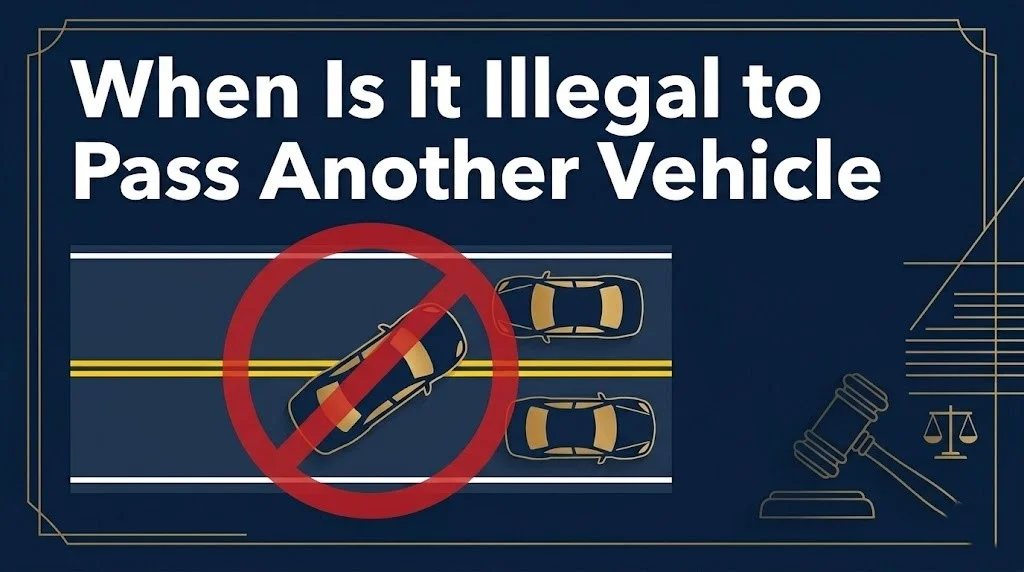
This is one of the most universally understood road markings in America. Two solid yellow lines painted down the center of a road signal that neither side may cross to pass. Every state enforces this rule.
There are a handful of narrow exceptions. Some states allow crossing a double yellow line to turn left into a driveway or side road. Oregon and Washington permit crossing a double yellow to pass a cyclist if the driver can do so safely. A few states allow crossing when directed by a law enforcement officer or a flagging crew in a construction zone.
| State | Can You Cross Double Yellow to Pass a Cyclist? | Statute |
|---|---|---|
| Oregon | Yes, if safe | ORS 811.420 |
| Washington | Yes, with 3 feet clearance | RCW 46.61.110 |
| Colorado | Yes, if safe | CRS 42-4-1003 |
| California | Yes, under specific conditions | CVC 21760 |
| Texas | No | TTC 545.055 |
| Florida | No explicit exception | FS 316.0875 |
The penalty for crossing a double yellow to pass another vehicle ranges from $100 to $500 in most states. In some jurisdictions, it adds 3 to 4 points to your driving record.
Don’t confuse a double yellow with a combination line. If one yellow line is solid and the other is broken, drivers on the broken-line side may pass. Drivers on the solid-line side may not.
Illegal Passing on a Solid Yellow Line
Crossing a solid yellow line on your side of the road to pass another vehicle is illegal in every state. A solid yellow line means “do not cross” for passing purposes.
Road engineers paint solid yellow lines where sight distance is insufficient for a safe pass. The Manual on Uniform Traffic Control Devices (MUTCD), published by the Federal Highway Administration, sets the standards for when and where solid lines must be used.
A single solid yellow line on your side combined with a broken yellow line on the other side creates a “passing permitted” zone only for the opposing lane. You must stay in your lane.
Two solid yellow lines mean neither direction may pass. This is the strongest prohibition on the road short of a physical barrier.
- Crossing a solid yellow line to pass is a moving violation.
- It carries a fine of $75 to $300 in most states.
- Some states issue 2 to 4 demerit points per offense.
- Repeat violations can lead to license suspension.
Think of the solid yellow line like a wall. You wouldn’t drive through a wall. Treat the line the same way. The paint is there because engineers calculated that you don’t have enough distance to see oncoming traffic and complete a pass safely.
Is It Illegal to Pass on the Right
Passing on the right is legal in some situations but illegal in others, depending on the state and road type. The rules around right-side passing are more nuanced than most drivers realize.
On multi-lane highways, passing on the right is generally legal. If the road has two or more lanes going the same direction, you can use any available lane to overtake a slower vehicle. This is standard on freeways and divided highways.
On two-lane roads, passing on the right is almost always illegal. Most states only allow it when the vehicle ahead is making a left turn and there is a paved shoulder or extra lane wide enough to pass safely.
| Scenario | Legal to Pass on the Right? |
|---|---|
| Multi-lane highway, passing in right lane | Yes, in all states |
| Two-lane road, vehicle ahead turning left, paved shoulder | Yes, in most states |
| Two-lane road, using unpaved shoulder to pass | No, in nearly all states |
| Passing on the right by driving off the roadway | No, in all states |
California Vehicle Code Section 21755 specifically allows right-side passing on a highway with unobstructed pavement wide enough for two lines of vehicles. New York VTL Section 1123 permits passing on the right only on roads wide enough for two lanes of traffic in the same direction.
Never pass on the right by leaving the paved roadway. That’s illegal everywhere and extremely dangerous.
Key Takeaway: Passing on the right is usually fine on multi-lane roads but restricted or banned on two-lane roads unless the vehicle ahead is turning left and space permits.
Is Passing on a Curve or Hill Illegal
Yes, passing on a curve or hill where you cannot see oncoming traffic is illegal in every state. These are the most dangerous places to attempt a pass, and the law treats them accordingly.
The reason is straightforward. On a curve or near the crest of a hill, you can’t see what’s coming toward you. If you pull into the oncoming lane and a vehicle appears, you have almost no time to react. Head-on collisions at combined speeds of 100+ mph are often fatal.
State transportation departments mark these areas with solid yellow centerlines and “No Passing Zone” signs. The MUTCD requires solid yellow markings anywhere the sight distance falls below the minimum needed for a safe pass, which is typically 400 to 800 feet depending on the speed limit.
- Passing near the crest of a hill is banned under statutes like California VCC 21752(a), Ohio ORC 4511.31, and Virginia Code 46.2-842.
- Passing on a curve with obstructed view is a moving violation carrying fines from $100 to $400.
- Multiple states add aggravated penalties if the pass causes an accident.
Even if no solid yellow line is painted, passing on a blind curve or hill is still illegal under general “unsafe passing” statutes. The absence of a line doesn’t give you permission. It just means the road crew hasn’t gotten to it yet.
Passing at an Intersection or Railroad Crossing
Passing another vehicle at or near an intersection or railroad crossing is illegal in most states. These locations carry too many conflict points for a pass to be safe.
At an intersection, cross traffic may enter the road, vehicles may turn, and pedestrians may be in crosswalks. Passing in this area forces you into the oncoming lane right where other vehicles are likely to cross your path. Most states prohibit passing within 100 feet of any intersection.
Railroad crossings pose a different risk. If you pull into the oncoming lane near tracks and a train approaches, you could be forced to stop on the tracks. States like Pennsylvania (Title 75, Section 3307) and Illinois (625 ILCS 5/11-704) specifically ban passing near railroad crossings.
| Feature | Typical No-Pass Distance | States with Explicit Statute |
|---|---|---|
| Intersection | 100 feet | CA, TX, NY, FL, OH, IL, PA |
| Railroad crossing | 100 feet | PA, IL, OH, VA, CA, TX |
| Bridge or viaduct | On structure | CA, NY, VA, FL, OH |
| Tunnel | Inside tunnel | All states |
Some states combine intersection and railroad rules into a single statute. Others list each location separately. Regardless of how it’s written, the practical rule is the same: don’t pass near any of these features.
Watch for the pennant-shaped “No Passing Zone” sign on the left side of two-lane roads. This sign specifically marks the beginning of a zone where passing is prohibited.
Is It Illegal to Pass a School Bus
Yes, passing a stopped school bus with its red lights flashing and stop arm extended is illegal in all 50 states. This is one of the most heavily enforced passing laws in the country.
When a school bus stops to load or unload children, it activates flashing red lights and extends a mechanical stop arm. All traffic in both directions must stop, except on divided highways where opposing traffic may not be required to stop depending on state law.
The penalties are severe. Fines range from $250 to over $1,000 for a first offense. Several states suspend your license for 30 to 90 days on a first violation.
| State | First Offense Fine | Points | License Suspension |
|---|---|---|---|
| New York | Up to $400 | 5 points | Possible |
| California | $695 minimum | 1.5 points | No |
| Texas | Up to $1,250 | No point system | No |
| Florida | $265 minimum | 4 points | Possible |
| Georgia | Up to $1,000 | 6 points | Yes, 6 months (3rd) |
| Illinois | $300 first, $1,000 second | None | 3 months (3rd) |
As of 2026, more than 25 states allow school bus stop-arm cameras. These cameras photograph vehicles that pass a bus illegally and generate citations mailed to the registered owner, similar to red-light camera tickets.
On a divided highway with a physical median or barrier, opposing traffic generally does not have to stop. But on undivided roads, even four-lane undivided roads, all lanes in both directions must stop. Many drivers don’t know this, and it’s one of the most ticketed violations in the country.
Key Takeaway: Passing a stopped school bus with its lights flashing is illegal everywhere, carries steep fines, and is increasingly enforced by automated cameras.
Passing Emergency Vehicles and Move Over Laws
Every state has a “Move Over” law that requires drivers to change lanes or slow down when passing a stopped emergency vehicle with its lights activated. Failing to comply is a traffic violation with escalating penalties.
Move Over laws originally covered police cars, fire trucks, and ambulances. By 2026, all 50 states have expanded coverage to include tow trucks, highway maintenance vehicles, and in many states, any vehicle with flashing warning lights stopped on the shoulder.
The general requirement is to move over one full lane away from the stopped emergency vehicle if it’s safe to do so. If changing lanes isn’t possible, you must slow to a speed well below the posted limit, often 20 mph below or to a specific speed like 25 mph.
- Fines for violating Move Over laws range from $50 to $2,500 depending on the state.
- At least 17 states now classify Move Over violations as misdemeanors if someone is injured.
- Virginia’s “Move Over” law (Virginia Code 46.2-921.1) carries fines up to $2,500.
- Florida increased its Move Over penalties in recent years, with fines up to $500 and mandatory points.
Passing an emergency vehicle that’s actively responding with lights and sirens is also prohibited. You must yield right of way and pull to the right side of the road until the vehicle passes. This applies to every road type, from city streets to interstate highways.
Passing a Cyclist Laws by State
Most states now require drivers to maintain a minimum safe distance when passing a cyclist. The specific distance and legal consequences vary, but the trend is clearly toward stricter enforcement.
The most common standard is a three-foot minimum passing distance. As of 2026, over 40 states have adopted some version of a safe-passing law for bicycles. Several states have increased the minimum to four feet or even six feet on higher-speed roads.
| State | Minimum Passing Distance | Higher Speed Adjustment | Statute |
|---|---|---|---|
| California | 3 feet | None | CVC 21760 |
| Florida | 3 feet | None | FS 316.083 |
| Pennsylvania | 4 feet | None | Title 75, 3303 |
| Virginia | 3 feet | None | VA Code 46.2-839 |
| Colorado | 3 feet | None | CRS 42-4-1003 |
| Michigan | 3 feet on roads under 45 mph | 5 feet over 45 mph | MCL 257.636 |
| Delaware | No specific distance | “Safe distance” required | Title 21, 4116 |
Some states allow drivers to cross a double yellow line to safely pass a cyclist, provided they can do so without creating an immediate hazard. Oregon and Washington both include this exception in their passing statutes.
Hitting a cyclist while passing too closely can result in enhanced penalties, including potential felony charges if the cyclist suffers serious injury. Insurance consequences are severe as well, with at-fault determinations nearly automatic when the driver violated a safe-passing statute.
If you live in a state without a specific distance law, you’re still required to pass at a “safe distance.” Courts interpret that based on road conditions, speed, and weather.
Key Takeaway: Safe-passing distance laws for cyclists are expanding rapidly. Over 40 states require at least three feet of clearance, and the penalties for violations are getting stiffer each year.
When Can You Legally Pass Another Vehicle
You can legally pass another vehicle on a two-lane road when the centerline on your side is broken (dashed) yellow, you have clear visibility of oncoming traffic, and you can complete the pass without exceeding the speed limit.
Legal passing requires several conditions to line up at once. Think of it like a checklist. Every item must be checked before you pull out.
- The centerline on your side must be broken (dashed) yellow.
- You must have at least 400 to 800 feet of clear visibility ahead.
- No “No Passing Zone” sign is posted.
- You are not near an intersection, railroad crossing, bridge, or tunnel.
- Oncoming traffic is far enough away for you to complete the pass.
- The vehicle ahead is not already traveling at or above the speed limit.
- You can return to your lane without cutting off the passed vehicle.
On multi-lane roads and highways, passing rules are simpler. You generally pass by moving to the left lane, overtaking the slower vehicle, and returning to the right lane. Most states require you to signal before changing lanes and give the passed vehicle adequate space before merging back.
One thing many drivers forget: you cannot exceed the speed limit to pass, even in a legal passing zone. If the limit is 55 mph and the car ahead is going 50, you can pass at 55 but not at 65. Speeding to pass is still speeding.
The vehicle being passed also has a legal duty. In every state, the driver being overtaken must not increase speed or otherwise prevent the pass. Blocking a legal pass is itself a traffic violation.
Passing in a No-Passing Zone Penalty
The penalty for passing in a no-passing zone is a traffic citation carrying fines from $75 to $500 in most states, with demerit points added to your license in nearly every jurisdiction.
No-passing zones exist because engineers determined that sight distance is inadequate for safe passing. When you pass in one of these zones, you’re committing a moving violation that goes on your driving record.
| State | Fine Range | Points | Additional Consequences |
|---|---|---|---|
| California | $238+ (with fees) | 1 point | Traffic school eligible |
| New York | $150 to $300 | 3 points | Surcharge if 6+ points |
| Texas | $200 max | No point system | Surcharge on record |
| Florida | $179+ (with fees) | 4 points | Insurance increase |
| Ohio | $150 max | 2 points | License review at 12 pts |
| Virginia | $250 max | 4 points | May affect CDL holders |
| Illinois | $120 to $500 | 20 to 55 merit points | Construction zone doubles fine |
Some states double fines in construction zones or school zones. Illinois, for example, doubles the fine for any moving violation committed in an active work zone, and passing violations are no exception.
A single no-passing zone violation typically won’t cause a license suspension. But combined with other moving violations, the accumulated points can trigger a suspension hearing. Commercial driver’s license (CDL) holders face even harsher consequences, as a serious traffic violation can disqualify them from driving commercially.
Illegal Passing Ticket Cost by State
An illegal passing ticket costs between $75 and $500 in base fines, but the total out-of-pocket cost is often much higher once court fees, surcharges, and insurance increases are factored in.
The base fine is only part of the equation. Most states add court costs, state surcharges, and administrative fees that can double or triple the amount printed on the ticket. California’s base fines, for example, balloon to two or three times the original amount after mandatory surcharges.
Then there’s insurance. A moving violation for illegal passing can raise your car insurance premiums by 15% to 30% for three to five years. On a $2,000 annual policy, that’s an extra $300 to $600 per year.
Quick Facts:
- Average base fine for illegal passing: $150 to $300
- Average total cost after fees and surcharges: $250 to $600
- Average annual insurance increase: 15% to 30%
- Total three-year cost of one ticket (fines + insurance): $1,000 to $2,500
- CDL holders may face separate federal penalties
Fighting an illegal passing ticket usually requires proving that road markings were faded or missing, the sign was obstructed, or the pass was necessary to avoid a hazard. Success rates vary widely by court and jurisdiction.
Some states offer traffic school or defensive driving courses to dismiss points or reduce fines. Check your state’s DMV website for eligibility requirements.
Key Takeaway: A single illegal passing ticket can cost you well over $1,000 when you add up fines, fees, surcharges, and increased insurance premiums over three to five years.
Illegal Passing Accident Liability
If you cause an accident while illegally passing another vehicle, you will almost certainly be found at fault. This has serious legal and financial consequences.
Fault determination in accident cases relies heavily on whether either driver violated a traffic law. When one driver was actively breaking the law by passing illegally, that violation creates a strong presumption of negligence. In most states, violating a traffic statute is considered “negligence per se,” meaning the court assumes you were negligent.
This presumption makes it very difficult to defend against a lawsuit. The injured party only needs to prove that you violated the passing law and that the violation caused the accident. They don’t have to prove you were careless beyond the traffic violation itself.
- You will likely be assigned 100% fault for the accident.
- Your insurance company will pay the other driver’s damages up to your policy limits.
- If damages exceed your policy limits, you’re personally liable for the rest.
- Your insurance rates will increase dramatically, possibly resulting in policy cancellation.
- If someone is seriously injured or killed, you may face criminal charges including vehicular manslaughter.
Criminal charges escalate the stakes enormously. In many states, causing a death while committing a traffic violation can result in vehicular homicide charges, which carry prison sentences of 1 to 15 years depending on the jurisdiction.
Even without criminal charges, a civil lawsuit from an accident caused by illegal passing can result in judgments of hundreds of thousands of dollars. This is why liability insurance exists, but many drivers carry minimum coverage that wouldn’t cover a serious crash.
States with the Strictest Passing Laws
Virginia, New York, and Georgia rank among the states with the strictest passing laws based on fine amounts, point penalties, and willingness to escalate charges.
Strictness isn’t just about the fine amount. It also includes how many demerit points are assessed, whether violations affect your license, and how aggressively the state enforces passing laws through cameras and patrols.
| State | Base Fine | Points | Notable Enforcement Feature |
|---|---|---|---|
| Virginia | Up to $250 | 4 | Reckless driving charges for aggressive passing |
| New York | Up to $300 | 3 to 5 | School bus cameras statewide |
| Georgia | Up to $1,000 | 3 to 6 | License suspension for school bus violations |
| Florida | $179+ | 4 | Aggressive enforcement, high surcharges |
| Illinois | Up to $500 | 20-55 | Doubled fines in construction zones |
| California | $238+ | 1 to 1.5 | High surcharge multiplier on fines |
Virginia deserves special mention. The state’s reckless driving statute (Virginia Code 46.2-852) is broad enough that aggressive or dangerous passing can be charged as reckless driving, a Class 1 misdemeanor. That means potential jail time of up to 12 months, a fine up to $2,500, and a criminal record.
Georgia takes school bus passing violations more seriously than most states. A third offense can result in a six-month license suspension. Combined with fines up to $1,000 and six demerit points, Georgia’s penalties are among the highest in the country.
States with lower penalties, like many in the rural Mountain West, tend to rely more on driver responsibility and less on aggressive enforcement. But even in those states, causing an accident while passing illegally triggers the same civil liability as anywhere else.
Key Takeaway: Virginia, New York, Georgia, and Illinois stand out for their aggressive penalty structures and enforcement of illegal passing laws. Fines, points, and potential criminal charges make violations costly.
Common Myths About Passing Another Vehicle
Several widespread beliefs about passing laws are flat wrong. Believing these myths can lead to tickets, accidents, and costly insurance claims.
Myth 1: You can speed to pass.
False. You cannot exceed the posted speed limit while passing another vehicle, even in a legal passing zone. Speeding is speeding, regardless of why you’re doing it. Every state enforces this.
Myth 2: A broken yellow line always means you can pass.
Mostly true, but not always. A broken yellow line on your side generally permits passing. But if a “No Passing Zone” sign is posted, the sign overrides the line marking. Signs take priority.
Myth 3: You don’t have to stop for a school bus on a divided highway.
This one is actually true in most states, but only if the road has a physical median or barrier. Painted center lines alone do not make a road “divided.” Many drivers make this mistake on four-lane roads without medians and get ticketed.
Myth 4: If there’s no line on the road, you can pass anywhere.
False. Unmarked roads still fall under general passing statutes. You cannot pass on a hill, curve, or near an intersection just because no one painted a line. The default legal rule still applies.
Myth 5: The vehicle being passed can speed up to prevent you from passing.
False. In every state, the vehicle being overtaken must maintain or reduce speed. Deliberately preventing a legal pass is itself a traffic violation. Some states charge it as impeding traffic.
These myths circulate because most drivers learn the basics in driver’s ed and never revisit the details. Traffic laws are more specific than people remember.
How to Pass Another Vehicle Safely and Legally
To pass another vehicle safely and legally, check for a broken yellow centerline, confirm clear visibility ahead, signal your intent, accelerate to complete the pass quickly, and return to your lane with plenty of room.
Think of passing like a pilot’s pre-takeoff checklist. You wouldn’t skip steps in an airplane, and you shouldn’t skip them on the road. Here’s the full sequence:
- Check your mirrors and blind spot.
- Confirm the centerline on your side is broken yellow or there’s a passing lane.
- Look ahead for oncoming traffic, intersections, driveways, and curves.
- Signal left before moving into the oncoming lane.
- Accelerate to pass quickly but do not exceed the speed limit.
- Give the passed vehicle at least two car lengths before merging back.
- Signal right and return to your lane smoothly.
A common mistake is lingering in the oncoming lane. The longer you stay there, the greater your exposure to a head-on collision. Complete the pass decisively and return to your lane as quickly as possible without cutting off the other driver.
Never pass when you feel uncertain. If you’re debating whether you have enough room, you probably don’t. Wait for a clear opportunity. There’s no prize for getting around one more car a few seconds sooner.
Patience is the most underrated driving skill. Aggressive passing saves minutes at best and risks lives at worst. If the vehicle ahead is going slightly below the speed limit, consider whether passing is really worth the risk.
Frequently Asked Questions
Is it always illegal to cross a double yellow line to pass?
In most situations, yes. A double yellow line means passing is prohibited for both directions of travel.
A few states allow crossing a double yellow to pass a cyclist if it can be done safely.
Crossing to turn left into a driveway is also generally permitted.
But crossing to pass another motor vehicle is illegal in all 50 states.
Can you get arrested for illegal passing?
A standard illegal passing violation is a traffic infraction, not an arrest-worthy offense.
However, if illegal passing involves reckless driving or causes a serious accident, criminal charges can follow.
In Virginia, aggressive passing can be charged as reckless driving, a Class 1 misdemeanor that carries potential jail time.
Causing a fatality while passing illegally can lead to vehicular manslaughter charges.
How many points go on your license for illegal passing?
Most states add 2 to 4 demerit points for an illegal passing conviction.
New York adds 3 points for a standard violation and 5 for passing a school bus.
Florida adds 4 points for most illegal passing offenses.
Texas does not use a traditional point system but tracks violations for surcharge purposes.
Is it legal to pass on the right on a highway?
Yes, on multi-lane highways, passing on the right by using an adjacent lane is legal in all states.
On two-lane roads, passing on the right is only allowed in limited circumstances, such as when the vehicle ahead is turning left.
You may never pass on the right by driving off the paved roadway.
What happens if you cause an accident while illegally passing?
You will almost certainly be found at fault for the accident.
Violating a passing law establishes negligence per se in most courts, meaning fault is presumed.
You face the traffic ticket, a civil lawsuit for damages, and potentially criminal charges if someone is seriously injured.
Your insurance premiums will increase significantly, and your insurer may cancel your policy.
This guide covers every angle of illegal passing laws across the United States as of 2026. Bookmark it and come back whenever you need a quick reference on passing rules, penalties, or state-specific statutes.
Understanding these laws protects your license, your wallet, and the people sharing the road with you. Stay informed as state laws continue to evolve.






