
No single car color is banned nationwide, but several colors are legally restricted for civilian vehicles depending on how they are used and which state you are in. The main colors that get people in trouble are blue, red, and certain amber shades tied to emergency vehicle identification.
Most people assume any paint color is fair game. That assumption gets cars pulled over and owners fined. The real issue is not always the paint itself but how a color mimics law enforcement or emergency vehicles.
This article covers every restricted color category, the states with the strictest rules, exact penalties where they are confirmed, and how special paint finishes like chrome, reflective vinyl, and underglow lighting fit into the legal picture for 2026.
What Color Is It Illegal to Use on Cars
No single paint color is universally illegal for civilian cars across all 50 states, but certain colors become illegal when they are used in ways that imitate emergency or law enforcement vehicles. The most restricted colors are blue, red, and specific amber shades associated with police, fire, and rescue vehicles.
The legal problem is not the color pigment sitting on your hood. It is what that color communicates to other drivers and law enforcement when your car is moving on a public road. Courts and state vehicle codes consistently focus on whether a color creates confusion about whether a vehicle is an official emergency unit.
The three main categories of color-based restrictions in the US are:
- Colors associated with emergency lighting (blue, red, amber) when used on exterior lights or in ways that mimic strobes
- Paint colors or schemes designed to impersonate law enforcement vehicles
- Special-finish paints (reflective, mirror chrome, fluorescent) that create safety hazards or violate specific state vehicle codes
Quick Facts:
- No federal law bans a specific paint color outright for civilian cars
- Restrictions are state-level and enforcement varies significantly
- Blue and red are the most restricted colors due to emergency vehicle association
- Special finish paints like chrome and reflective vinyl have separate rules in several states
Illegal Car Colors in the US
The term “illegal car colors” is slightly misleading. What is actually illegal in the US is not the color itself but the context in which certain colors are applied or displayed on a civilian vehicle. That distinction matters a lot when you are planning a custom build.
The clearest examples involve cars painted or modified to look like police vehicles. Many states have statutes that prohibit civilians from operating vehicles that could reasonably be mistaken for official law enforcement cars. Color schemes, decals, and lighting combinations all feed into that determination.
Beyond impersonation concerns, some states restrict specific colors on lighting fixtures mounted to civilian vehicles. California, Virginia, New York, and Florida all have vehicle codes specifying which colors are reserved for emergency use and cannot appear on civilian-operated lights or in configurations that mimic emergency signals.
| Color | Typical Restriction | Who It Applies To | Legal Basis |
|---|---|---|---|
| Blue (lights) | Banned on civilian lights in most states | All non-emergency drivers | State vehicle codes |
| Red (forward-facing lights) | Restricted or banned in most states | All non-emergency drivers | FMVSS + state codes |
| Amber | Restricted to specific vehicle types | Non-commercial civilian cars | State vehicle codes |
| Reflective paint | Restricted in certain configurations | All civilian vehicles | State safety codes |
| Chrome/mirror finish | Banned on certain surfaces in some states | All drivers | State vehicle inspection rules |
What Colors Are Reserved for Emergency Vehicles
Blue and red are the two colors most consistently reserved for emergency vehicles across the United States. Amber is reserved for construction, utility, and slow-moving vehicles in most states. No other colors carry broad legal restrictions for civilian use.
The rationale is straightforward. When drivers see flashing blue and red lights, they expect to be yielding to police or emergency responders. Any civilian vehicle displaying similar colors creates a public safety hazard and potentially impersonates law enforcement, which is a criminal offense in every state.
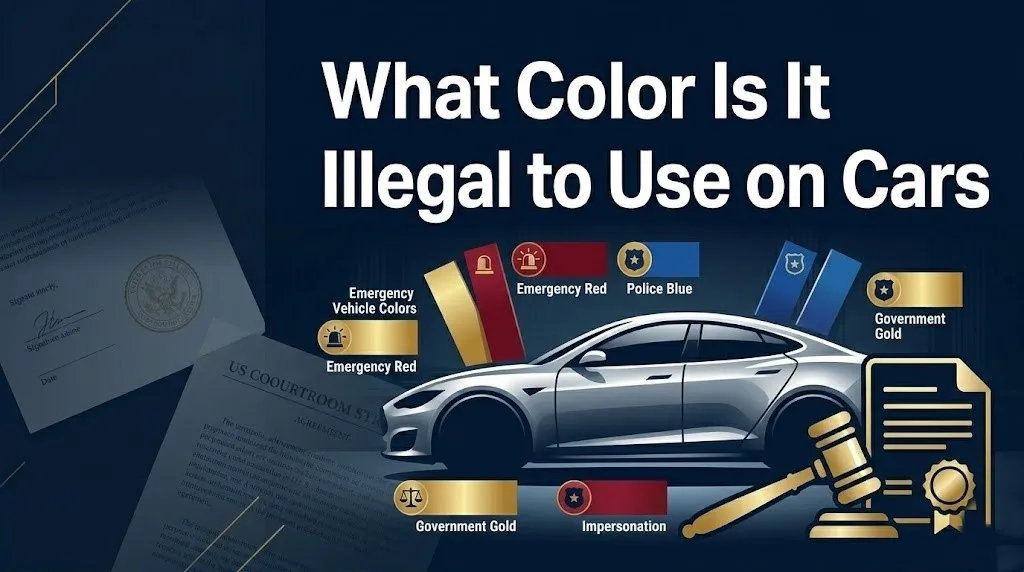
Fire trucks and ambulances typically use red and white combinations in their lighting. Police vehicles use blue and red in most states, though some jurisdictions use all blue or blue and white. Construction and utility vehicles use amber exclusively.
Specific colors reserved across most US states:
- Blue: Reserved for law enforcement and some volunteer fire departments
- Red: Reserved for fire apparatus, ambulances, and police in forward-facing configurations
- Amber/yellow: Reserved for construction vehicles, tow trucks, and highway maintenance
- Green: Reserved for volunteer firefighter vehicles in certain states including New York and New Jersey
- White strobes: Reserved for emergency use in specific configurations
Key Takeaway: Blue and red are the two colors with the broadest civilian restrictions in the US, primarily because of their association with emergency vehicle lighting and law enforcement identification.
Is It Illegal to Paint Your Car Blue
Painting your car blue is not illegal. Blue is one of the most popular car colors in the United States, and no state law prohibits civilians from having a blue paint job on a standard passenger vehicle. The legal issue with blue arises specifically with blue lighting, not blue paint.
Here is where people get confused. Having a blue car is fine. Installing blue flashing or rotating lights on that car is a different matter entirely. In most states, blue lights are reserved strictly for law enforcement and authorized emergency vehicles. A civilian car with blue strobes or a blue emergency light bar is illegal in almost every jurisdiction regardless of whether the body paint is also blue.
The confusion deepens because some states go further than others in regulating the combination of colors, decals, and lighting that together create an emergency vehicle appearance. A plain blue sedan with no special lighting raises zero legal concerns. A blue car with black-and-white decals, a spotlight, and tinted windows styled to look like an unmarked police unit is a much more serious issue.
Quick Facts:
- Blue paint on a civilian car: legal in all 50 states
- Blue flashing lights on a civilian car: illegal in nearly all states
- Blue steady-on lights (non-emergency): rules vary significantly by state
- Impersonating police with a blue car plus decals: criminal offense in all states
Blue Car Paint Laws by State
Blue car paint is legal in every US state. However, blue lighting mounted on civilian vehicles is restricted or banned in most states, and the specific rules vary considerably. Here is how the most active states handle blue lighting on non-emergency vehicles as of 2026.
California Vehicle Code Section 25252 restricts blue warning lights to authorized emergency vehicles. Violation can result in an equipment violation citation, with fines typically ranging from $100 to $250 before court fees. New York Vehicle and Traffic Law Section 375 similarly restricts blue lights to police and authorized emergency use.
Texas Transportation Code Section 547.305 prohibits civilian use of blue lights. Florida Statute 316.2397 creates one of the more detailed frameworks in the country, listing exactly which vehicles may display blue lights and prohibiting all other civilian use.
| State | Blue Paint Restricted | Blue Lights Restricted | Relevant Statute | Estimated Fine |
|---|---|---|---|---|
| California | No | Yes | Vehicle Code 25252 | $100 to $250 |
| New York | No | Yes | VTL Section 375 | $150 to $300 |
| Texas | No | Yes | Transportation Code 547.305 | $150 to $200 |
| Florida | No | Yes | Statute 316.2397 | $100 to $250 |
| Virginia | No | Yes | Code 46.2-1025 | $100 to $200 |
| Illinois | No | Yes | Vehicle Code 12-215 | $75 to $150 |
Red and Blue Paint on Civilian Cars
Red and blue paint on a civilian car is legal in the United States. No state has a statute prohibiting a civilian from painting their car red, blue, or a combination of both colors. The legal restrictions target red and blue lighting, not red and blue paint.
That said, context still matters. A civilian car painted to precisely replicate a marked police vehicle, complete with the agency name, badge graphics, and official-looking livery in police blue and white, crosses into impersonation territory regardless of whether any lights are involved. The paint scheme itself becomes evidence of intent to impersonate.
Think of it like a Halloween costume. Wearing a police-themed shirt is fine. Wearing a full accurate uniform with a badge, a gun holster, and a replica patrol car is impersonation. The law looks at the total picture, not just the color.
Red paint alone carries no legal risk on a standard civilian vehicle. It is one of the most popular car colors in the world, and no state singles out red paint as a prohibited civilian color. Red forward-facing lights are a different matter entirely and are restricted in most states under Federal Motor Vehicle Safety Standards and state vehicle codes.
Quick Facts:
- Red car paint: legal in all 50 states
- Blue car paint: legal in all 50 states
- Red and blue combined paint scheme: legal unless it mimics emergency vehicle livery
- Red and blue flashing lights together: strongly associated with law enforcement, restricted in all states
Key Takeaway: Red and blue paint colors are legal on civilian cars everywhere in the US. The legal line is crossed when lighting, decals, or full vehicle schemes are combined to impersonate law enforcement or emergency vehicles.
Unmarked Police Car Colors and Civilian Rules
Civilians cannot legally operate vehicles designed to impersonate unmarked police cars, even without any lights or sirens. The offense is called criminal impersonation of a law enforcement officer or official vehicle, and it exists in every state’s penal code.
Unmarked police cars come in a wide range of colors: black, white, silver, dark blue, dark red, tan, and more. Because they do not have a fixed color scheme, civilians cannot simply avoid a specific paint color to stay safe. The prohibition is based on the totality of how the vehicle presents itself, including spotlights, antenna configurations, push bumpers, and visible police equipment.
What makes a civilian car cross the legal line into impersonation territory includes:
- Mounting a spotlight on the driver’s side door pillar
- Installing a push bumper or brush guard typical of patrol vehicles
- Displaying replica police decals, badge logos, or agency identification
- Using a police scanner or PA system with external speaker
- Combining dark paint with tinted windows, an antenna array, and front-facing lights
Most states treat criminal impersonation of a law enforcement vehicle as a misdemeanor on the first offense, with felony charges possible if the vehicle was used to make a traffic stop or commit a crime. In California, Penal Code Section 538d covers this. In Texas, Penal Code Section 37.12 applies.
Can You Paint Your Car Any Color You Want
You can paint your car almost any color you want in the United States, but a small number of restrictions apply depending on your state and the specific finish you choose. Standard solid colors face virtually no legal barriers. Special finishes are where the rules start.
The practical limits most car owners hit are not legal bans but insurance and inspection requirements. Some states require that the color on your vehicle registration match the actual car color. If you repaint your car a different color without updating your registration, you can receive a citation during a traffic stop when the officer’s records show a different color than what they see.
Registration color mismatch citations are more common than most people expect. Several states, including California and New York, require owners to update their registration when a vehicle’s color changes significantly. The fines for failing to do so are typically in the $100 to $200 range but can increase if the discrepancy appears intentional.
Beyond registration, these are the practical color restrictions that affect the most drivers:
- Reflective or mirror chrome finishes: restricted or banned in several states due to glare hazards
- Fluorescent or extremely bright paints: subject to safety review in some states
- Camouflage patterns: restricted in states that require visible vehicle identification
- Paint that mimics emergency vehicle livery: restricted regardless of color
Reflective Car Paint Laws
Reflective car paint is restricted or outright banned in several states because it creates a glare hazard for other drivers. The legal concern is not the aesthetics but the safety impact of a surface that bounces direct sunlight or headlights into other drivers’ eyes.
California has addressed reflective paint under its vehicle equipment safety standards, which prohibit exterior surfaces that reflect light in a way that impairs other drivers’ vision. New York and Texas have similar provisions under their vehicle codes covering exterior modifications. Florida’s statute on vehicle equipment covers reflective surfaces that may interfere with traffic signal recognition.
The practical enforcement usually happens at vehicle inspections. A car with heavily reflective or mirror-chrome panels may fail a state safety inspection, which means it cannot legally be driven on public roads until the issue is corrected.
| State | Reflective Paint Restricted | Chrome Finish Restricted | Enforcement Point |
|---|---|---|---|
| California | Yes | Yes (certain surfaces) | Roadside + inspection |
| New York | Yes | Partial | Inspection |
| Texas | Partial | Partial | Roadside citation |
| Florida | Partial | No specific ban | Roadside citation |
| Virginia | Yes | Yes | Inspection |
Quick Facts:
- Full mirror chrome wraps fail vehicle inspection in California and Virginia
- Reflective vinyl on the hood or roof is the most commonly cited issue
- Glare from reflective paint can result in a moving traffic citation in addition to equipment violations
Key Takeaway: Reflective and chrome finishes are the special paint category most likely to create real legal problems, because they can fail vehicle inspections and result in both equipment violations and moving citations.
Chrome and Mirror Paint Car Laws
Chrome and mirror-finish paint or wrap is one of the most legally risky car customizations in 2026. Several states explicitly restrict it, and even states without a specific statute can cite drivers under general vehicle equipment safety laws.
The specific danger is glare. A full mirror-chrome vehicle reflects sunlight and artificial light so intensely that it can temporarily blind other drivers, cyclists, and pedestrians. Courts and state legislatures have treated this as a vehicle equipment safety issue rather than a color preference issue, which means it falls under vehicle codes rather than color-specific statutes.
California is the strictest. The California Vehicle Code prohibits any exterior surface treatment that causes glare sufficient to impair the vision of other drivers. A full chrome wrap on a California vehicle is likely to result in a failed smog and safety inspection, a fix-it ticket requiring immediate correction, and potential civil liability if the reflective surface contributed to an accident.
Virginia’s vehicle inspection standards similarly flag chrome and mirror finishes on front-facing surfaces. New York has cited drivers under general equipment violation statutes.
States with confirmed restrictions or inspection failures for chrome or mirror finishes:
- California: Equipment violation, inspection failure
- Virginia: Inspection failure, roadside citation
- New York: Equipment violation
- Texas: Case-by-case enforcement under general safety statutes
- Florida: No specific ban, but general glare statute applies
Camouflage Car Paint: Legal or Illegal
Camouflage car paint is legal in most US states for privately owned civilian vehicles. There is no federal law and no general state law that bans camouflage paint patterns on personal cars. The restrictions that do exist are narrow and specific.
The main legal concern with camouflage paint is visibility. Some states require that a vehicle’s color be distinguishable in normal driving conditions, and an argument can be made that camouflage patterns specifically designed to reduce visual detection could violate those provisions. In practice, enforcement of this theory against civilian cars is extremely rare.
A more practical concern involves registration. If your registration lists your vehicle color as “green” or “black” and the car sports a multi-tone camouflage pattern, the color description mismatch could prompt questions during a traffic stop or at a weigh station for commercial vehicles. Updating your registration to reflect “multicolor” or “camouflage” resolves this in most states.
The only real prohibition affecting camouflage involves military vehicle impersonation. Civilians cannot legally operate vehicles painted and configured to resemble active military or law enforcement tactical vehicles with intent to deceive. A camo-painted Jeep Wrangler used for recreational off-roading is completely different from a camo-painted vehicle outfitted with military-style markings used to conduct fake traffic stops or security operations.
Quick Facts:
- Camo paint on a personal civilian car: legal in all 50 states
- Camo paint plus military markings used to impersonate: illegal everywhere
- Registration color discrepancy with camo: update to “multicolor” to avoid questions
- Off-road vehicles with camo: no restrictions on private property
Underglow Lighting Laws by State
Underglow lighting is one of the most regulated car modification categories in the US, and the color of that underglow determines whether it is legal or illegal in most states. Blue and red underglow lights are banned for civilian vehicles in the vast majority of states. Other colors vary by state.
The legal problem with colored underglow is the same as with dashboard-mounted colored lights: certain colors are reserved for emergency and law enforcement vehicles. Blue underglow creates the impression of police lighting. Red underglow mimics emergency vehicle signals. Both create public safety concerns and potential law enforcement confusion.
California prohibits any blue or red lights visible from the front of a civilian vehicle, which effectively bans blue and red underglow for street-driven cars. Texas Transportation Code Section 547.305 bans blue lights on civilian vehicles. Florida bans red and blue underglow for non-emergency vehicles under Statute 316.2397.
| State | Blue Underglow | Red Underglow | Other Colors | Street Legal Caveat |
|---|---|---|---|---|
| California | Banned | Banned (front-facing) | Restricted configurations | Show only in many cases |
| Texas | Banned | Banned | Amber restricted | Static only in some areas |
| Florida | Banned | Banned | Some allowed | Not while moving |
| New York | Banned | Banned | Case by case | Not while moving |
| Illinois | Banned | Banned | Some allowed | Parked only in some cases |
| Nevada | Banned | Banned | White/amber allowed | Static configurations |
Key Takeaway: Underglow lighting color laws are stricter than most car owners realize. Blue and red underglow are effectively banned for civilian use on public roads in most states, regardless of whether the car is moving or parked.
Car Color Laws by State in 2026
As of 2026, no state has passed a new law banning a specific paint color for civilian vehicles. The existing framework of emergency vehicle color restrictions, lighting color bans, and impersonation statutes remains the primary legal structure. However, several states have updated enforcement and fine schedules in recent years.
California continues to have the broadest and most actively enforced vehicle color and modification laws. California Vehicle Code Sections 25252, 25268, and 26101 cover lighting colors, reflective surfaces, and equipment modifications respectively. The state’s vehicle inspection program catches most violations before cars reach the road.
Florida updated its vehicle equipment statute enforcement guidelines in 2024, increasing the base fines for lighting color violations. Texas remains a patchwork of local and state enforcement, with some counties more aggressive than others. Virginia and New York maintain strict inspection-based enforcement that catches color and modification violations at registration renewal.
| State | Primary Statute | Key Restriction | 2026 Fine Range |
|---|---|---|---|
| California | Vehicle Code 25252 | Blue/red lights banned | $100 to $250 plus fees |
| Florida | Statute 316.2397 | Blue/red underglow banned | $120 to $300 |
| Texas | Transportation Code 547.305 | Blue lights banned | $150 to $200 |
| New York | VTL Section 375 | Blue/red lights banned | $150 to $300 |
| Virginia | Code 46.2-1025 | Blue lights banned | $100 to $200 |
| Illinois | Vehicle Code 12-215 | Blue/red lights banned | $75 to $150 |
Penalties for Illegal Car Colors
Penalties for illegal car colors and color-related vehicle modifications range from minor equipment violation fines to criminal misdemeanor charges for impersonation. The severity depends on what the color was used for and whether an intent to deceive was involved.
A straightforward lighting color violation, such as having blue LED strips on your grille, typically results in a fix-it ticket (also called a notice to correct) in states like California. You pay a small base fine, fix the equipment, and have the correction verified. The total cost including court fees usually runs between $150 and $400 in most states.
Impersonating a law enforcement vehicle using color, lighting, and decals together is a completely different level of offense. In California, Penal Code Section 538d makes it a misdemeanor to falsely represent yourself as a peace officer using a vehicle, with fines up to $2,000 and up to one year in county jail. In Texas, Penal Code Section 37.12 covers impersonation of a government employee and can result in Class A misdemeanor charges carrying up to one year in jail and fines up to $4,000.
| Violation Type | Typical Penalty | Criminal Charge Possible | States With Highest Fines |
|---|---|---|---|
| Wrong color lighting (minor) | $75 to $300 fine | No | New York, Florida |
| Reflective/chrome paint violation | $100 to $200 fix-it ticket | No | California, Virginia |
| Camouflage registration mismatch | $50 to $150 | No | Most states |
| Underglow color violation | $100 to $250 | No | California, Florida |
| Law enforcement impersonation | $500 to $4,000+ fine | Yes (misdemeanor/felony) | Texas, California |
What Car Colors Are Restricted for Civilians
The colors restricted for civilian vehicles in the US fall into two clear categories: lighting colors and impersonation-triggering color schemes. Standard paint colors are not restricted for civilian use anywhere in the country.
Lighting colors restricted for civilians across most states include blue, red in forward-facing configurations, and amber on vehicles not classified as construction, utility, or slow-moving vehicles. These restrictions apply to exterior-mounted lights, underglow systems, wheel-well lighting, and any other illuminated element visible from outside the vehicle.
Color schemes that create impersonation concerns are not banned by a specific “no police-looking paint” statute but are addressed through criminal impersonation laws that look at the total appearance of the vehicle. A combination of any dark color, police-style push bumper, spotlight, antenna array, and decals that together create a convincing police appearance is illegal regardless of the specific paint shade.
For practical purposes, civilian car owners should focus on these restrictions:
- No blue lights of any kind on a civilian vehicle operated on public roads in most states
- No red forward-facing lights outside factory equipment on civilian vehicles
- No amber lights on standard passenger vehicles not classified for commercial or utility use
- No exterior paint scheme or decal combination designed to impersonate a law enforcement or emergency vehicle
- No mirror-chrome or high-glare reflective finishes on front-facing surfaces in states with glare statutes
Is It Illegal to Have a Red Car
Having a red car is not illegal anywhere in the United States. Red is consistently one of the top five most popular car colors in the country, and no federal or state law has ever restricted red paint on civilian passenger vehicles. The myth that red cars get more tickets is just that: a myth.
The insurance myth is equally unfounded. Insurance companies do not rate vehicles differently based on paint color. Red cars do not have higher premiums than identical cars in other colors. Studies on this question have consistently found no statistical connection between car color and insurance rates or ticket frequency.
Where red does become a legal issue is in lighting. Red lights mounted in forward-facing positions on civilian vehicles are restricted under Federal Motor Vehicle Safety Standards and most state vehicle codes. Factory brake lights and taillights are red and are legally required. Adding extra red lights to the front of your car, however, is restricted because red front-facing lights are associated with emergency vehicles.
Quick Facts:
- Red car paint: legal in all 50 states, no exceptions
- Red rear lights (brake lights, taillights): required by federal law
- Red front-facing lights added aftermarket: restricted in most states
- Red underglow lights: banned for civilian vehicles in most states
Frequently Asked Questions
What color is it illegal to use on cars in the US?
No paint color is universally illegal for civilian cars in the US.
The colors most restricted for civilian vehicles are blue and red, but only when applied to exterior lighting, not paint.
Certain paint schemes that combine colors with decals to impersonate law enforcement vehicles are prohibited under criminal impersonation laws.
Special finishes like full mirror chrome are banned or restricted in states including California and Virginia due to glare hazards.
Can you paint your car blue without breaking the law?
Yes, you can paint your car blue without breaking any law in any US state.
Blue paint is legal everywhere; the restriction applies to blue lights, not blue paint.
Installing blue flashing or rotating lights on your blue car would be illegal in nearly every state.
Is it illegal to have red lights or red paint on a civilian car?
Red paint is legal on civilian cars in all 50 states.
Red rear-facing lights such as brake lights and taillights are legally required under federal standards.
Red lights added to the front of a civilian vehicle in aftermarket configurations are restricted in most states under state vehicle codes and FMVSS guidelines.
What happens if your car color is considered illegal?
If a lighting color violation is found, most states issue a fix-it ticket requiring correction within a set timeframe, typically 30 days.
Fines for lighting color violations generally range from $75 to $300 before court fees.
If the vehicle color and configuration amount to law enforcement impersonation, criminal charges apply and can include misdemeanor or felony charges depending on the state and circumstances.
Are there any truly unrestricted car colors for civilians?
Standard solid colors including white, black, gray, silver, green, orange, yellow, brown, and purple face no legal restrictions on civilian vehicles anywhere in the US.
The only restrictions that exist apply to specific lighting colors (blue, red, amber) and to finishes that create glare or impersonation concerns.
Choosing any of the standard factory color options available from any automaker will never create a color-based legal issue on public roads.
Closing
The rules around car colors in the US are far less about paint and far more about lighting and impersonation. Standard colors are fair game for any civilian vehicle in every state. The legal risks cluster around blue and red lights, mirror-chrome finishes, and full vehicle schemes that look like police or emergency units.
Bookmark this page before your next paint job or lighting upgrade. Laws in this space get updated regularly at the state level, and knowing the rules in your specific state before you spend money on modifications is always the better move for 2026 and beyond






