
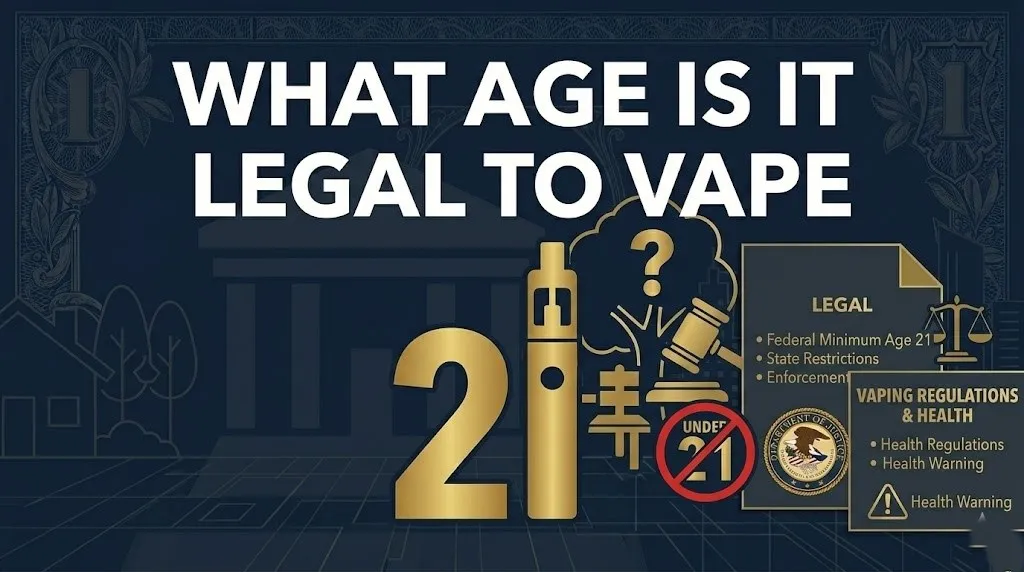
The legal age to vape in the United States is 21 years old. This is the federal minimum established by the Tobacco 21 law, which went into effect in December 2019 and applies in all 50 states without exception. There is no state in the U.S. where 18-year-olds can legally purchase vapes in 2026.
This trips up a lot of people because vaping age laws changed significantly in recent years. Before 2020, many states set 18 as their minimum. That changed when Congress raised the federal floor to 21, and now every state must comply.
Here is what surprises many people: the federal law targets retailers, not users. Minors who vape face consequences under state law, not federal law. The two legal tracks work very differently.
This article covers the federal law, how state rules layer on top of it, what happens to minors who get caught, what penalties retailers face, and the current 2026 enforcement landscape.
What Age Is It Legal to Vape
The legal age to vape in the United States is 21 years old, effective nationally since December 20, 2019. This applies to the purchase of all vaping products, e-cigarettes, vape pens, e-liquids, and any product containing nicotine or tobacco-derived materials.
The 21-year minimum is federal law. It was signed as part of the Further Consolidated Appropriations Act of 2020, which amended the Family Smoking Prevention and Tobacco Control Act. The Food and Drug Administration (FDA) enforces this law nationwide.
Before this change, states set their own minimum ages. Many states had already moved to 21, but about a dozen still allowed 18-year-olds to purchase tobacco and vaping products. Congress eliminated that variation by establishing a national floor.
Key facts for 2026:
- Federal minimum age to purchase: 21
- Applies to: all vapor products, e-cigarettes, nicotine pouches, cigarettes, cigars
- Does NOT apply to: military members in some state-specific contexts (no federal military exemption exists)
- Enforcement agency: FDA for retailers; state agencies for users
- No state can legally allow sales below age 21
The age 21 minimum is not a suggestion. It is a federal mandate that every retailer in every state must follow.
At What Age Is It Legal to Vape
You must be 21 years old to legally purchase and use vaping products in the United States as of 2026. The age threshold applies uniformly across all states because the federal Tobacco 21 law sets a floor that no state can lower.
Some people ask whether there is a difference between the legal age to purchase and the legal age to use or possess vaping products. Federally, the law targets the sale. States handle possession and use separately, and those rules vary.
Most states that regulate minor possession of vaping products set their threshold at 18, not 21. This creates an unusual situation: a 19-year-old cannot legally buy a vape, but in some states, possessing one may not carry the same statutory consequences as in states that have updated their possession laws to match the purchase age.
The practical age breakdown:
| Age | Can Purchase Vapes | Possession Laws | Purchase Consequences |
|---|---|---|---|
| Under 18 | No | Prohibited in all states | State law penalties |
| 18 to 20 | No | Varies by state | Federal retailer violation if sold to them |
| 21 and older | Yes | Legal | No restrictions |
The federal law made 21 the national standard for purchase. Your state determines whether possessing a vape under 21 is a separate offense.
When Is It Legal to Vape
It is legal to vape when you are 21 years old or older and you are in a location that permits vaping. Age is only one part of the legal equation. Where you vape and what you vape also matter.
Age 21 gives you legal access to purchase nicotine-based vaping products. It does not give you the right to vape anywhere you choose. Vaping is banned in most indoor workplaces, restaurants, bars, schools, and public facilities under state clean air laws and local ordinances. These location restrictions apply regardless of age.
Additionally, THC vapes (products containing cannabis) operate under a completely separate legal framework. Even in states where recreational marijuana is legal, the purchase age for THC products may differ from the tobacco/nicotine purchase age, though most set it at 21 as well.
The timing of legality in practice:
- At 21: legal to purchase nicotine vapes anywhere in the U.S.
- Location: must comply with state and local vaping bans
- Products: nicotine vapes fall under FDA rules; THC vapes fall under state cannabis law
- Public spaces: most states prohibit vaping wherever smoking is banned
So the most complete answer to “when is it legal to vape” is: when you are 21, using a legal product, in a location that permits it.
Key Takeaway: The legal vaping age is 21 nationwide. This federal minimum cannot be lowered by any state, though states set their own rules for minor possession, use locations, and additional penalties for retailers.
What Is the Legal Vaping Age in the US
The legal vaping age in the US is 21. This has been the national minimum purchase age since December 2019 under the Tobacco 21 law. The law was part of a broader federal spending bill signed in the final days of 2019 and became effective immediately upon signing.
Prior to this change, the federal minimum for tobacco products was 18. The Tobacco 21 movement had been advocating for the higher age for years, and Congress eventually included the provision in a must-pass spending bill. The change applied to all tobacco and nicotine products, explicitly including e-cigarettes and vaping devices.
The FDA oversees implementation and enforcement. Retailers who sell vaping products must verify the age of any purchaser who appears under 27 years old, check government-issued photo identification, and refuse sales to anyone who cannot prove they are 21 or older.
The legal framework:
- Statute: Family Smoking Prevention and Tobacco Control Act as amended
- Amendment vehicle: Further Consolidated Appropriations Act of 2020
- Effective date: December 20, 2019
- Enforcing agency: Food and Drug Administration (FDA)
- Applies to: all states and territories, including Washington D.C.
There is no federal exception for military personnel, despite some lobbying efforts. Service members under 21 are not legally permitted to purchase vaping products under federal law, though some states have enacted military exemptions at the state level.
Is It Illegal to Vape Under 21
Yes, it is illegal for anyone under 21 to purchase vaping products in the United States. Whether it is illegal to use or possess vaping products under 21 depends on the specific laws of your state.
The federal law specifically prohibits retailers from selling to anyone under 21. The law does not create a direct criminal offense for the minor who buys or uses the product. Instead, states have enacted their own minor possession and use laws that apply to underage vapers.
Most states classify minor possession of tobacco or vaping products as a civil infraction or a minor offense rather than a serious criminal charge. Penalties typically include fines, mandatory education programs, community service, or suspension of driving privileges in some states.
The distinction matters legally. A 19-year-old who vapes is not committing a federal crime. The retailer who sold the product is. At the state level, the same 19-year-old may be committing a state infraction, but rarely a felony.
States with the strictest penalties for underage vaping:
| State | Minor Possession Law | Penalty |
|---|---|---|
| Texas | Health and Safety Code 161.252 | Fine up to $250 |
| California | Business and Professions Code 308 | Fine up to $75 |
| Florida | Statute 569.11 | Fine up to $25 |
| New York | Public Health Law 1399-ee | Fine up to $100 |
| Illinois | 720 ILCS 675 | Fine up to $100 |
Can You Vape at 18
No, you cannot legally vape at 18 in the United States in 2026. The federal Tobacco 21 law requires you to be 21 to purchase any vaping or tobacco product, and this applies nationwide without exception for any state.
This is one of the most persistent misconceptions about vaping law. Many people who turned 18 before 2020 remember when 18 was the legal purchase age for tobacco. That changed permanently in December 2019. There is no pathway to legally purchase vapes at 18 anywhere in the U.S.
Some people ask about carve-outs or exceptions. Here is the complete list of exceptions at the federal level: there are none. Every person must be 21 to purchase. Some states previously exempted military members, but federal law does not include this exemption.
What happens at 18 regarding vaping:
- Purchasing vapes: illegal everywhere in the U.S.
- Being sold vapes: the retailer faces civil penalties, not you
- Possessing vapes: depends on your state’s specific minor possession laws
- Using vapes: not a federal crime, but may be a state offense
The only way an 18-year-old legally accesses vaping products is by purchasing them illegally or by receiving them from someone who did. Neither situation changes the fact that the purchase was unlawful.
Can You Vape at 18 in Any State
No, you cannot legally purchase vaping products at 18 in any U.S. state in 2026. The federal Tobacco 21 law overrides any state law that would allow an 18-year-old to buy vaping products. No state has the legal authority to set a lower purchase age.
This was not always the case. Before December 2019, states like Texas, Georgia, and many others set their minimum purchase age at 18. When Congress passed the federal law, those state laws became irrelevant for purchase purposes. Federal law preempts state law on this point.
The confusion arises because some older sources online still reflect pre-2020 information. Any website or resource that says 18 is legal somewhere in the U.S. is outdated and incorrect.
What changed when Tobacco 21 passed:
- States at 18: Automatically jumped to 21 under federal preemption
- States already at 21: No change needed
- States at 19 or 20: Federal law raised the floor to 21
- Military exemption states: Federal law has no military exemption; some states may still have state-level rules but retailers must follow the higher federal standard
If you are 18 and find a store selling you vaping products, the store is violating federal law and risking significant FDA penalties. You are not committing a federal crime by purchasing, but the sale itself is illegal.
Key Takeaway: No U.S. state allows 18-year-olds to purchase vapes legally. The federal Tobacco 21 law preempts all state laws and sets a hard floor of 21 for purchase nationwide. Any claim that 18 is legal somewhere in the U.S. is factually incorrect as of 2026.
Vaping Age by State
All 50 states have a minimum vaping purchase age of 21, matching the federal requirement. However, states have enacted their own additional laws covering minor possession, use in public places, retailer licensing, and the penalties associated with underage vaping.
The state-by-state differences involve these areas:
| State | Purchase Age | Military Exemption | Minor Possession Penalty | Retailer License Required |
|---|---|---|---|---|
| California | 21 (federal) | No | Fine up to $75 | Yes |
| Texas | 21 (federal) | State-level discussed | Fine up to $250 | Yes |
| Florida | 21 (federal) | No | Fine up to $25 | Yes |
| New York | 21 (federal) | No | Fine up to $100 | Yes |
| Virginia | 21 (federal) | State exemption (18+ military) | Fine varies | Yes |
| Colorado | 21 (federal) | No | Fine varies | Yes |
Virginia is notable because it enacted a state-level military exemption allowing active duty service members 18 or older to purchase tobacco products. However, most legal experts note that the federal law still technically applies to retailers who participate in interstate commerce, creating a complex compliance situation for Virginia retailers.
States also differ in how they handle online vape sales to minors, the specific enforcement agencies, and whether violations result in mandatory education or community service in addition to fines.
Legal Vaping Age in California
The legal vaping age in California is 21, consistent with the federal requirement. California was actually ahead of the federal government on this issue, having raised its tobacco and vaping purchase age to 21 in June 2016, several years before the federal law was enacted.
California Business and Professions Code Section 22963 prohibits the sale or furnishing of tobacco products, electronic cigarettes, and related products to any person under 21 years old. Retailers who violate this law face civil penalties and risk losing their tobacco retailer license.
California’s enforcement includes:
- Retailers who sell to minors: fines up to $6,000 for a single violation under repeated offense schedules
- Minor in possession (under 18): fine up to $75 (historically; verify current rates)
- Online sales to California minors: regulated under state law requiring age verification
- Flavored vaping products: California banned flavored tobacco products in 2022
California also bans most flavored tobacco and nicotine products under Senate Bill 793 (2020), which voters upheld in a 2022 referendum. This means that even if you are 21 in California, the variety of vaping products you can legally purchase is more restricted than in other states.
Legal Vaping Age in Texas
The legal vaping age in Texas is 21, matching the federal minimum. Before the federal Tobacco 21 law, Texas had a purchase age of 18 for tobacco products. The federal change automatically raised Texas to 21, and the state updated its own laws to reflect this.
Texas Health and Safety Code Chapter 161 governs the sale of tobacco and vapor products. The law requires age verification at point of sale and prohibits sales to anyone under 21. Texas also requires retailers to display signs regarding the minimum age and obtain tobacco retailer permits.
Key Texas vaping law details:
- Minor possession fine: up to $250 for a first offense under Texas Health and Safety Code 161.252
- Retailer violation: loss of tobacco permit, civil fines
- Online sales: Texas requires age verification for online tobacco and vapor product purchases
- THC vapes: illegal in Texas regardless of age under current state marijuana laws (Texas has not legalized recreational marijuana)
Texas takes retailer compliance seriously. The Texas Comptroller’s office and Texas Department of State Health Services both have roles in enforcing tobacco retailer requirements. Retailers caught selling to minors face permit suspension or revocation in addition to monetary penalties.
Legal Vaping Age in Florida
The legal vaping age in Florida is 21, consistent with the federal requirement. Florida law independently set the purchase age at 21 through legislation that predated the federal change in some respects, making it one of the states that moved early to align with the eventual federal standard.
Florida Statute 569.11 governs the sale of tobacco products, which Florida law defines to include vapor-generating electronic devices and liquid nicotine. The statute prohibits selling any of these products to anyone under 21 and requires retailers to check identification.
Florida-specific vaping law facts:
- Minor in possession: Florida Statute 569.11 imposes fines up to $25 for first offense, increasing for repeat violations
- Retailer violation: civil fines plus potential suspension of tobacco permit
- Underage use in school: additional school discipline consequences separate from state law
- Flavored products: Florida has not enacted a comprehensive flavored vape ban as of 2026
Florida also requires retailers to complete training on how to properly check identification and verify customer age. The Department of Business and Professional Regulation (DBPR) oversees tobacco retailer compliance in Florida, including conducting compliance checks where underage buyers attempt to purchase from retailers to test compliance.
Key Takeaway: California, Texas, and Florida all follow the federal minimum of 21 for vaping purchases, but each state has different penalty structures for minors in possession and retailers who sell to minors. California has the most additional restrictions, including a flavored product ban.
Federal Vaping Age Law Tobacco 21
The Tobacco 21 law is the informal name for the federal provision that raised the minimum age for tobacco and nicotine product purchases from 18 to 21. It was included in the Further Consolidated Appropriations Act of 2020 and signed into law in December 2019.
The law amended Section 906 of the Family Smoking Prevention and Tobacco Control Act, which is the primary federal law giving the FDA authority to regulate tobacco products. The amendment specifically added to 21 U.S.C. 387f a prohibition on retailers selling tobacco products to anyone under 21.
How the FDA enforces Tobacco 21:
- FDA inspectors conduct compliance checks at retail locations
- Retailers found selling to minors receive a Warning Letter for a first violation
- Subsequent violations lead to civil money penalties (CMPs)
- Retailers with multiple violations can face no-tobacco-sale orders
- FDA reports publicly on retailer violation rates
The FDA’s compliance check program uses underage buyers (minors working with the FDA) to test whether retailers check identification and refuse sales. This creates real enforcement pressure on retailers who might otherwise assume they will not get caught.
One important nuance: Tobacco 21 applies to the sale, not the purchase. The federal law does not make it a crime for a minor to possess or use tobacco products. The purchase itself is the illegal transaction on the retailer’s side. State laws then separately govern what happens to minors who possess vaping products.
Penalty for Minors Vaping
The penalty for minors caught vaping varies by state because there is no federal penalty that applies directly to underage users. Federal law targets retailers. State laws target minors who possess or use vaping products.
Most states treat minor possession of vaping products as a civil infraction rather than a criminal offense. The typical consequence is a fine, mandatory education program, or community service. Some states also include driver’s license implications.
State penalties for minor vaping possession:
| State | Penalty Type | Fine Amount | Additional Consequences |
|---|---|---|---|
| Texas | Civil infraction | Up to $250 | Tobacco education program |
| California | Civil infraction | Up to $75 | Community service possible |
| Florida | Civil infraction | Up to $25 | Possible community service |
| New York | Civil infraction | Up to $100 | Parent notification |
| Ohio | Minor misdemeanor | Up to $150 | Education program |
| North Carolina | Civil infraction | $25 to $50 | Varies by jurisdiction |
Some states have strengthened penalties over time. A few states have moved from civil infractions to minor misdemeanor classifications for repeat offenders, which can create a criminal record for juveniles.
School consequences are separate from state legal penalties. Schools can suspend or expel students for vaping on school property regardless of whether any state legal action is taken. Many schools treat vaping violations as seriously as traditional tobacco violations under their disciplinary codes.
Penalty for Selling Vapes to Minors
Retailers who sell vaping products to minors face penalties from both federal and state enforcement systems. The FDA enforces the federal Tobacco 21 law against retailers through a graduated penalty system that escalates with repeated violations.
FDA penalty structure for selling tobacco or vaping products to minors:
| Violation Number | FDA Response | Typical Penalty |
|---|---|---|
| First offense | Warning Letter | No fine, but documented |
| Second offense within 24 months | Civil Money Penalty | $0 to $11,182 |
| Third offense within 24 months | Civil Money Penalty | Up to $13,841 |
| Fourth or more within 24 months | No-Tobacco-Sale Order | Retail ban for up to 12 months |
These federal penalties are significant for small retailers. A no-tobacco-sale order can effectively shut down a business that depends on tobacco and vaping product sales. The FDA publishes violation data publicly, which also affects retailer reputation.
State penalties add to the federal framework. California retailers can face fines up to $6,000 for repeat violations. Texas can suspend or revoke tobacco retailer permits. Most states require retailers to complete age verification training and maintain logs of checks.
Online retailers face particularly aggressive enforcement. The FDA and state attorneys general have targeted online vape retailers for inadequate age verification, resulting in both federal enforcement actions and state consumer protection lawsuits.
What Happens if a Minor Gets Caught Vaping
When a minor gets caught vaping, the consequences typically unfold across two separate systems: the state legal system and the school disciplinary system. What happens depends on where the minor was caught, their age, and their state’s specific laws.
Getting caught by law enforcement:
- Police encounter during a routine stop or complaint
- Officer may issue a citation (similar to a traffic ticket) for minor possession
- Minor may be required to appear in court or pay a fine
- Some states require mandatory tobacco education programs
- Parents are typically notified regardless of other consequences
Getting caught at school:
- School administration issues discipline under the school code of conduct
- Consequences range from detention to suspension to expulsion
- School may also contact parents and law enforcement
- Vaping on school grounds often carries harsher penalties than off-campus vaping
- Some schools report to law enforcement automatically for on-campus vaping
Getting caught online (receiving shipped vapes):
- Packages may be seized by USPS or other carriers
- Retailers may face FDA action for the illegal sale
- Minors themselves rarely face federal consequences for receiving shipped vapes
- State law may apply if the minor is in possession of the product
A minor’s record for vaping possession is typically a civil infraction that does not result in a permanent criminal record. However, some states’ juvenile justice systems can create records that affect school applications, employment, and other outcomes if the violation is treated as a misdemeanor.
Is It Illegal to Buy Vapes Under 21
Yes, purchasing vaping products under 21 is illegal in the sense that the sale itself is illegal. The retailer who makes the sale is violating federal law. Whether the buyer under 21 is committing an offense depends on state law.
Federally, the Tobacco 21 law creates a prohibition on the sale, not specifically on the purchase. A retailer who sells to someone under 21 has violated federal law. The FDA can penalize that retailer. But the federal law does not explicitly create a criminal offense for the person who buys.
This creates a legal gap that states fill differently:
- Some states have laws specifically prohibiting minors from purchasing tobacco or vaping products, making the purchase itself a state offense
- Other states only prohibit possession, not the act of purchase
- A few states have both possession and purchase prohibitions for minors
- The majority of state penalties are civil, not criminal
From a practical standpoint, a 20-year-old who successfully buys a vape from a retailer is in a gray zone at the federal level (no direct federal offense applies to them) but may be violating state law. The retailer is clearly violating federal law regardless.
Key Takeaway: Buying vapes under 21 may or may not be a direct state offense depending on your state. Selling vapes to anyone under 21 is always a federal violation with escalating penalties for retailers.
Can Retailers Sell Vapes to 18 Year Olds
No, retailers cannot legally sell vapes to 18-year-olds anywhere in the United States in 2026. Federal law prohibits any tobacco or nicotine product sale to anyone under 21, and retailers who violate this face federal civil penalties and potential loss of their ability to sell tobacco products.
This is absolute. There is no exception based on military service under federal law, no exception based on parental consent, and no exception based on product type. All vaping products, e-cigarettes, vape pens, pods, cartridges, and e-liquids with nicotine fall under this prohibition.
Retailers who think they can sell to 18-year-olds because they remember old state laws are operating on outdated information. The federal law preempts any state law that would allow a lower purchase age. No state law can make it legal for a retailer to sell to an 18-year-old.
What retailers must do to comply:
- Check photo ID for any purchaser who appears to be under 27 years old
- Refuse sales to anyone who cannot provide valid ID showing they are 21 or older
- Complete FDA-required age verification training
- Display minimum age signage at the point of sale
- Maintain records of compliance checks
Retailers who receive Warning Letters from the FDA for selling to minors during compliance checks need to take those warnings seriously. The second violation within 24 months triggers financial penalties, and subsequent violations risk the ability to sell any tobacco products at all.
Frequently Asked Questions
What is the minimum legal age to vape in the United States?
The minimum legal age to purchase vaping products in the United States is 21.
This became federal law in December 2019 under the Tobacco 21 provision of the Further Consolidated Appropriations Act of 2020.
The 21-year minimum applies in all 50 states and cannot be lowered by any state law.
Can anyone vape at age 18 legally in the US?
No, no one can legally purchase vaping products at 18 anywhere in the United States.
The federal Tobacco 21 law eliminated any state-level exceptions that previously existed, including states that had an 18-year minimum before 2020.
Some states have state-level military exemptions, but these do not override federal law for retailers who sell in interstate commerce.
What happens to a minor who is caught vaping?
A minor caught vaping typically faces a state civil infraction fine, ranging from $25 in Florida to $250 in Texas, plus possible mandatory tobacco education.
School-based consequences (suspension, expulsion) operate separately from legal penalties and can be more immediate.
Federal law does not directly penalize the minor vaper; it penalizes the retailer who sold the product.
What is the penalty for a retailer who sells vapes to minors?
A retailer’s first FDA violation for selling to a minor results in a Warning Letter with no immediate fine.
Second violations within 24 months result in civil money penalties up to approximately $11,000.
Repeated violations can lead to a No-Tobacco-Sale Order, which bans the retailer from selling any tobacco products for up to one year.
Did any states have a lower vaping age before the federal Tobacco 21 law?
Yes, before December 2019 many states had 18 as their minimum purchase age for tobacco and vaping products.
States including Texas, Georgia, and about a dozen others had not yet updated to 21 before the federal law passed.
The federal Tobacco 21 law immediately superseded those state laws, making 21 the national minimum overnight.
The legal vaping age in the United States is 21, and that standard applies in every state without exception as of 2026. The federal Tobacco 21 law closed the door on any state-level variations that previously allowed younger purchasers.
Bookmark this article for a complete reference on vaping age law. State-level enforcement rules and retailer penalties continue to evolve, and staying current with both federal and state requirements is essential for anyone in the vaping industry or anyone navigating these laws.






