
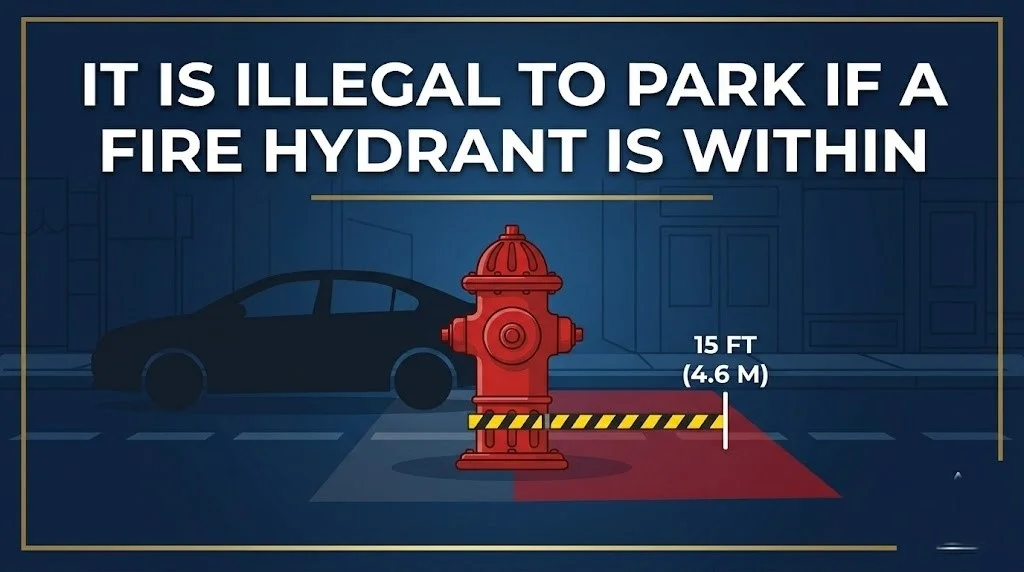
It is illegal to park if a fire hydrant is within 15 feet of your vehicle in most American states. This single rule catches thousands of drivers off guard every year, costing them anywhere from $65 to over $500 in fines.
Here’s the part most people don’t know: firefighters can legally smash your windows and run hoses straight through your car if you block their access. Your insurance won’t cover it. You’ll pay for the damage yourself.
The exact distance requirement varies by state. Some places demand 10 feet. Others require 20 feet or more. Painted curbs add another layer of confusion since red zones often extend beyond the hydrant itself.
This guide breaks down everything you need to know for 2026. You’ll learn the specific distance laws in every major state, current fine amounts, towing procedures, and the rare exceptions that actually exist. By the end, you’ll never wonder if that parking spot is safe again.
It Is Illegal to Park If a Fire Hydrant Is Within This Distance
It is illegal to park if a fire hydrant is within 15 feet of any part of your vehicle in the majority of US states. This measurement applies to the closest point of your car, not just the bumper or the door.
The 15 foot standard exists because firefighters need room to connect hoses quickly during emergencies. A fire hose is thick, heavy, and must make sharp turns to reach a hydrant connection. Parked cars blocking this space cost precious seconds when every moment counts.
Think of it like airport runway clearance. Pilots need specific distances to take off safely. Firefighters need specific distances to save lives and property.
Quick Facts:
- Standard distance: 15 feet from hydrant to closest vehicle point
- Measurement method: Straight line from hydrant to nearest part of car
- Applies 24/7, not just during posted hours
- Violations enforced even on private streets with public hydrants
Some cities measure from the center of the hydrant. Others measure from its edge. When in doubt, give yourself extra space. A few extra feet of walking beats a $200 ticket.
How Far From a Fire Hydrant Can You Park
You can legally park 15 feet or more from a fire hydrant in most states. That’s roughly the length of a standard sedan or about five large steps from the hydrant itself.
The 15 foot rule creates a safety buffer zone. Firefighters arrive at scenes with pumper trucks that need direct hydrant access. They connect large diameter supply hoses that require room to bend and maneuver without kinking.
Measuring this distance correctly matters more than most drivers realize.
| Measurement Reference | What It Means |
|---|---|
| From hydrant center | Add 6 to 12 inches to your estimate |
| From hydrant edge | Measure from the closest part of the hydrant body |
| To vehicle edge | Your bumper, mirror, or any protruding part |
| To vehicle center | Not used; always measure to the closest point |
Here’s a practical trick: most parking spaces are about 18 feet long. If you can fit an entire empty parking space between your car and the hydrant, you’re probably safe.
Night parking creates extra risk. Hydrants hide in shadows. Painted curbs fade under streetlights. Always check before walking away from your car.
Fire Hydrant Parking Distance by State
Fire hydrant parking distance requirements range from 10 feet to 20 feet depending on your state. California and New York both require 15 feet, while some Midwestern states allow closer parking.
State vehicle codes establish these minimums. Local cities can set stricter rules but cannot allow parking closer than state law permits.
| State | Required Distance | Statute Reference |
|---|---|---|
| California | 15 feet | Vehicle Code Section 22514 |
| New York | 15 feet | VTL Section 1202 |
| Texas | 15 feet | Transportation Code 545.302 |
| Florida | 15 feet | Statutes Section 316.1945 |
| Illinois | 15 feet | Vehicle Code 625 ILCS 5/11-1303 |
| Pennsylvania | 15 feet | Title 75 Section 3353 |
| Ohio | 15 feet | Revised Code 4511.68 |
| Michigan | 15 feet | Vehicle Code 257.674 |
| New Jersey | 10 feet | NJSA 39:4-138 |
| Washington | 15 feet | RCW 46.61.570 |
| Colorado | 15 feet | CRS 42-4-1204 |
| Georgia | 15 feet | Code Section 40-6-203 |
New Jersey stands out with its 10 foot minimum. But don’t celebrate if you live there. Many New Jersey cities enforce 15 feet through local ordinances anyway.
Some rural areas have fewer hydrants and less strict enforcement. Urban centers ticket aggressively since fire risk runs higher in dense neighborhoods.
Key Takeaway: The 15 foot rule applies in most major states, but always check your local vehicle code since city ordinances can add extra distance requirements.
15 Feet From Fire Hydrant Law Explained
The 15 feet from fire hydrant law creates standardized clearance for emergency fire response across most American jurisdictions. This distance allows firefighters to work without vehicle interference during active emergencies.
Where did 15 feet come from? Fire departments determined this number based on hose connection mechanics. Supply hoses must connect to hydrant outlets at specific angles. They need room to curve toward the fire without crimping or twisting.
The physics works like this: a charged fire hose filled with pressurized water becomes extremely rigid. It cannot make sharp 90 degree turns without losing pressure. The 15 foot buffer creates space for gradual bends.
- Supply hose diameter: 4 to 5 inches
- Operating pressure: 150 to 300 PSI
- Minimum bend radius needed: approximately 8 feet
- Safety buffer added: 7 feet
- Total clearance: 15 feet
Courts interpret this law strictly. Judges rarely accept “I was only 14 feet away” as a defense. Parking enforcement officers carry measuring wheels. They document exact distances before writing tickets.
The law applies to both sides of the hydrant. You cannot park 15 feet in front and 5 feet behind. Both directions require full clearance.
How Close Can You Park to a Fire Hydrant Legally
You can park exactly 15 feet from a fire hydrant legally in most states, but not one inch closer. The 15 foot line marks the boundary between legal and illegal.
Enforcement officers don’t round numbers in your favor. A car parked at 14 feet 6 inches receives the same ticket as one parked at 3 feet. The law creates a hard boundary, not a suggestion.
Several factors affect where that boundary actually sits:
Hydrant Position Variables:
- Hydrants set back from curbs: Measure from the hydrant, not the curb
- Hydrants on grass strips: The 15 feet still starts at the hydrant
- Angled hydrants: Measure from the closest outlet point
- Dual outlet hydrants: Measure from whichever outlet faces your vehicle
Some drivers think parking on the opposite side of the street exempts them. It doesn’t. The 15 foot zone extends in all directions from the hydrant, including across the road in narrow streets.
Your vehicle’s mirrors count as part of your car. If your extended mirror sits 14 feet from the hydrant while your bumper sits 16 feet away, you’re in violation. Enforcement measures to the closest point of the entire vehicle.
Motorcycle riders sometimes believe smaller vehicles get exceptions. They don’t. A motorcycle parked 10 feet from a hydrant receives the same ticket as a full size truck.
Fire Hydrant Parking Rules 2026
Fire hydrant parking rules for 2026 remain consistent with previous years in most states, though several cities have increased fine amounts and expanded no parking zones. The 15 foot standard continues as the national baseline.
Notable 2026 changes include higher fines in major metropolitan areas. New York City raised hydrant violation fines. San Francisco increased towing fees. Chicago added new enforcement technology using automated cameras near hydrants.
| City | 2026 Fine Amount | Change From 2025 |
|---|---|---|
| New York City | $115 | No change |
| Los Angeles | $80 | No change |
| Chicago | $200 | +$50 increase |
| Houston | $75 | No change |
| San Francisco | $110 | +$10 increase |
| Philadelphia | $76 | No change |
| Phoenix | $82 | +$7 increase |
| Dallas | $75 | No change |
Electric vehicle charging has created new hydrant conflicts. Some cities installed charging stations near hydrants without adjusting curb markings. Drivers parking to charge sometimes violate hydrant clearance without realizing it.
2026 also brings expanded use of license plate readers. Parking enforcement vehicles now scan plates automatically. Repeat hydrant violators face enhanced penalties in cities like Boston and Seattle.
Key Takeaway: Most 2026 fire hydrant rules stay the same as 2025, but fines have increased in several major cities, and enforcement technology continues advancing.
Can You Park Next to a Fire Hydrant
You cannot park next to a fire hydrant if “next to” means within 15 feet. The law prohibits parking within the clearance zone regardless of how you position your vehicle.
Parallel parking next to a hydrant means your car sits alongside it. This blocks the entire access zone. Firefighters cannot reach outlets on either side of the hydrant.
Perpendicular parking pointing at a hydrant creates similar problems. Your front bumper blocks approach angles. Hoses cannot connect from the obstructed direction.
Some drivers try creative positioning:
- Parking at an angle: Still illegal if any part enters the 15 foot zone
- Leaving engine running: Doesn’t create an exception
- Hazard lights on: Not a legal workaround
- Driver staying in vehicle: Most cities still prohibit this
Commercial vehicles face the same restrictions. Delivery trucks cannot claim loading zone exceptions near hydrants. Food trucks cannot operate within hydrant clearance zones. Moving vans must find alternative spots.
The only time you can legally stop near a hydrant involves actively loading or unloading passengers. Even then, the vehicle must not block access. Someone must remain with the vehicle ready to move it instantly.
Double parking next to a legally parked car doesn’t help if you’re now within 15 feet of a hydrant. The violation follows your vehicle, not the curb position.
Fire Hydrant Parking Ticket Cost
Fire hydrant parking ticket costs range from $65 to $250 depending on your city and state in 2026. Major metropolitan areas charge significantly more than small towns and rural jurisdictions.
New York City charges $115 for fire hydrant violations. San Francisco charges $110. Los Angeles charges $80. These base fines increase if you don’t pay within 30 days.
Late payment penalties add 25% to 100% to your original fine. A $115 NYC ticket becomes $173 after late fees. Wait longer and it jumps again.
| City | Base Fine | After 30 Days | After 60 Days |
|---|---|---|---|
| New York City | $115 | $173 | $230 |
| Chicago | $200 | $250 | $300 |
| Los Angeles | $80 | $144 | $208 |
| San Francisco | $110 | $165 | $220 |
| Boston | $100 | $150 | $200 |
| Seattle | $53 | $106 | $159 |
| Denver | $75 | $100 | $150 |
Towing adds hundreds more. If your car gets towed for blocking a hydrant, expect $200 to $500 for tow charges alone. Daily storage fees run $25 to $75. A simple parking violation can cost over $700 total.
Some states add points to your driving record for parking violations. Most don’t. But unpaid tickets can prevent license renewal, vehicle registration, or trigger collection agency involvement.
Parking Near Fire Hydrant Fine Amounts
Parking near fire hydrant fine amounts vary dramatically by location, ranging from under $50 in rural areas to over $200 in major cities. The violation itself remains identical. Only the price tag changes.
California cities set their own fine schedules within state guidelines. Los Angeles charges $80. San Diego charges $78. Sacramento charges $65. Same state, same violation, different prices.
Regional Fine Comparison:
| Region | Typical Fine Range | Towing Likelihood |
|---|---|---|
| Northeast Cities | $100 to $150 | High |
| Southeast Cities | $50 to $100 | Medium |
| Midwest Cities | $75 to $150 | Medium |
| Southwest Cities | $50 to $100 | Medium |
| West Coast Cities | $80 to $150 | High |
| Rural Areas | $25 to $75 | Low |
Repeat offenses increase fines in many jurisdictions. Your first hydrant ticket might cost $100. Your second costs $150. Your third could trigger mandatory towing plus enhanced fines of $300 or more.
Some cities offer reduced fines for immediate payment. New York offers no discount. San Francisco offers none. But smaller cities sometimes reduce fines by 10% to 20% if paid within 72 hours.
Payment plans exist for financial hardship cases. Contact your city’s parking authority before the deadline passes. Most jurisdictions work with drivers who cannot pay full amounts immediately.
Key Takeaway: Fire hydrant fines range from $50 to $250 depending on your city, with late fees potentially doubling the original amount.
Fire Hydrant Parking Violation Penalty
Fire hydrant parking violation penalties include fines, towing, vehicle damage liability, and potential points on your record depending on jurisdiction. The full cost often exceeds the ticket price significantly.
Immediate penalties happen fast. Parking enforcement can ticket and tow your vehicle within minutes. You return to find an empty space, a ticket stuck to the ground, and your car at an impound lot across town.
Secondary penalties pile up:
- Towing fee: $150 to $500
- Storage fee: $25 to $75 per day
- Administrative fee: $50 to $150
- Release inspection: $25 to $75
- Late ticket payment: 50% to 100% surcharge
- Collection agency fees if unpaid: 30% to 40% additional
Third tier consequences hit your driving record. Some states add points for parking violations. New York adds points for unpaid violations, not the violation itself. California does not add points for parking tickets.
Unpaid tickets block vehicle registration renewal. You cannot renew your tags with outstanding parking violations in most states. This forces payment before you can legally drive.
| Penalty Type | Typical Cost | Timeline |
|---|---|---|
| Base ticket | $65 to $200 | Immediate |
| Late fee | +50% | 30 days |
| Towing | $200 to $500 | Same day possible |
| Storage | $25 to $75/day | Starts immediately |
| Collection | +35% | 90+ days |
| Registration hold | Full payment required | Renewal time |
What Happens If You Park in Front of a Fire Hydrant
What happens if you park in front of a fire hydrant depends on timing. No emergency means a ticket. Active emergency means firefighters will destroy your car to access water, and you’ll pay for everything.
During normal conditions, parking enforcement issues a citation. An officer photographs your vehicle, measures the distance, writes the ticket, and places it on your windshield. Towing may or may not follow.
During active fires, everything changes. Firefighters have legal authority to access hydrants by any means necessary. They will break your windows. They will run hoses through your vehicle. They will push or drag your car with their truck if needed.
Emergency Response Sequence:
- Firefighters arrive at scene
- They identify nearest hydrant
- Your car blocks access
- Windows get smashed immediately
- Hose runs through vehicle interior
- Water damage ruins your car
- You pay for all damages
Insurance does not cover this damage. You parked illegally. Your comprehensive coverage excludes losses resulting from illegal acts. The fire department has no liability. Courts have ruled on this repeatedly.
Viral photos show cars with hoses running through broken windows. Those drivers paid thousands in repairs. Some vehicles were totaled by water damage. A $115 ticket looks cheap compared to a destroyed interior.
Firefighters don’t enjoy breaking windows. But they won’t hesitate for one second when lives are at stake. Your car becomes an obstacle, nothing more.
Can Firefighters Break Your Window for Parking Near Hydrant
Firefighters can legally break your windows to access a fire hydrant you’re blocking. Every state grants emergency responders this authority during active emergencies. You cannot sue them. You cannot claim damages. You pay for everything.
This authority comes from public safety laws that prioritize emergency response over private property. When someone’s house burns, firefighters need water immediately. Your car window ranks below human life and property preservation.
The legal doctrine involved is called “emergency necessity.” It permits property destruction when:
- An emergency exists
- The destruction prevents greater harm
- No reasonable alternative exists
- The actor uses only necessary force
Blocking a hydrant during a fire satisfies all four requirements. Courts have dismissed every lawsuit filed by vehicle owners against fire departments in these situations.
What Firefighters Can Legally Do:
- Break any window
- Break multiple windows for hose routing
- Push your vehicle with their truck
- Hook bumpers to drag your car
- Run hoses across your hood, roof, or trunk
- Cause water damage to your interior
Some fire departments take photos before and after. These photos document that your car was illegally parked. They become evidence against you, not for you.
Your only protection is not blocking hydrants. No magic phrase stops firefighters from accessing water. No amount of money recovers your losses afterward.
Key Takeaway: Firefighters have complete legal authority to break windows and damage vehicles blocking hydrants during emergencies, and vehicle owners have no legal recourse.
Illegal Parking Fire Hydrant Towing
Illegal parking near fire hydrants often results in immediate towing, especially in urban areas with high fire risk. Tow trucks work directly with parking enforcement in most major cities.
The towing process happens quickly. An enforcement officer spots your violation. They call dispatch. A tow truck arrives within 15 to 30 minutes. Your car disappears before you finish shopping.
Cities vary on towing policies:
| City | Automatic Tow? | Warning First? |
|---|---|---|
| New York City | Yes | No |
| Los Angeles | Sometimes | No |
| Chicago | Yes | No |
| Houston | Sometimes | No |
| San Francisco | Yes | No |
| Denver | Sometimes | No |
| Miami | Sometimes | Yes, in some zones |
| Boston | Yes | No |
Getting your car back requires visiting the impound lot in person. Bring valid ID, vehicle registration, proof of insurance, and enough cash or credit for all fees. Some lots accept only cash.
Impound lots often sit in industrial areas far from public transit. You’ll likely need a rideshare or taxi to retrieve your vehicle. Add $20 to $50 for transportation to your total cost.
Storage fees start immediately upon impound. Wait three days and you’ve added $75 to $225 to your bill before touching the car. Impound lots open limited hours. Weekend retrieval may not be possible until Monday.
Some jurisdictions auction vehicles after 30 days of storage. Outstanding fees can exceed vehicle value quickly. A $5,000 car isn’t worth $3,000 in accumulated fees.
Fire Hydrant Red Curb Parking Rules
Fire hydrant red curb parking rules prohibit stopping, standing, or parking anywhere along red painted curbs. The red zone often extends beyond the 15 foot hydrant clearance into adjacent areas.
Red curbs indicate no stopping zones. This means you cannot pause your car there even with the engine running and driver present. The restriction is absolute.
Cities paint red curbs near hydrants for several reasons:
- Visual clarity: Drivers see red more easily than measuring 15 feet
- Extended protection: Red zones often exceed minimum requirements
- Bus and emergency access: Adjacent loading needs
- Visibility: Fire trucks need sight lines to locate hydrants
Red Curb Extension Patterns:
| Situation | Typical Red Zone |
|---|---|
| Standard hydrant | 15 to 25 feet total |
| Corner hydrant | 30 to 40 feet total |
| Near intersection | Extended both directions |
| Commercial area | Often longer zones |
| Residential street | Usually minimum 15 feet |
Yellow curbs indicate loading zones with time limits. White curbs indicate passenger loading only. Blue curbs indicate disabled parking. Red curbs mean stay away completely.
Faded red paint creates legal ambiguity. Some drivers argue they couldn’t see the red color. Courts sometimes accept this defense if photos show severely faded paint. But don’t count on it.
When in doubt, don’t park. Fresh red paint, faded red paint, or suspicious pink tint all suggest a no parking zone. The ticket isn’t worth the risk.
Fire Hydrant Parking Exceptions
Fire hydrant parking exceptions exist but apply only in very limited circumstances. Most drivers will never qualify for any exception. The rules remain strict intentionally.
Legitimate exceptions include:
Emergency Vehicle Exception:
Marked emergency vehicles responding to calls can stop near hydrants. Fire trucks, ambulances, and police cars have operational necessity. Your personal vehicle does not qualify as an emergency vehicle.
Disability Exception:
Some jurisdictions allow disabled placard holders to park closer than 15 feet when no alternative accessible parking exists. This exception varies by state and city. Always verify local rules.
Active Loading Exception:
Commercial vehicles actively loading or unloading may stop briefly. The driver must remain with the vehicle. They must move immediately if emergency services arrive. This is stopping, not parking.
Parade and Event Exception:
Cities sometimes suspend parking rules during parades, festivals, or special events. Official announcements specify affected areas. Assume normal rules apply unless you see written notice.
| Exception Type | Who Qualifies | Conditions |
|---|---|---|
| Emergency vehicles | Fire, police, EMS | Active response only |
| Disability | Placard holders | Jurisdiction specific |
| Commercial loading | Delivery vehicles | Driver present, ready to move |
| Special events | General public | Official suspension posted |
Personal emergencies do not create exceptions. Running into a pharmacy for urgent medication? You’re still getting a ticket. Taking a sick child to urgent care? Park legally. Your emergency doesn’t override fire safety laws.
Key Takeaway: Fire hydrant parking exceptions are extremely rare and typically apply only to emergency vehicles, disability situations, or brief commercial loading with the driver present.
Parking Ticket Fire Hydrant Appeal Process
Parking ticket fire hydrant appeal processes vary by jurisdiction but typically allow 30 days to contest your citation. Success rates remain low unless you have solid evidence of improper ticketing.
Starting an appeal requires gathering evidence immediately. Return to the scene. Take photographs. Measure distances yourself. Document hydrant condition, curb markings, and signage.
Viable Appeal Grounds:
| Defense | Evidence Needed | Success Likelihood |
|---|---|---|
| Incorrect distance cited | Your measurements, photos | Medium |
| No hydrant visible | Photos showing obstruction | Medium to High |
| Faded curb paint | Close-up photos | Low to Medium |
| Wrong vehicle ticketed | Proof you weren’t there | High if documented |
| Broken parking meter | Meter records, photos | Not applicable |
| Emergency circumstances | Police report | Very Low |
File your appeal before the deadline. Late appeals get automatic rejection. Online filing exists in most major cities. Paper appeals require mailing or in-person submission.
Hearing options include:
- Written review: Submit evidence by mail or online
- In-person hearing: Present your case to a judge
- Video conference: Available in some jurisdictions
Bring all documentation to hearings. Photographs, measurements, witness statements, and any supporting records help your case. Dress appropriately. Be respectful. Present facts clearly.
If you lose, payment becomes due immediately. Appeals do not pause late fee accumulation in most cities. You might owe late penalties plus the original fine after losing.
Hiring an attorney rarely makes financial sense for parking tickets. Legal fees exceed fine amounts. Handle appeals yourself unless the ticket triggers unusual consequences.
Fire Hydrant Distance Law: Statutes by State
Fire hydrant distance law statutes establish specific parking clearance requirements in each state’s vehicle code. These laws provide the legal foundation for all enforcement actions.
Understanding statutory language helps with appeals and compliance. Each state phrases requirements differently but achieves similar results.
Major State Statute References:
| State | Statute | Exact Language Summary |
|---|---|---|
| California | Vehicle Code 22514 | No parking within 15 feet of fire hydrant |
| New York | VTL 1202(a)(1)(g) | No standing within 15 feet |
| Texas | Trans. Code 545.302(b)(3) | No parking within 15 feet |
| Florida | 316.1945(1)(a)(7) | No parking within 15 feet |
| Illinois | 625 ILCS 5/11-1303 | No parking within 15 feet |
| Pennsylvania | 75 Pa.C.S. 3353 | No parking within 15 feet |
California’s statute reads: “No person shall stop, park, or leave standing any vehicle within 15 feet of a fire hydrant except as follows…”
The “except as follows” section lists narrow exceptions for marked emergency vehicles. Personal vehicle exceptions do not appear in the text.
New York uses “standing” rather than “parking.” This broader term prohibits even brief stops with drivers remaining in vehicles. The distinction matters legally.
Texas combines hydrant rules with other parking prohibitions in a single comprehensive statute. Fire hydrant clearance appears alongside crosswalk, railroad crossing, and bridge regulations.
City ordinances supplement state law. Los Angeles Municipal Code Section 80.69.4 mirrors state requirements while establishing local fine schedules. Chicago Municipal Code Chapter 9-64 does the same.
Federal law does not regulate parking near fire hydrants. This remains exclusively a state and local matter. No federal parking ticket exists for hydrant violations.
Frequently Asked Questions
How many feet from a fire hydrant is it illegal to park?
Parking within 15 feet of a fire hydrant is illegal in most US states.
Some states like New Jersey set the minimum at 10 feet.
Local cities can require greater distances than state minimums.
Always check your specific state vehicle code and local ordinances.
Will I get towed for parking near a fire hydrant?
Towing for fire hydrant violations happens frequently in major cities.
New York City, Chicago, and San Francisco tow hydrant violators routinely.
Smaller cities may issue tickets without towing unless space is urgently needed.
Towing costs typically add $200 to $500 beyond the ticket fine.
Can firefighters legally damage my car to access a hydrant?
Firefighters can legally break windows, run hoses through vehicles, and push cars blocking hydrants.
Emergency necessity laws grant this authority in every state.
Vehicle owners have no legal recourse against fire departments for this damage.
Your insurance will not cover losses from illegally parked vehicles.
How much is a fire hydrant parking ticket in 2026?
Fire hydrant parking ticket costs range from $65 to $200 in 2026.
New York City charges $115 per violation.
Chicago charges $200, one of the highest rates nationally.
Late payment fees can add 50% to 100% to your original fine.
Can I fight a fire hydrant parking ticket and win?
Fighting fire hydrant tickets succeeds only with strong evidence of improper ticketing.
Valid defenses include incorrect distance measurements or no visible hydrant.
Faded curb paint sometimes works as a defense with photographic proof.
Most appeals fail because officers document violations carefully before ticketing.
Now you understand exactly how fire hydrant parking laws work in 2026. The 15 foot rule applies almost everywhere. Fines hurt your wallet. Towing hurts worse. And firefighters won’t hesitate to destroy your car during emergencies.
Save this guide for future reference. Share it with family members who drive. A few minutes of reading today prevents hundreds of dollars in tickets tomorrow.






