
It is illegal to park if a crosswalk is within 20 feet of your vehicle in most American states. That’s roughly four car lengths. Get this wrong, and you’re looking at fines ranging from $50 to over $250.
Here’s what catches most drivers off guard. The 20 foot rule applies to crosswalks you can see, and to ones you can’t. Unmarked crosswalks exist at every intersection by default in most states. You might be parked illegally right now without a painted line in sight.
Over 10 million parking tickets get issued annually in the United States. Crosswalk violations rank among the most common. Yet most drivers have never measured 20 feet in their lives.
This guide breaks down everything you need to know about crosswalk parking laws in 2026. You’ll learn the exact distances required in each state, current fine amounts, what triggers towing, and how to fight a ticket if you get one. Let’s get into it.
It Is Illegal to Park If a Crosswalk Is Within This Distance
It is illegal to park if a crosswalk is within 20 feet of your vehicle under most state vehicle codes. This distance is measured from the near edge of the crosswalk to the closest part of your car.
The 20 foot standard comes from the Uniform Vehicle Code, which most states adopted as their baseline. Think of it like a two-car buffer zone between where you park and where pedestrians cross. This gives drivers approaching the intersection a clear view of anyone stepping into the road.
Some states set stricter requirements. A few allow parking slightly closer under specific conditions. The key is knowing your state’s exact rule before you parallel park near any corner.
| State | Required Distance | Statute Reference |
|---|---|---|
| California | 20 feet | CVC 22500(a) |
| New York | 20 feet | VTL 1202(a) |
| Texas | 20 feet | TTC 545.302 |
| Florida | 20 feet | FS 316.1945 |
| Illinois | 20 feet | 625 ILCS 5/11-1303 |
The measurement starts at the edge of the marked crosswalk lines. For unmarked crosswalks, it starts at the extension of the curb line or edge of the roadway at intersections. This confuses many drivers because there’s no paint to guide them.
Quick Fact: The 20 foot rule applies whether the crosswalk is on your side of the street or across from you at an intersection.
How Close Can You Park to a Crosswalk
You can park no closer than 20 feet from a crosswalk in most states across America. Some jurisdictions require 25 feet or more, while a handful allow 15 feet under limited circumstances.
Measuring this distance accurately takes practice. Twenty feet equals roughly the length of an average parking space and a half. If you’re eyeballing it, imagine your car plus another half-car length between your bumper and the crosswalk.
Parking enforcement officers carry measuring wheels specifically for this purpose. They don’t estimate. They measure to the inch. If your car sits at 19 feet 6 inches, you’re getting a ticket.
Here’s a practical trick that works: find the nearest fire hydrant or utility pole and use it as a reference point. Most cities place these at consistent distances from intersections. After a few tries, you’ll develop an eye for the safe zone.
- Standard requirement in 45 states: 20 feet minimum
- Strictest states (PA, some cities): 25 feet or more
- Always measure from crosswalk edge to nearest part of your vehicle
- Mirrors and bumpers count as part of your vehicle
Urban areas enforce this rule aggressively because pedestrian accidents spike in cities. Suburban and rural areas may show more leniency, but the law applies everywhere.
How Many Feet From Crosswalk Can You Park
You must park at least 20 feet from a crosswalk in the majority of American jurisdictions. This measurement protects pedestrian visibility and gives approaching drivers time to react.
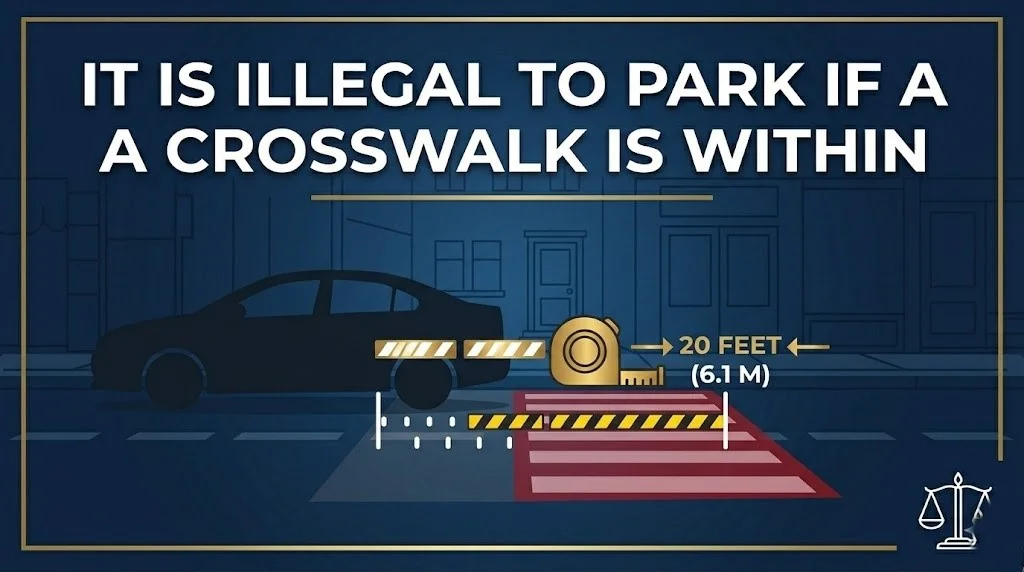
The number 20 isn’t arbitrary. Traffic engineers calculated the minimum sight distance needed for a driver traveling 25 miles per hour to spot a pedestrian and stop safely. Twenty feet provides that buffer at typical neighborhood speeds.
At higher speed limits, some cities require even greater distances. School zones often extend the no-parking buffer to 30 feet or more on both sides of crosswalks.
| Speed Limit | Typical Required Distance |
|---|---|
| 15 mph (school zone) | 25 to 30 feet |
| 25 mph (residential) | 20 feet |
| 35 mph (arterial) | 20 to 25 feet |
| 45+ mph (highway) | Usually no crosswalks |
The measurement matters in court if you contest a ticket. Officers must document where your car sat relative to the crosswalk. Photographs showing measurement wheels or marked distances often accompany citations.
Key Takeaway: Twenty feet is the national standard, but your specific city or state may require more distance, especially near schools and high-traffic pedestrian areas.
Crosswalk Parking Distance by State
Crosswalk parking distance requirements vary by state, though 20 feet serves as the most common standard nationwide. About 45 states follow this baseline, while others set their own requirements.
California enforces 20 feet under Vehicle Code Section 22500. New York matches this under VTL 1202. Texas, Florida, and Illinois all align with the 20 foot rule as well.
Pennsylvania takes a stricter approach in some municipalities, requiring 25 feet or more near marked crosswalks in downtown areas. Local ordinances can always exceed state minimums but never fall below them.
| State | Distance | Key Notes |
|---|---|---|
| California | 20 feet | Applies to marked and unmarked |
| New York | 20 feet | NYC has enhanced enforcement |
| Texas | 20 feet | Measured from nearest line |
| Florida | 20 feet | Includes intersection crosswalks |
| Pennsylvania | 20-25 feet | Varies by municipality |
| Ohio | 20 feet | Standard UVC adoption |
| Michigan | 20 feet | MCL 257.674 |
| Georgia | 20 feet | OCGA 40-6-203 |
Some states measure from the center of the crosswalk rather than the edge. This subtle difference can add or subtract several feet from your legal parking zone. When in doubt, add extra distance.
City parking regulations sometimes exceed state requirements. San Francisco, Chicago, and Washington DC all enforce enhanced crosswalk buffer zones in certain districts.
Crosswalk Parking Laws 2026
Crosswalk parking laws in 2026 remain consistent with previous years, though enforcement has increased through automated technology and higher fine amounts in major cities.
No significant federal or state legislation changed the fundamental 20 foot rule this year. What has changed is how violations get detected and processed. More cities now use camera systems to identify illegally parked vehicles near crosswalks.
New York City expanded its automated enforcement program in 2026. Chicago increased crosswalk violation fines by 15 percent. Los Angeles added new crosswalk buffer zones near transit stops.
- 2026 average crosswalk parking fine: $75 to $150
- Cities with camera enforcement: NYC, DC, SF, Chicago, Seattle
- School zone violations: Often double standard fines
- Repeat offender penalties: Enhanced in 12 states
The push for pedestrian safety following high-profile accidents has made crosswalk enforcement a priority. Vision Zero programs in dozens of cities specifically target illegal parking near pedestrian crossings.
Electric vehicle charging stations near intersections have created new confusion. Some drivers assume charging exempts them from parking rules. It doesn’t. Crosswalk buffer zones apply regardless of why you’re stopped.
Quick Fact: In 2026, over 6,000 pedestrians will be killed by vehicles in the US, making crosswalk visibility a life-or-death enforcement priority.
Is It Illegal to Park in Front of a Crosswalk
Yes, parking in front of a crosswalk is illegal when your vehicle falls within the required buffer distance, typically 20 feet in most states. This applies to the approach side of the crosswalk where vehicles travel toward the crossing.
The law distinguishes between the approach side and the far side of a crosswalk. Most states prohibit parking within 20 feet on the approach side, where your parked car blocks the view of pedestrians waiting to cross.
Some states also restrict parking within a certain distance on the far side of crosswalks. This is less common but exists in about a dozen jurisdictions to protect pedestrians who might step back onto the road unexpectedly.
| Position | Typical Restriction |
|---|---|
| Approach side (before crosswalk) | 20 feet, strictly enforced |
| Far side (after crosswalk) | 5 to 10 feet in some states |
| Within crosswalk lines | Always illegal |
Think of it this way: if a driver heading toward the crosswalk can’t see a pedestrian because your car blocks the view, you’re parked illegally. The law protects sight lines above all else.
Standing or stopping in a crosswalk is also prohibited. This means you can’t wait in your car with the engine running while blocking a crosswalk, even for just a minute.
Key Takeaway: Parking within 20 feet of a crosswalk on the approach side is illegal in nearly every state, with stricter rules applying near schools and high-traffic areas.
Parking Near Crosswalk Fine
Parking near crosswalk fines range from $35 in small towns to $250 or more in major metropolitan areas in 2026. The national average sits around $65 to $100 for a first offense.
Fine amounts depend heavily on your location. A crosswalk parking ticket in rural Iowa might cost $40. The same violation in Manhattan costs $115 base, with added fees pushing the total past $150.
Late payment penalties multiply these costs quickly. Most jurisdictions double the fine after 30 to 60 days. Some add daily late fees that can triple your original ticket amount.
| City | Base Fine | With Late Fees |
|---|---|---|
| New York City | $115 | $230+ |
| Los Angeles | $93 | $186+ |
| Chicago | $100 | $200+ |
| Houston | $60 | $120+ |
| Phoenix | $75 | $150+ |
| Philadelphia | $76 | $152+ |
School zone crosswalk violations often carry enhanced penalties. Expect to pay 50 to 100 percent more than standard crosswalk fines when the violation occurs near a school during posted hours.
Repeat offenders face escalating consequences. Your second crosswalk parking ticket within a year might cost twice as much. Some cities boot or tow vehicles belonging to chronic parking violators.
Parking at Crosswalk Ticket Cost
A parking at crosswalk ticket typically costs between $50 and $175 depending on your jurisdiction and whether additional penalties apply. This represents just the base fine before processing fees and potential late charges.
The ticket itself is only part of the financial hit. Most cities add administrative fees ranging from $5 to $25. Payment processing fees tack on another $2 to $5 if you pay online or by phone.
If you ignore the ticket, costs escalate dramatically. After 60 to 90 days, many jurisdictions send violations to collections. At that point, collection agency fees add 20 to 40 percent to your total balance.
- Base ticket: $50 to $175
- Administrative fees: $5 to $25
- Processing fees: $2 to $5
- Late penalties: 50% to 100% of base fine
- Collection fees: 20% to 40% additional
Some states allow judges to reduce fines for financial hardship. Community service alternatives exist in certain jurisdictions. These options require appearing in court rather than simply paying the ticket.
Outstanding parking tickets affect your ability to renew vehicle registration in most states. You might save money by ignoring a ticket short-term, but you’ll pay more when registration renewal time arrives.
Crosswalk Parking Violation Penalty
Crosswalk parking violation penalties extend beyond fines to include towing, points on your record in some states, and potential vehicle immobilization for repeat offenders.
The immediate penalty is always a citation with a fine attached. What happens after that depends on your response and history. Pay promptly and the matter ends. Ignore it and consequences compound.
Towing represents the most expensive potential penalty. If your car blocks pedestrian visibility or access, parking enforcement can authorize immediate towing. You’ll pay the ticket, towing fees, and daily storage costs.
| Penalty Type | Typical Cost | When Applied |
|---|---|---|
| Base citation | $50 to $175 | All violations |
| Towing | $150 to $400 | Blocking access |
| Storage fees | $25 to $75/day | If towed |
| Boot removal | $100 to $200 | Repeat offenders |
| Registration hold | Variable | Unpaid tickets |
Most states don’t add points to your driving record for parking violations. However, some cities report chronic parking offenders to insurance companies, which can affect your rates.
The penalty that catches most people off guard is the registration hold. Unpaid parking tickets in many states prevent you from renewing your plates. This forces payment eventually, plus accumulated late fees.
Key Takeaway: Crosswalk parking penalties start with fines but can escalate to towing, boots, and registration holds for unpaid tickets or repeat offenses.
Parking Too Close to Crosswalk
Parking too close to a crosswalk triggers enforcement even when you’re just a few feet inside the restricted zone. Officers don’t give partial credit for almost being far enough away.
The “too close” threshold is binary in most jurisdictions. You’re either 20 feet away or you’re not. Parking at 18 feet earns the same ticket as parking at 5 feet. The law doesn’t graduate penalties based on how much you encroached.
Enforcement officers use measuring wheels that document exact distances. These measurements appear on your citation and in court records. Arguing “I was almost far enough” won’t reduce your fine.
Visual estimation fails most drivers. Studies show people consistently underestimate distances when parallel parking near intersections. What looks like 25 feet is often 15 feet in reality.
- Common mistake: Pulling forward into the restricted zone to straighten out
- Overlooked factor: Your bumper counts, not your tires
- Measurement method: Wheel to crosswalk edge, documented photographically
Parking on the crosswalk lines themselves adds potential complications. Some jurisdictions charge this as obstruction rather than illegal parking, which can carry different penalties.
Quick Tip: When in doubt, park farther back. An extra car length of walking beats a $100 ticket every time.
Unmarked Crosswalk Parking Rules
Unmarked crosswalk parking rules apply the same restrictions as marked crosswalks in most states. The 20 foot buffer zone exists whether or not you can see painted lines on the pavement.
This surprises many drivers. An unmarked crosswalk legally exists at every intersection where the roadway meets a sidewalk, whether or not paint marks the crossing area. You can receive a ticket for parking too close to an invisible crosswalk.
State vehicle codes define unmarked crosswalks as the extension of sidewalk lines across the roadway at intersections. Picture where the sidewalk would continue if it crossed the street. That’s the unmarked crosswalk.
| Crosswalk Type | Legal Status | Parking Restriction |
|---|---|---|
| Painted lines | Marked crosswalk | 20 feet |
| No paint, has intersection | Unmarked crosswalk | 20 feet |
| No paint, no intersection | Not a crosswalk | Standard rules |
The only way an intersection lacks an unmarked crosswalk is if signs specifically prohibit pedestrian crossing. Otherwise, assume every corner has a crosswalk you must respect.
Officers know these rules even when drivers don’t. Claiming you didn’t see a crosswalk won’t excuse you when the crosswalk was unmarked but legally present.
Marked vs Unmarked Crosswalk Parking
Marked and unmarked crosswalks carry identical parking restrictions under most state laws. The presence or absence of paint doesn’t change your obligation to park 20 feet away.
Marked crosswalks feature painted lines, often white parallel bars or the zebra stripe pattern. They appear at busy intersections, school zones, mid-block crossings, and anywhere traffic engineers want to direct pedestrian movement.
Unmarked crosswalks have no paint but exist by legal definition. They’re the invisible extension of sidewalks across intersecting streets. Every corner where a sidewalk meets a road has an unmarked crosswalk unless signs prohibit crossing.
- Marked: Painted lines clearly visible
- Unmarked: No paint, exists at intersections with sidewalks
- Legal status: Both types are legally enforceable crosswalks
- Parking restriction: 20 feet applies to both
The main practical difference is visibility. You can see marked crosswalks from your car. Unmarked crosswalks require you to identify the intersection and calculate where the sidewalk would extend.
Mid-block crosswalks are always marked. If there’s no intersection and no paint, there’s no crosswalk and standard parking rules apply. This distinction matters in areas with long blocks between intersections.
Key Takeaway: Unmarked crosswalks exist at every intersection with sidewalks and carry the same 20 foot parking restriction as painted crosswalks.
Why Is Parking Near Crosswalk Illegal
Parking near crosswalks is illegal because parked vehicles block drivers’ sight lines and prevent them from seeing pedestrians entering the road. This single factor causes thousands of pedestrian injuries and deaths annually.
Picture this scenario: a child walks toward a crosswalk. A parked SUV sits 10 feet from the crossing. A driver approaching the intersection can’t see the child until both reach the crossing point simultaneously. This is exactly what the 20 foot rule prevents.
Traffic engineers call this the “sight triangle.” It’s the zone drivers need unobstructed to spot hazards and stop safely. Parked vehicles within 20 feet of crosswalks collapse this triangle and create blind spots.
| Sight Distance Blocked | Potential Consequence |
|---|---|
| 5 feet | Near-total blind spot |
| 10 feet | Dangerous obstruction |
| 15 feet | Marginal visibility |
| 20+ feet | Adequate sight lines |
Studies show pedestrian accident rates drop significantly when crosswalk parking restrictions are enforced. Cities with aggressive enforcement report 15 to 30 percent fewer pedestrian injuries at intersections.
The rule protects drivers too. Hitting a pedestrian, even accidentally, brings criminal charges, civil lawsuits, and permanent guilt. The 20 foot buffer zone gives everyone a fighting chance to see danger coming.
Crosswalk Parking Towing Rules
Crosswalk parking towing happens when your vehicle poses an immediate safety hazard or blocks pedestrian access. Towing authority varies by jurisdiction, but most cities can remove illegally parked vehicles near crosswalks.
Not every crosswalk violation triggers towing. Simple encroachment into the 20 foot zone typically earns a ticket without removal. Parking on the crosswalk lines, blocking wheelchair ramps, or obstructing school crossings usually triggers towing.
The tow decision often comes down to officer discretion and local policy. High-pedestrian areas like downtown districts, school zones, and transit hubs have faster tow triggers than residential neighborhoods.
- Ticket only: Minor encroachment, no access blocked
- Immediate tow: On crosswalk, blocking ramp, school zone
- Officer discretion: Most situations in between
Towing costs add dramatically to your total penalty. The tow fee ranges from $150 to $400 depending on your city. Daily storage fees of $25 to $75 begin accumulating immediately. Weekend impounds can add extra days before you can retrieve your car.
| Cost Component | Typical Range |
|---|---|
| Base ticket | $50 to $175 |
| Tow fee | $150 to $400 |
| Storage (per day) | $25 to $75 |
| Total if towed | $275 to $700+ |
To retrieve a towed vehicle, you’ll need valid ID, proof of registration, and payment for all fees. Some impound lots accept only cash. Call before arriving to confirm what they require.
What Happens If You Park in a Crosswalk
Parking directly in a crosswalk results in an immediate ticket and potential towing, with total costs potentially exceeding $500 when all fees combine. This is treated more seriously than parking near a crosswalk.
Parking within the crosswalk lines crosses from passive obstruction into active blocking. Pedestrians, wheelchairs, and strollers must go around your vehicle, often into traffic. This creates immediate danger that officers prioritize.
Most jurisdictions authorize towing for any vehicle parked on crosswalk lines. You won’t get a warning first. When you return to find your car missing, it’s at the impound lot.
What happens step by step:
- Officer spots your vehicle on crosswalk
- Photographs document the violation
- Citation is written with maximum applicable fine
- Tow is authorized immediately in most cases
- Your car goes to impound
- You pay ticket, tow, and storage to retrieve it
The base fine for parking on a crosswalk often exceeds parking near one. Some cities charge double the standard crosswalk parking fine for vehicles actually blocking the crossing area.
Your vehicle may also be photographed and included in safety campaigns or social media posts by local police. This isn’t illegal, but it adds public embarrassment to your financial losses.
Key Takeaway: Parking directly in a crosswalk triggers maximum penalties including immediate towing, with total costs potentially reaching $500 or more.
Crosswalk Parking Ticket How to Fight
Fighting a crosswalk parking ticket requires evidence that challenges the officer’s measurements, the crosswalk’s legal status, or procedural errors in issuing the citation. Success rates run about 30 percent when you actually contest.
Most people pay without fighting because the time investment exceeds the fine amount. But if you have evidence supporting your case, contesting can work. The key is having more than just your word against the officer’s.
Valid defenses include proving the crosswalk was unmarked and no intersection existed, demonstrating measurement errors with your own photographs and measurements, or showing the citation contains procedural errors like wrong date, location, or license plate.
| Defense Type | Required Evidence | Success Likelihood |
|---|---|---|
| Measurement error | Your photos, measurements | Moderate |
| No legal crosswalk | Maps, photos, signage | Moderate to high |
| Procedural error | Citation documents | High if valid |
| Financial hardship | Income documentation | Reduction only |
To contest, request a hearing within the timeframe listed on your ticket. This is usually 30 days. Bring photographs showing your car’s position, a measuring tape if possible, and any documentation supporting your case.
Judges see dozens of parking cases daily. Be concise, factual, and polite. Present your evidence clearly without emotional arguments. If you can show reasonable doubt about the violation, you may get the ticket dismissed or reduced.
Frequently Asked Questions
How many feet from a crosswalk is it illegal to park?
Parking within 20 feet of a crosswalk is illegal in most US states.
This distance is measured from the edge of the crosswalk to the nearest part of your vehicle.
Some states require 25 feet, particularly near schools.
The 20 foot rule applies to both marked and unmarked crosswalks.
Can you get towed for parking near a crosswalk?
Yes, towing is authorized for crosswalk parking violations in most cities.
Vehicles parked directly on crosswalk lines face immediate towing.
Cars parked within the 20 foot zone may be towed based on officer discretion.
Towing adds $200 to $500 to your total penalty beyond the ticket fine.
Does the parking rule apply to unmarked crosswalks?
Yes, the 20 foot parking restriction applies equally to unmarked crosswalks.
Unmarked crosswalks legally exist at every intersection where sidewalks meet roads.
You can receive a ticket for parking too close to a crosswalk with no painted lines.
Only intersections with “no crossing” signs lack legal crosswalks.
How much is a crosswalk parking ticket in 2026?
Crosswalk parking tickets range from $50 to $175 in 2026 depending on location.
Major cities like New York charge $115 or more per violation.
Late fees can double the original fine within 30 to 60 days.
School zone violations often carry enhanced penalties of 50 to 100 percent more.
Can you fight a crosswalk parking ticket and win?
Yes, about 30 percent of contested parking tickets get dismissed or reduced.
Valid defenses include measurement errors, no legal crosswalk, or citation mistakes.
You need photographic evidence and documentation to succeed.
Request a hearing within 30 days and present facts without emotional arguments.
Understanding crosswalk parking laws protects your wallet and keeps pedestrians safe. The 20 foot rule exists for good reason, and knowing it keeps you on the right side of the law.
Bookmark this guide for quick reference when parking near intersections. Share it with family members and friends who drive. One shared article could save someone hundreds in fines and towing fees.






