Building your own gun is legal under federal law for most law-abiding American adults, but the rules around how you do it, what type of gun you build, and where you live determine whether that activity stays legal or becomes a serious federal crime. The legal picture has also shifted significantly in recent years due to new ATF rules and a 2024 Supreme Court decision.
Most people assume building a gun at home is either completely fine or completely illegal. Neither is accurate. Federal law has long permitted individuals to make firearms for personal use, but that permissive tradition now exists alongside new regulations and a growing number of state bans.
Here is the fact that changes everything for many people: several states have enacted laws that make building an unserialized gun at home a felony, even if federal law would otherwise permit it.
This article covers the full legal framework in 2026: federal rules, the ATF ghost gun rule, state-by-state restrictions, NFA weapon exceptions, the prohibition on selling homemade guns, and the real penalties for getting it wrong.
Is It Legal to Build Your Own Gun
Building your own gun is federally legal for most law-abiding adult Americans, provided the firearm is for personal use and does not fall into restricted categories. The Gun Control Act of 1968 (18 U.S.C. 921-931) permits individuals who are not prohibited from owning firearms to manufacture guns for their own use without obtaining a federal firearms license.
This federal permissive tradition predates modern gun control by centuries. Americans have always been able to build their own firearms. The Gun Control Act, which modernized federal firearms regulation, deliberately preserved that right for non-commercial personal manufacture.
The key federal conditions that must all be met:
- You must not be a prohibited person (felon, domestic violence convict, illegal immigrant, person adjudicated mentally defective, etc.)
- The firearm must be for personal use, not for sale or distribution
- The firearm must not be an undetectable weapon under the Undetectable Firearms Act
- The firearm must comply with the National Firearms Act if it is an NFA-regulated item (suppressor, short-barreled rifle, machine gun)
Federal law permits building a gun for personal use. State law may not. And building the wrong type of gun without approval creates serious federal felony exposure.
The 2024 Supreme Court decision in Garland v. VanDerStok upheld key elements of the ATF’s ghost gun rule, which added new requirements for commercially sold parts kits. Those requirements now shape the legal environment for home builders who use commercially purchased components.
Is It Illegal to Build Your Own Gun
Building your own gun is not illegal at the federal level for eligible adults making firearms for personal use. However, it can be illegal in specific states that have enacted ghost gun bans, and it is always illegal if you are a prohibited person, building for commercial purposes, or constructing an NFA-regulated weapon without approval.
The confusion arises because the federal rule and state rules operate simultaneously. A person in Texas building an AR-15 lower receiver from scratch for their own collection is operating in a completely different legal environment from someone doing the same thing in California, where the state’s ghost gun law requires serialization before the gun becomes functional.
The categories of people for whom building any gun is federally illegal:
| Prohibited Category | Federal Statute | Consequence |
|---|---|---|
| Convicted felons | 18 U.S.C. 922(g)(1) | Up to 15 years federal prison |
| Domestic violence misdemeanor convicts | 18 U.S.C. 922(g)(9) | Up to 15 years federal prison |
| Illegal aliens | 18 U.S.C. 922(g)(5) | Up to 15 years federal prison |
| Mental health adjudications | 18 U.S.C. 922(g)(4) | Up to 15 years federal prison |
| Subject to restraining orders | 18 U.S.C. 922(g)(8) | Up to 15 years federal prison |
If you fall into any of these categories, building a gun is illegal even in the most permissive state environment.
Is It Illegal to Build Guns
Building guns (plural) for personal use remains federally legal in the same framework that applies to building a single firearm. The quantity itself does not automatically trigger commercial manufacturing regulations, though building large numbers can attract ATF scrutiny regarding whether the activity has crossed into commercial manufacturing.
The “engaged in the business” standard is the critical legal threshold. Federal law requires a federal firearms license (FFL) for anyone who is “engaged in the business” of manufacturing firearms. Courts and the ATF have interpreted this to mean manufacturing firearms primarily for profit or as a commercial enterprise, rather than for occasional personal manufacturing.
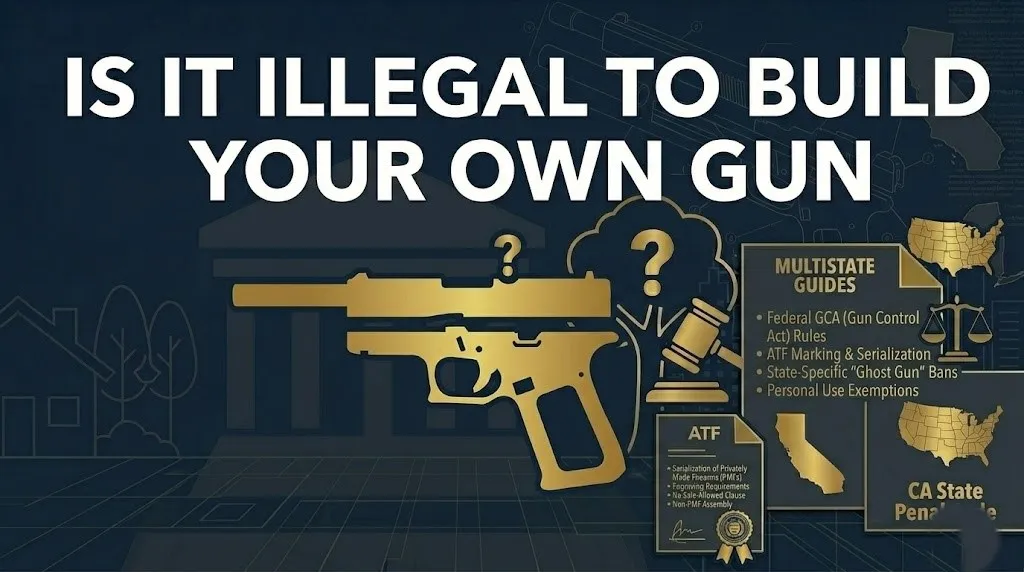
Building one gun clearly falls within personal use. Building fifty identical guns raises questions about whether the intent has shifted from personal use to commercial distribution, even without actual sales taking place.
Practical guidance for staying within personal manufacturing territory:
- Build guns for your own recreational and collecting use
- Do not list, advertise, sell, or transfer homemade firearms
- Keep records demonstrating personal use intent
- Be prepared to explain the purpose if authorities ever question you
- Understand that building at commercial scale without an FFL creates federal exposure
The ATF has not published a specific number that triggers “engaged in the business” status. Context matters: a person who builds ten rifles for their personal collection and uses them at the range is different from someone who builds ten rifles and then sells them.
Is It Illegal to Build a Gun
Building a gun is not illegal as a general matter under federal law. What makes it illegal is the presence of specific factors: being a prohibited person, building for commercial distribution, building without required NFA approval, building in a state that prohibits it, or building a gun that cannot pass a metal detector.
The Undetectable Firearms Act (18 U.S.C. 922(p)) adds one critical federal restriction. A gun that is entirely undetectable by a walk-through metal detector and unidentifiable by X-ray is illegal to manufacture or possess regardless of your other legal status. This law directly affects some polymer-based home build projects.
To be undetectable law compliant, a homemade gun must:
- Contain at least 3.7 ounces of stainless steel or equivalent material
- Have a major component identifiable by X-ray imaging
- Most functional homemade guns automatically comply because they use metal barrels, springs, and components
The undetectable firearm prohibition applies everywhere in the United States and carries penalties of up to 5 years in federal prison under 18 U.S.C. 924.
Most home builders automatically comply with this requirement because functional firearms require metal components. The concern arises primarily with certain 3D-printed designs that use minimal metal parts.
Key Takeaway: Building a gun is federally legal for eligible adults making firearms for personal use. It becomes illegal through prohibited person status, commercial intent, NFA violations, state law, or building an undetectable weapon. Know all four categories before you begin.
Can You Legally Build Your Own Gun at Home
Yes, you can legally build your own gun at home if you are an eligible adult in a state that permits home gun manufacture and the gun meets all applicable federal and state requirements. Building at home rather than in a commercial shop does not change the legal analysis.
The location of manufacture has no specific legal significance under federal law. Your kitchen table, garage workshop, or dedicated home workshop are all treated the same. What matters legally is who is building, what they are building, why they are building it, and what state they are in.
Home building has a long tradition in American gun culture, predating CNC machines and 3D printers. People have built rifles, pistols, and shotguns from raw materials and parts for generations. The law has consistently recognized this as lawful personal activity.
What makes a home build lawful in 2026:
- Builder is 18+ years old (21+ for handguns purchased from dealers, but home-built handguns follow different rules)
- Builder is not a prohibited person under 18 U.S.C. 922(g)
- Gun is built for personal use, not commercial distribution
- State law does not prohibit home manufacture or requires serialization before completion
- Gun complies with NFA requirements if it is an NFA-regulated type
- Gun is not undetectable under the Undetectable Firearms Act
Is It Legal to Build a Gun at Home
Building a gun at home is legal in the majority of U.S. states under the federal framework. However, the number of states where this activity is restricted or prohibited has grown significantly since 2019, as state legislatures have responded to concerns about ghost guns by enacting serialization requirements and outright bans.
The state-level restrictions operate independently of federal law. Federal law sets a floor; states can add restrictions above that floor. In states like California, New York, and New Jersey, you cannot legally complete a homemade gun without going through a serialization process that involves background checks and registration.
States with the most significant home build restrictions in 2026:
| State | Restriction Type | Key Requirement | Penalty |
|---|---|---|---|
| California | Serialization required | Must get DOJ serial number before completion | Felony up to 3 years |
| New York | Manufacturing ban | Cannot manufacture without license | Class E Felony |
| New Jersey | Manufacturing ban | Personal manufacture requires FFL | 3rd degree crime |
| Washington | Serialization required | Must serialize before transfer or completion | Gross misdemeanor to felony |
| Colorado | Serialization required | Must serialize unserialized guns | Class 1 misdemeanor to felony |
Even in states where home building is technically legal, the ghost gun rule changes what parts you can legally acquire for the build, as commercial sellers of frames and receivers must now conduct background checks before the sale.
Do You Need a License to Build a Gun
You do not need a federal firearms license to build a gun for personal use. The FFL requirement applies to those who manufacture firearms for commercial purposes, specifically those who are “engaged in the business” of manufacturing, dealing, or importing firearms.
The personal use exception has been a consistent part of ATF interpretation and federal court decisions. A hobbyist building a rifle for their own use is not a manufacturer in the legal sense that requires an FFL. They are a private individual exercising a right that federal law has always recognized.
The license question becomes relevant in specific circumstances:
- Building guns to sell: requires an FFL as a manufacturer (SOT/07 FFL)
- Building NFA-regulated items (suppressors, SBRs): requires ATF Form 1 approval, not an FFL but a separate NFA process
- Building in a commercial setting for others: requires an FFL
- Inheriting a build business: the estate must address FFL requirements
No state license specifically for gun manufacturing exists for personal home builders in most states. However, states that have enacted ghost gun registration requirements create an administrative process that is sometimes described as a “registration” but is not technically a license to manufacture.
The ATF’s position: personal use home manufacturing does not require an FFL. Commercial manufacturing of any scale requires the appropriate FFL type.
Ghost Gun Laws 2026
Ghost gun laws in 2026 represent the primary regulatory framework affecting home gun builders, particularly those using commercially available parts kits and 80% receivers. The term “ghost gun” refers to any unserialized, untraceable firearm, which includes homemade guns built for personal use.
The federal ghost gun regulatory environment changed significantly with the ATF’s Rule 2021R-05F, which became effective in 2022. The rule redefined what constitutes a “frame or receiver” under the Gun Control Act and required commercial sellers of parts kits and unfinished frames to conduct background checks.
The Supreme Court’s 2024 decision in Garland v. VanDerStok upheld key elements of this rule, confirming that parts kits designed to be readily converted into functional firearms fall within the ATF’s regulatory authority. This decision has real implications for people who purchase 80% lowers and parts kits from commercial sellers.
Key elements of the ghost gun regulatory framework in 2026:
- Commercial sellers must serialize frames and receivers and conduct background checks before sale
- FFLs must serialize any ghost gun brought to them for service before returning it
- Individuals who privately manufacture guns for personal use operate under less direct federal requirement
- State laws increasingly require serialization even for purely personal builds
- The ATF can inspect and regulate ghost gun possession in contexts involving commercial transactions
The ghost gun rule primarily affects the commercial supply chain, not purely private home manufacture. But purchasing parts from commercial sellers now involves background checks that did not previously apply.
ATF Rules on Homemade Guns
The ATF’s rules on homemade guns have evolved significantly since the ghost gun rule went into effect and the Supreme Court weighed in on the matter. Understanding the current ATF framework is essential for anyone considering home gun manufacture in 2026.
ATF’s key positions on homemade guns as of 2026:
- A privately made firearm (PMF) is still legal for personal use by eligible individuals
- Any frame or receiver sold commercially must now be serialized and sold through background check requirements
- Unfinished frames or receivers “designed to be readily converted” are treated as firearms for commercial sale purposes
- Individuals who make guns for personal use without commercial transactions face fewer direct requirements
- If a PMF is ever transferred to an FFL for service, it must be serialized
The practical impact for different types of home builders:
| Builder Type | Commercial Parts Used | ATF Impact | Key Requirement |
|---|---|---|---|
| Scratch builder (raw steel) | No | Minimal direct impact | Personal use compliance |
| 80% lower builder | Yes (frame purchase) | Background check now required for frame | FFL transfer of frame |
| Parts kit builder | Yes | Kit now potentially requires background check | Depends on kit type |
| 3D printer builder | No commercial frame | Less direct impact | Personal use compliance |
Home builders who manufacture entirely from raw materials without commercial transactions face the least regulatory friction under the current framework.
Do Homemade Guns Need Serial Numbers
Homemade guns do not need a federal serial number for personal use under federal law, but a growing number of states require serialization before a homemade gun can be completed, transferred, or even possessed.
Federal law requires manufacturers (FFLs) to serialize the guns they produce. Private individuals who make guns for their own use have historically not been required to add serial numbers. This remains technically true at the federal level for purely private builds.
However, the practical situation has shifted. If you ever want to transfer a homemade gun (sell it, give it away, leave it to an heir), that gun must go through an FFL, and the FFL must serialize it before completing the transfer. This means any gun you eventually want to transfer will need a serial number at that point.
State serialization requirements that apply in 2026:
| State | Serialization Required | When | How |
|---|---|---|---|
| California | Yes | Before completion | Apply to DOJ for number |
| New York | Yes | Before possession as functional | State serialization process |
| New Jersey | Yes | Required for possession | State process |
| Washington | Yes | Before transfer | State process |
| Colorado | Yes | Before transfer | State process |
| Hawaii | Yes | Registration required | State registry |
In states without serialization requirements, federal law does not require a serial number for a personal-use homemade gun. But if you ever want to legally transfer that gun, serialization becomes necessary.
Key Takeaway: Homemade guns do not require federal serial numbers for personal use, but several states require serialization before completion or possession, and any homemade gun that will eventually be transferred must be serialized through an FFL at that time.
Homemade Gun Laws by State
Homemade gun laws vary significantly by state, with some states remaining broadly permissive and others having enacted strict prohibitions or serialization requirements. Here is a comprehensive state-by-state overview of the key restrictions:
| State | Home Build Legal | Serialization Required | Manufacturing Prohibited | Key Statute |
|---|---|---|---|---|
| California | With serialization | Yes, before completion | No (with serialization) | Penal Code 29180 |
| Texas | Yes | No specific requirement | No | Penal Code 46.06 context |
| New York | Restricted | Yes | Effectively banned | Penal Law 265.00 |
| New Jersey | No | N/A | Yes without FFL | N.J.S.A. 2C:39-9 |
| Florida | Yes | No state requirement | No | No specific ban |
| Washington | With serialization | Yes | No (with serialization) | RCW 9.41.325 |
| Colorado | With serialization | Yes (for transfer) | No (with process) | C.R.S. 18-12-114 |
| Hawaii | Registration required | Yes | Restricted | HRS 134-15 |
States without specific ghost gun or homemade gun statutes generally follow the federal framework, meaning personal use home manufacture is legal for eligible individuals without specific additional state requirements.
The trend in state law is clearly toward greater restriction. Each legislative cycle since 2019 has seen additional states enacting ghost gun legislation. The number of states where home building requires additional steps beyond federal compliance has grown substantially.
States Where Building a Gun Is Illegal
Several states effectively prohibit home gun manufacture through a combination of outright bans, serialization requirements so burdensome they are functionally prohibitive, or restrictions that require a commercial FFL to legally manufacture any firearm.
States with the most restrictive home gun build environments in 2026:
- New Jersey: Manufacturing a firearm without an FFL is a third-degree crime, punishable by 3 to 5 years in state prison. This effectively bans personal home manufacturing.
- New York: The combination of registration requirements and construction restrictions makes personal manufacture extremely difficult. Possession of an unserialized homemade gun is a criminal offense.
- Hawaii: Strict registration requirements and purchase restrictions effectively limit home manufacture options significantly.
- California: While technically legal with prior serialization, the process requires applying to the California DOJ before the gun becomes functional, which many consider a de facto barrier to personal manufacture.
Penalties for manufacturing a gun illegally in ban states:
| State | Offense | Penalty |
|---|---|---|
| New Jersey | Manufacturing without FFL | 3rd degree crime, 3 to 5 years |
| New York | Possessing unserialized manufactured firearm | Class E Felony, up to 4 years |
| Hawaii | Ghost gun possession/manufacturing | Felony |
| California | Manufacturing without prior serialization | Felony, up to 3 years |
These penalties can stack with federal charges in cases involving additional violations.
Can You Build Your Own AR-15 Legally
Building your own AR-15 is federally legal for eligible adults in states that do not ban it. The AR-15’s legal status as a semiautomatic rifle means it does not fall under NFA restrictions, making it one of the more legally accessible home build projects from a federal perspective.
The AR-15 lower receiver is legally the “firearm” in the AR-15 platform. Building or purchasing just the lower receiver triggers the same legal analysis as buying or building any firearm. The upper receiver, barrel, stock, and other components are not legally “firearms” under federal law.
State-level complications for AR-15 home builds:
- California classifies the AR-15 as an assault weapon with specific configuration restrictions that apply to both commercially purchased and home-built rifles
- New York’s SAFE Act similarly restricts AR-15 features regardless of how the gun was manufactured
- Connecticut, Maryland, Massachusetts, and New Jersey have assault weapon restrictions that apply to home builds
- States without assault weapon restrictions generally allow AR-15 home builds following the same rules as any other firearm
In permissive states, building an AR-15 from a serialized lower receiver, commercial upper, and other parts follows the same federal rules as any other personal use home build.
The 80% AR-15 lower receiver market has been the most directly affected by the 2022 ATF ghost gun rule, because these unfinished lowers were the most common starting point for home builds without background checks.
Is It Legal to Build an NFA Weapon
Building an NFA-regulated weapon requires specific federal approval before construction begins, and doing so without that approval is a serious federal felony. NFA weapons include suppressors, short-barreled rifles (barrel under 16 inches), short-barreled shotguns (barrel under 18 inches), and machine guns.
The process for legally building an NFA item as a private individual:
- Submit ATF Form 1 (Application to Make and Register a Firearm)
- Pay the $200 NFA tax stamp fee
- Pass a background check through the ATF
- Wait for approval before beginning any NFA-classified manufacturing
- Register the weapon on the NFA registry upon completion
Machine guns present an additional problem. The Firearm Owners Protection Act of 1986 prohibited civilians from manufacturing or transferring machine guns made after May 19, 1986. There is no legal pathway for most private individuals to legally build a new machine gun for civilian ownership.
Penalties for NFA violations under 26 U.S.C. 5861:
| Violation | Maximum Federal Penalty |
|---|---|
| Making NFA weapon without approval | Up to 10 years federal prison |
| Possessing unregistered NFA weapon | Up to 10 years federal prison |
| Making/possessing machine gun (post-1986) | Up to 10 years federal prison |
| Transferring NFA weapon without approval | Up to 10 years federal prison |
NFA weapon violations are among the most seriously prosecuted gun offenses. The ATF actively enforces these rules, and ignorance of the NFA registration requirement is not a legal defense.
Can You Sell a Gun You Built Yourself
No, you cannot legally sell a gun you built yourself without a federal firearms license. Federal law under 18 U.S.C. 922(a) prohibits any person who is not a licensed dealer, manufacturer, or importer from selling or transferring firearms in the course of business.
This prohibition applies to all firearms, including those you personally manufactured. The gun’s origin does not change the rules about its transfer. If you built it and want to sell it, you are engaging in commercial firearm dealing and need an FFL.
The “engaged in the business” standard applies to selling as well as manufacturing. Even a single sale can constitute dealing without a license if the intent is clearly commercial. Prosecutors have charged individuals who sold homemade firearms and claimed they were doing so on a one-time basis.
Penalties for unlicensed dealing in firearms:
- Dealing without FFL: up to 5 years federal prison under 18 U.S.C. 922(a)
- Dealing to prohibited persons: up to 10 years federal prison under 18 U.S.C. 922(d)
- Trafficking firearms: up to 10 years federal prison under 18 U.S.C. 933
The practical rule: you can give a homemade gun to an immediate family member in most states without FFL involvement, but any sale, commercial transfer, or transfer to a non-family member must go through a licensed dealer.
Key Takeaway: You can build a gun for yourself legally in most states. You cannot sell it without an FFL. Transferring a homemade gun to anyone, even giving it away, typically requires going through a licensed dealer who will add a serial number and conduct a background check.
Penalty for Building an Illegal Gun
The penalty for building an illegal gun depends on which specific law was violated. Federal violations can carry serious prison time, and state violations add additional exposure that can run simultaneously with federal charges.
Federal penalties for illegal home gun manufacturing:
| Federal Violation | Maximum Penalty | Statute |
|---|---|---|
| Manufacturing for sale without FFL | Up to 5 years | 18 U.S.C. 922(a) |
| Manufacturing as prohibited person | Up to 15 years | 18 U.S.C. 922(g) |
| Building undetectable firearm | Up to 5 years | 18 U.S.C. 922(p) |
| Building unregistered NFA weapon | Up to 10 years | 26 U.S.C. 5861 |
| Building machine gun post-1986 | Up to 10 years | 26 U.S.C. 5861 |
State penalties for ghost gun manufacturing violations (selected states):
| State | Offense | Maximum State Penalty |
|---|---|---|
| California | Manufacturing without serialization | Felony, up to 3 years |
| New Jersey | Manufacturing without FFL | 3rd degree crime, up to 5 years |
| New York | Possessing unserialized manufactured firearm | Class E Felony, up to 4 years |
| Nevada | Ghost gun manufacturing violation | Category C Felony, up to 5 years |
Federal and state charges can be filed simultaneously. A person who builds a gun illegally in California could face federal charges for being a prohibited person and California state charges for manufacturing without serialization in the same case.
Building a Gun from an 80 Percent Lower
Building a gun from an 80% lower receiver was for many years the most common method of home gun manufacture precisely because these receivers were sold commercially without background checks. The ATF’s 2022 ghost gun rule changed this significantly.
An 80% lower is a receiver that is approximately 80% complete. The remaining 20% of machining must be done by the buyer. Before the ghost gun rule, these were sold as firearm parts, not as “firearms,” meaning no background check was required at point of sale.
The 2022 ATF rule and the Supreme Court’s 2024 affirmation of key provisions changed how 80% lowers are regulated:
- Lowers sold as parts of “weapon parts kits” designed to be readily converted are now treated as frames/receivers
- Commercial sellers must conduct background checks before selling these items
- The rule affects the commercial sale side, not home manufacture itself
What changed and what did not change for 80% lower builders:
| Aspect | Pre-2022 Rule | Post-2022 Rule (2026) |
|---|---|---|
| Background check for 80% lower purchase | Not required | Required through FFL |
| Personal home completion | Legal for eligible individuals | Same as before for eligible individuals |
| State serialization requirements | Varied | Expanded in restrictive states |
| Transferring completed gun | Required serialization | Required serialization |
The 80% lower home build remains a legal pathway for eligible individuals in permissive states, but the commercial supply chain now involves background checks that make the process more similar to buying a complete firearm from a dealer.
Frequently Asked Questions
Is building your own gun legal in the United States?
Yes, building your own gun is federally legal for eligible adults who are not prohibited persons, provided the gun is for personal use.
Several states have enacted restrictions or bans that make home manufacture illegal or require serialization before completion.
NFA-regulated weapons like suppressors and short-barreled rifles require ATF approval before manufacturing begins, regardless of state rules.
Do you need a license to build a gun at home?
No, you do not need a federal firearms license to build a gun at home for personal use.
The FFL requirement applies to those who manufacture firearms commercially or are “engaged in the business” of dealing or manufacturing.
Some states have created administrative processes for serialization that are sometimes called registration but are not manufacturing licenses in the traditional sense.
Can you sell a gun you built yourself?
No, you cannot legally sell a gun you built yourself without a federal firearms license.
Federal law prohibits dealing in firearms without an FFL, and this applies to homemade firearms just as it does to commercially manufactured ones.
Selling a homemade gun without an FFL can result in up to 5 years in federal prison under 18 U.S.C. 922(a).
Which states have banned homemade or ghost guns?
States with the most significant bans or restrictions include New Jersey (effectively bans personal manufacture), New York (possession of unserialized manufactured firearms is criminal), California (requires serialization before completion), Washington, Colorado, and Hawaii.
These states have enacted ghost gun laws that either prohibit unserialized home-built firearms or require registration processes before a gun can be legally completed.
The trend in state law is toward greater restriction, with more states enacting ghost gun legislation each legislative cycle.
What happens if you build a gun illegally?
Building a gun illegally can result in federal prosecution with penalties ranging from 5 years to 15 years or more in federal prison depending on the specific violation.
Penalties are highest for prohibited persons who build any gun (up to 15 years), those who build NFA-regulated weapons without approval (up to 10 years), and those who manufacture for commercial purposes without an FFL (up to 5 years).
State charges can run simultaneously with federal charges, resulting in additional penalties in states with their own ghost gun laws.
Home gun building law in 2026 operates on three simultaneous levels: federal law, ATF rules, and state law, each with its own requirements and enforcement priorities. Knowing all three before you begin is essential.
Bookmark this page as your reference before starting any home firearm build. The legal framework here changes regularly, particularly at the state level, and checking current rules in your state protects you from serious criminal exposure.