
Turning into the far lane is illegal in most US states, and it is one of the most frequently committed traffic violations that drivers do not even realize they are making. The law in virtually every state requires drivers to turn into the nearest available lane, not to skip across lanes to reach a more convenient position.
Most drivers treat far-lane turns as a normal driving habit. Officers do not. It is a citable moving violation that adds points to your license and carries real fines.
This article covers the exact legal standard for both right and left turns, which states enforce this most aggressively, when turning into the far lane is actually permitted, and what the consequences are for getting it wrong.
Is It Illegal to Turn Into the Far Lane
Yes, turning into the far lane is illegal in virtually every US state under the nearest-lane rule, which is the traffic law standard governing where a driver must end up after completing a turn. The rule is embedded in state vehicle codes across the country.
The nearest-lane rule requires that when you make a turn at an intersection, you must turn into the lane of the roadway closest to your original lane of travel. Skipping over that nearest lane to enter a farther lane is an improper turn and a citable traffic violation.
The legal basis comes from the Uniform Vehicle Code Section 11-601, which most state vehicle codes mirror. The UVC establishes that vehicles making right turns must approach from as far right as practicable and turn into the right-most lane. For left turns, the vehicle must approach from as close to the centerline as practicable and turn into the lane immediately to the right of the centerline.
Quick Facts:
- The nearest-lane rule applies in all 50 states
- Right turns must end in the rightmost available lane
- Left turns must end in the leftmost available lane of the road being entered
- Turning into any other lane is a citable moving violation in most states
- Exceptions exist for specifically marked intersections with pavement markings authorizing multi-lane turns
Is It Illegal to Turn Right Into the Far Lane
Turning right into the far lane is illegal in all 50 states under standard traffic law. When making a right turn, a driver must enter the rightmost available lane of the road being turned onto, not a middle or left lane.
The far lane for a right turn means any lane other than the rightmost lane. Completing a right turn and immediately landing in the second or third lane from the right is an improper turn regardless of how gradually or smoothly it is done.
California Vehicle Code Section 22100(a) is one of the clearest examples. It states that right turns must be made from as close as practicable to the right edge of the roadway and turned into the right-hand lane lawfully available to traffic moving in the right turn direction. Other states including Texas (Transportation Code 545.101), Florida (Statute 316.151), and New York (VTL 1160) have equivalent provisions.
| State | Right Turn Statute | Lane Requirement |
|---|---|---|
| California | CVC 22100(a) | Rightmost available lane |
| Texas | Trans. Code 545.101 | Rightmost lane |
| Florida | FS 316.151 | Right portion of roadway |
| New York | VTL 1160(a) | Lane closest to right curb |
| Illinois | 625 ILCS 5/11-802 | Rightmost lane available |
The practical consequence is that if you turn right from a one-way street or a multi-lane road onto a multi-lane road, you must end up in the lane furthest to the right after the turn. Moving into a left-of-right lane to avoid a parked car or to position for another turn counts as a lane change, which has its own separate rules.
Can You Turn Left Into the Far Lane
You cannot legally turn left into the far lane in most circumstances. Left turns must end in the leftmost available lane of the road being entered, which is the lane immediately to the right of the centerline or median on a two-way road.
The far lane for a left turn means any lane to the right of that leftmost available lane. A driver who completes a left turn and swings wide into the second or third lane from the left is making an improper turn that is citable in every state.
The reasoning is practical and safety-oriented. Left turns are the most dangerous common traffic maneuver. Completing a left turn into a far lane means the vehicle is crossing multiple lanes while in the middle of a turn, which dramatically increases the risk of collision with vehicles in those lanes.
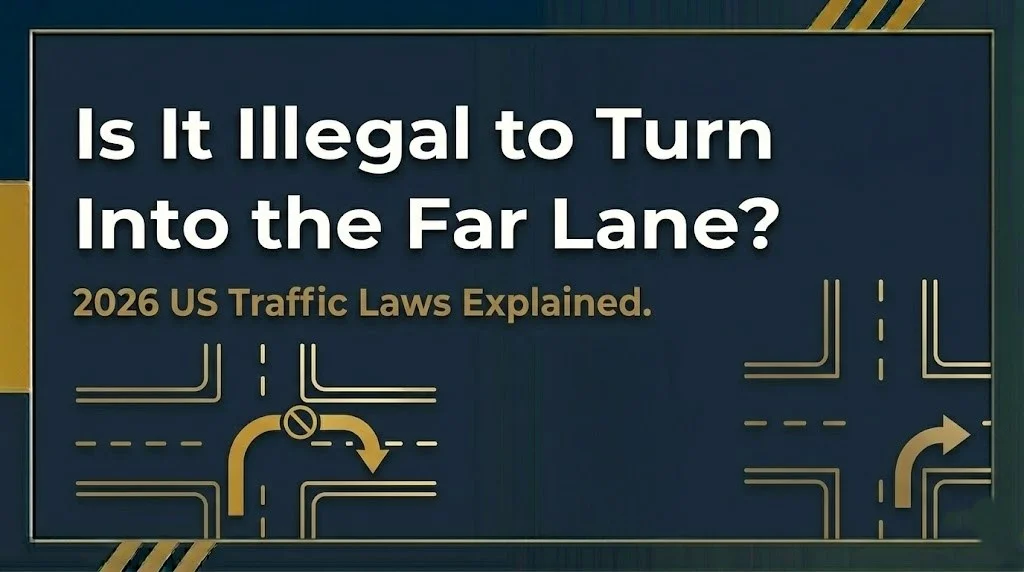
Why left turns into the far lane are specifically dangerous:
- The turning vehicle crosses oncoming lanes while already in a turn arc
- Other vehicles in adjacent lanes may not anticipate the far-lane entry
- The driver’s visibility is compromised during the turning arc
- Simultaneous turns from the opposite direction create collision risk with far-lane destinations
Is It Illegal to Turn Left Into the Far Lane
Turning left into the far lane is illegal under the vehicle codes of all 50 states, mirroring the same nearest-lane rule that applies to right turns. The standard is that left turns end in the leftmost lane of the entered roadway, not a lane further to the right.
New York Vehicle and Traffic Law Section 1160(b) specifically addresses left turns: the vehicle shall turn into the lane of traffic lawfully available to traffic moving in such direction and positioned nearest the marked center of the roadway. That last phrase, nearest the marked center, is the legal standard that prohibits far-lane left turns.
Illinois Vehicle Code 625 ILCS 5/11-802(b) states that the driver of a vehicle intending to turn left shall approach the turn in the extreme left-hand lane and turn into the extreme left-hand lane of the road entered. Ending up in a right-of-center lane after a left turn violates this provision.
Key Takeaway: Whether turning right or left, the nearest-lane rule applies. Right turns end in the rightmost available lane. Left turns end in the leftmost available lane. Turning into any other lane from either direction is a violation of state traffic law in all 50 states.
Which Lane Should You Turn Into When Making a Right Turn
When making a right turn, you should turn into the rightmost available lane of the road you are entering. This is the legal standard in all 50 states, not just a driving recommendation.
The rightmost lane after a right turn is typically what most drivers think of as the lane directly in front of them during the turn. On a standard two-lane road with one lane in each direction, that is the only lane and the question is moot. On a multi-lane road, the rightmost available lane is the one immediately adjacent to the curb or right shoulder.
The confusion arises on multi-lane roads where drivers want to turn right and immediately be in a left or center lane to position for a subsequent turn or to pass slower traffic. That positioning must happen after the turn is completed through a proper lane change with signaling, not during the turn itself.
Proper right turn execution:
- Approach from the rightmost through lane or dedicated right-turn lane
- Stay as close to the right curb as safely practicable during the turn
- Enter the rightmost available lane of the road being turned onto
- Signal and change lanes after the turn is complete if a different lane is needed
- Do not cross into a non-rightmost lane during the turning arc itself
Which Lane Should You Turn Into When Making a Left Turn
When making a left turn, you should turn into the leftmost available lane of the road you are entering. On a standard two-way road, that is the lane immediately to the right of the centerline, which is the inner left lane.
On a multi-lane one-way street, the leftmost available lane is the leftmost lane of that street. On a standard two-way street, it is the lane farthest left among those traveling in your new direction.
Most drivers understand the intuitive version of this: complete your left turn and land in the lane that keeps you on the left side of the road. The violation occurs when drivers swing wide during a left turn and end up in a right-of-center or far-right lane without making a separate lane change after completing the turn.
| Turn Type | Required Lane to Enter | Common Violation |
|---|---|---|
| Right turn onto two-lane road | Right lane (only lane available) | N/A |
| Right turn onto four-lane road | Rightmost lane | Turning into second or third lane |
| Left turn onto two-lane road | Left lane (nearest to center) | Swinging into right lane |
| Left turn onto four-lane road | Leftmost lane | Swinging into second or third lane |
| Left turn from one-way onto two-way | Lane nearest the left side | Far right lane entry |
What Is the Correct Lane to Turn Into
The correct lane to turn into is always the nearest available lane in the direction of your turn. For a right turn, nearest means rightmost. For a left turn, nearest means leftmost. This single rule covers virtually every standard turn situation in the US.
Think of it like a conveyor belt system at a factory. Each belt feeds into the next one in sequence. You don’t jump a belt. You use the one directly in front of you. The lane turn rule works the same way: you use the lane directly accessible from your turn, not a lane that requires crossing other traffic.
The nearest-lane principle exists for a reason beyond legal compliance. It ensures that multiple vehicles can make simultaneous turns from adjacent lanes without conflict. When everyone follows the nearest-lane rule, the turning driver on the left and the turning driver on the right each have a designated lane waiting for them without overlap.
Simple decision rule for any turn:
- Turning right: End up in the lane closest to the right curb of the new road
- Turning left: End up in the lane closest to the centerline of the new road
- Any other outcome requires a separate, properly signaled lane change after the turn
- Pavement markings can authorize exceptions; always follow painted lane assignments
Can You Turn Right Into Any Lane
You cannot turn right into any lane. You must turn right into the rightmost available lane, and that is a legal requirement, not just a recommendation. Turning right into a middle or left lane is an improper turn violation.
This is one of the most commonly misunderstood traffic rules in the US. Many drivers believe that once they have cleared the intersection and are on the new road, where they land is their business. Traffic law disagrees. The turning arc itself is regulated, and where it ends is part of the legal requirement for a proper turn.
The practical test officers use is whether the vehicle ended up in the rightmost lane of the road it turned onto, without having crossed any lane markings during the turn. A vehicle that completes a right turn and is observed in the second lane from the right upon completing the turn has committed an improper turn.
When turning right into a non-rightmost lane is technically permissible:
- Pavement markings specifically authorize turning into that lane
- A sign at the intersection directs traffic to a specific lane
- The rightmost lane is blocked by an emergency vehicle, construction, or hazard
- The intersection is a multi-turn intersection where both the near and far lanes are authorized
Is It Illegal to Change Lanes While Turning
Yes, changing lanes while turning is illegal in virtually all US states. It combines the improper lane turn with an unsafe lane change, both of which are independent violations. Doing both simultaneously creates compounded legal exposure.
A lane change while turning means the driver begins the turn aimed at one lane and shifts to an adjacent lane before completing the turn arc. This is different from turning into the far lane from the start; it is a mid-turn lane shift that is distinctly unsafe because the driver is simultaneously managing a turning arc and a lateral movement.
California CVC 22107 and equivalent statutes in other states require that lane changes be made only when safe and after giving an appropriate signal. Initiating a lane change in the middle of a turning maneuver fails both the safety requirement and the signal requirement simultaneously in most cases.
Key Takeaway: Turning into the far lane and changing lanes while turning are both illegal, and they often happen together. A driver who starts a right turn aimed at the rightmost lane and drifts left into the second lane during the arc has committed both violations in a single maneuver.
When Is It Legal to Turn Into the Far Lane
Turning into the far lane is legal when pavement markings at the intersection specifically authorize it. These marked multi-turn intersections are the main legal exception to the nearest-lane rule.
Multi-turn intersections have painted lane markings that assign turning drivers to specific destination lanes. White arrow markings on the pavement indicate which lane a driver turning from that position must enter. When those markings direct a driver to a lane other than the nearest one, following the markings is both legally required and the exception that makes the far-lane entry lawful.
The MUTCD (Manual on Uniform Traffic Control Devices) governs these intersection markings across all federally aided highways. When a multi-turn intersection is properly marked under MUTCD standards, the painted arrows take precedence over the default nearest-lane rule.
| Exception Type | When It Applies | What It Looks Like |
|---|---|---|
| Pavement arrow markings | Intersection with multi-turn designations | Painted arrows directing turns to specific lanes |
| Posted signs directing lane | Signs at intersection specify turn destinations | “Right turn only to lane 2” or similar |
| Simultaneous turn designation | Two or more vehicles turn simultaneously, each assigned a lane | Dual-turn arrows showing two lanes turning in same direction |
| Emergency vehicle obstruction | Rightmost lane blocked by emergency situation | Practical exception; officer discretion |
Multi-Lane Turn Rules at Intersections
Multi-lane turn intersections are intersections designed to allow two or more vehicles to turn simultaneously in the same direction, each entering a different lane of the destination road. At these intersections, the nearest-lane rule is modified by the specific lane assignments painted on the pavement.
When an intersection has two right-turn lanes, the vehicle in the innermost right-turn lane must turn into the nearest available lane, and the vehicle in the outermost right-turn lane also turns into its nearest available lane, which may be the second lane from the right. Both drivers follow their designated assignments simultaneously without conflict.
The same principle applies at dual-left-turn intersections, which are common on busy arterial roads. The vehicle in the leftmost left-turn lane enters the leftmost lane of the destination road. The vehicle in the second-from-left turn lane enters the second lane from the left of the destination road.
How to identify a multi-turn intersection:
- Look for multiple turn arrows in the lane markings approaching the intersection
- White painted arrows pointing into specific destination lanes
- Lane marking lines extending from the turn lanes into the destination road
- Signs indicating separate turn lane assignments
- When in doubt, follow the arrows painted on the road surface, not habit
Simultaneous Turn Who Has Right of Way
At standard intersections without multi-turn lane markings, when two vehicles attempt simultaneous turns that would result in both entering the same lane, the vehicle making the right turn generally has priority over the vehicle making the left turn, because the right-turning vehicle has the shorter arc and occupies the destination lane first.
The right-turning vehicle completes its shorter arc into the rightmost lane quickly. The left-turning vehicle has a longer, more complex arc that crosses further into the intersection before entering the destination road. In most conflict scenarios, the vehicle completing the left turn is the one responsible for yielding to avoid the conflict.
However, the right-of-way analysis is secondary to the primary rule: both vehicles should be turning into the nearest available lane. If both follow the nearest-lane rule, a vehicle turning right enters the rightmost lane and a vehicle turning left enters the leftmost lane, and they do not conflict at all. The conflict only arises when one or both vehicles deviate from the nearest-lane requirement.
Who is at fault when turns conflict:
- Right-turner who stays in rightmost lane: Generally not at fault
- Left-turner who swings wide into rightmost lane: At fault for improper turn
- Right-turner who swings into second or left lane: At fault for improper turn
- Both turning into the same non-nearest lane: Both potentially at fault
- Documentation at the scene matters: Dashcam footage showing who was in which lane is critical
What Happens if You Turn Into the Wrong Lane
Turning into the wrong lane results in a traffic citation for an improper turn, which is a moving violation in most states. The citation adds points to your driving record, generates a fine, and can affect your insurance rates at renewal.
The officer who observes the violation can initiate a traffic stop immediately. The stop is valid because an improper turn is a clearly observable traffic violation. During the stop, the officer can also address any other violations discovered, such as expired tags, no insurance, or a suspended license.
Points added for an improper turn vary by state. Most states assign one to two points for this violation. Accumulating enough points triggers license suspension or mandatory driver improvement programs depending on the state’s point threshold.
Consequences of turning into the wrong lane:
- Traffic citation for improper turn
- Moving violation added to driving record
- One to three points added in most states
- Fine ranging from $100 to $350 before court fees in most states
- Potential insurance rate increase at next renewal
- If an accident resulted from the improper turn, increased civil liability
Far Lane Turn Ticket and Fine
The fine for a far lane turn violation, typically cited as an improper turn, ranges from approximately $100 to $350 in base fine before court fees and penalty assessments are added. Total costs after fees vary significantly by state and county.
California’s base fine for an improper turn under CVC 22100 starts at approximately $70, but with mandatory penalty assessments and court fees, the total typically reaches $230 or more. Texas bases its fine on the county of the violation; improper turn fines generally range from $150 to $250 total in most Texas jurisdictions.
| State | Base Fine Estimate | With Fees Estimate | Points |
|---|---|---|---|
| California | $70 | $230 to $490 | 1 point |
| Texas | $100 to $200 | $150 to $250 | 2 points |
| Florida | $60 to $100 | $130 to $200 | 3 points |
| New York | $150 | $200 to $300 | 2 points |
| Illinois | $75 to $100 | $120 to $200 | Varies |
| Georgia | $100 to $125 | $150 to $200 | 3 points |
Construction zone multipliers apply in most states: fines typically double when workers are present. School zone violations also carry enhanced fines. An improper far-lane turn near a school or in a construction zone can cost significantly more than the base range above.
Improper Lane Turn Traffic Violation
An improper lane turn is a moving violation, not just an administrative infraction, and that classification matters because it means the violation stays on your driving record, adds points, and shows up in insurance company checks at renewal time.
Moving violations are specifically defined as traffic offenses committed while the vehicle is in motion. Improper turns clearly qualify. This distinguishes them from non-moving violations like expired registration or a broken tail light, which do not add points and have minimal insurance impact.
The improper turn citation is typically written under the state’s general improper turn statute or under the specific right-turn or left-turn statute depending on which maneuver was at issue. Defense attorneys can sometimes challenge these citations by arguing the pavement markings were unclear, the driver was following traffic conditions, or the officer’s observation angle did not allow accurate identification of which lane the vehicle entered.
Defense arguments sometimes raised for improper turn tickets:
- Pavement markings at the intersection were faded or absent
- The rightmost lane was occupied or blocked, making the turn into the nearest clear lane necessary
- Multi-turn markings at the intersection authorized the lane entered
- The officer was positioned where accurate observation of lane entry was not possible
- The driver signaled and changed lanes after the turn was complete, not during
Is Turning Into the Far Lane a Moving Violation
Yes, turning into the far lane is a moving violation in all states where it is cited. Moving violations are offenses committed while the vehicle is in motion, and they carry points, fines, and potential insurance consequences that non-moving violations do not.
The moving violation classification for an improper turn is consistent across states. California classifies improper turns as one-point moving violations under CVC 12810. New York assigns two points under VTL 1160 violations. Texas assigns two points through its point system under the Transportation Code.
One point may not sound like much, but insurance companies look at moving violations during renewal. A single one-point moving violation can increase premiums by 10 to 25 percent depending on the insurer and the driver’s prior record. A driver with multiple one-point violations within three years may face significantly higher increases or non-renewal.
Impact of an improper turn moving violation:
- Points stay on record for 3 to 5 years in most states
- Insurance companies check records at each renewal
- Multiple violations compound the premium impact
- Traffic school may be available in some states to prevent the point from being counted
- Court supervision or deferred adjudication options vary by state and jurisdiction
Lane Turn Rules by State
Lane turn rules are consistent in their core principle across all 50 states, all of which require turning into the nearest available lane, but they vary in fine amounts, point assignments, and specific statutory language. The foundational rule is universal even if the consequences differ.
All 50 states have adopted some version of the Uniform Vehicle Code’s turn lane requirements. The UVC is a model law that most states have incorporated into their vehicle codes either directly or with minor modifications. The nearest-lane principle is one of the UVC’s most consistently adopted provisions.
| State | Right Turn Statute | Left Turn Statute | Points for Violation |
|---|---|---|---|
| California | CVC 22100(a) | CVC 22100(b) | 1 point |
| Texas | Trans. Code 545.101 | Trans. Code 545.101(b) | 2 points |
| Florida | FS 316.151(1)(a) | FS 316.151(1)(b) | 3 points |
| New York | VTL 1160(a) | VTL 1160(b) | 2 points |
| Illinois | 625 ILCS 5/11-802(a) | 625 ILCS 5/11-802(b) | Per conviction |
| Ohio | ORC 4511.36 | ORC 4511.36(A) | 2 points |
| Georgia | OCGA 40-6-120 | OCGA 40-6-121 | 3 points |
The variation in point assignments reflects each state’s overall point system design, not a difference in how seriously the violation is treated. Georgia’s 3-point assignment and Florida’s 3-point assignment reflect those states’ point system scales, not a stricter policy than California’s 1-point system.
Frequently Asked Questions
Is it illegal to turn into the far lane in the United States?
Yes, turning into the far lane is illegal in all 50 US states under the nearest-lane rule.
Right turns must end in the rightmost available lane, and left turns must end in the leftmost available lane of the road entered.
The only exceptions are intersections with pavement markings that specifically authorize entry into a particular non-nearest lane.
Is it illegal to turn right into the far lane?
Yes, turning right into any lane other than the rightmost available lane is an improper turn violation in all US states.
California CVC 22100(a), Texas Transportation Code 545.101, and equivalent statutes in every other state require right turns to end in the rightmost lane.
Fines range from $100 to over $350 total with court fees, and the violation adds points to the driver’s record.
When is turning into the far lane ever legal?
Turning into the far lane is legal only when pavement markings at the intersection specifically authorize entry into that lane.
Multi-turn intersections with painted arrows designating destination lanes are the most common legitimate exception.
When arrows on the road direct you to a specific lane, following them is both legal and required, even if that lane is not the nearest one.
Can two cars turn simultaneously without conflict at an intersection?
Yes, at properly marked multi-turn intersections, two cars can turn in the same direction simultaneously without conflict because each is assigned a different destination lane by the pavement markings.
Without multi-turn markings, simultaneous turns create a conflict only when one or both vehicles deviate from the nearest-lane rule.
The vehicle completing a left turn is generally responsible for yielding when a conflict arises with a right-turning vehicle both headed to the same lane.
Is turning into the wrong lane a moving violation?
Yes, an improper turn into the wrong lane is a moving violation in every US state.
Moving violations add points to your driving record, typically one to three points depending on the state.
The violation can increase your car insurance premium by 10 to 25 percent at your next renewal, making a single turn into the wrong lane more costly than just the fine.
Lane turn law is one of those areas where everyday driving habits and legal requirements are genuinely out of sync for a large number of drivers. The rule is consistent, the violations are real, and the fines are significant. Knowing the nearest-lane rule protects your driving record and your insurance rates every time you turn.
Bookmark this page as your reference for lane turn law in 2026, and share it with any new driver or anyone who has recently received an improper turn ticket and wants to understand why.






