
Passing on the right on the highway is not illegal in all situations, but whether it is illegal to pass on the right on the highway depends on your state, the number of lanes, and how the maneuver is executed. On a multi-lane interstate with two or more lanes going your direction, right-side passing is legal in every US state.
Here’s what trips people up: the highway is where most Americans actually do this, yet many still believe it’s automatically against the law. That belief is flat wrong. Millions of right-side highway passes happen legally every single day across the US.
The legal complexity kicks in when you factor in “keep right” laws, left-lane camping, speed thresholds, and shoulder use. Each of those elements changes the legal calculation significantly.
This guide covers every angle for 2026: the core legality, state-by-state rules with statute references, the connection to keep-right laws, what the fines look like, and when a routine highway pass can escalate into a reckless driving charge.
Is It Illegal to Pass on the Right on the Highway
Passing on the right on the highway is not illegal when the highway has two or more lanes moving in the same direction, which describes virtually every interstate and major state highway in the US. That’s the core legal answer, and it applies in all 50 states.
The confusion around this question comes from a genuine rule that gets misapplied. The “pass on the left” default exists for two-lane roads where oncoming traffic is a factor. On a divided multi-lane highway with no oncoming traffic in your lanes, that default logic doesn’t apply in the same way.
Every state’s traffic code recognizes this distinction. The Uniform Vehicle Code Section 11-304, which forms the basis of passing laws in most states, explicitly permits right-side overtaking on roadways with sufficient width for two or more lanes of traffic going the same direction.
What makes right-side highway passing illegal:
- Using the emergency shoulder to pass
- Weaving aggressively through multiple lanes to execute a pass
- Passing at a speed so far above the limit that the pass constitutes reckless driving
- Cutting off another vehicle in a way that forces sudden braking
The highway is actually the easiest legal environment for right-side passing. The rules are clearer, the road is wider, and the lanes are defined. It’s on two-lane roads and surface streets where right-side passing gets legally complicated.
Quick Facts:
- Multi-lane highway: Right-side passing legal in all 50 states
- Two-lane highway: Right-side passing only legal with left-turn exception
- Emergency shoulder: Illegal for passing in virtually all states
- Federal law: No blanket prohibition on right-side highway passing
Is Passing on the Right on a Highway Legal
Passing on the right on a highway is legal in all 50 states when the highway has multiple lanes traveling in the same direction. This is one of the clearest and most consistent rules in American traffic law.
The legal basis is straightforward. A multi-lane highway is, by definition, a road with sufficient width for two or more lines of traffic. That condition is exactly what state traffic codes require for right-side passing to be permitted.
Think about how a grocery store express lane works. You don’t have to wait in a slow lane just because it’s on your left. If the lane to your right is moving faster, you can move into it. Highway lanes operate on the same basic logic: each lane is a distinct travel path, and you can move between them lawfully.
The legal standard comes from the Uniform Vehicle Code and state equivalents:
| Legal Basis | Requirement for Legal Right-Side Highway Pass |
|---|---|
| UVC Section 11-304 | Road must have two or more lanes same direction |
| State traffic codes | Pass must be made safely |
| Federal highway regulations | No federal ban on right-side passing |
| Individual state statutes | Safety execution required; no shoulder use |
One nuance: being in the right lane and maintaining your speed while a left-lane driver goes slower is not even technically “passing.” You’re simply traveling in your lane. True right-side passing involves a deliberate lane change to overtake a vehicle. Both are legal on a multi-lane highway.
Can You Pass on the Right on a Highway
Yes, you can pass on the right on a highway in every US state, as long as the highway has at least two lanes moving in your direction and you stay within a marked travel lane. This is perhaps the most commonly misunderstood fact in everyday American traffic law.
The practical reality is that right-side passing on highways happens constantly. Anytime you’re in the right lane on an interstate and you pass a vehicle in the left lane, you’ve just passed on the right. Officers don’t pull drivers over for this because it’s completely legal under normal highway conditions.
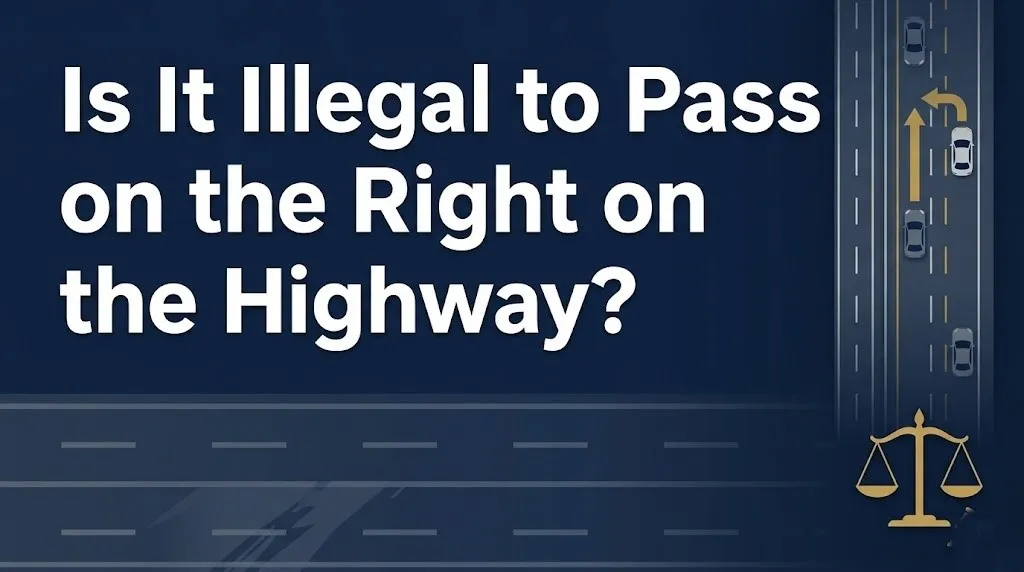
Where drivers get into trouble is when they combine right-side passing with other behaviors:
- Tailgating before the pass: Following too closely is a separate violation
- Cutting back in too soon: Cutting off the vehicle you just passed can result in unsafe lane change charges
- Speeding to complete the pass: If you exceeded the speed limit significantly, that’s the ticket, not the direction of the pass
- Using the shoulder: Illegal in virtually every state regardless of direction
The distinction between the pass itself and how you execute it matters legally. A clean, safe right-side lane change to pass a slower vehicle on a four-lane interstate is as legal as any other driving maneuver. A reckless, aggressive weave through traffic that happens to go right is a different story entirely.
Passing on the Right on a Multi-Lane Highway
Passing on the right on a multi-lane highway is fully legal in all 50 states and is one of the most routine driving maneuvers on American roads. A multi-lane highway, by its design, creates the exact road condition that state traffic codes require for legal right-side passing.
A multi-lane highway is any road with two or more travel lanes moving in the same direction. This includes interstate highways, US routes with divided medians, and state highways with multiple lanes. The presence of multiple lanes in your direction of travel is the legal green light for right-side passing.
Here’s how state statutes frame it:
| State | Statute | Key Language |
|---|---|---|
| California | CVC 21755 | Permits passing on right when road has unobstructed pavement for two or more moving lanes |
| Texas | TTC 545.057 | Allows overtaking on right on road with two or more lanes moving same direction |
| New York | VTL 1123 | Permits right-side overtaking on roadway with two or more lanes same direction |
| Florida | F.S. 316.085 | Allows passing on right when road has sufficient pavement width for two moving lanes |
| New Jersey | N.J.S.A. 39:4-85 | Permits right-side overtaking on multi-lane road or one-way street |
Every one of these statutes was written with the multi-lane highway as the primary use case. They all require that the pass be made safely, but none prohibit the direction of the pass on these roads.
Key Takeaway: Passing on the right on a multi-lane highway is legal in all 50 states. The law is consistent and clear on this point. The legal risks arise from how the pass is executed, not from the direction alone.
When Is Passing on the Right on a Highway Illegal
Passing on the right on a highway becomes illegal when you leave the travel lanes to do it, when you do it in an unsafe manner, or when the highway only has one lane in your direction. Those are the three primary conditions that convert a legal maneuver into a traffic violation.
The most common illegal variations:
- Shoulder passing: Driving onto the emergency shoulder to get around a vehicle is prohibited in virtually every state, on any road type, at any speed
- Single-lane highway passing: On a divided highway with only one lane per side, right-side passing has no legal lane to use
- Unsafe execution: Any lane change that forces another driver to brake, swerve, or react is legally actionable regardless of direction
- No-passing zones: If a stretch of highway is specifically marked as a no-passing zone, that restriction applies to both directions
Officers who cite drivers for improper right-side passing on a multi-lane highway are almost always citing the execution, not the direction. The typical fact pattern involves a driver who cut someone off, traveled on a shoulder, or made the maneuver at a highly unsafe speed.
Bold fact: A 2022 NHTSA report found that improper lane changes and improper passing combined account for approximately 6% of all highway fatalities in the US each year. The direction of the pass is rarely the legal issue. The danger is in how drivers execute it.
Keep Right Laws and Passing on the Right
Keep right laws are directly connected to the legal context of right-side highway passing. These laws require slower drivers to stay in the right lane and reserve the left lane for faster traffic or passing, and they’re enforced in the majority of US states.
The connection is this: when a driver ignores the keep-right law and camps in the left lane going slower than surrounding traffic, other drivers are effectively forced to pass on the right. In many states, that right-side pass is legal. In a few, it creates a gray area where both drivers could theoretically be cited.
As of 2026, over 40 states have keep-right or left-lane laws that require drivers to move right when not passing. The specific language varies:
| State | Keep Right Law | Fine for Violation |
|---|---|---|
| Georgia | O.C.G.A. 40-6-184 | $75 to $500; strictly enforced |
| New Jersey | N.J.S.A. 39:4-88 | $100 to $300 |
| Florida | F.S. 316.081 | $60 to $158 |
| Washington | RCW 46.61.100 | $136 base fine |
| Illinois | 625 ILCS 5/11-701 | $120 to $1,000 |
The practical legal takeaway: if someone is breaking the keep-right law by sitting in the left lane, and you pass them on the right in a safe, legal lane change, you’re generally in the clear legally. The other driver is arguably the one violating traffic law.
Is It Illegal to Pass on the Right in the Fast Lane
Passing on the right when someone is blocking the fast lane is legal in all states where the highway has two or more lanes, as long as you execute the pass in a marked travel lane and do so safely. The “fast lane” has no special legal status that prohibits passing on its right side.
The left lane is commonly called the “fast lane” or “passing lane,” but those are informal terms. In traffic law, it’s simply another travel lane. On most US highways, every lane is a legal travel lane, and the rules about which direction you can pass in don’t change based on which lane the slower driver is in.
Where this gets nuanced: some states have begun adding language to their traffic codes specifically addressing left-lane blocking. Georgia is one of the most aggressive, with fines up to $500 for left-lane camping. In those states, passing the left-lane blocker on the right is not only legal but arguably the intended result of the enforcement pressure.
Key facts about the “fast lane” and right-side passing:
- No state law requires you to wait indefinitely behind a slow left-lane driver
- Passing that driver on the right, in a marked lane, is legal on multi-lane highways
- Flashing your lights or honking to pressure a left-lane driver is a separate issue
- The maneuver must still be made safely regardless of whether you’re “entitled” to pass
Bold fact: Georgia’s left-lane law generated over 3,000 citations in its first two years of aggressive enforcement after 2016, reflecting growing state interest in clearing left-lane blockers.
Passing on the Right Highway Laws by State
Highway passing laws in the US are set at the state level, and while the core rule is consistent across states, the specific statute language, fine amounts, and enforcement priorities differ meaningfully. Every state permits right-side passing on multi-lane highways; the differences are in how they frame the safety requirement and what violations cost.
Here is a state-by-state breakdown of right-side highway passing laws for 2026:
| State | Statute | Right-Side Highway Passing | Fine for Illegal Passing |
|---|---|---|---|
| California | CVC 21755 | Legal on multi-lane roads; must be safe | Approx. $238 with fees; 1 point |
| Texas | TTC 545.057 | Legal on multi-lane roads or when vehicle turns left | $150 to $250; 2 points |
| New York | VTL 1123 | Legal on multi-lane roads; must stay on pavement | $150 to $300; 3 points |
| Florida | F.S. 316.085 | Legal with sufficient pavement for two lanes | $129 to $179; 3 points |
| New Jersey | N.J.S.A. 39:4-85 | Legal on multi-lane road or one-way street; done safely | $85 to $200; 2 points |
| Georgia | O.C.G.A. 40-6-42 | Legal on multi-lane highways | $100 to $250; 2 points |
| Illinois | 625 ILCS 5/11-704 | Legal when vehicle turns left or road has two or more lanes | $75 to $150; 2 points |
| Ohio | ORC 4511.28 | Legal on multi-lane road or when vehicle turns left | $150 typical; 2 points |
Every state in this table permits right-side passing on multi-lane highways. The fine amounts reflect illegal passing, meaning a pass done outside the permitted conditions or in an unsafe manner.
Key Takeaway: Every US state allows right-side passing on multi-lane highways, but penalty amounts for doing it illegally range from $75 to over $300 before fees. The state you’re in when you get the ticket matters significantly for your wallet and your license.
Is It Illegal to Pass on the Right in California on the Highway
Passing on the right in California on a highway is legal under California Vehicle Code Section 21755 when the road has unobstructed pavement of sufficient width for two or more lines of moving vehicles. California’s highways qualify without question.
CVC 21755 is California’s primary statute governing right-side passing. It permits the maneuver under two conditions: the road has two or more lanes of moving traffic in the same direction, or the vehicle being overtaken is making a left turn. On any California freeway or divided multi-lane highway, the first condition is always met.
California-specific details for highway right-side passing:
- Statute: CVC 21755
- Fine for illegal passing: Approximately $238 after fees and court assessments
- License points: 1 point added to DMV record
- Insurance impact: Moving violation; premiums can rise 10% to 25%
- Shoulder use: Prohibited under CVC 21755; must stay on paved travel lanes
- Enforcement focus: CHP focuses on unsafe execution, not direction alone
California’s freeway system is among the busiest in the world. Right-side passing on the 405, the I-5, the 101, and other major freeways is an everyday occurrence that happens billions of times per year legally. The CHP’s enforcement priority on passing-related violations focuses on unsafe lane changes and reckless behavior, not the direction of travel.
One California-specific note: bike lanes exist on some surface streets and occasionally near highway on-ramps. Using a bike lane to pass on the right is a separate violation under CVC 21209.
Is It Illegal to Pass on the Right in Texas on the Highway
Passing on the right in Texas on a highway is legal under Texas Transportation Code Section 545.057 when the road has two or more lanes moving in the same direction. Texas’s extensive highway network makes this one of the most commonly applied passing rules in the state.
Texas law explicitly allows right-side overtaking in two situations: when the vehicle ahead is making or about to make a left turn, and when the road has sufficient width for two or more lanes moving the same direction. Every Texas interstate and divided highway meets the second condition automatically.
Texas highway passing specifics:
| Texas Rule Element | Detail |
|---|---|
| Governing statute | TTC 545.057 |
| Multi-lane highway | Right-side passing fully legal |
| Shoulder use | Prohibited under TTC 545.058 |
| Fine for illegal passing | $150 to $250 typical |
| License points | 2 points |
| Defensive driving option | Available for first-time violations in most counties |
Texas has a unique geographic element: frontage roads alongside highways. On Texas frontage roads, right-side passing is legal when the road’s width supports two lanes of traffic. Texas courts have generally treated frontage road passing as legal when the pavement supports it.
Texas also has a keep-right statute under TTC 545.051, which requires drivers to travel in the right lane on a multi-lane road unless passing, turning left, or when road conditions require otherwise. This creates the legal backdrop where right-side passing a left-lane blocker is routine and legally supported.
Is It Illegal to Pass on the Right in New York on the Highway
Passing on the right in New York on a highway is legal under New York Vehicle and Traffic Law Section 1123 when the road has two or more lanes moving in the same direction or when the vehicle ahead is making a left turn. New York’s interstates and thruways qualify by design.
VTL 1123 has two subsections. Subsection (a) allows right-side overtaking of a left-turning vehicle. Subsection (b) allows it on roadways “of sufficient width for two or more lines of vehicles” moving the same direction. Every New York State Thruway segment and interstate satisfies subsection (b).
New York highway passing details:
- Statute: NY VTL 1123
- Fine range: $150 to $300 for a first offense
- License points: 3 points for unsafe passing
- Mandatory surcharge: $88 to $93 added to all traffic infraction fines
- Repeat offender risk: 6 or more points in 18 months triggers a Driver Responsibility Assessment fee
- New York City highways: Same state law applies; NYPD enforces on city expressways
New York assigns 3 points for unsafe passing violations, which is higher than many other states. That makes illegal passing in New York more likely to affect your license status, especially combined with other violations.
The New York State Thruway, the Long Island Expressway, and the major arteries through metro New York see constant right-side passing. None of it is illegal under normal conditions. The enforcement focus is on aggressive weaving, tailgating, and unsafe execution.
Is It Illegal to Pass on the Right in Florida on the Highway
Passing on the right in Florida on a highway is legal under Florida Statute 316.085 when the road has sufficient paved width for two or more lanes of moving traffic. Florida’s interstates, turnpikes, and multi-lane state roads all meet this standard.
F.S. 316.085 uses the phrase “unobstructed pavement of sufficient width for two or more lines of moving vehicles.” That’s the same language found in the Uniform Vehicle Code. Florida’s extensive highway system, including I-95, I-4, I-75, and the Florida Turnpike, fully satisfies this condition.
Florida highway passing specifics:
| Florida Rule Element | Detail |
|---|---|
| Governing statute | F.S. 316.085 |
| Multi-lane highway | Right-side passing fully legal |
| Shoulder use | Prohibited under F.S. 316.089 |
| Fine for illegal passing | $129 to $179 base fine |
| License points | 3 points |
| Traffic school option | Eligible for first-time violations in many counties |
Florida also has a keep-right law under F.S. 316.081(3), which prohibits driving in the left lane of a highway at a speed below the normal speed of traffic unless passing or preparing to turn left. This law directly creates the legal context for right-side passing: if the left-lane driver is violating 316.081(3), passing them on the right in a legal travel lane is the natural and lawful alternative.
Florida State Troopers enforce both statutes. A driver who gets cited for blocking the left lane while another driver passes them on the right creates an interesting double-citation scenario, though both getting tickets in the same stop is relatively rare.
Fines for Passing on the Right on the Highway
Fines for illegally passing on the right on the highway range from approximately $75 to $500 across US states, before any additional court fees, surcharges, or assessments are added. The specific amount depends on your state, whether the pass was deemed unsafe or merely technical, and your prior driving record.
It’s worth being precise here: these fines apply to illegal passing, meaning a pass that violates your state’s statute because it was done unsafely, used the shoulder, or occurred on a road type that doesn’t permit it. A legal right-side highway pass results in no fine at all.
| State | Base Fine for Illegal Passing | With Court Fees/Assessments |
|---|---|---|
| California | $100 to $150 base | Approximately $238 total |
| New York | $150 to $300 | Plus $88 to $93 mandatory surcharge |
| Texas | $150 to $250 | Plus court costs vary by county |
| Florida | $129 to $179 | Plus $65 court cost typically |
| New Jersey | $85 to $200 | Plus $6 to $12 surcharge |
| Georgia | $100 to $250 | Plus $200 state surcharge possible |
| Illinois | $75 to $150 | Plus court costs |
| Ohio | $150 typical | Plus court costs |
These numbers reflect the civil fine component. If the illegal pass involved a crash, caused injury, or was combined with speeding or reckless driving, the financial exposure increases dramatically and may move into criminal territory.
Key Takeaway: Fines for illegal right-side highway passing range from $75 to $500 in base fines across US states, with total costs after fees often reaching $200 to $400 or more. Legal right-side passing on a multi-lane highway costs nothing because it isn’t a violation.
Points on License for Passing on the Right
License points for passing on the right on a highway typically range from 1 to 3 points per violation, depending on the state. These points stay on your driving record and can trigger insurance increases, license reviews, and suspension if they accumulate.
Most states treat improper passing as a moving violation in the 2-point range. A few, like New York, assign 3 points for unsafe passing, making it one of the higher-point basic traffic violations. California assigns only 1 point, which is its standard rate for most moving violations.
| State | Points for Improper Passing | Points for License Suspension Threshold |
|---|---|---|
| California | 1 point | 4 points in 12 months; 6 in 24 months; 8 in 36 months |
| New York | 3 points | 11 points in 18 months triggers suspension |
| Texas | 2 points | 6 points triggers surcharge; higher levels risk suspension |
| Florida | 3 points | 12 points in 12 months triggers 30-day suspension |
| New Jersey | 2 points | 12 points triggers suspension |
| Georgia | 2 points | 15 points in 24 months triggers suspension |
Points remain on your record for varying periods. California’s points drop off after 39 months. New York’s points from a violation remain for 18 months for the purpose of suspension calculations but stay on the record longer.
Insurance companies access your driving record during renewal periods. A 2-point passing violation can raise your premium by 10% to 25% depending on your insurer and history. In some high-risk categories, a single moving violation can raise rates by significantly more.
Can Passing on the Right Be Considered Reckless Driving
Yes, passing on the right on a highway can be elevated to a reckless driving charge when the manner of execution shows willful disregard for the safety of other drivers. The direction of the pass itself doesn’t make it reckless. The behavior surrounding it does.
Reckless driving is typically defined in state traffic codes as operating a vehicle in willful or wanton disregard for the safety of persons or property. That’s a much higher legal bar than a basic traffic infraction. It’s usually a misdemeanor, not a civil ticket.
Behaviors that can turn a right-side highway pass into a reckless driving charge:
- Cutting across multiple lanes at high speed to execute the pass
- Forcing another vehicle to brake suddenly or swerve to avoid collision
- Passing at a speed significantly above the speed limit in heavy traffic
- Repeated aggressive weaving that demonstrates a pattern of disregard for safety
- Making the pass in a construction zone or school zone at unsafe speed
| Offense Level | Typical Consequence |
|---|---|
| Civil traffic infraction (basic improper passing) | Fine, points, no criminal record |
| Reckless driving misdemeanor | Up to $1,000 fine, up to 12 months in jail, criminal record |
| Reckless driving resulting in injury | Felony in some states; significant jail time |
| Vehicular manslaughter (crash causes death) | Felony; prison sentence possible |
The threshold for reckless driving varies by state. Virginia is known for one of the broadest definitions, classifying any highway driving at 80 mph or more as per se reckless regardless of surrounding conditions. In most other states, it requires a more fact-specific analysis.
Passing on the Right vs Passing on the Left on a Highway
On a multi-lane highway, passing on the right and passing on the left are equally legal maneuvers in all 50 states. The preference for left-side passing is a convention rooted in two-lane road logic and driver education tradition, not a highway-specific legal requirement.
The left-pass preference exists because American vehicles are left-hand drive, giving the driver better visibility of oncoming traffic when passing on the left side of a two-lane road. On a divided multi-lane highway with no oncoming traffic in your lanes, that reasoning doesn’t apply.
| Factor | Passing on the Left | Passing on the Right |
|---|---|---|
| Legal on two-lane roads | Yes, when safe | Only with left-turn exception |
| Legal on multi-lane highways | Yes | Yes |
| Default rule in traffic law | Yes | Exception allowed when conditions met |
| Typical driver visibility | Slightly better (driver’s side) | Slightly reduced (passenger side blind spot) |
| Perceived risk level | Standard | Slightly higher due to blind spots |
| Common in daily driving | Yes | Yes, constantly on highways |
The practical difference for highway drivers is minimal. Both directions of passing happen constantly and legally. The right-side pass carries a marginally higher blind-spot risk because you’re moving into the lane less visible to most drivers in their mirrors, but that’s a safety consideration, not a legal one.
State traffic codes treat them the same way on multi-lane highways. Neither direction requires a special signal, a special maneuver, or any permission beyond the lane change itself being executed safely.
Using the Shoulder to Pass on the Right on the Highway
Using the emergency shoulder to pass on the right on the highway is illegal in virtually every US state, on every highway, under essentially all circumstances. This is one of the clearest and most consistently enforced rules in American traffic law.
Emergency shoulders are designed for disabled vehicles, emergency stops, and law enforcement activity. They are not travel lanes. Driving on the shoulder to pass a slow or stopped vehicle is treated as a separate and serious violation in most states, distinct from basic improper passing.
State-specific shoulder-passing laws:
| State | Statute | Penalty for Shoulder Driving |
|---|---|---|
| California | CVC 21755 / CVC 21960 | $238 with fees; same as improper passing |
| Texas | TTC 545.058 | $150 to $250; shoulder use restricted |
| Florida | F.S. 316.089 | $129 to $179; shoulder for emergency only |
| New York | VTL 1130 | $150 to $300; prohibited except in emergency |
| Pennsylvania | 75 Pa.C.S. 3301 | $25 to $200; limited shoulder use only |
A narrow exception exists in a few states where specific highway segments have designated rush-hour shoulder travel programs. Maryland has operated such a program on parts of I-270. These segments are clearly marked with electronic overhead signs indicating when shoulder travel is permitted and what speed applies.
Outside of those specifically designated and signed programs, shoulder driving to pass is illegal. It doesn’t matter if traffic is stopped, moving slowly, or if you’ve been stuck for 20 minutes. The shoulder is not a passing lane, and treating it as one will get you cited.
Bold fact: In most states, driving on the shoulder is considered a more serious violation than basic improper passing because it creates additional hazards for disabled motorists and emergency responders using the shoulder legitimately.
Frequently Asked Questions
Is passing on the right on a highway always illegal?
No, passing on the right on a highway is not always illegal.
On any highway with two or more lanes moving in the same direction, right-side passing is legal in all 50 states.
It becomes illegal only when you use the shoulder, execute the pass unsafely, or do it on a single-lane highway without a left-turn exception.
Can you get pulled over for passing someone on the right on the highway?
You can be pulled over, but only if the officer believes the pass was illegal or unsafe.
A clean, safe lane change to pass a slower vehicle on a multi-lane highway is not a citable offense.
Officers focus on unsafe execution, shoulder use, or aggressive behavior surrounding the pass, not the direction of travel.
Is it legal to pass on the right if someone is driving slowly in the left lane?
Yes, passing on the right is legal when someone is blocking the left lane on a multi-lane highway.
In most states, the left-lane blocker is actually the one violating traffic law under keep-right statutes.
Your right-side pass, done safely in a marked travel lane, is a lawful response to that situation.
What states have the strictest laws against passing on the right on highways?
No state bans right-side passing on multi-lane highways, but some states assign higher penalties for violations.
New York assigns 3 license points for unsafe passing, which is among the highest in the country.
Virginia has broad reckless driving definitions that can ensnare aggressive passing maneuvers at highway speeds.
Georgia enforces both passing laws and keep-right laws with active patrolling and fines up to $500.
Can passing on the right on the highway lead to a reckless driving charge?
Yes, if the manner of the pass shows willful disregard for safety, a reckless driving charge is possible.
Cutting across multiple lanes at high speed, forcing other drivers to brake, or weaving aggressively while passing can all qualify.
Reckless driving is typically a misdemeanor, not a civil infraction, meaning it creates a criminal record.
The direction of the pass alone will never trigger a reckless driving charge; it’s always about how the maneuver is executed.
Highway driving laws are more permissive than most drivers realize, and right-side passing on a multi-lane road is legal every day in every state. The rules exist to protect everyone on the road, and knowing them keeps you confident and protected.
Bookmark this guide before your next long drive or share it with anyone still convinced that right-side highway passing is always illegal. The law tells a very different story.






