
Having things on your dashboard is not automatically illegal, but specific items in specific locations absolutely can get you a ticket, and in some states those tickets carry fines over $200. The legal issue is not the item itself but whether it obstructs your view while driving.
Most drivers have no idea that the same law covering cracked windshields also covers their dangling air freshener or suction-cup GPS. These are not obscure rules buried in traffic codes. Officers use them regularly during traffic stops.
This article breaks down exactly which items are restricted, which states have the strictest rules, what the actual fines look like, and how to keep your car legal without gutting your entire setup.
Is It Illegal to Have Things on Your Dashboard
Having items on your dashboard is not universally illegal, but it becomes illegal when those items obstruct your forward view through the windshield or interfere with safe vehicle operation. No federal law bans dashboard items outright, but state windshield obstruction statutes cover them directly.
The legal framework in every state revolves around one core concept: the driver must have an unobstructed view of the road ahead and to the sides. Anything that blocks, limits, or reduces that view is potentially subject to a citation under your state’s vehicle equipment code.
The dashboard surface itself is less regulated than the windshield glass. An item sitting flat on the dashboard below the windshield line typically does not create a legal problem unless it slides into view or creates a glare hazard. The real legal exposure comes when items are attached to the windshield, hung from the mirror, or stacked high enough to block the driver’s sightlines.
Quick Facts:
- No federal law bans dashboard items as a category
- State windshield obstruction laws are the primary legal framework
- The driver’s forward line of sight is the legal threshold, not a specific item list
- Both the driver side and passenger side of the windshield can be regulated differently
Dashboard Items That Are Illegal
The dashboard items most commonly cited as illegal are those that create a material obstruction of the driver’s view through the windshield. That includes items mounted to the windshield glass, items hanging from the rearview mirror, and items placed on the dashboard surface that extend into the driver’s field of vision.
State laws do not typically publish a banned items list. Instead, they define “obstruction” and leave enforcement to officer discretion. This creates a situation where the same item, such as a large GPS unit, might get one driver ticketed in New Jersey and ignored in Texas. The officer on the scene applies the standard to what they observe.
Common items that create legal exposure across multiple states:
- Large suction-cup GPS units mounted in the lower driver-side corner of the windshield
- Phone mounts attached to the windshield in the driver’s direct line of sight
- Stuffed animals or decorations placed on the dashboard above the windshield line
- Multiple hanging items from the rearview mirror creating a cluster of obstructions
- Tinted or reflective sun shades left partially deployed while driving
- Stickers, decals, or non-transparent materials applied to the windshield glass
- Cracked or chipped windshields with damage in the driver’s primary sightline
| Item Type | Legal Risk Level | Primary Concern | States with Active Enforcement |
|---|---|---|---|
| Large windshield-mounted GPS | High | Obstructs forward view | CA, NJ, PA, NY |
| Hanging air freshener (single) | Low to medium | Minor obstruction | NJ, PA |
| Multiple hanging items from mirror | High | Clustered obstruction | CA, NJ, IL |
| Stuffed animals on dashboard | Medium | Blocks view when stacked | CA, NJ |
| Phone mount on windshield | Medium to high | Driver-side obstruction | CA, NY, PA |
| Dash cam (small, mounted high) | Low | Minimal view impact | Most states allow |
What Can You Legally Put on Your Dashboard
You can legally place items on the flat dashboard surface in most states as long as they do not extend upward into your line of sight through the windshield. The dashboard surface below the windshield line is generally the safest legal zone for car accessories.
Items that consistently fall within legal limits in most states include:
- Small decorative figurines or items placed below the windshield line on the passenger side
- Phone holders mounted on the air vent rather than the windshield
- Small air fresheners clipped to vents rather than hung from the mirror
- Dash cams mounted near the top of the windshield in a small footprint behind the mirror
- Navigation devices mounted on a dashboard vent or dash cradle rather than the windshield glass
The passenger side of the dashboard generally has more legal flexibility than the driver side. Laws targeting windshield obstruction are primarily concerned with the driver’s forward field of vision, which covers the area directly ahead and to the driver’s left. Items on the far right of the dashboard or windshield are less likely to obstruct that sightline, though they are not categorically exempt.
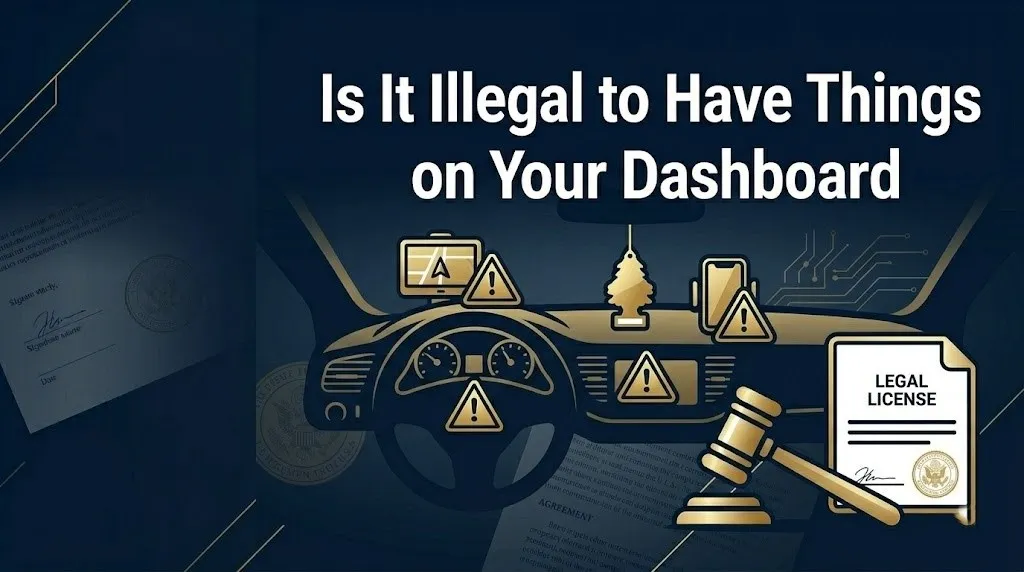
Think of your windshield as a picture frame. The law protects what the driver needs to see through that frame. Anything that physically gets in the way of that picture, whether it is hanging, mounted, or stacked, is where legal exposure begins.
Key Takeaway: The legal rule for dashboard items is not about what the item is but where it sits relative to the driver’s forward line of sight. Items below the windshield line on the passenger side carry far less legal risk than anything mounted to or hanging from the windshield or mirror.
Is It Illegal to Have Things Hanging from Your Rearview Mirror
Hanging items from your rearview mirror is illegal in several states when those items create a material obstruction to the driver’s view. California, New Jersey, Pennsylvania, Illinois, and Minnesota all have active enforcement of mirror-hanging restrictions, with others applying general windshield obstruction law to cover the same behavior.
The rearview mirror is positioned directly in the driver’s forward field of vision. Anything hanging from it, whether a single air freshener or a cluster of charms, physically occupies space in that sightline. States that specifically address mirror-hanging items typically use language requiring that nothing be hung from the mirror if it “materially obstructs, obscures, or impairs the driver’s clear view.”
New Jersey Statute 39:3-74 is one of the most frequently cited and enforced statutes on this issue. It prohibits driving with any object, other than a required inspection sticker, hanging from the interior of the windshield in a position that obstructs the driver’s view. Officers in New Jersey have used this statute to ticket drivers for single air fresheners, graduation tassels, and religious medallions.
Items commonly hung from rearview mirrors and their legal risk levels:
- Air fresheners (single): low to medium risk, enforced in NJ and PA
- Graduation tassels: medium risk, treated as decorative obstruction in multiple states
- Religious medallions: medium risk, no religious exemption exists in most states
- Dream catchers or large charms: high risk due to size and movement
- Multiple items clustered together: high risk in all states with obstruction laws
- Disabled parking placards: high risk if left hanging while driving
Obstructed Windshield Laws by State
Obstructed windshield laws exist in every US state, but they vary significantly in specificity, language, and enforcement priority. Some states define obstruction narrowly and require that the item actually impair the driver’s view. Others apply a broader standard that covers anything attached to or hanging from the windshield or mirror.
The legal test used by most states focuses on whether the item “materially obstructs” the driver’s view. This is a practical rather than absolute standard. A tiny air freshener that a reasonable person would not say impairs driving is less likely to result in a citation than a large GPS unit centered in the driver’s line of sight.
| State | Statute | What Is Prohibited | Penalty Range |
|---|---|---|---|
| California | Vehicle Code 26708 | Non-transparent objects on windshield/side windows | $25 to $197 (fix-it ticket) |
| New Jersey | Statute 39:3-74 | Objects obstructing driver’s view from interior or exterior | $54 to $150 |
| Pennsylvania | Title 75 Section 4524 | Obstructions to driver’s clear view through windshield | $25 to $100 |
| Florida | Statute 316.2004 | Objects that obstruct driver’s view | $60 to $116 |
| Illinois | Vehicle Code 12-503 | Material obstruction to driver’s forward view | $75 to $150 |
| Texas | Transportation Code 547.613 | Objects obstructing driver’s view through windshield | $25 to $200 |
| Minnesota | Statute 169.71 | Objects hanging from mirror that obstruct view | $120 to $200 |
Is It Illegal to Have a GPS on Your Windshield
Having a GPS device mounted on your windshield is legal in most states but illegal in California and several other states when mounted in a position that obstructs the driver’s view. The specific location of the mount determines legality more than the GPS device itself.
California Vehicle Code Section 26708 is the primary statute used to cite GPS windshield mounts. The law prohibits attaching any object to the windshield that obstructs or reduces the driver’s clear view. California amended the law to create a specific exception for GPS and navigation devices, but only when mounted in a seven-inch square in the lower right corner of the windshield or a five-inch square in the lower left corner.
That exception is narrower than most drivers realize. A large GPS unit mounted in the center of the windshield at eye level is still illegal in California even under the GPS-specific exception. The mount must occupy the approved corner zones to qualify.
New Jersey and Pennsylvania apply their general obstruction statutes to GPS mounts without creating a specific exception. Officers in those states have discretion to cite a GPS mount if they determine it materially obstructs the driver’s view.
Quick Facts:
- California: GPS allowed in specific corner zones only, per Vehicle Code 26708
- New Jersey: No GPS exception; general obstruction law applies
- Pennsylvania: No GPS exception; officer discretion applies
- Texas: GPS allowed if it does not obstruct driver’s view
- Florida: GPS allowed if placement does not create a view obstruction
- Most states: GPS is legal if positioned to minimize forward view impact
Is It Illegal to Have a Phone Mount on Your Windshield
Phone mounts on windshields are legal in some states and restricted in others, with the driver-side windshield position being the riskiest placement in every jurisdiction. The legal analysis mirrors the GPS mount framework closely.
California’s Vehicle Code Section 26708 applies to phone mounts the same way it applies to GPS devices. A windshield-mounted phone holder is only permitted in the approved corner zones, which are a seven-inch square in the lower right corner or a five-inch square in the lower left corner. A phone mount centered at eye level in California is illegal regardless of whether the phone is actively in use.
Beyond windshield obstruction law, phone mounts intersect with distracted driving statutes. Several states prohibit holding or interacting with a phone while driving, which has driven more drivers toward windshield or dashboard mounts. The irony is that the mount intended to avoid a distracted driving ticket can itself create an obstruction violation if placed improperly.
Safest legal practices for phone mounts across all states:
- Mount to a dashboard vent cradle rather than the windshield whenever possible
- If using a windshield mount, place it in the lower corner of the passenger side
- Keep the device small enough that it does not extend upward into the driver’s primary sightline
- Remove the mount when not in use in states with strict obstruction enforcement
Key Takeaway: Phone mounts and GPS devices are legal in most states but only in specific windshield locations. California has the most clearly defined placement rules, and the lower corners of the windshield are always safer than center or eye-level mounting positions.
Is It Illegal to Have a Dash Cam on Your Windshield
Dash cams are legal in all 50 states, but their windshield placement is subject to the same obstruction rules that govern GPS units and phone mounts. A small dash cam mounted near the top of the windshield, tucked behind the rearview mirror, is the legally safest position in virtually every state.
The top-center position behind the rearview mirror is preferred for two reasons. First, the mirror already occupies that space, so the driver’s view through that point is already partially blocked. A small dash cam added to that zone creates minimal additional obstruction. Second, most state statutes exempt devices mounted in the uppermost strip of the windshield from obstruction concerns because that area is generally outside the driver’s primary forward view.
California is the strictest state on dash cam placement. California Vehicle Code Section 26708 permits electronic devices mounted in the lower corner zones or in a five-inch square at the top center of the windshield. A dash cam mounted perfectly behind the mirror in that top-center zone complies with California law.
States where dash cams have specific guidance or exceptions:
- California: Legal in defined zones per Vehicle Code 26708
- Minnesota: Legal, no specific placement restrictions beyond general obstruction law
- Pennsylvania: Legal, officer discretion applies to placement
- New York: Legal, no specific dash cam statute
- Texas: Legal, general obstruction standard applies to placement
Is an Air Freshener Hanging from Your Mirror Illegal
A single air freshener hanging from a rearview mirror is illegal in several states and is one of the most commonly enforced minor traffic violations in New Jersey and Pennsylvania. In other states, it is technically covered by obstruction law but rarely enforced for a single item.
New Jersey has the most aggressive enforcement record on this specific item. New Jersey Statute 39:3-74 has been used to stop drivers specifically for a single tree-shaped air freshener hanging from the mirror. Several court cases in New Jersey have upheld those stops, and the state Supreme Court addressed mirror-hanging items in State v. Bacome (2017), confirming that even small hanging items can justify a valid traffic stop if an officer has reasonable suspicion they constitute an obstruction.
The practical reality differs by state. In Texas, Florida, and most southeastern states, a single small air freshener rarely triggers enforcement action unless an officer is looking for another reason to stop the vehicle. In California, New Jersey, and Minnesota, it is a more active enforcement point.
| State | Single Air Freshener Risk | Legal Basis | Enforcement Level |
|---|---|---|---|
| New Jersey | High | Statute 39:3-74 | Active, confirmed stops |
| California | Medium | Vehicle Code 26708 | Moderate, officer discretion |
| Minnesota | Medium | Statute 169.71 | Moderate |
| Pennsylvania | Medium | Title 75 Section 4524 | Moderate |
| Texas | Low | Transportation Code 547.613 | Rarely enforced for single item |
| Florida | Low | Statute 316.2004 | Rarely enforced for single item |
Are Stuffed Animals on a Dashboard Illegal
Stuffed animals placed on a dashboard are not specifically banned by any state law, but they can result in a citation if they are large enough or positioned in a way that obstructs the driver’s view through the windshield. The item does not matter legally; its placement and visual impact do.
A small stuffed animal sitting flat on the passenger side of the dashboard, below the windshield line, creates essentially zero legal risk in any state. The same stuffed animal propped against the windshield on the driver side or piled high enough to block forward sightlines is a different matter. That configuration falls directly under windshield obstruction statutes.
Officers have ticketed drivers for dashboard stuffed animals in California, New Jersey, and Pennsylvania under general windshield obstruction provisions. In each of those cases, the issue was the animal’s position relative to the driver’s view, not its existence as a decoration.
Three factors that push a dashboard stuffed animal into illegal territory:
- Placed directly against the windshield glass on the driver side
- Large enough to extend above the dashboard line into the forward sightline
- Multiple items stacked together creating a combined obstruction
Quick Facts:
- No state has a stuffed animal ban by name
- California Vehicle Code 26708 and similar statutes cover them under general obstruction rules
- Small items below the windshield line on the passenger side are lowest risk
- Large items against the windshield on the driver side are the highest risk
Are Religious Items Hanging from a Mirror Legal
Religious items hanging from a rearview mirror, such as rosary beads, crosses, medallions, or hamsa charms, have no special legal exemption in any US state. They are subject to the same windshield obstruction analysis as any other hanging object.
This is a common misconception. Many drivers believe that religious items receive First Amendment protection that shields them from traffic enforcement. That is not accurate. The First Amendment protects religious expression from government censorship of belief, but it does not exempt religious decorations from neutral, generally applicable traffic safety laws.
Courts in New Jersey and other states have addressed this directly. A religiously significant item hanging from the mirror is treated identically to a decorative item. What matters is whether it obstructs the driver’s view, not what the item represents to the driver.
The practical enforcement picture varies. Most officers use discretion and are unlikely to stop a driver solely for a small cross or medallion on the mirror. But in a state like New Jersey with active mirror-hanging enforcement, a religious item is not legally protected from a citation.
Lowest-risk options for keeping religious items in a vehicle:
- Attach them to the dashboard surface rather than hanging them from the mirror
- Place them on the passenger visor where they do not hang in the driver’s sightline
- Use a small item rather than a large or visually prominent hanging piece
- Keep them on the passenger side rather than centered in the driver’s view
Key Takeaway: Religious items have no legal exemption from windshield obstruction laws anywhere in the US. They are treated the same as any decorative hanging item, and placement determines legal risk, not the item’s religious significance.
Is It Illegal to Have a Parking Placard Hanging While Driving
Leaving a disabled parking placard hanging from the rearview mirror while driving is illegal in most states and is specifically addressed in the laws of California, Florida, Minnesota, Michigan, and several others. The placard is only supposed to be displayed when the vehicle is parked in a disabled parking space.
California Vehicle Code Section 26708 and the California disabled parking placard statute together create clear rules: the placard must be removed from the mirror before the vehicle is driven. Driving with it hanging constitutes a windshield obstruction violation. California Highway Patrol has actively cited drivers for this violation, and the placard itself does not protect its holder from the ticket.
Florida Statute 320.0848 specifically requires that disabled parking placards be removed from the mirror when the vehicle is in motion. Minnesota Statute 169.346 contains the same requirement. Both states treat driving with the placard displayed as a separate infraction from any obstruction citation.
The placard is particularly problematic because it is larger than most hanging items and positioned directly in the center of the driver’s forward view.
| State | Must Remove Placard While Driving | Statute | Fine Range |
|---|---|---|---|
| California | Yes | Vehicle Code 26708 | $25 to $197 |
| Florida | Yes | Statute 320.0848 | $60 to $116 |
| Minnesota | Yes | Statute 169.346 | $120 to $200 |
| Michigan | Yes | MCL 257.675d | $150 (estimated) |
| Texas | Yes | Transportation Code 547.613 | $25 to $200 |
| New Jersey | Yes | Statute 39:3-74 | $54 to $150 |
Windshield Obstruction Laws by State in 2026
As of 2026, no state has repealed or significantly relaxed its windshield obstruction statute. Enforcement remains active in most states, and the statutes that have been on the books for decades continue to be applied to modern accessories including dash cams, large phone mounts, and suction-cup GPS units.
Several states updated their vehicle codes between 2022 and 2025 to add specific language about electronic device mounts, bringing clarity to what had been a gray area for GPS and phone holders. California’s amendments to Vehicle Code 26708 providing specific corner-zone exceptions for navigation devices remain the most detailed framework in the country.
State inspection programs in states including New York, Pennsylvania, New Jersey, and Virginia include checks for windshield obstructions during annual inspections. A vehicle with a non-transparent sticker, large suction mount residue, or obvious damage in the driver’s sightline can fail inspection.
The current enforcement priorities by state as of 2026:
- California: Active enforcement, specific placement zones, fix-it tickets common
- New Jersey: Active enforcement, mirror-hanging items actively cited
- Pennsylvania: Inspection-based enforcement, officer discretion on road
- Minnesota: Active enforcement, specific mirror-hanging statute
- Florida: Moderate enforcement, primarily citation-based at traffic stops
- Texas: Moderate enforcement, general obstruction standard applied broadly
California Dashboard Item Laws
California has the most detailed and actively enforced dashboard and windshield item laws in the country. California Vehicle Code Section 26708 is the primary statute, covering both the windshield and the side windows visible to the driver.
Section 26708 prohibits driving with any object placed, displayed, installed, affixed, or applied on or in the motor vehicle that obstructs or reduces the driver’s clear view through the windshield or side windows. The statute was amended to create specific carve-outs for:
- Navigation devices in a seven-inch square in the lower right corner of the windshield
- Navigation devices in a five-inch square in the lower left corner of the windshield
- Electronic devices mounted in a five-inch square at the top center of the windshield
Outside those defined zones, any object mounted to the windshield is potentially subject to citation. Tinted window film, decorative stickers covering windshield area, and suction mounts outside the permitted zones all fall under the statute.
California’s enforcement process typically results in a “fix-it ticket” rather than a straight fine. A fix-it ticket requires the driver to correct the violation and have it verified, usually by a law enforcement officer or court official. The base fine is relatively low, around $25 to $50, but court fees can push the total to $197 or more. Failing to correct the violation and get it signed off results in a higher penalty.
Quick Facts:
- California Vehicle Code Section 26708: the controlling statute
- GPS/navigation devices allowed only in defined corner zones
- Dash cams allowed in a five-inch square at top center
- Fix-it ticket process: correct the violation, get it verified, avoid the full fine
- Stickers and non-transparent materials on windshield: illegal regardless of size
New Jersey Windshield Obstruction Law
New Jersey Statute 39:3-74 is one of the most actively enforced windshield obstruction laws in the United States, and it has generated more case law around hanging mirror items than almost any other state statute. New Jersey courts have consistently upheld traffic stops based on this statute for even small hanging objects.
The statute prohibits driving any vehicle on a public highway with any object, material, or obstruction placed or hanging in front of or attached to the windshield that obstructs the driver’s clear view of the road or intersecting roads. The language “hanging in front of” covers anything suspended from the rearview mirror.
New Jersey courts addressed this directly in multiple cases. Officers in New Jersey can conduct a lawful traffic stop based solely on a hanging object from the mirror, as long as they have reasonable articulable suspicion that the object materially obstructs the driver’s view. Courts have upheld stops for single tree-shaped air fresheners, graduation tassels, and small charms.
The fine for a first offense under Statute 39:3-74 is $54 to $150 depending on the court. Unlike California, New Jersey does not operate a fix-it ticket system for this violation. The fine is assessed at the time of citation.
Items that have triggered enforcement under Statute 39:3-74 in documented New Jersey cases:
- Single pine tree air fresheners
- Graduation tassels from the mirror
- Religious medallions and small crosses
- Sports team charms
- Dream catchers
Penalties for Dashboard Obstruction Violations
Penalties for dashboard and windshield obstruction violations range from a $25 fix-it ticket to over $200 once court fees are added, with some states treating repeat offenses as moving violations that add points to the driver’s license. The specific penalty structure depends heavily on whether the state uses a fix-it ticket system or a straight fine approach.
Fix-it ticket states, including California, allow the driver to correct the violation and have it certified before the court date. If verified, the fine is reduced to a nominal administrative fee, typically around $25 to $35. If the driver fails to correct and certify the violation, the full fine plus court fees applies.
Straight fine states, including New Jersey and Minnesota, assess the fine at the time of citation with no correction option. The fine must be paid regardless of whether the driver removes the offending item afterward.
Moving violation points are rare for windshield obstruction tickets but are possible in states that treat equipment violations as moving violations. Points affect insurance rates and accumulate toward license suspension thresholds.
| State | Fine Type | Base Fine | With Court Fees | Points Added |
|---|---|---|---|---|
| California | Fix-it ticket | $25 to $50 | Up to $197 if not corrected | No (if corrected) |
| New Jersey | Straight fine | $54 to $150 | $54 to $150 | No |
| Pennsylvania | Fine or fix-it | $25 to $100 | Up to $150 with fees | No |
| Florida | Straight fine | $60 to $116 | $60 to $116 | No |
| Minnesota | Straight fine | $120 to $200 | $120 to $200 | No |
| Texas | Fine | $25 to $200 | $25 to $200 | No |
| Illinois | Fine | $75 to $150 | Up to $200 with fees | Possible |
Frequently Asked Questions
Is it illegal to have things on your dashboard while driving?
Having items on your dashboard is not automatically illegal, but it becomes illegal when those items obstruct your forward view through the windshield.
Items mounted to the windshield glass or hanging from the mirror create the most legal exposure under state obstruction statutes.
Items sitting flat on the dashboard surface below the windshield line are generally legal in all states.
Can you get pulled over for items hanging from your rearview mirror?
Yes, in states including New Jersey, California, Minnesota, and Pennsylvania, a hanging item from the rearview mirror is a valid reason to stop a driver.
New Jersey courts have upheld traffic stops based solely on a single small air freshener hanging from the mirror.
The legal standard is whether the item materially obstructs the driver’s clear view, and officers have discretion in making that determination.
Is a GPS or phone mount on a windshield legal in all states?
GPS and phone mounts are legal in most states but only when placed in positions that do not obstruct the driver’s forward view.
California has the strictest rules, allowing GPS and navigation devices only in defined corner zones per Vehicle Code Section 26708.
Vent-mounted or dashboard cradle mounts are the safest legal option in every state because they avoid windshield placement entirely.
What is the fine for a windshield obstruction violation?
Fines for windshield obstruction violations range from $25 to $200 depending on the state and whether court fees are included.
California uses a fix-it ticket system where the fine can be reduced to a small administrative fee if the violation is corrected before the court date.
New Jersey and Minnesota use straight fines with no correction option, with amounts ranging from $54 to $200.
Are parking placards legal to hang while driving?
No, disabled parking placards must be removed from the rearview mirror before the vehicle is driven in California, Florida, Minnesota, Michigan, Texas, and New Jersey.
Driving with the placard hanging constitutes a windshield obstruction violation in those states and is subject to the same fines as other obstruction citations.
The placard is only meant to be displayed when the vehicle is parked in a designated disabled parking space.
Closing
Dashboard and windshield item laws are enforced far more often than most drivers expect, and the fines are real. The core rule is simple: anything that sits between your eyes and the road can create legal risk, regardless of how small or harmless it looks.
Bookmark this page before your next car accessories purchase or if you are heading into a state with stricter enforcement than your own. The rules differ enough by state that what is fine at home can get you stopped on a road trip.






