
Pepper spray is legal to own and carry in all 50 states, but the rules around how you carry it, how strong it can be, and when you can use it vary significantly from state to state. Most states permit it with few restrictions. A small number of states impose strict rules that can make an otherwise routine can of pepper spray a criminal possession issue.
The surprise for most people is that even where pepper spray is legal to carry, using it illegally can result in assault charges, weapons charges, or worse. The container in your bag is legal. Deploying it without legal justification is not.
This article covers every major legal scenario: state-by-state restrictions, self-defense rules, what happens when you spray someone illegally, specific rules in New York and California, whether felons can carry it, and the age requirements that retailers enforce.
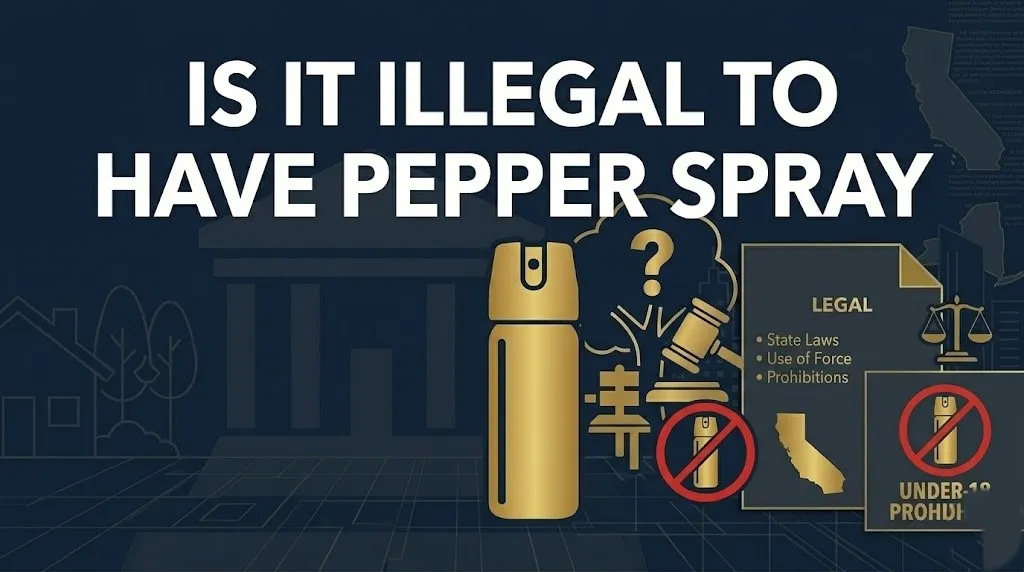
Is It Illegal to Have Pepper Spray
Having pepper spray is not illegal at the federal level, and it is legal to possess in all 50 states. There is no federal law prohibiting civilians from owning or carrying defensive chemical sprays like pepper spray or OC (oleoresin capsicum) sprays.
The federal government does regulate chemical weapons under 18 U.S.C. 229, but that statute targets mass-casualty agents, not personal defense sprays. Pepper spray is explicitly carved out of federal chemical weapons restrictions because of its legitimate civilian self-defense use.
Where the legal questions arise is at the state and local level. Every state has passed its own rules about who can carry pepper spray, in what container size, at what concentration, and in what locations. Some states are highly permissive. Others impose strict size and strength limits.
Key restrictions that states commonly impose on pepper spray:
- Maximum canister size (often 2 to 4 ounces in more restrictive states)
- Maximum OC concentration (some states cap at 10% or 2% major capsaicinoids)
- Minimum age for purchase (typically 18, though some states allow 16+)
- Prohibition on felons possessing it
- Prohibition on use in certain locations (schools, government buildings)
Having pepper spray is legal everywhere in the US, but the specific size, strength, and who can carry it depends entirely on your state.
Is It Legal to Have Pepper Spray
Yes, it is legal to have pepper spray in every U.S. state. No state has enacted a total ban on civilian possession of pepper spray for personal defense. The legal variations are about restrictions on type, size, and who qualifies, not about an outright prohibition.
This is a common misconception. Some people believe certain states have banned pepper spray entirely. That is not accurate in 2026. States like Massachusetts, New York, and California are often cited as having strict rules, but they allow possession with specific conditions.
Here is a broad overview of how permissive states are:
| Category | States | Key Restrictions |
|---|---|---|
| Highly permissive | Texas, Florida, Arizona, Colorado | Few or no size or strength limits |
| Moderate restrictions | California, Illinois, Virginia | Size or concentration limits |
| Stricter restrictions | New York, Massachusetts, New Jersey | Age, size, or purchase location rules |
| Most restrictive (but still legal) | Hawaii | Strong purchase restrictions |
Hawaii is worth noting. Hawaii requires a permit to purchase pepper spray and mandates it be obtained from licensed dealers, making access significantly harder than other states. But even in Hawaii, civilian possession is not banned.
The bottom line: owning pepper spray is legal nationwide. What you can own varies by location.
Is It Illegal to Pepper Spray
Using pepper spray, meaning actually deploying it, is legal when used in lawful self-defense. It is illegal when used without legal justification, the same way any other force can be legal or illegal depending on the circumstances.
The act of spraying someone with pepper spray is legally the same as any other use of physical force. If the use is justified under your state’s self-defense laws, it is legal. If there is no imminent threat that justifies a defensive response, you have just committed an assault or worse.
This distinction matters enormously. A lot of people carry pepper spray thinking it is always legal to use if they feel uncomfortable. That is not how the law works. Feeling uneasy is not the same as facing an imminent threat of bodily harm.
Most states require that before you use any force in self-defense, including pepper spray, the following must apply:
- You reasonably believed you were in imminent danger of bodily harm
- Your response was proportional to the threat you faced
- You were not the initial aggressor in the situation
- You did not use more force than necessary to stop the threat
Spray someone who was just arguing with you loudly, not threatening you physically, and you likely face assault charges. Spray someone who is physically attacking you, and you have a valid legal defense.
Key Takeaway: Owning pepper spray is legal in all 50 states with varying restrictions on size and strength. Using pepper spray is only legal in self-defense against a genuine, imminent threat. Using it without legal justification can result in criminal assault charges.
Pepper Spray Laws by State
Pepper spray laws vary more than most people realize, and the differences can be significant enough to turn legal carry in one state into illegal possession across the state line. Here is a comparison of the states with the most significant rules:
| State | Max Size | Concentration Limit | Min Age | Felons Prohibited | Key Statute |
|---|---|---|---|---|---|
| California | 2.5 oz | No specific OC limit | 16 (with restrictions) | Yes | Penal Code 22810 |
| New York | 2 fl oz | 0.7% to 4% MC | 18 | Yes | Penal Law 265.20 |
| Massachusetts | 1.5 oz | No specific limit | 18 | Yes | M.G.L. c. 140 s. 131A |
| Michigan | 1.2 oz | 10% OC limit | 18 | Yes | MCL 750.224d |
| New Jersey | 3/4 oz | 10% OC, 1% MC | 18 | Yes | N.J.S.A. 2C:39-6 |
| Texas | No limit | No limit | 18 | Yes | Penal Code 46.05 |
| Florida | No limit | No limit | 18 | Yes | No specific statute |
OC means oleoresin capsicum concentration. MC refers to major capsaicinoids, the actual pain-causing compound. Some states measure one, some measure the other, and some measure neither.
New Jersey deserves a closer look. Its ¾-ounce limit is among the most restrictive in the country. Standard keychain pepper spray sold nationwide often exceeds this limit, which means common products sold legally in most states would be illegal in New Jersey.
Is It Illegal to Pepper Spray Someone
Pepper spraying another person is illegal when done without legal justification. Under the laws of all 50 states, intentionally spraying someone with any chemical irritant without their consent and without a lawful defense qualifies as an assault or battery, depending on the state’s definitions.
The key word is “illegal.” It means no valid self-defense claim exists. If you spray a neighbor in a dispute, a coworker who made you angry, or a stranger you dislike, you have assaulted them with a dangerous chemical. The fact that you used pepper spray instead of your fist does not change the assault charge.
Potential criminal charges for unlawfully using pepper spray:
- Simple assault or battery (most common for non-injurious uses)
- Aggravated assault (if the spray causes significant injury or was used while committing another crime)
- Assault with a caustic chemical (specific charge in some states for chemical sprays)
- Reckless endangerment (if spray affects bystanders)
Civil liability runs alongside criminal exposure. Pepper spray a person without justification, and they can sue you for medical expenses, pain and suffering, and any other damages the spray caused. Civil cases proceed independently of criminal charges.
Is It Illegal to Pepper Spray Someone in Self-Defense
No, it is not illegal to pepper spray someone in legitimate self-defense. Using pepper spray to defend yourself against an imminent physical attack is a lawful use of defensive force under the laws of every U.S. state.
Self-defense laws across the country recognize that individuals have the right to use reasonable force to protect themselves from bodily harm. Pepper spray, as a non-lethal defensive tool, is generally considered proportional force against most unarmed physical threats.
The legal requirements for a lawful self-defense pepper spray use are consistent across most states:
- You did not initiate the confrontation
- You faced an imminent threat of physical harm (not just verbal abuse)
- A reasonable person in your position would have felt threatened
- You used only the force necessary to stop the threat
Think of it like a fire extinguisher: it is a tool designed for a specific purpose, and using it for that purpose is completely legal. Using it to spray someone you disagree with is a crime, regardless of how the product itself is classified.
Some states have Stand Your Ground laws that remove any duty to retreat before using defensive force. In these states, you do not have to attempt to escape before defending yourself with pepper spray. In states with a duty to retreat, you should attempt to retreat if you can safely do so before deploying spray.
Is It Legal to Pepper Spray Someone
Pepper spraying another person is legal only in self-defense or in defense of another person facing imminent harm. Outside of those justified scenarios, deploying pepper spray on a human being is an illegal act.
There are a few limited additional legal contexts where pepper spray use is permitted:
- Law enforcement officers may deploy pepper spray in authorized situations as part of their use-of-force training and policies
- Corrections officers may use it in authorized prison/jail contexts
- Private security personnel may use it within the scope of their authority and training
- Parents or guardians in extremely limited situations protecting a minor (though this falls under self-defense or defense of others)
For ordinary civilians, the legal use of pepper spray is confined to self-defense. The clearest signal that the use is legal: you faced an imminent physical threat, you responded to stop that threat, and you stopped when the threat ended.
Using pepper spray pre-emptively without an actual threat is not legal. Spraying someone after the threat has already ended (retaliation) is not legal. Spraying a restrained person is not legal.
Is It Illegal to Spray Someone with Pepper Spray
Spraying someone with pepper spray without a legal justification is illegal and qualifies as assault in every U.S. state. The method of injury does not change the legal character of the act. A chemical spray that causes pain, temporary blindness, and respiratory distress is a weapon, and using it on someone unlawfully is assault with that weapon.
The severity of the charge depends on the circumstances. In most states, a single unjustified pepper spray incident against a person who was not threatening you would be charged as:
- Simple assault (misdemeanor in most states if no serious injury results)
- Battery with a chemical agent (some states have this specific charge)
- Assault with a dangerous weapon (if the state classifies pepper spray as a dangerous weapon)
Some states have enhanced charges when chemical sprays are involved. California’s Penal Code 244 covers assault with caustic chemicals, and while standard pepper spray is specifically exempted for lawful defensive use, deploying it unlawfully can still lead to significant charges.
If bystanders are affected by the spray, additional charges for reckless endangerment may apply. Spraying pepper spray in a crowded space where it affects people who were not your intended target creates additional criminal exposure.
Key Takeaway: Spraying someone with pepper spray without justification is illegal assault in all 50 states. The legal self-defense exception only applies when you faced an imminent physical threat and used the spray proportionally to stop it.
Pepper Spray Self Defense Legal
Pepper spray used in genuine self-defense is legal in all 50 states. Every state’s self-defense laws recognize the right to use reasonable, non-lethal force to protect yourself from imminent bodily harm, and courts have consistently treated pepper spray as an appropriate defensive tool within that framework.
The legal protection for self-defense pepper spray use is strongest when:
- The threat was immediate and real, not speculative
- You communicated verbally that you would defend yourself before spraying, when safely possible
- You stopped spraying as soon as the threat ceased
- You remained at the scene and cooperated with police who arrived afterward
- You did not taunt or escalate the situation before spraying
That last point matters legally. If you say “Come at me” or otherwise invite a confrontation, you may have eliminated your self-defense claim by becoming the aggressor. Self-defense law is about responding to threats, not inviting and then meeting them.
States with Stand Your Ground laws (Florida, Texas, Arizona, Georgia, and dozens of others) make the self-defense claim stronger by eliminating any duty to retreat. In these states, you are not required to try to escape before defending yourself. In states without Stand Your Ground (New York, Massachusetts, New Jersey), you may be legally required to retreat if you can do so safely before using any defensive force.
What Happens if You Pepper Spray Someone Illegally
If you pepper spray someone without legal justification, you face both criminal prosecution and civil liability. The severity depends on your state’s laws, whether anyone was seriously injured, and whether the spray was used as part of another crime.
Criminal consequences for illegal pepper spray use:
| Charge Type | States Where Common | Typical Penalty |
|---|---|---|
| Simple assault (misdemeanor) | All states | Up to 1 year jail, fine |
| Aggravated assault (felony) | All states for severe situations | 1 to 10+ years prison |
| Assault with chemical agent | California, some others | Felony, 2 to 4 years |
| Reckless endangerment | All states (if bystanders affected) | Misdemeanor to felony |
Civil consequences run parallel. The victim can sue you for:
- Medical bills from treating the chemical exposure
- Lost wages if the injury prevented them from working
- Pain and suffering damages
- Punitive damages if the court finds your conduct was malicious
The legal outcome is often worse if the spray was used during another crime. Using pepper spray while committing robbery, burglary, or any other offense creates additional felony exposure beyond just the illegal spray use itself.
Is It Illegal to Have Pepper Spray in New York
Having pepper spray in New York is legal for adults 18 and older, but New York imposes some of the strictest restrictions on pepper spray content and container size in the country. Violating these restrictions can turn legal self-defense equipment into criminal possession.
New York law under Penal Law 265.20 defines a legal “pocket pager” or defensive spray device. To be legal in New York:
- The canister must hold no more than 2 fluid ounces of solution
- The active ingredient must be between 0.7% and 4% major capsaicinoids (MC)
- The buyer must be at least 18 years old
- Buyers must not have any felony conviction or any assault or similar conviction
New York also restricts where you can purchase pepper spray. Under General Business Law 393-a, pepper spray must be sold only by licensed dealers (gun shops, pharmacies with firearms dealers, sporting goods stores with appropriate licenses). You cannot legally order it online and have it shipped to a New York address from an out-of-state retailer that does not hold a New York license.
New York’s major capsaicinoid limit of 0.7% to 4% MC is one of the most specific in the country, and many standard products sold in other states exceed New York’s limits.
Using spray that exceeds New York’s specifications could mean your otherwise-justified self-defense use is legally compromised because you were carrying an illegal device.
Is It Legal to Have Pepper Spray in NY
Yes, it is legal to have pepper spray in New York for adults who meet the state’s specific requirements. The key requirements are age 18+, no disqualifying criminal history, and a product that meets New York’s size and concentration specifications.
The practical challenge is finding products that comply with New York’s unique major capsaicinoid standard. New York measures potency in major capsaicinoids (the specific compounds that cause pain) rather than OC percentage (which measures the overall concentration of pepper extract). These are different measurements, and a spray that lists a legal OC percentage might still exceed New York’s MC limit.
What to look for on New York-legal pepper spray:
- “NY Legal” labeling from the manufacturer
- Container holding 2 fluid ounces or less
- MC concentration listed as 0.7% to 4%
- Purchase from a licensed New York firearms or sporting goods dealer
- Age verification at purchase (18+)
Penalties for possessing non-compliant pepper spray in New York can include criminal possession of a weapon charges. New York’s weapon laws are strict, and possessing a defensive spray that falls outside the legal specifications could result in misdemeanor charges even if you never used it.
Is It Illegal to Pepper Spray Someone in CA
In California, using pepper spray on another person is illegal unless you are acting in lawful self-defense. California Penal Code 22810 specifically governs pepper spray (which California calls “tear gas” or “chemical agent”) and sets out both the legal possession framework and the prohibited uses.
California law allows possession of pepper spray canisters up to 2.5 ounces for personal protection. Using that legally carried spray on another person without a valid self-defense justification triggers criminal liability under multiple provisions:
- California Penal Code 244 (assault with caustic chemicals)
- California Penal Code 242 (battery)
- Additional charges if the victim is in a protected class (law enforcement, elderly, etc.)
The critical question in California is whether the use was justified. California follows a “reasonable person” standard: would a reasonable person in your situation have feared imminent bodily harm? If yes, the use may be legally justified. If no, you face assault charges.
California also prohibits use of tear gas (including pepper spray) against officers performing their duties under Penal Code 22810(g)(2). This applies even in situations where you might otherwise claim self-defense, because striking an officer is treated differently under California law.
Is It Legal to Have Pepper Spray in California
Yes, it is legal to have pepper spray in California with specific restrictions. California is one of the more restrictive states regarding pepper spray but still allows civilian possession for personal protection under California Penal Code 22810.
California’s specific rules for legal pepper spray possession:
- Maximum canister size: 2.5 ounces net weight
- Minimum purchase age: 16 with parental consent; 18 without restriction
- Prohibited persons: felons, persons convicted of assault charges, minors under 16
- Use restriction: only for self-defense purposes
- Location restrictions: prohibited in most public schools, government buildings
California does not set a specific OC concentration limit, which differs from some other states. However, the product must be sold as a personal protection product and not as something with a different intended use.
The 16-year-old provision is notable. California allows minors between 16 and 18 to possess pepper spray if a parent or guardian consents to the purchase and the minor understands the legal constraints. This makes California somewhat more accessible for young adults than states with a strict 18 minimum.
Key Takeaway: California and New York both permit pepper spray with strict restrictions. New York focuses on MC concentration and purchase location. California focuses on canister size and prohibited persons. Violating either state’s rules can turn legal carry into criminal possession.
Can Felons Have Pepper Spray
Convicted felons are generally prohibited from possessing pepper spray in most states. While pepper spray is not a firearm, many states have extended their dangerous weapon or restricted weapon possession statutes to include chemical defensive sprays as items prohibited for felons.
State-by-state felon restrictions on pepper spray:
| State | Felons Prohibited | Statute | Criminal Charge |
|---|---|---|---|
| California | Yes (felons, assault convicts) | Penal Code 22810 | Felony possession |
| New York | Yes (felons, assault convicts) | Penal Law 265.20 | Misdemeanor to felony |
| Massachusetts | Yes | M.G.L. c. 140 s. 131A | Criminal violation |
| Michigan | Yes | MCL 750.224d | Felony |
| New Jersey | Yes | N.J.S.A. 2C:39-6 | Criminal charge |
| Texas | Yes | Penal Code 46.05 | Felony |
| Florida | Varies by conviction type | Specific penalties not confirmed | Charge may vary |
The penalty for a felon caught with pepper spray can be significant. In many states, possession by a prohibited person is itself a felony, regardless of whether the spray was used for anything. The mere act of possession after a disqualifying conviction creates new criminal exposure.
Some states also extend the prohibition beyond felons to include people convicted of certain misdemeanors, particularly assault, domestic violence, and drug-related offenses. In New York and California, an assault conviction, even if only a misdemeanor, can disqualify someone from legal pepper spray possession.
Age to Buy Pepper Spray
The minimum age to purchase pepper spray in the United States is 18 in most states, though a small number of states allow purchases at 16 with parental consent. There is no federal minimum age law for pepper spray, so state law controls.
State minimum ages for pepper spray purchase:
| State | Minimum Age | Notes |
|---|---|---|
| California | 16 (with parental consent) | 18 without consent |
| Texas | 18 | Standard purchase age |
| New York | 18 | Strict purchase location rules also apply |
| Florida | 18 | Standard purchase age |
| Massachusetts | 18 | Licensed dealer required |
| Michigan | 18 | Canister size limits apply |
For online purchases, retailers selling to customers in restrictive states face compliance obligations. Reputable online retailers require age verification and often refuse to ship to states with restrictive requirements (like New York) without confirming compliance with local laws.
Parents in states that allow 16-year-olds to possess pepper spray with consent should be aware that the product purchased must still comply with all size and concentration requirements for that state. Parental consent does not waive the product specifications.
The practical reality is that most retail stores simply require a valid government-issued ID showing age 18+ when purchasing any pepper spray product, regardless of whether their specific state technically allows younger purchases. This is a retailer risk management decision, not always a legal requirement.
Is It Legal to Pepper Spray
Using pepper spray legally is permitted in all 50 states for self-defense purposes. The act of deploying pepper spray becomes legal or illegal based entirely on whether you had legal justification at the moment you used it.
The legal test for a lawful pepper spray use in a self-defense context is consistent across states:
- Imminent threat: the danger was happening now, not anticipated for later
- Reasonable belief: a reasonable person in your shoes would have felt threatened
- Proportional response: the level of force matched the threat level
- No prior aggression: you were not the one who started the confrontation
- Ceased when threat ended: you stopped spraying when the person stopped being a threat
Passing all five tests means your use was legally justified. Failing any one of them creates serious legal risk.
Courts in self-defense pepper spray cases look at the full factual picture. What was said before the spray was used? What was the physical position of both parties? Were there witnesses? What injuries resulted? All of these factors shape whether a prosecutor will file charges and whether a jury would convict.
Protecting yourself with pepper spray is a legal right in the United States. Deploying it responsibly, only when genuinely threatened, and stopping as soon as the threat ends are the practical keys to keeping that use legally protected.
Frequently Asked Questions
Is pepper spray legal to carry in all 50 states?
Yes, pepper spray is legal to carry in all 50 states, but restrictions vary significantly.
Some states have strict rules on canister size, OC or major capsaicinoid concentration, minimum purchase age, and prohibited persons.
New Jersey limits canisters to 3/4 ounce, while Texas imposes almost no restrictions beyond age 18.
Can you legally use pepper spray on someone attacking you?
Yes, using pepper spray against a genuine physical attack is legal self-defense in all 50 states.
The use must be proportional and in response to an imminent threat, not a verbal argument or speculative future harm.
You must stop using the spray as soon as the threat ends to keep the use legally justified.
What happens if you use pepper spray illegally?
Using pepper spray without legal justification can result in assault charges, battery charges, or assault with a chemical agent charges depending on the state.
Civil liability for medical bills and damages runs alongside any criminal charges.
In states with strict weapon laws, unlawful use can also result in weapon-related charges.
Can a convicted felon legally possess pepper spray?
Felons are prohibited from possessing pepper spray in most states including California, New York, Texas, Michigan, New Jersey, and Massachusetts.
Penalties for felon possession of pepper spray can be significant, up to a felony charge in many states.
Some states also prohibit people with certain misdemeanor assault convictions from possessing pepper spray, not just felons.
What is the legal age to buy pepper spray?
The minimum age to purchase pepper spray is 18 in most states.
California allows purchase at 16 with parental consent.
There is no federal minimum age law, so state law controls the purchase age requirement for each jurisdiction.
Pepper spray laws in 2026 give civilians broad rights to carry defensive chemical sprays, but the specific rules vary enough that knowing your state’s requirements is essential before you buy or carry.
Bookmark this article for reference before purchasing or traveling with pepper spray across state lines. State laws change, and checking current requirements in your destination state prevents legal complications.






