
In most states, it is illegal to use a train horn on a personal vehicle, and many states treat the installation itself as a potential equipment violation. Whether you’re curious or already shopping for a kit, the legal answer depends on where you live and how the horn is used.
Here’s what catches most people off guard: installing a train horn is not always what gets you cited. Using it is. Several states draw a sharp line between having it mounted and actually blasting it on a public road.
Train horns produce between 130 and 150 decibels. Standard car horns cap out at 100 to 110 decibels. That gap is the core of nearly every legal restriction you’ll encounter.
This guide covers federal rules, state-by-state laws, decibel limits, real penalty amounts, inspection consequences, and what your legal options actually look like in 2026.
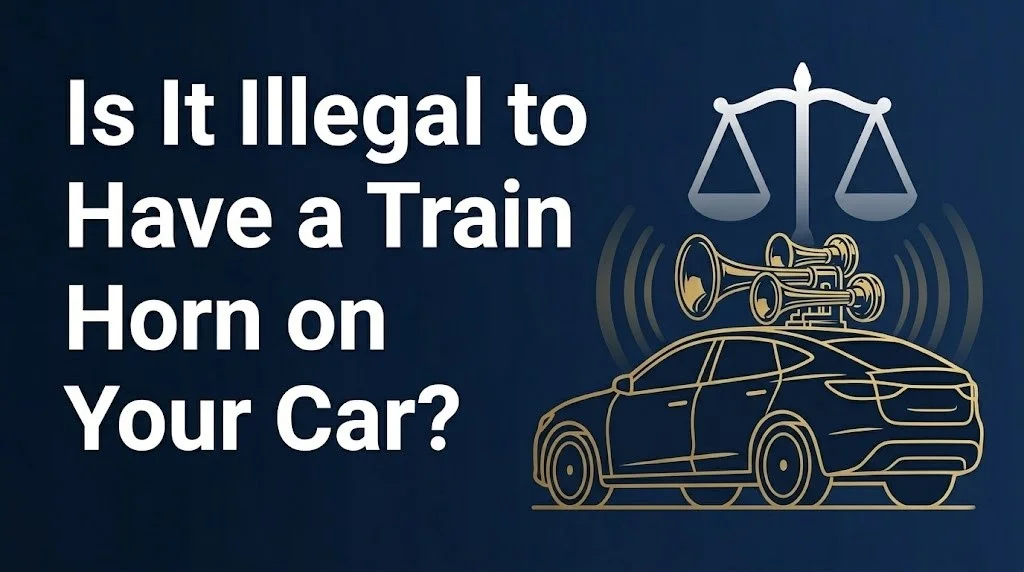
Is It Illegal to Have a Train Horn on Your Car?
Having a train horn installed on a personal vehicle is not explicitly banned under federal law, but using it on a public road is illegal in most states. The distinction between installation and use is where many drivers get confused.
Federal law, specifically 49 CFR § 571.101, does not prohibit aftermarket horns outright. It sets requirements for how horn controls must be identified and accessible if a horn is installed. It does not specify a maximum decibel output for passenger car horns at the federal level.
What creates the legal problem is state law. Every state’s vehicle code includes some version of a prohibition on horns that produce an “unreasonably loud or harsh sound.” A train horn at 130 to 150 decibels almost always triggers that standard. Officers don’t need a decibel meter to write the ticket. They just need to hear it.
Quick Facts:
- Federal law: No explicit ban on installation, but sets horn control requirements
- State law: All 50 states prohibit horns emitting unreasonably loud or harsh sounds
- Typical train horn output: 130 to 150 decibels
- Legal car horn output: 100 to 110 decibels
- Primary risk: Use on a public road, not installation alone
Is It Illegal to Put a Train Horn on Your Car?
Putting a train horn on your car is a legally gray area at the federal level, but many state vehicle codes treat the installation of non-compliant audible warning devices as an equipment violation. Whether it’s illegal to install one depends heavily on your state.
Some states, including California, explicitly state that a train horn may be mounted but not used. That tells you installation alone is not the trigger for a citation in those states. Other states have broader equipment modification laws that can be applied to any device that is incompatible with the original safety systems of the vehicle.
States that require vehicles to pass periodic equipment inspections create a separate risk. Even if you never honk the horn, an inspector who identifies a non-compliant audible device can fail the vehicle. The result is a required repair and reinspection before the vehicle is road-legal again.
| Installation Status | Legal Risk Level | Primary Concern |
|---|---|---|
| Mounted, never used, factory horn intact | Low to moderate | Equipment inspection depending on state |
| Mounted, used once on public road | High | Noise violation, equipment citation |
| Factory horn removed, train horn only | Very high | Equipment violation, failed inspection |
| Used near residential area or near pedestrians | Highest | Noise ordinance, possible reckless endangerment |
Is It Legal to Have a Train Horn on Your Car?
Having a train horn on your car is legal in a small number of states, provided the factory horn is intact, the train horn cannot be used while the vehicle is in motion, and it is wired only as an anti-theft or stationary alarm system. Outside of those narrow conditions, legality is doubtful.
No state gives blanket permission to drive down a public road and blast a 150-decibel train horn at other drivers. The closest thing to “legal” ownership is a state that does not explicitly prohibit installation while also requiring that the OEM horn stays functional.
Think of it like having a spotlight mounted on your car. The fixture itself may not be banned. Shining it at oncoming traffic is a different matter entirely. Train horn laws work the same way: the device plus the use together determine whether you’re in violation.
Key Takeaway: Whether a train horn is “legal” on your car depends on three separate questions: Is the installation itself restricted in your state? Is your factory horn still functional? And are you using it in a way that violates your state’s noise or equipment laws?
Is It Legal to Put a Train Horn on a Car?
Putting a train horn on a car is not automatically illegal at the point of installation in many states, but it creates several downstream legal exposures the moment you drive the vehicle. Federal rules don’t ban the hardware. State vehicle codes almost universally ban its use.
The safest legal interpretation is this: if you install a train horn and keep the OEM horn functioning, and you wire the train horn so it cannot be activated while driving, you may avoid a citation in states where installation alone is not restricted. That is a narrow window, and it closes the moment you drive through a state with stricter rules.
California’s Vehicle Code § 27000 says a horn cannot emit an unreasonably loud or harsh sound, but also allows a mounted horn that isn’t used. That carve-out is the legal basis most vendors use when they say their kits are “not illegal.” They’re technically right about the install. They don’t mention the fines you’d face for honking it.
Train Horn Laws by State
Train horn laws vary significantly by state, but every state prohibits horns that produce unreasonably loud or harsh sounds. The differences lie in how strictly each state defines that standard and whether installation alone triggers a violation.
States like California create an explicit carve-out: you can mount the horn, but you cannot use it. States like Texas have no specific decibel threshold in state law, leaving enforcement to officer discretion. Other states have broad equipment modification statutes that can capture an aftermarket train horn even before it’s used.
| State | Installation Status | Use Restriction | Key Statute |
|---|---|---|---|
| California | Permitted (if not used) | Banned on public roads | Vehicle Code § 27000 |
| Texas | Not explicitly banned | “Unreasonably loud” standard | Transportation Code § 547.501 |
| Florida | Not explicitly banned | Prohibited if unnecessarily loud | Florida Statute § 316.271 |
| Virginia | Restricted (type approval required) | Must be approved type | Code § 46.2-1060 |
| Oregon | Not explicitly banned | Class C traffic violation if misused | ORS § 815.225 |
| Alabama | Not explicitly banned | Prohibited if unreasonably loud | Code § 32-5-213 |
| Washington | Not explicitly banned | Prohibited unless reasonable warning | RCW 46.37.380 |
Local city and county ordinances often impose stricter standards than state law. Always check your municipality’s noise ordinance in addition to state vehicle codes.
Is a Train Horn Legal in California?
In California, you may mount a train horn on a personal vehicle, but you cannot use it on public roads. That is the specific legal position under California Vehicle Code § 27000, which requires a horn audible at 200 feet but prohibits any horn emitting an unreasonably loud or harsh sound.
The California Vehicle Code § 27001 adds that horns may only be used when reasonably necessary for safe operation. Using a train horn for any other purpose, including expressing frustration, greeting someone, or testing the sound, violates § 27001 directly. A Ninth Circuit Court ruling in 2023 (Porter v. Martinez) affirmed California’s broad authority to restrict when horns may be used.
Authorized emergency vehicles are the sole exception. Under § 27000, emergency vehicles may be equipped with air horns that do not comply with the standard noise restrictions when used in conjunction with a siren. No private vehicle qualifies for this exemption. The minimum fine for a horn violation in California is $108, not counting any penalty assessments that typically double or triple the base amount.
Quick Facts:
- Mounting: Allowed
- Use on public roads: Banned (Vehicle Code § 27000)
- Emergency vehicle exception: Applies only to authorized emergency vehicles
- Minimum fine: $108 base, typically higher with assessments
- Semi-trucks: Permitted only if attached to the air brake system and meeting FMVSS standards 121 and 106
Is a Train Horn Legal in Texas?
In Texas, using a train horn on a personal vehicle is effectively illegal under Texas Transportation Code § 547.501, which prohibits motor vehicle horns from emitting unreasonably loud or harsh sounds. Texas does not set a specific decibel limit in state code, so enforcement depends on officer discretion.
A train horn at 130 decibels or more will almost always be judged as unreasonably loud under § 547.501. Texas also enforces noise through the Texas Health and Safety Code § 382.085, which prohibits excessive noise contributing to air pollution. While that statute targets industrial sources primarily, courts have applied it in extreme vehicular noise cases.
Local ordinances add another enforcement layer. Houston’s Noise Ordinance (Chapter 30, Section 30-1) caps residential noise at 68 decibels during the day and 58 decibels at night. Dallas City Code Section 30-2 bans sounds plainly audible from more than 50 feet away. A train horn violates both thresholds by a wide margin. Reckless driving charges under Texas Transportation Code § 545.401 can be applied in cases where horn use causes dangerous driving behavior from other motorists.
Key Takeaway: Texas has no specific decibel number in state law, but “unreasonably loud” under § 547.501 will almost always apply to a train horn. City ordinances in Houston and Dallas set explicit limits that a train horn exceeds by 60 to 80 decibels.
Train Horn Laws in Florida
In Florida, using a train horn on a personal vehicle violates Florida Statute § 316.271, which prohibits unnecessary or unreasonably loud use of horns or other audible warning devices. Florida does not ban installation outright, but the use restriction is broad and consistently enforced.
Florida Statute § 316.271 applies the same “unreasonably loud or harsh” language found in most state vehicle codes. It also prohibits using a horn except as a reasonable warning. That means honking a train horn at a pedestrian, in a parking lot, or to express road rage creates a clear violation regardless of whether the horn is otherwise legally installed.
Florida municipalities compound the state restriction with local noise ordinances. Many Florida cities cap vehicle noise at 75 to 85 decibels measured at 50 feet. A train horn at 130-plus decibels would exceed that threshold by 45 to 55 decibels. Florida law enforcement can also classify an excessively loud horn as a moving violation, which adds points to your license in addition to any fine.
| Florida Violation Type | Potential Consequence |
|---|---|
| Unreasonably loud horn use (§ 316.271) | Moving violation, fine, possible license points |
| Local noise ordinance violation | Separate municipal citation, fine |
| Equipment modification violation | Fix-it ticket, required removal |
| Reckless driving if horn causes accident | Criminal charge, serious penalties |
Is It Illegal to Not Have a Horn in Your Car?
Not having a working horn on your car is illegal in virtually every state, even though the federal government does not technically require one. NHTSA confirmed in a formal interpretation letter that federal standard 49 CFR § 571.101 does not mandate a horn on motor vehicles. What it does is set requirements for how horn controls are labeled and accessible if a horn is installed.
State vehicle codes close that federal gap completely. California Vehicle Code § 27000 requires every motor vehicle operated on a highway to be equipped with a working horn capable of producing sound audible under normal conditions from at least 200 feet. Alabama, Virginia, Texas, Washington, and virtually every other state has equivalent language requiring a functional horn as a condition of roadworthiness.
Getting caught without a working horn typically results in what’s called a fix-it ticket, a citation that gets dismissed when you show proof of repair and pay a small processing fee. It’s a lower-stakes violation than a moving offense, but it can compound quickly if combined with an equipment inspection failure or a separate noise violation.
Do You Legally Need a Horn on Your Car?
Yes, you legally need a working horn on your car in almost every state, even though there is no single federal mandate requiring one. The state-level requirement is consistent across jurisdictions and enforced as an equipment standard.
The reason the NHTSA clarification matters is this: it confirms there is no federal rule blocking states from defining their own horn requirements. Every state has exercised that authority. So the practical answer is yes, a functional horn is legally required everywhere in the United States.
Removing your factory horn entirely to install a train horn creates an equipment violation in any state that mandates a horn meeting its specific requirements. A train horn that produces 140 decibels does not satisfy a requirement for a horn that must not produce an unreasonably loud or harsh sound. You’d be violating two rules at once: the requirement to have a compliant horn, and the prohibition on having a non-compliant one.
Key Takeaway: Federal law doesn’t mandate a horn, but all 50 states do through vehicle codes. Removing your factory horn creates an equipment violation. Installing a train horn as a replacement, rather than an addition, almost certainly makes the vehicle non-compliant in every state.
Can You Remove Your Factory Horn When Installing a Train Horn?
Removing your factory horn when installing a train horn is almost certainly illegal in all 50 states. State vehicle codes require a functional horn that meets their audible warning standard, and a train horn does not qualify because it violates the “unreasonably loud” prohibition.
Think of it as a trap door: removing the factory horn voids the compliant horn, and adding the train horn adds a non-compliant one. You’ve now failed both requirements simultaneously. An officer doesn’t need to hear you honk the train horn to cite you. If the factory horn is gone and replaced with an illegal device, the vehicle itself is in violation.
The correct installation approach used by train horn vendors is to wire the train horn as an additional device, leaving the factory horn fully operational. That way, the vehicle still has a legally compliant audible warning device. Whether the train horn itself creates a separate violation depends on your state’s use and installation laws.
What to keep in mind:
- Always retain and maintain the original factory horn
- Wire the train horn separately, not as a replacement
- Ensure the train horn cannot be activated while the vehicle is in motion in states like California
- Keep documentation of the installation method in case of a traffic stop
How Loud Can a Car Horn Legally Be?
The maximum legal volume for a car horn on a passenger vehicle is generally 100 to 110 decibels at close range, based on what state vehicle codes classify as the threshold between compliant and unreasonably loud. No federal statute sets a specific decibel ceiling for passenger car horns.
Most state vehicle codes do not publish a numeric decibel limit in the horn statute itself. They use the “unreasonably loud or harsh sound” standard, which gives law enforcement discretion to cite any horn they judge to be excessive. In practice, that standard is consistently applied to anything above roughly 110 decibels when heard by nearby drivers or pedestrians.
Local noise ordinances are more specific. A city ordinance might cap vehicle-generated sound at 70 to 85 decibels measured from 50 feet away. That creates an objective, measurable standard officers can enforce with a sound meter without relying on subjective judgment. Train horns at 130 to 150 decibels surpass even the most permissive local threshold by a significant margin.
| Sound Source | Approximate Decibel Level |
|---|---|
| Standard factory car horn | 100 to 110 dB |
| Aftermarket performance horn (legal) | 110 to 115 dB |
| Train horn on a car | 130 to 150 dB |
| Actual locomotive horn (regulated by FRA) | 96 to 110 dB at 100 feet |
| Jet engine at 100 feet | Approximately 140 dB |
Decibel Limit for a Car Horn by State
Most states do not publish a specific numeric decibel limit for passenger car horns in their vehicle codes. Instead, they rely on the “unreasonably loud or harsh sound” standard, leaving enforcement to officer discretion. A handful of cities and counties step in with specific ordinance numbers.
The practical enforced ceiling across most states is around 100 to 110 decibels, based on the output of standard OEM horns. Any horn perceptibly louder than that invites a citation. City ordinances that do set specific numbers typically range from 68 to 85 decibels measured at 50 feet from the vehicle.
Even states where no numeric limit exists will apply the law against a train horn. The sound profile of a locomotive horn is designed for a vehicle weighing hundreds of thousands of pounds operating in a completely different acoustic environment. No state allows a direct transfer of that technology to a 3,000-pound passenger car operating in residential areas.
| Jurisdiction | Specific Decibel Limit | Measurement Distance | Source |
|---|---|---|---|
| Houston, TX (day) | 68 dB | Standard measurement | Chapter 30, Section 30-1 |
| Houston, TX (night) | 58 dB | Standard measurement | Chapter 30, Section 30-1 |
| Dallas, TX | Plainly audible at 50 ft | 50 feet | Dallas City Code § 30-2 |
| California (state law) | No specific number; unreasonably loud banned | N/A | Vehicle Code § 27000 |
| Texas (state law) | No specific number; unreasonably loud banned | N/A | Transportation Code § 547.501 |
| Florida (state law) | No specific number; unreasonably loud banned | N/A | Florida Statute § 316.271 |
Key Takeaway: Most states have no numeric decibel ceiling in the statute, but the enforced standard is roughly 100 to 110 decibels. Train horns at 130 to 150 decibels exceed every known local ordinance and easily trigger the “unreasonably loud” standard wherever it appears.
Fine for Having a Train Horn on Your Car
The fines for a train horn violation range from around $100 to several hundred dollars depending on the state, the nature of the violation, and whether local ordinance charges stack on top of the state citation. California’s base fine of $108 is typical, but penalty assessments can multiply the total significantly.
In California, the $108 base fine for a horn violation typically climbs to $250 to $350 after mandatory state and county penalty assessments are added. Texas citations under Transportation Code § 547.501 are handled as Class C misdemeanor traffic violations, typically resulting in fines of $150 to $500 before court fees. Local ordinance fines come separately and can add another $100 to $500 per incident.
More serious outcomes are possible. If a train horn blast causes another driver to panic, swerve, or crash, the driver of the vehicle with the train horn could face reckless driving charges, which in most states carry misdemeanor penalties including jail time and fines of $1,000 or more. Equipment violations that trigger a mandatory inspection failure can also mean towing fees, reinspection costs, and lost time.
| Violation Type | Typical Fine Range | Additional Consequences |
|---|---|---|
| Horn noise violation (state law) | $100 to $500 | Plus state and county penalty assessments |
| Local ordinance noise violation | $100 to $500 | Separate from state citation |
| Equipment violation / failed inspection | Towing and repair costs | Vehicle impounded until compliant |
| Reckless driving (if horn causes accident) | $1,000+ plus possible jail time | Criminal record, insurance impact |
Can You Get Pulled Over for a Train Horn?
Yes, you can absolutely get pulled over for a train horn on your car. Officers who hear an unreasonably loud or harsh horn have legal authority to stop the vehicle and issue a citation under state vehicle codes in all 50 states.
You don’t have to be in a residential area or creating a disturbance. A single use of a train horn on any public road in a state that prohibits unreasonably loud horns is enough for a lawful traffic stop. The officer’s audio judgment is legally sufficient to initiate the stop. A decibel meter is not required for the citation to hold up.
Repeat stops for the same device can also escalate the consequences. An officer who stops the same vehicle multiple times for the same horn is more likely to request removal or to involve code enforcement. In states with vehicle inspection requirements, a notation in a police report can trigger a mandatory inspection order.
Legal Alternatives to a Train Horn on a Car
Legal alternatives to a train horn include high-output aftermarket horns designed for passenger vehicles, dual-tone horns, and electric air horns that stay within the 100 to 115 decibel range that most states treat as acceptable. These options give you a significantly louder signal than a stock horn without crossing into legally restricted territory.
Aftermarket “loud” horns like Stebel Nautilus-style dual-tone horns produce around 139 decibels, which is technically in train horn territory. However, many smaller air horn setups produce 118 to 125 decibels, sitting in a gray zone that most state officers do not actively pursue. The practical advice is to target the 110 to 120 decibel range and to ensure the factory horn remains intact.
If you genuinely want to maintain a train horn for non-road use, some owners install them only for private property use, agricultural land, off-road vehicles, or stationary anti-theft purposes. In those applications, the “unreasonably loud on a public highway” restriction does not apply, because there is no public road involved.
Legal options to consider:
- Dual-tone electric air horn: 110 to 118 dB, typically legal at state level
- Wolo or Kleinn-style horn upgrades: Louder than factory, still within range
- Train horn wired for anti-theft alarm only: Stationary use, cannot be driver-activated while in motion
- Factory horn retention: Always keep the OEM horn functional regardless of any addition
Frequently Asked Questions
Is it illegal to have a train horn on your car in all 50 states?
Using a train horn on a personal vehicle is effectively prohibited in all 50 states under “unreasonably loud or harsh sound” provisions in state vehicle codes. The installation itself is not always explicitly banned, but using the horn on a public road is a violation everywhere. Some states allow the horn to be mounted if it cannot be activated while driving and if the factory horn remains functional.
Can a train horn cause you to fail a vehicle inspection?
Yes, a train horn can cause your vehicle to fail a mandatory equipment inspection in states that check horn compliance. An inspector who identifies a non-compliant audible device or a missing factory horn can flag the vehicle as non-roadworthy. This typically results in a required repair and reinspection before the vehicle can legally operate on public roads.
What is the maximum legal decibel level for a car horn?
Most state vehicle codes do not set a specific decibel limit for passenger car horns, but the practical enforced ceiling is 100 to 110 decibels. That reflects the output of standard OEM horns, which most states treat as the baseline for what is “not unreasonably loud.” Train horns produce 130 to 150 decibels, which exceeds that standard in every state and virtually every local ordinance.
Is it legal to use a train horn on a truck or semi?
On a commercial semi-truck, a train horn may be permitted in some states if it is attached to the vehicle’s air brake system and meets FMVSS standards 121 and 106. California explicitly allows this configuration for semi-trucks meeting those specifications. Private pickup trucks and personal vehicles do not qualify under that commercial vehicle exemption, regardless of whether air brake systems are involved.
Can you honk a train horn on your car in an emergency?
Using a train horn during a genuine safety emergency is a potential defense, but it does not guarantee immunity from a citation. State vehicle codes require horns to be used only when reasonably necessary for safe operation, and a real emergency could meet that standard. However, officers still retain discretion to issue a citation, and the burden falls on the driver to demonstrate the use was genuinely necessary.
Train horn laws are not simple, and the gap between “you can install it” and “you can use it” is where most violations actually happen. Knowing the specific rules in your state before mounting any aftermarket horn is the only way to avoid a fine, a failed inspection, or a worse outcome.
Bookmark this guide and check back whenever your state updates its vehicle code. Horn modification laws shift with local ordinances, and what’s tolerated in one city may mean a citation in the next.






