
Having a knife in your car is legal in the vast majority of situations across the United States, but the specific type of knife, the blade length, and whether it is considered “concealed” inside your vehicle can turn a completely ordinary tool into a criminal possession charge. The line between legal and illegal is thinner than most people expect.
This matters right now because millions of Americans keep utility knives, pocket knives, and hunting knives in their vehicles for work and everyday use, often without knowing whether their specific knife creates any legal risk during a traffic stop.
Here is the fact that surprises most people: in many states, it is not the act of having a knife in your car that is illegal. It is having it concealed in a way that the state defines as “concealed carry” of a weapon, which triggers a separate and more serious set of laws.
This article breaks down the federal rules, state-by-state laws, specific knife type restrictions, what happens at traffic stops, and the actual penalty ranges you are looking at if something goes wrong.
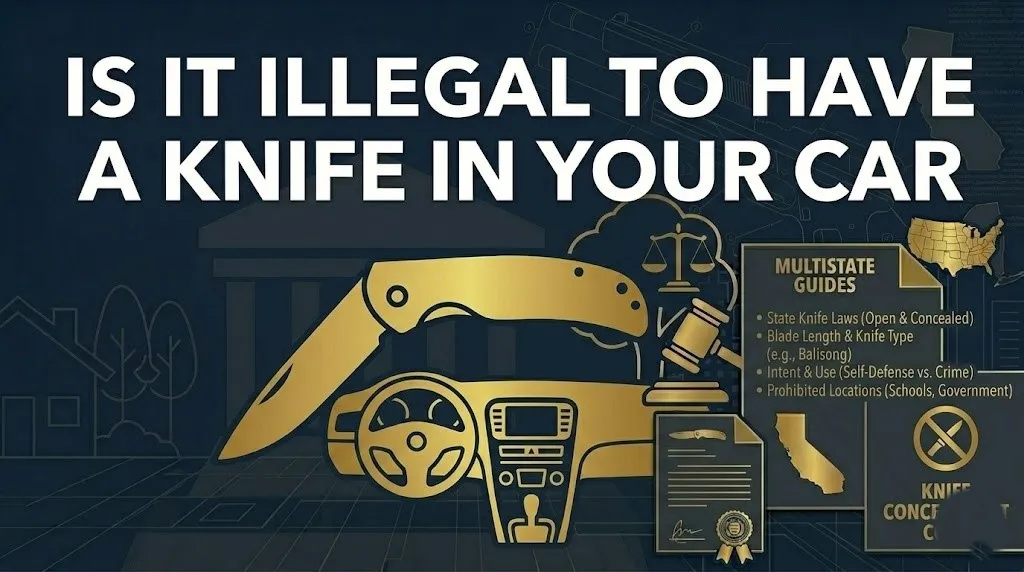
Is It Illegal to Have a Knife in Your Car
Having a knife in your car is legal in most U.S. states for most common knife types, but the legality depends entirely on the specific knife, the state you are in, and where and how the knife is stored in the vehicle. There is no federal law that prohibits Americans from keeping knives in their vehicles.
The general legal principle is that a knife stored openly in a vehicle, such as in plain sight on the seat, in a toolbox, or in a sheath clipped to a visor, is treated differently from a knife hidden in a glove box or tucked under a seat. Many states’ knife laws focus on “concealed carry,” which is the act of hiding a weapon on your person or within easy reach in a way that is not visible to others.
A vehicle creates a unique legal situation because the question of whether a knife is “concealed” in a car varies by state. Some states treat any knife in a vehicle as subject to open carry rules. Others specifically address vehicle carry in their weapon statutes.
Key factors that determine legality when carrying a knife in a vehicle:
- The type of knife (folding vs. fixed blade, automatic vs. manual)
- The blade length (many states have specific limits)
- Whether the knife is visible or hidden
- The state’s specific statutes on knives in vehicles
- Whether you are in a city or county with stricter local ordinances
- Your own criminal history (some people are prohibited from possessing knives)
Having a common pocket knife or utility knife in a glove box or center console is legal in most states, but a few states treat this as concealed carry of a weapon.
Is It Legal to Have a Knife in Your Car
Yes, having a knife in your car is legal throughout most of the United States for common knife types used in everyday life. No federal law prohibits vehicle knife possession, and most states specifically allow folding knives, pocket knives, and utility blades in vehicles without restriction.
The confusion arises because knife laws are some of the most patchwork and inconsistent regulations in American criminal law. What is perfectly legal in Texas might be a misdemeanor in California if you have the wrong blade length or knife type.
States with the broadest permissions for vehicle knife carry include Texas, Arizona, Oklahoma, Alaska, and most rural states with strong hunting and outdoor traditions. These states typically impose few if any restrictions on the type or length of knives you can keep in your vehicle.
States with the most restrictions on knives in vehicles include California, New York, Illinois, New Jersey, and Massachusetts. These states have specific rules about knife types, blade lengths, and how the knife must be stored to avoid a concealed carry violation.
The practical takeaway: a standard folding pocket knife or Swiss Army knife is legal to keep in your vehicle in every U.S. state. The restrictions kick in when you move to larger knives, fixed blades, automatic knives, or specific prohibited types like switchblades or gravity knives in certain states.
Is It Illegal to Have a Pocket Knife in Your Car
Having a pocket knife in your car is legal in all 50 states for reasonable blade lengths and non-prohibited folding knife designs. A standard pocket knife with a blade of 3 to 3.5 inches that folds into the handle is considered one of the least legally restricted personal items in American law.
No state has enacted a complete ban on pocket knives in vehicles. Even the most restrictive states like California and New York permit folding pocket knives in vehicles, provided they meet local blade length requirements.
The pocket knife category does have some limits worth knowing:
- “Automatic” folding knives (switchblades) are treated separately from manual folding knives in most states
- Assisted-opening folding knives occupy a gray area in some states
- Blade length limits can still apply even to folding knives in certain states
- A pocket knife that locks open may be treated differently from one that does not in some jurisdictions
Most pocket knife users have nothing to worry about from a legal standpoint. The average folding knife you would buy at a sporting goods store or hardware store falls well within what every state permits in a vehicle.
The exceptions tend to involve knives that have been modified from their factory configuration, knives with very long blades (over 4 inches in restrictive states), or knives with features that classify them differently than a standard pocket knife.
Key Takeaway: A standard pocket knife is legal to have in your vehicle in all 50 U.S. states. Legal complications begin when the knife has unusual features like automatic opening, is a prohibited type in your state, or has a blade length that exceeds your state’s limit.
Can You Have a Knife in Your Car
Yes, you can have a knife in your car in most circumstances across the United States. The more specific legal question is what kind of knife, in what state, stored in what way, and whether any of the specific prohibitions that do exist apply to your situation.
The broader legal principle is that vehicles are generally treated as an extension of the driver’s personal space under most state weapon laws. This means the same rules that apply to open carry on your person often apply to open carry in a vehicle, and the same concealed carry rules apply to hidden weapons in a vehicle.
States take three main approaches to vehicle knife carry:
- States that treat vehicle carry the same as personal carry (most common)
- States that specifically exempt vehicles from some knife restrictions, allowing more permissive car carry than personal carry
- States that treat vehicle carry as concealed carry by default, making it more restrictive
The third category is the most legally dangerous for drivers who assume that keeping a knife under the seat or in a glove box is automatically fine. In states like New York, keeping a gravity knife (which New York has historically defined broadly) in a vehicle in a concealed location has been used as grounds for arrest.
The safest approach in any state is to keep your knife visible and accessible for legitimate purposes, rather than hidden in enclosed storage areas where it could be interpreted as a concealed weapon.
What Knives Are Illegal to Have in Your Car
Several knife types are specifically prohibited in vehicles across multiple states, regardless of where they are stored or how they are carried. Understanding these prohibited categories is essential for anyone who keeps knives in their vehicle regularly.
The most commonly prohibited knife types in U.S. states include:
| Knife Type | Why Restricted | States With Bans |
|---|---|---|
| Switchblades/automatic knives | Automatically spring-open blade | California, New York, Illinois, New Jersey, and others |
| Gravity knives | Blade drops open by gravity/centrifugal force | New York (though law changed in 2019), some others |
| Ballistic knives | Blade fires from handle | Federal ban + most states |
| Balisong/butterfly knives | Considered switchblade in some states | California, Hawaii, some others |
| Dirks and daggers | Double-edged stabbing weapons | California, others |
| Stilettos | Very thin pointed stabbing knives | California, New York, others |
| Knives over specified blade length | Length restriction | Varies significantly by state |
Federal law specifically bans the interstate transport and sale of switchblades under the Federal Switchblade Act (15 U.S.C. 1241-1245), though this law has exceptions and does not directly prohibit individual possession in most contexts.
Some of these knife types are illegal to possess anywhere, not just in vehicles. Others are only illegal when carried concealed or in specific circumstances. The vehicle context matters because a knife that is legal to own might become illegal when carried concealed in a car.
Knife in Car Laws by State
Knife laws across states vary dramatically, from highly permissive to strict regulation of specific knife types and blade lengths. Here is a comprehensive overview of the key states and their vehicle knife rules:
| State | Blade Length Limit | Prohibited Types | Vehicle-Specific Rules | Key Statute |
|---|---|---|---|---|
| California | 2.5 inches (concealed) | Switchblades, dirks, daggers, balisong | Fixed blades must be open | PC 21310, 16470 |
| Texas | No general limit | Clubs (over 5.5 inch “location restricted”) | Generally permissive | Penal Code 46.01 |
| Florida | 4 inches (some areas) | Ballistic knives, concealed carry limits | Generally permissive | Statute 790.001 |
| New York | No specific limit | Gravity knives, stilettos, daggers | Concealed carry rules apply | Penal Law 265.01 |
| Illinois | No specific limit | Switchblades | Can carry in vehicle with valid reason | 720 ILCS 5/24-1 |
| Arizona | No limit | Few restrictions | Very permissive | ARS 13-3102 |
| Georgia | 5 inches | Concealed blades over 5 inches | Must be open or permitted | OCGA 16-11-126 |
These restrictions apply to adults with no criminal history. People with certain prior convictions may face stricter rules about any weapon possession, including knives.
Local ordinances in major cities can be significantly stricter than state law. New York City, Chicago, and Los Angeles have historically applied their knife laws more aggressively than their state laws suggest, and local prosecutors have more flexibility than many people realize.
Blade Length Limit in Car
Blade length limits for knives in vehicles vary by state from no limit at all to restrictions as short as 2.5 inches in California for concealed carry. Understanding your state’s specific blade length rules is one of the most practical things you can do to stay legal.
The most common blade length thresholds applied by states include:
- 2.5 inches: California’s limit for concealed knife carry (PC 21310)
- 3 inches: Common threshold in various jurisdictions for concealed carry
- 3.5 inches: Some cities and counties use this as their limit
- 4 inches: Florida and Georgia use this for certain contexts
- 5 inches: Georgia’s limit for open carry; Texas previously had limits in this range
- No limit: Arizona, Alaska, Texas (for most knives), and many other states
The blade length measurement itself can be contested. Most states measure from the tip of the blade to where the blade meets the handle, not including any ricasso (unsharpened portion near the handle). But definitions vary, and officers sometimes measure differently.
A crucial practical point: blade length limits almost always apply to the concealed carry context, not to open carry or possession at home. A knife that is too long to carry concealed may still be legal to have in your car if it is stored openly and visibly.
Keeping your knife in a sheath clipped to a visor, lying on the passenger seat, or stored in an open toolbox generally means it is not “concealed” and blade length limits are less likely to apply, depending on your state.
Is It Illegal to Have a Switchblade in Your Car
Switchblades are illegal to possess in many states, and having one in your car in those states is a criminal offense regardless of where it is stored or how it is intended to be used. The Federal Switchblade Act (15 U.S.C. 1241-1245) bans interstate commerce in switchblades but does not directly prohibit individual possession in most situations, leaving that to state law.
States that specifically ban switchblade possession include California (Penal Code 21510), New York (Penal Law 265.01), New Jersey (N.J.S.A. 2C:39-3), Illinois (720 ILCS 5/24-1), and several others. In these states, having a switchblade in your car is a criminal offense even if the knife is in the trunk.
States that permit switchblade possession under certain conditions include Texas (allowed since 2017), Arizona, Alaska, and others that have liberalized their knife laws in recent years.
Key facts about switchblades and vehicles:
- In ban states, the car location does not matter: any possession is illegal
- Some states ban switchblades but allow assisted-opening knives, which can look similar
- The distinction between automatic and assisted-opening is legally significant
- Law enforcement officers are trained to recognize the difference
- First-time possession charges in most states are misdemeanors
In California, possessing a switchblade with a blade 2 inches or longer is a misdemeanor under Penal Code 21510, with penalties up to 6 months in jail and a $1,000 fine.
Is It Legal to Have a Hunting Knife in Your Car
Having a hunting knife in your car is legal in the vast majority of states when the knife is stored openly and is not concealed. Hunting knives are among the most widely accepted knife types in American law because of their clear practical and traditional use, but blade length and storage location still matter in restrictive states.
Hunting knives are typically fixed-blade knives with blades ranging from 3 to 6 inches or longer. This blade length creates legal considerations in states like California, where concealing a fixed-blade knife of any length is a criminal offense under Penal Code 21310 regardless of its intended use.
The key legal rules for hunting knives in vehicles:
- Most states allow hunting knives in vehicles without restriction
- California specifically prohibits concealing any dirk or dagger (which includes large fixed blades) in a vehicle
- New York focuses on the knife’s specific design rather than calling it a “hunting knife”
- States with hunting traditions (Texas, Montana, Wyoming, etc.) are highly permissive
- Federal lands and national parks may have their own rules independent of state law
The practical approach: if you transport a hunting knife to and from hunting trips, keep it in a case, sheath, or bag that is not immediately accessible for use as a weapon. This factual pattern demonstrates the legitimate purpose of the knife and reduces the risk of a concealed weapon interpretation.
Key Takeaway: Hunting knives are broadly legal to have in vehicles across the U.S. when stored openly or in hunting gear. The legal risk increases in California and states with strict concealed carry rules for fixed-blade knives, where any hidden fixed blade can be treated as illegal concealed carry.
Can You Have a Fixed Blade Knife in Your Car
Fixed blade knives are legal to keep in vehicles in most states, but they face stricter rules than folding knives in several jurisdictions because they cannot be folded away and are considered more immediately dangerous. The concealment issue is more pronounced with fixed blades than with folding knives.
Fixed blade knives include hunting knives, tactical knives, kitchen knives, and utility blades that have a blade permanently extended from the handle. The legal distinction between fixed and folding is meaningful in states like California and Hawaii.
California is the most significant example. California Penal Code 21310 makes it illegal to carry any dirk or dagger (which California broadly defines to include most large fixed-blade knives) in a concealed manner. A fixed blade knife in a glove box, under a seat, or in a zipped bag in a California vehicle creates criminal liability under this statute.
Compare this to Texas, where fixed blade knives are almost entirely unrestricted for vehicle carry, with no concealed carry license required and no blade length limit for most knife types in most locations.
Fixed blade knife rules by state:
| State | Fixed Blade in Vehicle | Concealment Rule | Penalty |
|---|---|---|---|
| California | Legal if open/visible | Concealment = misdemeanor | Up to 1 year jail |
| Texas | Legal with minimal restrictions | Generally permissive | Varies by context |
| Florida | Legal with some limits | Concealed over 4 inches is an issue | Misdemeanor |
| New York | Depends on knife design | Concealment rules apply | Class A misdemeanor |
| Arizona | Highly permissive | Few restrictions | Rarely charged |
Is It Illegal to Have a Knife in Your Car in California
Having a knife in your car in California can be illegal depending on the type of knife and how it is stored. California has some of the strictest knife laws in the United States, and the vehicle context does not provide any automatic legal protection for knife types that are prohibited or storage methods that count as concealed carry.
Specific California vehicle knife rules:
- Folding knives with blades under 2.5 inches: Legal to carry concealed in a vehicle
- Folding knives with blades over 2.5 inches: Illegal to carry concealed in a vehicle (PC 21310 applies to concealed carry of large folding knives)
- Fixed blade knives of any size: Illegal to carry concealed in a vehicle under PC 21310 (the dirk/dagger rule)
- Switchblades with blades 2 inches or longer: Illegal anywhere in California, including in a vehicle (PC 21510)
- Balisong/butterfly knives: Illegal in California as a switchblade equivalent
The California concealed carry analysis means that keeping a large folding knife in your glove box, under your seat, or in a closed bag can result in a misdemeanor charge even if the knife is otherwise legal to own.
California Penal Code 21310 classifies concealed carry of a dirk or dagger as a misdemeanor with penalties up to 1 year in county jail and a fine up to $1,000.
Officers enforcing this law have significant discretion, but the statute gives them authority to arrest for what many people would consider routine vehicle storage of a common knife.
Is It Illegal to Have a Knife in Your Car in Texas
Having a knife in your car in Texas is legal in almost all circumstances under Texas’s generally permissive knife laws. Texas significantly liberalized its knife statutes in 2017, eliminating many of the blade length restrictions and knife type bans that previously existed, while creating a specific category of “location-restricted” knives for certain venues.
Current Texas vehicle knife rules:
- All folding knives: Legal to keep in your car without restriction
- Fixed blade knives of any legal size: Legal to keep in your car
- Knives with blades over 5.5 inches: Classified as “location-restricted knives” in Texas, meaning they cannot be carried in or near schools, churches, amusement parks, or sporting events, but they are legal in your vehicle
- Switchblades: Legal in Texas since the 2017 law change
- Balisong/butterfly knives: Legal in Texas
Texas Penal Code 46.01 defines weapons, and the 2017 changes under House Bill 1935 removed most common knives from the list of prohibited weapons. This was a significant liberalization that made Texas one of the most knife-friendly states in the country.
In Texas, you can legally keep a hunting knife, pocket knife, switchblade, or virtually any other knife in your vehicle without a permit or special authorization, with only limited exceptions for location-restricted areas.
The only Texas knife-related concern for vehicle carriers is traveling through other states. A switchblade that is perfectly legal in Texas becomes illegal as soon as you drive into California or New York. Cross-state travel with knives requires understanding the laws of each state you pass through.
Is It Illegal to Have a Knife in Your Car in Florida
Having a knife in your car in Florida is legal for most common knife types, but Florida’s knife laws have some specific restrictions that can catch people off guard, particularly around concealed carry rules and certain knife designs. Florida is generally considered a permissive state for knife carry but not as permissive as Texas.
Florida Statute 790.001 defines weapons, and Florida Statute 790.01 governs concealed carry. The key Florida rules for vehicle knife carry:
- Common pocket knives with ordinary handles: Generally legal to carry concealed
- Fixed blade knives with blades over 4 inches: Illegal to carry concealed without a concealed weapon license
- Switchblades: Florida does not have a general switchblade ban, making them legal to possess
- Ballistic knives: Illegal in Florida
- Concealed weapon license holders: May carry most legal knives that fit under the license
Florida’s concealed weapon license does cover knives for those who have one. This means a knife that would otherwise be a concealed carry violation can be carried legally by a licensed individual.
The vehicle-specific concern in Florida is the concealed carry rule applied to knives. A large knife (fixed blade over 4 inches) stored in a closed glove box or bag might be treated as concealed carry, which without a license is a criminal offense.
Florida Statute 790.01 makes unlicensed concealed carry of a weapon a first-degree misdemeanor in Florida, with penalties up to 1 year in jail and a $1,000 fine.
Is a Knife Considered a Concealed Weapon in a Car
Whether a knife is considered a concealed weapon in a car depends entirely on state law and the specific circumstances of how the knife is stored. This is the single most legally important question for vehicle knife carry, because it determines whether possession becomes concealed carry of a weapon.
The general legal principle across states is that a weapon is “concealed” when it is hidden from ordinary observation and not visible to a person who approaches or encounters the vehicle. A knife in plain sight on the seat is not concealed. A knife in a zipped bag under the seat is likely concealed.
How vehicle courts typically analyze concealment:
| Storage Location | Generally Concealed? | Legal Risk Level |
|---|---|---|
| On the seat, visible | No | Low |
| In a dashboard cup holder | No | Low |
| In an open toolbox in the bed | No | Low |
| In a closed glove box | Usually yes | Higher |
| Under the seat | Usually yes | Higher |
| In a closed bag or case | Usually yes | Higher |
| In a locked container | Varies by state | Depends |
California, New York, and Illinois apply their concealed carry rules to vehicles. Texas and Arizona generally do not treat vehicle carry as concealed carry in the same way.
The practical advice: if you want to avoid any concealed carry issue with your vehicle knife, keep it in plain sight when officers might be around, use a visible sheath, or store it in an open container rather than a closed one.
What Happens if Police Find a Knife in Your Car
When police find a knife in your car during a traffic stop or vehicle search, the outcome depends on the type of knife, where it was stored, your state’s laws, and the officer’s discretion. Most encounters involving common legal knives end without any charges.
The sequence of events typically follows this pattern:
- Officer spots or discovers the knife during the stop
- Officer assesses the knife type and where it was found
- Officer may ask about the knife’s purpose (you have the right to remain silent on this)
- Officer determines whether the knife appears to violate any law
- Officer either notes the knife and continues, or runs a more detailed check
For knives that are clearly legal in that state (a pocket knife on the seat in Texas, for example), officers typically note the presence and move on without any legal action. For knives that raise questions (a large fixed blade in a closed bag in California), the officer has discretion to issue a citation, make an arrest, or let it go depending on the totality of circumstances.
What you should not do when an officer finds a knife:
- Do not volunteer information about why you have it without considering your right to remain silent
- Do not make reaching movements toward the knife
- Do not claim the knife is for self-defense (this often increases officer concern)
- Do not argue about your rights at the scene; that is for court
The phrase “it is for self-defense” is legally counterproductive in most knife encounters. Self-defense is a legal defense to using the weapon, not a justification for concealed carry of a restricted weapon.
Penalty for Having an Illegal Knife in Your Car
The penalty for having an illegal knife in your car ranges from a small fine for minor violations to a felony charge for certain prohibited knife types or aggravating circumstances. The severity depends on the specific violation and the state’s classification of the offense.
Common penalty ranges by violation type:
| Violation Type | Typical Classification | Fine Range | Jail Time |
|---|---|---|---|
| Concealed carry of legal knife without license | Misdemeanor | $500 to $1,000 | Up to 1 year |
| Possession of prohibited knife (switchblade, etc.) | Misdemeanor | $500 to $2,000 | Up to 1 year |
| Felony weapons possession (prior conviction, etc.) | Felony | $1,000 to $10,000+ | 1 to 5 years |
| Possession during commission of another crime | Felony enhancement | Added penalties | Additional years |
State-specific first offense penalties for common vehicle knife violations:
| State | Violation | Max Penalty |
|---|---|---|
| California | Concealed dirk/dagger (PC 21310) | 1 year county jail, $1,000 fine |
| New York | Possession of prohibited weapon | Class A misdemeanor, 1 year |
| Florida | Concealed knife without license | First-degree misdemeanor, 1 year |
| Illinois | Unlawful use of a weapon | Class A misdemeanor to felony |
A prior criminal conviction, particularly a felony, significantly changes the penalty analysis in most states. People with certain prior convictions may be prohibited from possessing any knife that qualifies as a weapon, and violation of that prohibition typically results in felony charges.
Key Takeaway: Most first-time knife violations in a vehicle result in misdemeanor charges with fines and potential jail time under 1 year. The charge escalates to a felony when the person has prior convictions, when the knife was used or displayed threateningly, or when certain specifically prohibited knife types are involved.
Can Police Search Your Car for a Knife
Police can search your car for a knife in specific circumstances, but not simply because they want to or because they suspect you might have one. The Fourth Amendment protects against unreasonable searches, and law enforcement needs legal justification to search a vehicle.
Legal justifications that allow a vehicle search include:
- Plain view: If the officer can see the knife from outside the vehicle, they can retrieve and examine it without a separate search
- Consent: If you voluntarily agree to a search, they can look anywhere in the vehicle
- Probable cause: If the officer has specific facts suggesting the vehicle contains evidence of a crime
- Search incident to arrest: If you are arrested, the officer can search the immediate area
- Warrant: Police can obtain a search warrant if they establish probable cause to a judge
The plain view doctrine is the most common way knife discoveries happen. An officer who can see a knife on the passenger seat, dashboard, or visible through the window has legal authority to observe it, identify it, and take action if it appears to be illegal.
You have the right to refuse a vehicle search if the officer does not have one of the above justifications. You can politely state “I do not consent to a search” without physically interfering with any search the officer conducts anyway (if they do search without your consent, that is an issue for your attorney to challenge in court, not something to physically resist).
Refusing a search does not give the officer permission to search. It does preserve your ability to challenge the search later if one happens anyway.
Frequently Asked Questions
Is it legal to keep a knife in your car in the United States?
Yes, keeping a knife in your car is legal throughout the United States for most common knife types stored in accessible locations.
No federal law prohibits vehicle knife possession, and most states allow folding knives and most hunting knives in vehicles.
The exceptions involve prohibited knife types like switchblades in certain states, blade length violations when a knife is concealed, and specific state rules about fixed-blade knives stored in hidden locations.
What blade length is legal in a vehicle in most states?
There is no single nationwide blade length limit for vehicle knife carry.
Most states have no blade length limit for knives kept openly in vehicles, but concealment restrictions in states like California apply to blades over 2.5 inches.
The safest approach is to keep your knife visible in your vehicle to avoid any concealed carry interpretation, which eliminates the blade length issue in most states.
Is a knife in your car considered a concealed weapon?
Whether a knife in your car is a concealed weapon depends on your state’s law and how the knife is stored.
A knife hidden in a closed glove box, under a seat, or in a zipped bag is more likely to be treated as concealed carry in states that regulate vehicle concealment.
A knife stored visibly on the seat, in an open holder, or in plain view is generally not considered concealed in any state.
What happens if a police officer finds a knife in your car?
When an officer finds a knife in your car, the outcome depends on the knife type, your state’s laws, and where the knife was stored.
For common legal knives stored openly, most officers note the knife and continue the stop without further action.
For knives that may violate the law, the officer may issue a citation or make an arrest depending on the specific violation and their discretion.
Are switchblades legal to have in a vehicle?
Switchblades are legal in some states and illegal in others, with the vehicle context making no difference to that basic legal status.
States that ban switchblade possession include California, New York, New Jersey, Illinois, Hawaii, and several others.
States that permit switchblades include Texas (since 2017), Arizona, Alaska, and others that have liberalized their knife laws in recent years.
Vehicle knife laws in 2026 remain some of the most varied and confusing areas of American criminal law. The difference between a legal and illegal knife in your car often comes down to blade length, knife type, and how it is stored rather than the act of possession itself.
Bookmark this page before traveling across state lines with a knife in your vehicle. State rules change, and what is legal at home may become a violation the moment you cross into another state.






