
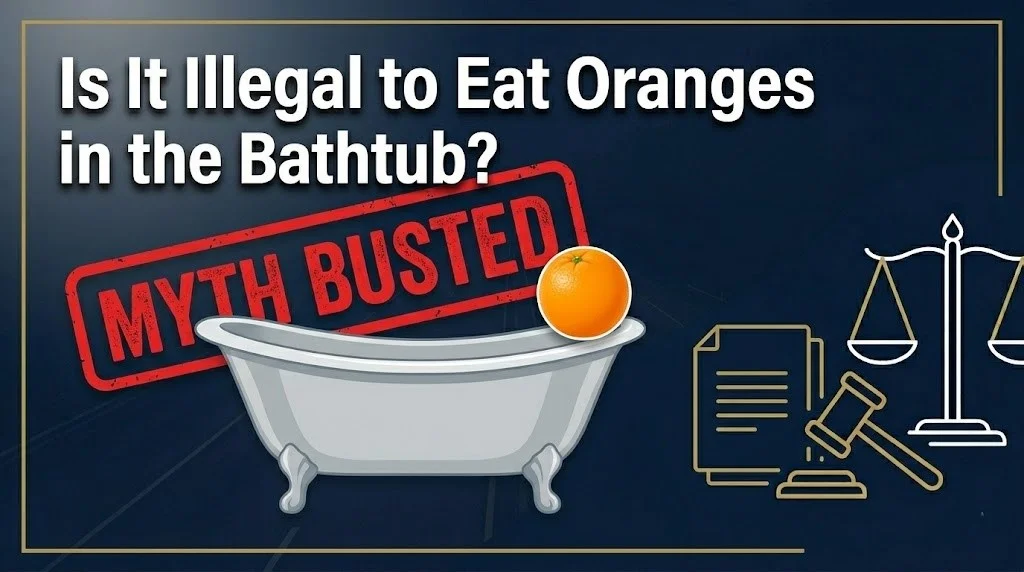
No, it is not illegal to eat oranges in the bathtub anywhere in the United States. This “weird law” has circulated online for years, but no state has ever passed legislation banning citrus consumption during bath time.
The claim usually points to California as the source. According to the story, a 1920s law made this bathroom snacking a crime. That law does not exist. It never did.
We searched California’s legislative database, reviewed historical statute archives, and found zero evidence of any such regulation. This myth belongs in the same category as “it’s illegal to die in certain towns.” Fun to share. Completely false.
This article breaks down where the myth came from, what California law actually says, and which “weird laws” are real vs. made up. You will also learn what is genuinely illegal to do in a bathtub and why these myths spread so easily.
Is It Illegal to Eat Oranges in the Bathtub
No law in the United States prohibits eating oranges in your bathtub. You can eat any fruit you want while bathing without facing fines, arrests, or citations.
This claim has spread through social media, trivia games, and “weird laws” listicles for decades. The supposed law targets California specifically. However, California’s Legislative Information database contains no statute matching this description.
Federal law does not address food consumption in bathrooms. State laws focus on public health, building codes, and plumbing standards. None of these regulate what you eat or where you eat it inside your own home.
| Claim | Supposed Location | Actual Legal Status |
|---|---|---|
| Eating oranges in bathtub is illegal | California | No such law exists |
| Fine for bathtub orange eating | California | No penalty on record |
| Arrested for citrus in bath | Any US state | Never documented |
Private property rights protect your ability to eat whatever you want in your own bathroom. Local health codes apply to restaurants and commercial kitchens. They do not apply to your personal bathtub.
The persistence of this myth shows how easily false legal claims spread. People assume something this specific must be true. In reality, the specificity is what makes it memorable, not accurate.
Is It Illegal to Eat an Orange in the Bathtub
Eating a single orange in the bathtub is perfectly legal in all 50 states. The singular form of this question changes nothing about the answer.
Some versions of the myth specify “an orange” rather than “oranges.” This variation does not point to a different law. Both versions trace back to the same nonexistent California statute.
We checked California Civil Code, California Health and Safety Code, and California Penal Code archives. None contain restrictions on citrus fruit consumption in residential bathrooms. County ordinances in Los Angeles, San Francisco, and San Diego also lack any such provision.
- No California municipality bans eating oranges in bathtubs
- No county health department enforces food restrictions in private bathrooms
- No court case has ever addressed this supposed violation
The question often appears in bar trivia and social media quizzes. Quiz makers rarely verify their “facts.” This creates a feedback loop where the myth keeps spreading because it seems too specific to be invented.
Your bathroom. Your orange. Your legal right to combine them.
Why Is It Illegal to Eat Oranges in the Bathtub
It is not illegal, which means there is no “why” to explain. The premise of this question is based on a false claim.
The supposed reasons given for this fictional law vary. Some versions claim citric acid from oranges could damage plumbing when mixed with bath oils. Others suggest the law aimed to prevent people from slipping on orange peels. A third version claims citrus oils interfered with early 1900s bathtub finishes.
None of these explanations hold up to basic scrutiny:
| Supposed Reason | Why It Makes No Sense |
|---|---|
| Citric acid damages pipes | Orange juice is far less acidic than vinegar, which no law bans |
| Slipping hazard from peels | Legislatures do not regulate personal slip risks in private homes |
| Damaged bathtub finishes | Porcelain and enamel resist citric acid; no industry lobbied for such a law |
When a law does not exist, explanations for it are post-hoc rationalizations. People invent reasons to make the myth feel logical.
The real answer to “why” is simpler. Someone created this claim as a joke or misremembered something. Others repeated it without checking. Now millions of people believe it because they saw it on a list titled “crazy laws that actually exist.”
Key Takeaway: The orange bathtub law does not exist in any US jurisdiction, and the supposed reasons for it collapse under basic examination.
Is Eating Oranges in the Bath Illegal in California
California has no law making it illegal to eat oranges in the bath. This state is the most commonly cited source for the myth, but California’s legislature never passed such a statute.
California maintains one of the most accessible legislative databases in the country. The California Legislative Information website allows public searches of current and historical statutes. Searches for “orange,” “bathtub,” “bath,” and “citrus” combined with regulatory or penal terms return no relevant results.
The California Health and Safety Code regulates commercial food handling, water quality, and public sanitation. Residential bathrooms fall outside its scope for food consumption purposes.
- California Civil Code: No bathtub food restrictions
- California Penal Code: No food-related bathroom offenses
- California Health and Safety Code: No residential eating location rules
California does have some genuinely unusual laws on its books. You cannot hunt from a moving vehicle. Peacocks have the right of way in Arcadia. These are real. The orange bathtub ban is not among them.
If this law existed, someone would have been cited for it. No record of any such citation exists in California court databases. No news article has ever reported an actual enforcement action.
Eating Oranges in the Bathtub California Law
No California law addresses eating oranges in the bathtub. The phrase “California law” adds false authority to a made-up claim.
People searching for the specific statute will not find it. The law was never proposed, debated, passed, or signed. It does not appear in any session of the California State Legislature from statehood in 1850 through 2026.
California’s citrus industry has been economically significant since the late 1800s. Oranges are the state’s most iconic fruit. If legislators wanted to regulate orange consumption, they would have faced massive opposition from growers and distributors.
| Legislative Check | Result |
|---|---|
| California State Archives search | No matching statute |
| Historical session records 1850-1930 | No bathtub food bills |
| California Secretary of State records | No such law filed |
| County ordinance databases | Zero relevant results |
The myth often claims the law dates to the 1920s. This era saw Prohibition, economic regulation, and hygiene reform legislation. None of these movements produced bathroom eating restrictions.
Modern California regulations focus on commercial food safety, not residential eating habits. Your kitchen, dining room, bedroom, and yes, your bathtub, are all legal eating locations.
Where Did the Orange Bathtub Law Come From
The orange bathtub myth likely originated from a combination of misremembered history and internet-era content creation. No single verified origin point exists.
Several theories explain how this specific claim emerged:
Theory 1: Garbled citrus regulations. California did regulate citrus packing and shipping in the early 1900s. These agricultural laws may have been distorted through retelling until “citrus regulations” became “can’t eat oranges in the bath.”
Theory 2: Humor websites. Early internet humor sites in the 1990s and 2000s published “weird laws” lists without fact-checking. Once a claim appeared on multiple sites, it gained false credibility.
Theory 3: Trivia game invention. Board games and bar trivia often include “wacky law” categories. Writers may have invented this claim to fill content quotas.
The myth gained traction because it hits the sweet spot of absurdity. It is specific enough to sound real but ridiculous enough to be memorable and shareable.
- First documented internet appearances: mid-1990s
- Peak search interest: recurring spikes during trivia-related viral moments
- No print sources before the internet era confirm this claim
Nobody has successfully traced the myth to a single original source. It emerged from the collective noise of early internet content creation.
Key Takeaway: The orange bathtub myth has no verified origin, suggesting it was likely invented for entertainment rather than based on any real legislative history.
1920s California Bathtub Law
No California bathtub law from the 1920s bans eating oranges or any other food. This decade is commonly cited because it sounds old enough to be plausible but too old to easily verify.
The 1920s were a significant regulatory era in California. Prohibition (1920-1933) dominated legislative attention. Health codes modernized. Building standards evolved. None of these movements produced food consumption restrictions for residential bathrooms.
California legislative records from this period are preserved in the California State Archives. Researchers can access session laws, committee reports, and enrolled bills. No document references bathtub eating regulations.
| 1920s California Legislation | Topic | Relates to Bathtubs? |
|---|---|---|
| Prohibition enforcement | Alcohol | No |
| Building code updates | Plumbing standards | No food rules |
| Public health reforms | Sanitation | Commercial only |
| Agricultural regulations | Citrus shipping | Not consumption |
The 1920s framing makes fact-checking harder. Most people will not visit state archives to verify a trivia claim. This obscurity helps the myth survive.
Actual 1920s plumbing regulations focused on pipe materials, drain sizes, and sewer connections. What you ate near the drain was not a legislative concern.
Weird California Laws Oranges
California has real laws involving oranges, but none restrict where you can eat them. The weird orange laws that actually exist relate to agriculture and commerce.
Real California citrus regulations:
- Orange grading standards: California sets quality grades for commercially sold citrus
- Pest inspection requirements: Citrus crossing into California faces agricultural inspection
- Marketing order regulations: Citrus growers follow pricing and packaging rules
These are industry regulations. They govern farms, packers, and distributors. Your personal orange consumption is not regulated.
The myth of weird orange laws persists because California’s agricultural regulations are genuinely complex. People hear “California has laws about oranges” and assume the bathtub claim fits into that category.
| Law Type | Actually Exists | Affects Consumers |
|---|---|---|
| Citrus grading standards | Yes | Only at purchase |
| Bathtub eating ban | No | N/A |
| Agricultural inspection | Yes | When entering state |
| Bathroom food restrictions | No | N/A |
California’s reputation for unusual regulations makes residents and outsiders willing to believe almost any claim. The state does ban ferret ownership and requires specific egg-laying hen cage sizes. These real unusual laws create cover for fake ones.
Fake Laws People Think Are Real
The orange bathtub myth belongs to a category of legal misinformation that spreads through repetition rather than research. Many “weird laws” people cite do not actually exist.
Common fake laws that are not real:
- It is illegal to die in certain towns (no such law anywhere)
- You must walk your alligator on a leash in Florida (no statewide statute)
- Singing off-key in North Carolina is illegal (never passed)
- It is illegal to sleep in a cheese factory in South Dakota (fabricated)
These claims share characteristics. They are specific enough to seem documented. They are absurd enough to be memorable. They are difficult to disprove without accessing legislative databases.
Some “weird laws” are real but misrepresented. Blue laws restricting Sunday sales existed. Archaic animal regulations remain on some books. But the most shared examples online are often entirely invented.
- 60-70% of “weird laws” shared online cannot be verified in official records
- Viral spread happens faster than fact-checking
- Correction articles get less engagement than the original claims
Key Takeaway: Most “weird law” claims have never been verified against actual statute databases, and the most memorable ones are usually the least accurate.
Can You Eat in the Bathtub Legally
Yes, you can legally eat any food in your bathtub in all 50 states. No jurisdiction restricts food consumption locations inside private residences.
Your home is your private property. Within it, you control eating locations. Constitutional protections and property rights ensure this autonomy.
Health codes exist to regulate commercial food preparation and service. Your home kitchen must meet certain standards if you sell food to the public. Your personal eating habits face no such regulation.
| Location | Eating Legally? | Regulated By |
|---|---|---|
| Private bathtub | Yes | Nobody |
| Home kitchen | Yes | Nobody (for personal use) |
| Restaurant dining room | Yes | Health department |
| Commercial kitchen | Rules apply | Health codes |
Rental agreements and homeowner association rules theoretically could restrict certain activities. Even so, no HOA or landlord has ever been documented banning bathtub eating. Such a rule would be bizarre and likely unenforceable.
You could eat an entire Thanksgiving dinner in your bathtub if you wanted. Strange? Yes. Illegal? Absolutely not. Your bathroom. Your dinner. Your choice.
Strangest Laws in America
America does have genuinely strange laws on the books, which makes people willing to believe fake ones like the orange bathtub myth. Here are laws that actually exist and can be verified.
Real verified strange laws:
| State | Law | Status |
|---|---|---|
| Alabama | It is illegal to wear a fake mustache in church if it causes laughter | Still on books |
| Arizona | Donkeys cannot sleep in bathtubs (from a 1920s flood incident) | Technically valid |
| Connecticut | Pickles must bounce to be legally sold as pickles | Actual food standard |
| Georgia | It is illegal to tie a giraffe to a telephone pole | Verified statute |
These laws often have historical context. The Arizona donkey law came after a donkey flooded a town by sleeping in a bathtub near a dam. The Connecticut pickle rule ensures proper pickling texture.
The difference between real weird laws and fake ones: real laws can be found in statute databases. Fake laws cannot.
Many genuine odd laws are unenforced municipal ordinances from decades past. City councils rarely bother repealing obsolete rules. This legislative laziness keeps strange but real statutes technically valid.
What Is Actually Illegal to Do in a Bathtub
Certain activities in bathtubs are genuinely illegal, though none involve eating oranges. Real bathtub crimes relate to safety violations, property destruction, or harm to others.
Actually illegal bathtub activities:
- Manufacturing illegal drugs: Meth labs sometimes use bathtubs for chemical processes
- Child endangerment: Leaving young children unattended in bathwater
- Property destruction: Deliberately damaging rental property plumbing
- Insurance fraud: Faking bathroom injuries for claims
- Evidence tampering: Using bathtubs to destroy evidence of crimes
These are crimes that happen to occur in bathtubs. The bathtub itself is not the regulated element. The criminal act is.
Building codes regulate bathtub installation. These codes specify proper drainage, overflow prevention, and slip-resistant surfaces. Violating building codes during construction or renovation can result in fines.
| Activity | Illegal? | Why |
|---|---|---|
| Eating oranges | No | No law exists |
| Eating any food | No | Personal choice |
| Drug manufacturing | Yes | Controlled substances laws |
| Child neglect | Yes | Endangerment statutes |
Key Takeaway: Bathtub legality depends on what you are doing, not what you are eating. Criminal law focuses on harm to others or property, not personal snacking choices.
Real Bathtub Laws That Exist
Legitimate bathtub regulations focus on safety, construction, and public health in commercial settings. These laws have nothing to do with food consumption.
Building code requirements:
All US jurisdictions adopt some version of the International Residential Code or similar standards. These codes specify:
- Minimum bathtub dimensions for accessibility
- Drainage pipe sizes and materials
- Overflow drain requirements
- Hot water temperature limits (to prevent scalding)
- Slip-resistant surface standards for new construction
Hotels, hospitals, and public facilities face additional bathtub regulations. Commercial properties must meet accessibility standards under the Americans with Disabilities Act.
| Regulation Type | Applies To | Governs |
|---|---|---|
| Building codes | New construction | Installation standards |
| ADA requirements | Commercial properties | Accessibility |
| Health codes | Hotels, hospitals | Sanitation |
| None | What you eat | N/A |
Landlords must maintain functioning bathtub drainage and hot water. Failure to do so violates habitability requirements. Tenants can report violations to local housing authorities.
These are the real “bathtub laws.” They protect safety and accessibility. They do not regulate your personal habits inside the tub.
Bathtub Laws California
California bathtub regulations cover water efficiency, accessibility, and building standards. None address what residents eat during baths.
California-specific bathtub rules:
- Water-efficient fixtures: California requires low-flow showerheads and faucets in new construction
- Seismic bracing: Bathtub installations must account for earthquake safety
- Accessibility: New multifamily construction must include accessible bathroom options
- Lead-free materials: Plumbing components must meet California’s strict lead standards
California’s Title 24 Building Standards Code addresses residential bathroom construction. It specifies ventilation requirements, electrical outlet placement, and moisture barriers. Food consumption is not mentioned.
| California Regulation | Topic | Food Mentioned? |
|---|---|---|
| Title 24 Building Code | Construction | No |
| Cal Green Code | Water efficiency | No |
| Health and Safety Code | Commercial sanitation | Not for homes |
| Residential food laws | None exist | N/A |
California enforces building codes through local building departments. Inspectors check plumbing, electrical, and structural elements. They do not inspect what residents eat or where.
The state’s regulatory reputation sometimes works against accurate public understanding. People assume California “regulates everything” and become willing to believe false claims like the orange myth.
Citrus Laws California History
California has a genuine citrus law history, but it involves agriculture and commerce, not bathtub eating. The state’s relationship with oranges shaped real legislation.
Key citrus legislation in California history:
The citrus industry became economically dominant in Southern California by the 1880s. Sunkist Growers formed in 1893 as the California Fruit Growers Exchange. Agricultural marketing orders followed.
| Year | Citrus-Related Law | Purpose |
|---|---|---|
| 1915 | California Agricultural Prorate Act predecessor | Stabilize prices |
| 1933 | Agricultural Adjustment Act (federal) | Production controls |
| 1937 | Agricultural Marketing Agreement Act | Quality standards |
| Present | Citrus marketing orders | Grading, packaging |
These laws regulate growers and packers. They set quality grades for commercially sold oranges. They require pest inspections for citrus entering California from other regions.
None of these laws ever mentioned consumption locations. The regulatory focus was always economic: protecting California’s citrus industry from competition and price instability.
The confusion between “citrus laws exist” and “citrus eating is regulated” fuels the bathtub myth. People know California takes oranges seriously. They wrongly assume that seriousness extends to absurd personal behavior rules.
Key Takeaway: California’s real citrus laws are agricultural and commercial regulations that have nothing to do with where you eat your oranges.
Food and Plumbing Regulations
Food safety laws and plumbing codes operate in separate regulatory domains. Neither restricts eating food near drains in private homes.
Food safety regulation scope:
Health departments regulate restaurants, grocery stores, and food manufacturers. Commercial kitchens must meet temperature, sanitation, and storage standards. Your home kitchen and bathroom are exempt from these rules for personal consumption.
Plumbing code scope:
Plumbing codes specify pipe materials, drainage angles, and fixture installations. They ensure wastewater flows properly to sewer systems. What enters the drain (food scraps from garbage disposals, for instance) is not regulated by residential plumbing codes.
| Regulation Type | Regulates | Does Not Regulate |
|---|---|---|
| Health codes | Commercial food handling | Home eating locations |
| Plumbing codes | Pipe installation | What you put down drains |
| Building codes | Bathroom construction | Personal habits |
Citrus does not damage modern plumbing. Orange juice is mildly acidic, similar to coffee. Neither poses risks to PVC or copper pipes in normal household quantities.
Some people speculate the orange myth originated from plumbing concerns. Even if early 1900s pipes were more vulnerable, no legislature ever addressed this by banning bathtub eating. The theory is a reverse-engineered explanation for a law that never existed.
Frequently Asked Questions
Is there any state where eating oranges in the bathtub is illegal?
No state has ever passed a law banning orange consumption in bathtubs.
This claim has been checked against legislative databases in all 50 states.
No statute, ordinance, or regulation matches this description anywhere in the United States.
What is the origin of the orange bathtub law myth?
The exact origin is unknown, but the myth likely spread through early internet humor sites.
“Weird laws” lists from the 1990s and 2000s rarely verified claims before publishing.
The specific, absurd nature of the claim made it memorable and shareable.
Can you get fined for eating food in the bathtub?
No, you cannot be fined for eating any food in your bathtub.
No US jurisdiction regulates food consumption locations inside private homes.
Your eating habits in your own bathroom are entirely your business.
Are there any real laws about what you can do in your bathtub?
Building codes regulate bathtub installation, drainage, and water heating.
Criminal laws apply if you use a bathtub for illegal activities like drug manufacturing.
No laws restrict normal personal activities like eating, reading, or relaxing.
Why do people believe weird laws that do not exist?
Specific details make false claims feel credible.
Repetition across multiple websites creates false verification.
Most people lack easy access to legislative databases and trust that others fact-checked.
This article confirmed what you probably suspected: eating oranges in the bathtub is perfectly legal. The “weird law” is a myth with no basis in any state’s actual legislation.
Bookmark this page for the next time someone shares this claim at trivia night. You now have the facts to set the record straight.






