
Buying a gun for someone else is sometimes perfectly legal. But do it wrong, and you’re looking at a federal felony with up to 15 years in prison.
That line between a thoughtful gift and a serious crime is thinner than most people realize. In 2022, Congress passed a law that created a brand-new federal crime specifically targeting this kind of purchase. Millions of Americans still don’t know it exists.
This guide breaks down exactly when buying a gun for someone else crosses into illegal territory, what the law says now, how the rules differ by state, and how to do it right if you want to stay on the correct side of federal law.
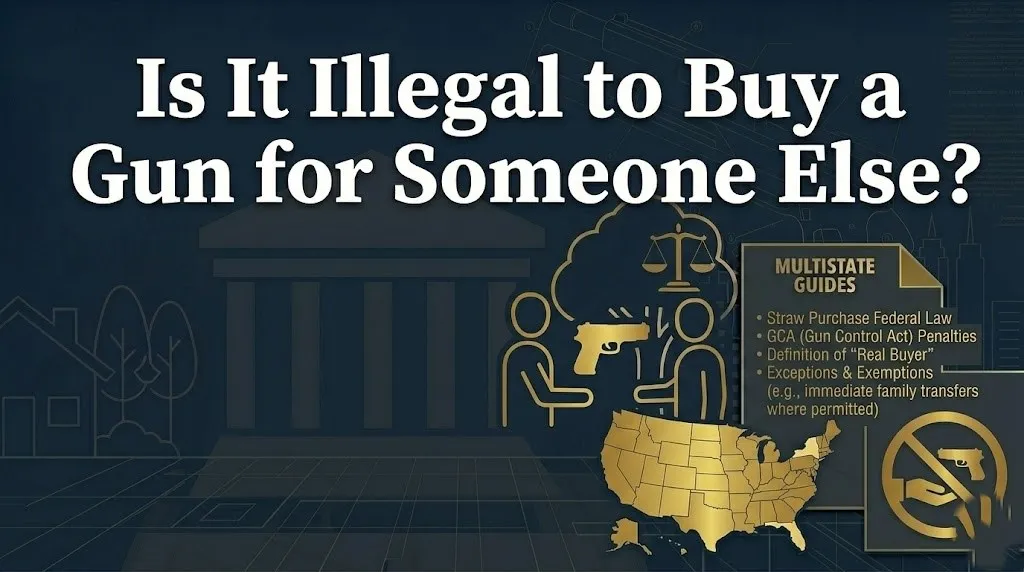
Is It Illegal to Buy a Gun for Someone Else?
It depends entirely on your intent and on who is receiving the gun. Buying a firearm for someone else is not automatically illegal under federal law.
If you’re purchasing the gun as a genuine gift, using your own money, for someone who can legally own a firearm, that transaction is generally lawful. Federal law specifically recognizes bona fide gifts as legal purchases.
The transaction becomes illegal when you’re buying the gun for someone else who gave you the money, when you’re acting as a middleman to help someone bypass a background check, or when you know the recipient cannot legally own a firearm. That’s where federal law draws the line. And that line now carries steeper consequences than ever before.
Quick Facts:
- Bona fide gift using your own money: generally legal under federal law
- Buying with the recipient’s money, acting as a proxy: illegal (straw purchase)
- Buying for a prohibited person: illegal regardless of intent
- Penalties under updated 2022 law: up to 15 years in prison
What Is a Straw Purchase?
A straw purchase is when one person buys a gun on behalf of another, acting as a stand-in for the real buyer. The “straw” buyer’s name goes on the paperwork, but the gun is intended for someone else from the start.
This happens in two main scenarios. First, someone who is legally prohibited from owning a gun, like a convicted felon, recruits a friend or partner to buy the gun for them. Second, someone with no criminal record buys a gun for a friend as a favor, usually because the friend gave them cash and asked them to handle the purchase.
Both are federal crimes. The law does not require the end recipient to be prohibited from gun ownership for a straw purchase charge to stick. What matters is whether the person filling out the paperwork is the actual, intended buyer.
| Scenario | Legal? | Why |
|---|---|---|
| You use your own money to buy a gun as a gift | Legal | Bona fide gift with no reimbursement |
| Recipient gives you cash to buy the gun | Illegal | You are not the actual buyer |
| You buy for someone with a felony record | Illegal | Knowing transfer to prohibited person |
| You buy for a friend who “can’t make it to the store” | Illegal | You are a proxy, not the actual buyer |
| Friend picks gun, you pay as a genuine gift | Legal | If truly your money, your decision |
Is Buying a Gun for a Felon Illegal?
Yes, buying a gun for someone who is prohibited from owning one is a federal felony, full stop. It does not matter whether you knew every detail of their criminal history.
Federal law under 18 U.S.C. § 922(d) makes it illegal to transfer any firearm to a person you know or have reasonable cause to believe is prohibited from possessing one. Prohibited persons under federal law include convicted felons, people under domestic violence restraining orders, individuals adjudicated mentally defective, and several other categories.
“Reasonable cause to believe” is the key phrase. You don’t have to know for certain. If a friend tells you they “might have an issue with a background check,” that alone can create legal exposure for you if you buy the gun anyway. Courts have upheld prosecutions where the buyer had general knowledge that the recipient had legal trouble, even without knowing the exact charges.
Who counts as a federally prohibited person:
- Anyone convicted of a felony (any crime punishable by more than one year)
- Anyone convicted of a domestic violence misdemeanor
- Anyone subject to a qualifying domestic violence restraining order
- Unlawful users of or addicted to controlled substances
- Individuals adjudicated as mentally defective or committed to a mental institution
- Illegal aliens and certain non-immigrant visa holders
- Anyone dishonorably discharged from the military
Straw Purchase Gun Law Penalties
The penalties for a straw purchase increased significantly after 2022. First-time offenders who previously might have received probation now regularly receive prison sentences.
Before 2022, prosecutors used 18 U.S.C. § 922(a)(6), the false statements statute, which carried a maximum of 10 years. Some judges treated it as a paperwork violation and gave lighter sentences. That changed with the Bipartisan Safer Communities Act.
Under the current law, straw purchasing carries up to 15 years in federal prison and fines up to $250,000. If prosecutors can prove the firearm was intended for use in a violent crime, terrorism, or drug trafficking, the maximum sentence rises to 25 years.
| Charge | Statute | Maximum Prison Term | Maximum Fine |
|---|---|---|---|
| Straw purchase | 18 U.S.C. § 932 | 15 years | $250,000 |
| Straw purchase, weapon used in violent crime | 18 U.S.C. § 932 | 25 years | $250,000 |
| False statement on ATF form | 18 U.S.C. § 922(a)(6) | 10 years | $250,000 |
| Gun trafficking | 18 U.S.C. § 933 | 15 years | $250,000 |
| Transferring to prohibited person | 18 U.S.C. § 922(d) | 10 years | $250,000 |
Real sentences since the 2023 implementation of the new law have commonly landed between 48 and 60 months for first-time offenders with no prior record.
Key Takeaway: The 2022 Bipartisan Safer Communities Act made straw purchasing its own distinct federal felony with up to 15 years in prison. This law is now actively enforced, and first-time offenders are no longer walking away with probation.
Federal Gun Trafficking Law 18 USC 932
18 U.S.C. § 932 is the statute Congress created in 2022 specifically to target straw purchases. Before it existed, prosecutors had to shoehorn straw purchase cases into older, broader statutes.
The law makes it a federal crime to knowingly purchase a firearm on behalf of any other person when the buyer knows or has reasonable cause to believe that person is prohibited from possessing firearms, plans to use the gun in a felony or drug trafficking crime, or plans to pass the gun along to someone in those categories.
A companion statute, 18 U.S.C. § 933, covers firearm trafficking more broadly, targeting people who ship, transfer, or receive firearms knowing they will be used to violate federal or state gun laws. The two statutes are often charged together. Between October 2023, when the law fully took effect, and early 2024, over 250 defendants had already been charged under these provisions.
The law also allows prosecutors to pursue civil forfeiture. That means any property connected to the crime, including proceeds, can be seized. Fines can also be set at twice the gross profit of the illegal transaction.
What Happens If You Buy a Gun for Someone Who Can’t Legally Own One?
You become a federal felon. There is no exception for good intentions, family relationships, or ignorance of the person’s exact legal status.
The federal charge typically comes in one of two forms. If you lied on ATF Form 4473 by checking “yes” to being the actual buyer when you were not, prosecutors use 18 U.S.C. § 922(a)(6). If your purchase met the specific criteria of the new straw purchase statute, prosecutors use 18 U.S.C. § 932. Often, both are charged at once.
The real-world consequences extend beyond prison time. A federal felony conviction strips you of your own right to own firearms for life. It affects employment, housing, professional licenses, and voting rights in many states. Think of it like co-signing a loan for someone, except instead of a debt, you’re assuming the full legal liability for whatever happens with that gun after it leaves your hands.
Can You Buy a Gun as a Gift?
Yes, you can legally buy a gun as a gift under federal law, but only if certain conditions are met. The ATF has explicitly confirmed that bona fide gift purchases are legal.
The critical requirement is that the purchase must be your own decision, using your own money, with no reimbursement expected or received. If the person who will receive the gun gave you money, told you exactly which gun to buy, or is paying you back in any form, it is no longer a gift by legal definition.
The recipient must also be able to legally own a firearm. You carry legal responsibility for knowing, or having no reason to believe otherwise. If you gift a gun to someone and later discover they were prohibited, that is a different legal situation than if you knew in advance.
Conditions for a legal gun gift:
- You use your own money with no reimbursement
- The recipient has not paid you or given you money for this purchase
- You have no knowledge or reasonable cause to believe the recipient is prohibited
- The transfer complies with state law in both your state and the recipient’s state
- The firearm itself is legal for the recipient to own in their state
How to Legally Buy a Gun for Someone Else
The safest route is to buy a gift certificate from a licensed firearms dealer near the recipient. The ATF actually recommends this approach. The recipient then handles their own background check and paperwork, eliminating any legal ambiguity about who the actual buyer is.
If you want to purchase the actual firearm, here is what to do. Use only your own money. Do not accept any payment, reimbursement, or “cash back” from the recipient, before or after the purchase. At the gun store, be honest about the fact that it is a gift. Some dealers may be overly cautious, but your honesty is legally protective.
Verify the recipient can legally own a firearm. Check that the specific firearm is legal in the recipient’s state. If they live in a state that requires all transfers to go through a licensed dealer, you must route the gift through one. Document the transfer with a simple written record: the gun’s make, model, serial number, and the date of transfer.
Buying a Gun for a Family Member
Buying a gun as a genuine gift for a family member is legal under federal law, as long as the standard gift conditions are met. The family relationship does not change the legal analysis. What matters is the same thing it always is: your money, your decision, no reimbursement.
Some states add additional rules for family transfers. Washington State, for example, requires background checks for all firearm transfers, but exempts transfers between “immediate family members” defined as spouses, parents, children, and siblings, when the transfer is a bona fide gift or loan. California requires all transfers, including family gifts, to go through a licensed dealer regardless of the relationship.
The one scenario where family relationship truly matters is inheritance. Inheriting a firearm from a deceased family member follows different legal rules than purchasing one. Most states allow direct inheritance without an FFL transfer, though some require going through a dealer.
Key Takeaway: Family gifts are legal under federal law as long as you use your own money, the recipient is not prohibited, and you comply with your state’s transfer requirements. State rules vary significantly, so always check local law.
Buying a Gun for Your Spouse
Buying a gun as a gift for your spouse is legal under federal law. This is one of the clearest examples the ATF uses to explain the gift exception.
If you walk into a gun store and buy a firearm with your own money as a surprise birthday gift for your spouse, you are the actual buyer. The fact that the gun is intended for them does not make it a straw purchase. You can even tell the dealer it is a gift for your spouse without legal consequence.
Where this gets complicated: if your spouse gave you the money or if they are coming with you and picking out the gun themselves, that changes the picture. The key is who is making the purchasing decision and whose money is being used. If your spouse is standing next to you at the counter, calling the shots on the model, and handed you cash before you walked in, that looks much more like a proxy purchase.
Be aware that in states like California and Colorado, even a spousal gift must be processed through a licensed dealer, which requires a background check on the recipient spouse.
Can You Buy a Gun for Someone in Another State?
Buying a gun for someone who lives in a different state involves significant additional legal hurdles. Federal law generally prohibits interstate transfers between non-licensed individuals.
If you want to legally gift a firearm to someone out of state, the gun must be shipped to a licensed FFL dealer in the recipient’s state. The recipient then goes to that dealer, completes ATF Form 4473, passes a background check, and takes possession there. You cannot simply drive across the state line and hand someone a gun you bought for them.
The gun must also comply with the laws of the recipient’s state. You cannot buy an assault-style weapon in a state where it’s legal and ship it to someone in California where it may be banned. Each state’s restrictions apply at the point of delivery, not just the point of purchase.
| Transfer Type | Route Required | Background Check |
|---|---|---|
| Gift within same state (most states) | Direct transfer allowed | Not always required |
| Gift within same state (CA, CO, NY, WA, etc.) | Must go through FFL dealer | Required on recipient |
| Gift to out-of-state recipient | Must ship to FFL in recipient’s state | Required on recipient |
| Private sale across state lines | Must go through FFL | Required |
States That Require FFL Transfer for Gun Gifts
Roughly 19 states and the District of Columbia have universal background check laws that require all firearm transfers, including gifts, to go through a licensed dealer. This applies even to transfers between family members in most of these states.
States with the strictest requirements include California, Colorado, Connecticut, Delaware, Illinois, Maryland, Nevada, New Jersey, New York, Oregon, Rhode Island, and Washington State. In these states, you cannot hand a gun directly to a gift recipient. The gun must be transferred through an FFL, the recipient fills out Form 4473, and a background check runs on the recipient.
Pennsylvania and Minnesota require background checks for private handgun transfers specifically, though not necessarily all long guns. Other states allow direct private transfers between residents with no background check required.
| State | Gift Transfer Rules |
|---|---|
| California | All transfers through FFL; background check on recipient required |
| Colorado | All transfers through FFL; background check on recipient required |
| New York | All transfers through FFL; license required for handguns |
| Washington | Universal background check; family gifts to immediate relatives exempted |
| Pennsylvania | Background check required for private handgun transfers |
| Texas | No state-level background check for private transfers |
| Florida | No state-level background check for private transfers |
| Arizona | No state-level background check for private transfers |
Private Gun Sale Laws by State
Private gun sales between two individuals who are not licensed dealers are regulated primarily at the state level. Federal law generally allows private sales as long as both parties are in the same state and the seller has no reason to believe the buyer is prohibited from owning a firearm.
In most states, a private sale between two residents requires no paperwork and no background check. This is sometimes called the “private sale exemption.” In practice, it means someone can legally sell or transfer a firearm from their personal collection to a neighbor without using a dealer at all.
That exemption does not exist in states with universal background check laws. In those states, even a casual private sale between neighbors must go through a licensed dealer. Skipping that step is a state crime, separate from any federal charges.
Key Takeaway: Whether you need a background check for a private sale or gift depends entirely on which state you are in. In about 19 states and D.C., the answer is yes for all transfers. In the remaining states, federal law applies by default, which does not require a background check for private transfers.
ATF Form 4473 Straw Purchase Question
ATF Form 4473 is the federal form every buyer must complete when purchasing a firearm from a licensed dealer. Question 21a on that form asks: “Are you the actual transferee/buyer of the firearm(s) listed on this form?”
The form itself explains what “actual buyer” means. It states that you are not the actual buyer if you are acquiring the firearm on behalf of another person. If you check “yes” when you are not the actual buyer, you have just committed a federal crime under 18 U.S.C. § 922(a)(6), making a false statement in connection with a firearm purchase.
This is where many well-intentioned people get tripped up. If you are buying a gun as a genuine gift with your own money, you are the actual buyer, and you can legally check “yes.” If the recipient is with you, gave you money, or is directing the purchase in any way, checking “yes” becomes a false statement. The form’s instructions are clear: if you are buying the gun for someone else and that person gave you money or is directing the purchase, you are not the actual buyer.
Can a Convicted Felon Have Someone Buy a Gun for Them?
No. A convicted felon cannot legally have someone else buy a gun for them under any circumstances. The law specifically prohibits this arrangement, and both the felon and the buyer face federal charges.
The felon would be charged under 18 U.S.C. § 922(g), which makes it illegal for prohibited persons to possess, receive, or constructively control a firearm. Even if the felon never touches the gun, receiving it or having it accessible in their home may constitute illegal possession. The buyer faces straw purchase charges under 18 U.S.C. § 932.
This is also one of the most common ways straw purchase investigations start. ATF routinely traces guns used in crimes back to the licensed purchaser. When investigators find that the person who bought the gun is not the person who possessed it, they start asking questions. People who bought guns as a favor for a felon, even once, have ended up with federal felony convictions and prison sentences.
Is It Illegal to Buy a Gun From Someone Else?
Buying a gun from a private individual, rather than a store, is legal in most states under federal law. This is the private sale market, and federal law allows it as long as both parties live in the same state and the seller has no reason to believe the buyer is prohibited.
The legal risk here is almost entirely on the buyer if they are prohibited from owning a gun, and on the seller if they have reason to believe the buyer cannot legally own one. Private sellers are not required to run background checks under federal law, but they can still face charges if they ignore obvious red flags about a buyer’s eligibility.
In states with universal background check laws, buying from a private individual still requires going through a licensed dealer. The seller and buyer meet at an FFL, the dealer processes the transfer, and the background check runs on the buyer. Skipping that step is illegal in those states.
| Transaction Type | Federal Law | State Law May Vary |
|---|---|---|
| Buying from FFL dealer | Background check required | Some states add waiting periods |
| Buying privately, same state | Legal (no check required) | 19 states require check through FFL |
| Buying privately, different state | Must use FFL in buyer’s state | Recipient’s state law applies |
| Buying for someone who paid you | Illegal (straw purchase) | Also violates state law in most states |
Frequently Asked Questions
Is it a crime to buy a gun for someone who can legally own one?
It can be, depending on how the transaction is structured. If the other person paid for the gun or directed you to buy a specific model, it is a straw purchase, even if they could legally buy it themselves. If you used your own money as a genuine gift and the recipient can legally own a firearm, it is generally lawful. The intent and money source determine legality, not just the recipient’s eligibility.
What is the penalty for a straw purchase?
Under 18 U.S.C. § 932, a straw purchase carries up to 15 years in federal prison and fines up to $250,000. If the weapon was intended for use in a violent crime, terrorism, or drug trafficking, the maximum rises to 25 years. Since the law fully took effect in October 2023, first-time offenders with no prior record have commonly received sentences of four to five years. The older false statements charge under 18 U.S.C. § 922(a)(6) is often filed alongside it, carrying an additional 10-year maximum.
Can I buy a gun as a birthday gift for my spouse?
Yes, you can legally buy a gun as a genuine birthday gift for your spouse under federal law. Use your own money, make the purchasing decision yourself, and ensure your spouse is legally allowed to own a firearm. If your spouse gave you money or directed you to buy a specific gun, it may not qualify as a legal gift. Check your state’s laws, since states like California and Colorado require all transfers, including spousal gifts, to go through a licensed dealer with a background check.
What states require a background check for private gun transfers?
As of January 2025, 19 states and the District of Columbia require background checks for all firearm sales and transfers, including private ones. Those states include California, Colorado, Connecticut, Delaware, Illinois, Maryland, Nevada, New Jersey, New York, Oregon, Pennsylvania (handguns), Rhode Island, Vermont, Virginia, Washington, and others. In those states, even a gift between friends must be processed through a licensed FFL dealer. In the remaining states, federal law applies, which does not require background checks for private transfers.
What is Question 21a on ATF Form 4473?
Question 21a asks: “Are you the actual transferee/buyer of the firearm(s) listed on this form?” If you answer “yes” while buying a gun on behalf of someone else who paid you or directed the purchase, you have committed a federal crime. The form’s own instructions clarify that if someone gave you money to buy the gun, you are not the actual buyer. Lying on this form is a federal felony under 18 U.S.C. § 922(a)(6), separate from the straw purchase charge itself.
Closing
The rules around buying a gun for someone else are more specific than most people expect. A genuine gift is legal. Acting as a proxy, taking someone’s money, or buying for a prohibited person is a federal crime with serious prison time behind it.
This article covers the federal framework and the key state-level variations in one place. Bookmark it before any situation where you’re thinking about transferring, gifting, or buying a firearm on another person’s behalf.






