
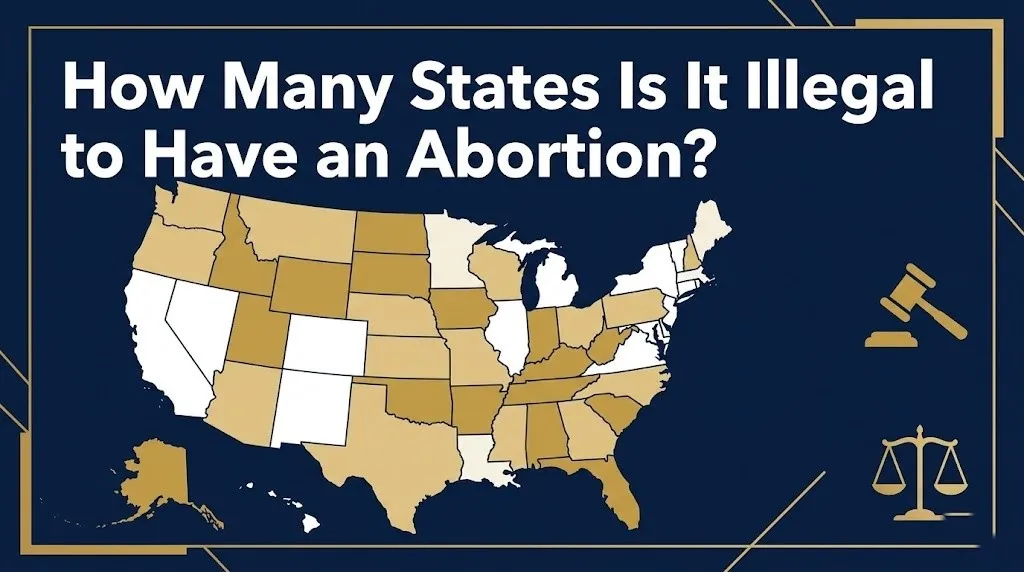
As of 2026, abortion is illegal or effectively inaccessible in approximately 14 states due to total or near-total bans, and the question of how many states is it illegal to have an abortion has become one of the most searched legal questions in the country since the Supreme Court’s Dobbs decision in 2022.
The number is not static. Court challenges, new legislation, and state constitutional amendments have shifted the count repeatedly since 2022. Knowing the current number matters enormously for personal health decisions.
This guide breaks down the total count, names every ban state, explains the different types of bans, covers exceptions, explains penalties for providers and patients, and addresses the travel and medication abortion questions that affect millions of Americans in 2026.
How Many States Is It Illegal to Have an Abortion?
As of 2026, abortion is illegal or banned at very early gestational stages, effectively eliminating access, in approximately 13 to 14 states.
The exact count has shifted since the Dobbs v. Jackson Women’s Health Organization decision in June 2022, which overturned Roe v. Wade and returned abortion regulation entirely to individual states. States have enacted bans, had bans blocked by state courts, reinstated bans through appeals, and in some cases passed state constitutional amendments protecting or banning abortion.
The 14-state figure as of 2026 reflects states with total bans in effect or bans that take effect at such an early gestational stage (before most women know they are pregnant) that they function as practical total bans. An additional cluster of states has bans between 6 and 22 weeks that significantly restrict but do not eliminate all access.
Quick Facts:
- States with total or near-total bans in effect (2026): Approximately 13 to 14
- States with significant gestational restrictions (6-22 weeks): Approximately 5 to 7 additional states
- States where abortion remains broadly legal: Approximately 27 to 29 states
- Governing Supreme Court precedent: Dobbs v. Jackson Women’s Health Organization (2022)
- Prior precedent overturned: Roe v. Wade (1973); Planned Parenthood v. Casey (1992)
Which States Is It Illegal to Have an Abortion?
As of 2026, the states where abortion is illegal or nearly completely inaccessible include Alabama, Arkansas, Idaho, Indiana, Kentucky, Louisiana, Mississippi, Missouri, North Dakota, Oklahoma, South Dakota, Tennessee, Texas, and West Virginia.
Each of these states has a total abortion ban or a ban so early in pregnancy (six weeks or at fertilization) that it functions as a total ban in practical terms. Several of these states had pre-Roe abortion bans that became enforceable after Dobbs, while others enacted new statutes specifically designed to take effect upon the Dobbs ruling.
The legal situation in some states has changed since 2022 due to ongoing court challenges. States including Arizona, Georgia, and Florida have had court battles over their ban statutes that shifted the enforceable gestational limits. The table below reflects the status of primary ban states as of 2026.
| State | Ban Type | Gestational Limit | Law Name or Code |
|---|---|---|---|
| Alabama | Total ban | No gestational limit | Alabama Human Life Protection Act |
| Arkansas | Total ban | No gestational limit | Arkansas Code 5-61-404 |
| Idaho | Total ban | No gestational limit | Idaho Defense of Life Act |
| Kentucky | Total ban | No gestational limit | KRS 311.772 |
| Louisiana | Total ban | No gestational limit | La. RS 14:87.7 |
| Mississippi | Total ban | No gestational limit | Mississippi Code 41-41-45 |
| Missouri | Total ban | No gestational limit | Mo. Rev. Stat. 188.017 |
| Oklahoma | Total ban | Fertilization | Oklahoma HB 4327 |
| Tennessee | Total ban | No gestational limit | Tennessee Human Life Protection Act |
| Texas | Total ban | Fertilization (effective) | Texas SB 8; Texas HB 1280 |
States Where Abortion Is Completely Illegal
States where abortion is completely illegal with no gestational exceptions include Alabama, Arkansas, Louisiana, Mississippi, Missouri, Oklahoma, Tennessee, and Texas as of 2026, though all of these states have narrow medical emergency exceptions.
“Completely illegal” means there is no lawful period during pregnancy when a person can obtain an elective abortion. These states allow abortion only when a physician certifies a specific medical emergency that threatens the life of the pregnant patient or, in some states, when the pregnancy results from rape or incest (though those exceptions vary significantly in practice and documentation requirements).
The phrase “completely illegal” is important to clarify for patients seeking information. It does not mean there are zero circumstances under which a pregnancy can be terminated medically. It means there is no legal option for elective termination based on the patient’s choice rather than a physician-certified medical necessity.
States with total bans and their primary exceptions:
- Alabama: Life-threatening physical condition of the pregnant person
- Arkansas: Medical emergency; no rape or incest exception
- Louisiana: Life-threatening emergency; specific documented conditions only
- Mississippi: Life-threatening emergency; rape requires law enforcement report
- Missouri: Life-threatening emergency only
- Oklahoma: Life-threatening emergency; rape and incest with law enforcement report
- Tennessee: Life-threatening emergency only
- Texas: Life-threatening emergency; very narrow definition applied in practice
What States Banned Abortion After Dobbs?
Following the Dobbs decision in June 2022, 13 states activated pre-existing trigger laws or enacted new legislation to ban abortion, and several additional states enacted gestational bans that took effect through new legislation or court rulings.
Trigger laws were statutes pre-enacted to automatically take effect upon the overturning of Roe v. Wade. States with trigger laws that became enforceable immediately or within weeks of Dobbs include Arkansas, Idaho, Kentucky, Louisiana, Mississippi, Missouri, North Dakota, Oklahoma, South Dakota, Tennessee, Texas, Utah, and Wyoming.
Not all trigger law states resulted in immediate enforcement. Some faced court injunctions. Others saw their trigger laws upheld through expedited state court review. The process of which bans took effect, when, and in what form played out differently in each state during 2022 and 2023.
States that enacted new post-Dobbs legislation to ban abortion (rather than relying on pre-existing trigger laws) include Indiana and West Virginia, both of which passed new ban statutes in 2022.
Bold fact: Within 100 days of the Dobbs decision, abortion became illegal in 13 states through trigger law activation, according to tracking by the Guttmacher Institute.
Quick Facts:
- States with trigger laws that activated after Dobbs: 13 (including AR, ID, KY, LA, MS, MO, ND, OK, SD, TN, TX, UT, WY)
- States that passed new ban legislation post-Dobbs: Indiana, West Virginia
- States where bans were blocked by state courts: Multiple states including Arizona (temporarily); court battles ongoing
- Timeline of first enforceable ban: Texas (pre-Dobbs SB 8 via civil enforcement mechanism)
Key Takeaway: Approximately 13 to 14 states have total or near-total abortion bans in effect as of 2026, all enacted or activated following the Supreme Court’s June 2022 Dobbs decision, which returned abortion regulation entirely to the states.
Which States Have Abortion Bans 2026?
The states with active abortion bans of some form in 2026 include total-ban states plus states with gestational limits ranging from six weeks to 22 weeks, covering approximately 20 states with meaningful restrictions.
Beyond the total-ban states, several states have enacted restrictions at 6 weeks, 12 weeks, 15 weeks, or 22 weeks that significantly limit access even when they do not constitute complete bans. Florida enacted a six-week ban that took effect in 2024 after extended court proceedings. Georgia’s six-week law known as the LIFE Act has been in effect since 2022 after court challenges were resolved. North Carolina enacted a 12-week ban in 2023.
The distinction matters practically because a six-week gestational limit (measured from the last menstrual period) means most people who become pregnant will not know they are pregnant before the legal window closes. That functional reality means a six-week ban operates more similarly to a total ban in practice than the name suggests.
| State | Current Restriction | Gestational Limit | Exception Categories |
|---|---|---|---|
| Florida | Gestational ban | 6 weeks | Life, health, rape, incest, fetal anomaly |
| Georgia | Gestational ban | 6 weeks | Life, rape, incest, fetal anomaly |
| North Carolina | Gestational ban | 12 weeks | Life, rape, incest, fetal anomaly |
| Arizona | Gestational ban | 15 weeks | Life only (litigation ongoing) |
| Nebraska | Gestational ban | 12 weeks | Life, rape, incest |
| South Carolina | Gestational ban | 6 weeks | Life, rape, incest, fetal anomaly |
States With Heartbeat Abortion Laws
States with heartbeat abortion laws ban abortion after fetal cardiac activity is detectable, typically around six weeks of pregnancy, before many people know they are pregnant.
The term “heartbeat law” is used in state legislation but is medically disputed. At six weeks of pregnancy, the structure detected is electrical activity in embryonic cardiac cells, not a fully formed heart. The label is a political and legislative term rather than a medical one, but it is the term embedded in the actual state law names.
States that enacted heartbeat-style six-week bans include Georgia (LIFE Act, OCGA 16-12-141), South Carolina, Florida, and Iowa at various points. Texas enacted Senate Bill 8 in 2021 using a unique civil enforcement mechanism that created a pre-Dobbs de facto ban. Several other states have six-week provisions in their broader ban statutes.
States with six-week or heartbeat-style provisions:
- Georgia: LIFE Act; six-week ban with exceptions; active since 2022
- Florida: Six-week ban effective May 2024; exceptions for rape, incest, life, health, fatal fetal anomaly
- South Carolina: Six-week ban with exceptions
- Texas: SB 8 enforcement mechanism plus HB 1280 total ban; overlapping provisions
- Iowa: Six-week ban enacted; court proceedings have affected enforcement
States With Gestational Limits on Abortion
Gestational limits on abortion set a specific week of pregnancy after which abortion becomes illegal, with the most common limits being 6, 12, 15, and 22 weeks as of 2026.
A gestational limit is a restriction rather than a total ban. It means abortion is legal up to the specified week but prohibited after that point, with exceptions that vary by state. These states are legally distinct from total-ban states because they permit some access during the permitted window.
The 22-week limit represents the traditional viability threshold that Roe v. Wade established, and some states that did not enact stricter bans after Dobbs still use viability as their reference point. States including Colorado and New Mexico have no gestational limit and allow abortion throughout pregnancy.
| Gestational Limit | States (as of 2026) | Notes |
|---|---|---|
| 6 weeks | Florida, Georgia, South Carolina, Iowa | Effectively very restrictive |
| 12 weeks | North Carolina, Nebraska | Moderate restriction with exceptions |
| 15 weeks | Arizona (ongoing litigation) | Challenged in state courts |
| 22 weeks (viability) | Multiple states that did not enact post-Dobbs bans | Pre-Dobbs standard retained |
| No limit | Colorado, New Mexico, Oregon, others | Broadest access states |
Abortion Trigger Laws Explained
Abortion trigger laws are statutes pre-enacted to automatically take effect when a specific legal event occurs, in this case the overturning of Roe v. Wade, without requiring additional legislative action.
Before Dobbs, legislatures in abortion-restrictive states could not enforce total bans because Roe v. Wade made them unconstitutional. They prepared by passing trigger laws that said, in effect: “This ban shall become law the moment Roe is overturned.” When Dobbs was decided in June 2022, those triggers activated.
Not all trigger laws took effect identically. Some included built-in waiting periods of 10 to 30 days after the Supreme Court ruling. Others required certification by the state attorney general before taking effect. Some faced immediate legal challenges in state courts that delayed or blocked enforcement for months.
How trigger law activation worked:
- Texas: HB 1280 trigger law activated 30 days after Dobbs certification; combined with existing SB 8
- Missouri: Attorney general certified activation; took effect almost immediately
- Kentucky: Trigger law took effect; subsequently challenged in state courts
- Louisiana: Trigger law activated; enforcement briefly delayed by court order
- Idaho: Trigger law activated following a brief state court challenge period
- Arkansas: Trigger law activated with no successful court challenge
Key Takeaway: Trigger laws were the mechanism most ban states used to prohibit abortion quickly after Dobbs. They were pre-written bans designed to automatically activate upon the Supreme Court’s ruling, requiring no new legislative vote.
What Are the Exceptions to Abortion Bans?
Every state with an abortion ban includes at least one exception, most commonly a life-of-the-mother exception, though the specifics of what qualifies vary dramatically by state and have been the source of significant legal disputes.
The most universal exception across all ban states is a medical emergency exception that permits abortion when continuing the pregnancy poses a risk to the life of the pregnant person. However, what constitutes a qualifying emergency differs by state, and the legal risk to providers who make that determination has caused many physicians and hospitals to delay or refuse care even in clear emergency situations.
Rape and incest exceptions exist in some ban states but not all. States that include them typically require law enforcement reports, documentation requirements, or gestational time limits on when those exceptions can be invoked. Arkansas, Missouri, and Tennessee do not have rape or incest exceptions in their total ban statutes.
Fetal anomaly exceptions, which allow abortion when a fetus has a diagnosis incompatible with life outside the womb, exist in some states but not in the strictest ban states.
| Exception Type | States That Include It | States That Exclude It |
|---|---|---|
| Life of pregnant person | All ban states | None |
| Serious health risk | Some (varies by definition) | Alabama, Missouri, others |
| Rape | Oklahoma, Georgia, Florida, others | Arkansas, Missouri, Tennessee |
| Incest | Oklahoma, Georgia, Florida, others | Arkansas, Missouri, Tennessee |
| Lethal fetal anomaly | Florida, Georgia, South Carolina, others | Alabama, Texas (very narrow), others |
States Where Abortion Is Legal 2026
Abortion remains broadly legal in approximately 27 states as of 2026, including the most populous states in the country such as California, New York, Illinois, Pennsylvania, and Michigan.
These states have either enacted affirmative protections for abortion access, have no post-Dobbs restrictions in effect, or retain access under pre-existing state law. The legal framework in protection states differs significantly from pre-Dobbs federal protection because it is grounded in state law and state constitutional provisions, which makes it insulated from federal legislative changes.
Several states have gone further than simply maintaining the pre-Dobbs status quo. California, Colorado, Illinois, Maryland, Michigan, Minnesota, Nevada, New Jersey, Oregon, Vermont, and Washington have enacted specific statutory or constitutional protections that establish abortion access as a matter of state law.
States with broadest abortion access in 2026:
- Colorado: No gestational limit; constitutional protection
- New Mexico: No gestational limit; no significant restrictions
- Oregon: No gestational limit; constitutional protection enacted
- Vermont: No gestational limit; constitutional amendment (Prop 5, 2022)
- California: Legal through viability; state constitutional right affirmed
- Illinois: Legal through viability; Reproductive Health Act
- New York: Legal through 24 weeks; broader with physician discretion after
States That Protect Abortion Rights
At least 23 states actively protect abortion rights through state statutes, state constitutional provisions, or executive orders that shield providers and patients from prosecution and protect access to care.
The distinction between “legal” and “protected” matters. Abortion being legal in a state means there is no ban in effect. Abortion being protected means the state has taken affirmative steps to defend providers, create legal shields, and in some cases protect residents from enforcement by other states.
Shield laws are the clearest example of active protection. States including California, Colorado, Illinois, Massachusetts, New York, and Washington have enacted shield laws that specifically prohibit state officials from cooperating with other states’ abortion-related investigations, decline to extradite providers or patients sought by ban states, and protect patients who receive abortion services within the shield state.
Quick Facts:
- States with affirmative abortion protection statutes: Approximately 23 states
- States with constitutional abortion rights (state level): Vermont, California, Michigan, and others following ballot measures
- States with shield law protections: California, Colorado, Illinois, Massachusetts, New York, Washington, and others
- States with executive protection orders: Multiple states via governor’s executive action post-Dobbs
Key Takeaway: Approximately 27 states have abortion broadly legal in 2026, with a subset of those states enacting affirmative shield laws that protect providers and patients from prosecution by ban states.
Medication Abortion Laws by State
Medication abortion, which uses a combination of mifepristone and misoprostol to end a pregnancy, is subject to both state abortion ban laws and federal FDA regulations, and its legal status follows the same geographic pattern as surgical abortion.
In states with total abortion bans, medication abortion obtained within that state and used within that state is illegal under the same statutes that ban surgical abortion. Total ban states including Texas, Alabama, and Mississippi prohibit all methods of abortion regardless of technique, including medication abortion.
In states where abortion is legal, medication abortion is generally available through providers, telehealth services, and in some cases through mail prescription. The FDA approved mifepristone for use through 10 weeks of pregnancy, and it remains on the federal market following the Supreme Court’s unanimous ruling in FDA v. Alliance for Hippocratic Medicine (2024), which rejected a challenge to the FDA’s approval.
Medication abortion by state category (2026):
| State Category | Medication Abortion Status | Method |
|---|---|---|
| Total ban states (TX, AL, MS, MO, etc.) | Illegal by state law | No legal provider access |
| 6-week limit states (FL, GA) | Legal within gestational window | Provider or telehealth within limit |
| 12-15 week limit states (NC, NE) | Legal within gestational window | Provider or telehealth within limit |
| Protection states (CA, NY, IL, CO) | Fully legal; telehealth available | In-person or mail prescription available |
Penalty for Getting an Abortion in a Ban State
Penalties for abortion in ban states fall almost entirely on providers rather than patients, and most state ban statutes explicitly state that the pregnant person cannot be criminally prosecuted for obtaining an abortion.
This is one of the most important and widely misunderstood points in current abortion law. When Texas, Alabama, or other ban states criminalized abortion, they specifically chose not to target patients. The criminal penalties in virtually every ban state apply to physicians, nurses, pharmacists, and anyone else who performs or assists in performing the abortion.
That said, the picture is not uniformly protective of patients. Texas Senate Bill 8 created a civil enforcement mechanism that allowed private citizens to sue anyone who “aids or abets” an abortion, which some legal scholars have argued could theoretically reach patients in certain circumstances. And some states have broadly worded aiding and abetting provisions that create at least theoretical legal risk for people who assist others in obtaining abortions.
| State | Provider Criminal Penalty | Patient Criminal Penalty | Civil Exposure |
|---|---|---|---|
| Texas | Felony; license revocation; up to life in prison for certain violations | Explicitly excluded from prosecution | SB 8 civil suits ($10,000+ per defendant) |
| Alabama | Class A felony; up to 99 years or life in prison | Explicitly excluded | Specific penalties have not been publicly confirmed |
| Louisiana | Felony; up to 10 years prison; $100,000 fine | Explicitly excluded | Specific penalties have not been publicly confirmed |
| Mississippi | Felony; 1 to 10 years prison | Explicitly excluded | Specific penalties have not been publicly confirmed |
| Missouri | Class B felony; up to 15 years prison | Explicitly excluded | Specific penalties have not been publicly confirmed |
| Oklahoma | Felony; up to 10 years prison; $100,000 fine | Explicitly excluded | Specific penalties have not been publicly confirmed |
Can You Be Arrested for Having an Abortion?
In virtually every US state with an abortion ban, a person who has an abortion cannot be arrested or prosecuted for that act, because the criminal penalties in all major ban state statutes are directed exclusively at providers and assistants, not patients.
This was a deliberate legislative choice. When ban states wrote their abortion statutes, most followed a model that explicitly excluded the pregnant person from criminal liability. Alabama’s Human Life Protection Act, Texas’s Human Life Protection Act (HB 1280), and other ban state statutes all contain language stating that the pregnant woman cannot be prosecuted as a party to the abortion.
The practical risk for patients in ban states relates more to civil liability in states like Texas, where private citizens can sue anyone who aids or abets an abortion for a minimum of $10,000 per violation, than to criminal arrest. But even civil suits under Texas SB 8 have generally been directed at providers and fund organizations, not patients.
Bold fact: Every major abortion ban statute enacted since Dobbs explicitly exempts the pregnant person from criminal prosecution. Arrests of patients for having abortions have not occurred under these statutes as of 2026.
Quick Facts:
- Patient criminal prosecution for abortion in ban states: Not authorized by any current ban state statute
- Provider criminal prosecution: Authorized and pursued in some cases
- Civil liability for patients: Theoretical risk in Texas (SB 8); minimal enforcement against patients
- Arrest of patients reported under current bans: None as of 2026
Is It Illegal to Help Someone Get an Abortion?
Helping someone get an abortion can be illegal in ban states under aiding and abetting provisions, though the enforcement focus has been on providers and funds rather than individuals assisting a friend or family member.
Texas Senate Bill 8 created the most aggressive “aid and abet” framework. It allows private citizens to sue anyone who performs, induces, or “aids or abets” an abortion after cardiac activity is detectable. The minimum civil penalty per lawsuit is $10,000. This provision was written broadly enough that transporting someone to a clinic, paying for the procedure, or providing information could theoretically be included, though courts have addressed the scope of this provision in litigation.
Several ban states have broader criminal aiding and abetting statutes in their abortion laws. Oklahoma, Missouri, and others prohibit providing assistance for an abortion within the state. The key legal question in most of these provisions is whether the state’s jurisdiction extends to assistance that helps someone travel out of state to access abortion legally elsewhere.
Quick Facts:
- Criminal aiding and abetting provisions: Present in several ban state statutes
- Civil aiding and abetting (Texas SB 8): Applies to anyone who “aids or abets” abortion; $10,000 minimum per violation
- Enforcement focus: Providers, funds, and organizations rather than individual helpers
- Out-of-state assistance: Jurisdiction questions remain legally unresolved in most states
- Shield law protection for helpers: Available in California, New York, and other protection states
Can States Prosecute You for Traveling for an Abortion?
States cannot currently prosecute someone who travels to another state where abortion is legal and obtains a legal abortion there, because no state has successfully enacted a law that applies its criminal abortion statutes to conduct in another state, and such laws face significant constitutional obstacles.
Several ban states have considered or attempted to enact laws that would prohibit their residents from traveling to other states for abortion or that would target people who assist in that travel. Idaho, Texas, and Missouri have seen legislative proposals along these lines, but none have been enacted into enforceable law as of 2026.
The constitutional barriers to interstate abortion travel prosecution are substantial. The right to interstate travel is recognized as a fundamental right under federal constitutional doctrine. Any state law that effectively punishes a person for traveling to another state where their conduct was legal would face serious Commerce Clause and constitutional challenges.
Protection states like California, Colorado, and Illinois have reinforced this framework by enacting shield laws that explicitly refuse to cooperate with other states’ investigations of abortion-related travel, refuse extradition requests, and provide legal protection for providers who treat out-of-state patients.
Bold fact: As of 2026, no ban state has successfully prosecuted a resident for traveling to another state to obtain a legal abortion. Constitutional barriers to such prosecution remain firmly in place under current federal constitutional doctrine.
Quick Facts:
- Current prosecution of interstate abortion travel: None; no successful cases as of 2026
- States that attempted travel restriction legislation: Idaho, Texas, Missouri (proposals)
- Constitutional barrier: Right to interstate travel; Commerce Clause concerns
- Shield law states that protect travelers: California, Colorado, Illinois, Massachusetts, New York, Washington, and others
- Legal consensus on prosecutability: Constitutional scholars broadly consider interstate travel prosecution unconstitutional under current doctrine
Frequently Asked Questions
How many states is it illegal to have an abortion in 2026?
Approximately 13 to 14 states have total or near-total abortion bans in effect as of 2026.
An additional 5 to 7 states have gestational bans between 6 and 22 weeks that significantly restrict access.
The exact count has shifted since the 2022 Dobbs decision due to ongoing court challenges and new legislation.
Which states have a total abortion ban?
States with total abortion bans or bans so early they function as total bans include Alabama, Arkansas, Idaho, Kentucky, Louisiana, Mississippi, Missouri, North Dakota, Oklahoma, South Dakota, Tennessee, Texas, and West Virginia.
All of these states have narrow exceptions for life-threatening medical emergencies.
Some include rape and incest exceptions while others, including Arkansas and Missouri, do not.
Can you be arrested for having an abortion in a ban state?
No, patients cannot be criminally arrested for having an abortion under any current ban state statute.
Every major abortion ban law enacted after Dobbs specifically exempts the pregnant person from criminal prosecution.
Criminal penalties in ban states apply to providers, not to the people who receive abortions.
Is it legal to travel to another state to get an abortion?
Yes, traveling to a state where abortion is legal to obtain a legal abortion is constitutionally protected under the right to interstate travel.
No ban state has successfully prosecuted a resident for traveling out of state for a legal abortion as of 2026.
Protection states like California and New York have enacted shield laws specifically to protect out-of-state patients who seek care within their borders.
What states protect abortion rights with state constitutional amendments?
Vermont, California, Michigan, Ohio, and Missouri (by ballot measure in 2024) have passed state constitutional amendments protecting abortion rights.
These state constitutional protections are insulated from federal legislative interference and can only be removed by a subsequent state constitutional amendment.
Several other states have similar ballot measures pending or anticipated for future election cycles.
Closing
The map of abortion legality in the United States is not stable. Court rulings, ballot measures, and new legislation continue to shift which states restrict access and which protect it. As of 2026, approximately 14 states have bans in effect, and approximately 27 states retain broad legal access.
Bookmark this guide and share it with anyone who needs a clear, current picture of where the law stands. The legal framework is expected to continue evolving through the 2026 election cycle and beyond, making updated information more important than ever.






