
The reason why it is illegal to remove a mattress tag comes down to a 1958 federal law designed to protect consumers, not punish them. The prohibition applies to manufacturers and retailers, not the person sleeping on the mattress.
This is one of the most widespread legal myths in American households. Most people assume that little white tag is a trap waiting to catch them. The actual target of the law is the seller, not the buyer.
This guide covers the real statute, who it applies to, what the penalties look like, and how the rule extends to pillows, furniture, and other bedding products in 2026.
Why Is It Illegal to Remove a Mattress Tag?
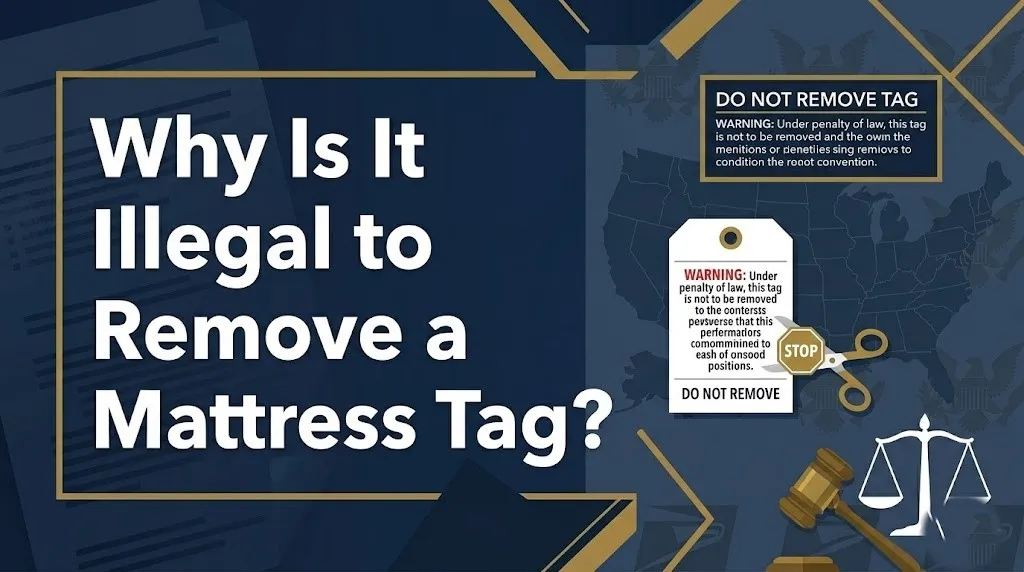
Removing a mattress tag is illegal only for manufacturers, retailers, and distributors, not for consumers, because the tag exists to disclose fill materials before the point of sale.
The legal requirement comes from the Textile Fiber Products Identification Act of 1958, codified at 15 U.S.C. 70. That federal law requires that certain textile products, including mattresses and bedding, carry labels identifying the materials used in their construction. The purpose is consumer protection. A buyer has the right to know whether a mattress is filled with new materials, recycled fibers, or repurposed stuffing before they purchase it.
The tag is not there to scare buyers. It is there to give them information before the sale is complete. Once a consumer takes ownership of the product, the law’s disclosure purpose has already been served.
The phrase “under penalty of law” printed on the tag refers to penalties that apply to commercial parties in the supply chain, not the household consumer who wants to declutter their bedroom. That wording has caused decades of unnecessary anxiety.
Quick Facts:
- Governing federal law: Textile Fiber Products Identification Act, 15 U.S.C. 70
- Enforcement agency: Federal Trade Commission (FTC)
- Who the law targets: Manufacturers, distributors, retailers
- Who the law does NOT target: End consumers after purchase
- Year enacted: 1958
Is It Illegal to Remove a Mattress Tag?
It is not illegal for a consumer to remove a mattress tag from a mattress they own. The prohibition is directed at commercial sellers and handlers, not buyers.
This is the core myth that has persisted for decades. The tag itself contributes to the confusion because the warning language, “do not remove under penalty of law,” does not specify who bears that penalty. Most people read it and assume it applies to them. It does not.
The FTC, which enforces the Textile Fiber Products Identification Act, has never prosecuted a consumer for removing a mattress tag from their own mattress. The law’s entire purpose is to ensure buyers receive accurate material disclosures before they hand over money. Once the sale is complete, the tag has served its function.
Removing the tag from a mattress you already own and sleep on carries zero legal consequence for you personally.
Key myth vs. fact:
| Claim | Reality |
|---|---|
| It is illegal for consumers to remove mattress tags | False; only applies to commercial parties |
| The FTC can fine you for removing your own tag | False; no consumer enforcement exists |
| The warning applies to everyone | False; it applies to manufacturers and retailers |
| Removing the tag voids your warranty | Depends on manufacturer policy, not federal law |
| The law was designed to protect sellers | False; it was designed to protect buyers |
Is It Illegal to Remove the Tag From a Mattress?
Removing the tag from a mattress is illegal only when done by someone in the commercial chain before the product reaches the end consumer.
The distinction matters because the same physical act, pulling off a tag, carries completely different legal consequences depending on who does it. A mattress manufacturer that removes the label before selling to a retailer has violated federal law. A retailer that strips the tag before putting the mattress on the floor violates the same law. A consumer who cuts it off their own mattress after buying it has done nothing wrong legally.
Several states have their own bedding laws that parallel the federal requirement. California, New York, and New Jersey all have state-level bedding regulations enforced by state agencies. Those state laws generally mirror the federal structure, targeting commercial parties rather than end consumers.
The bottom line is that the tag requirement is a disclosure law. Its job is to guarantee information flows from producer to buyer. After that transfer happens, the law’s purpose is complete.
Quick Facts:
- Federal prohibition: Applies during commercial handling before consumer purchase
- State-level laws: California, New York, New Jersey have parallel state bedding regulations
- Consumer’s right after purchase: Full right to remove the tag
- Legal risk to consumer: None
What Law Says You Cannot Remove a Mattress Tag?
The law behind mattress tags is the Textile Fiber Products Identification Act of 1958, a federal statute found at 15 U.S.C. 70 through 70k.
Congress passed this law to address widespread deception in the bedding and textile industry during the mid-20th century. Manufacturers were selling mattresses and pillows stuffed with undisclosed materials, including recycled rags, animal hair, and industrial waste fibers. Consumers had no way of knowing what was inside the products they were buying and sleeping on.
The Act requires that textile fiber products sold in the United States carry labels identifying the fiber content by percentage. For mattresses specifically, state sanitation laws often add requirements about disclosing whether fill materials are new or used. The federal and state frameworks work together to ensure full disclosure before purchase.
The FTC was given authority to enforce the Textile Fiber Products Identification Act and to create implementing regulations. Those regulations, found in 16 CFR Part 303, spell out exactly what information the label must contain and how it must be displayed.
| Law or Regulation | Coverage | Enforcer |
|---|---|---|
| Textile Fiber Products Identification Act, 15 U.S.C. 70 | Fiber content disclosure on bedding and textiles | FTC |
| 16 CFR Part 303 | Specific label format and content requirements | FTC |
| State bedding laws (California, New York, New Jersey) | Material disclosure, sanitation standards | State agencies |
| Wool Products Labeling Act, 15 U.S.C. 68 | Wool content in bedding and textiles | FTC |
Key Takeaway: The mattress tag law is the Textile Fiber Products Identification Act of 1958, enforced by the FTC, and its regulations at 16 CFR Part 303 spell out exactly what must be disclosed and how.
Do Not Remove Under Penalty of Law Meaning
The phrase “do not remove under penalty of law” on a mattress tag is directed at commercial handlers, not consumers, and the penalty refers to civil fines imposed on manufacturers and retailers.
That warning language dates back to the early enforcement era of the Textile Fiber Products Identification Act. At the time, regulators wanted to make clear to warehouse workers, delivery staff, and retailers that stripping labels off products before sale was a federal violation. The warning was never intended to scare individual consumers.
The “penalty of law” is a civil monetary penalty under the FTC Act. Violations of the Textile Fiber Products Identification Act can result in fines under Section 5 of the FTC Act, which governs unfair or deceptive acts in commerce. Those penalties are aimed at businesses in the supply chain, not households.
Modern mattress tags are more consumer-friendly than the original version. Many tags now include a second line that reads “except by consumer” to clarify that the prohibition does not apply after purchase. Older mattresses may only have the original warning without that clarification, which is the primary source of the ongoing confusion.
Quick Facts:
- “Penalty of law” target: Manufacturers, distributors, and retailers
- Type of penalty: Civil fine under FTC Act Section 5
- Consumer penalty: None, ever
- Why the confusion exists: Older tags lacked the “except by consumer” clarification
- Modern tag language: Often includes “except by consumer” to resolve the ambiguity
Who Can Legally Remove a Mattress Tag?
A consumer who has purchased a mattress can legally remove the tag at any time. Anyone in the commercial supply chain cannot remove it before the sale is complete.
The legal line is drawn at the point of consumer purchase. Before that moment, the tag must remain on the product. After that moment, the consumer owns the product and has no legal restriction on removing the label.
This means that factory workers, shipping handlers, warehouse staff, retail floor employees, and delivery crews all work with mattresses that must retain their tags. Removing a tag before the product reaches its final buyer is the act the law prohibits.
There is one additional commercial context worth knowing. Hotels, hospitals, dormitories, and other institutions that purchase mattresses in bulk are considered end consumers for this purpose. Once they receive the purchased mattresses, they are legally free to remove tags. However, state sanitation laws in some states require that mattresses used in commercial lodging settings retain certain tags for inspection purposes.
| Party | Can Remove Tag Legally? | Condition |
|---|---|---|
| Consumer (individual buyer) | Yes | After purchase is complete |
| Retailer | No | Not before sale to end consumer |
| Manufacturer | No | Not during production or distribution |
| Warehouse/shipping staff | No | Not before consumer purchase |
| Hotel or institution (bulk buyer) | Yes | After purchase; state sanitation rules may apply |
| Hospital or care facility | Yes | After purchase; state inspection rules may vary |
Can You Remove a Mattress Tag After Purchase?
Yes, you can remove a mattress tag after purchase with no legal consequence whatsoever.
This is the clearest and most direct answer to one of the most misunderstood questions in everyday legal knowledge. The federal law that governs mattress tags was designed to protect consumers, not restrict them. Once you have made the purchase and taken ownership of the mattress, the tag’s legal purpose is fully satisfied.
No federal agency, no state agency, and no local authority has ever cited or fined a consumer for removing a mattress tag from their own property. The FTC does not track consumer tag removal. State bedding inspectors do not enter homes to check mattress tags. The enforcement machinery that exists around this law is pointed entirely at commercial actors.
If removing the tag is something you want to do for aesthetic reasons, comfort reasons, or because your child keeps grabbing it, go ahead. You will not receive a fine, a summons, or any other legal consequence for doing so.
Bold fact: The FTC has never prosecuted a single consumer for removing a mattress tag from their own mattress in the entire history of the Textile Fiber Products Identification Act since 1958.
What Happens If You Remove a Mattress Tag?
If a consumer removes a mattress tag, nothing happens legally. If a commercial seller removes it before the sale, they risk an FTC enforcement action and civil penalties.
For individual consumers, removing the tag from their own mattress produces no legal consequence. There is no fine, no notification, no record, and no penalty of any kind. The fear that removing a mattress tag will result in legal trouble is entirely a myth rooted in misreading the tag’s warning language.
For manufacturers and retailers, the consequences are real. A company that sells mattresses without the required fiber content label is in violation of the Textile Fiber Products Identification Act and the FTC’s regulations at 16 CFR Part 303. The FTC can investigate, issue warning letters, and pursue civil penalties through its enforcement authority under the FTC Act.
The FTC has brought enforcement actions against bedding companies for label violations, though these typically involve missing labels entirely or false fiber content disclosures rather than physical tag removal alone.
Quick Facts:
- Consumer removes tag: No consequence, no fine, no record
- Retailer sells product without required tag: FTC violation, potential civil penalty
- Manufacturer ships without tag: FTC violation, potential civil penalty
- FTC enforcement focus: False disclosures and missing labels, not consumer behavior
- Criminal penalty for tag removal: None; this is a civil regulatory matter
Key Takeaway: Removing a mattress tag after you buy the mattress results in zero legal consequences for you. The law targets commercial sellers who strip labels before the sale, not consumers who remove tags from products they already own.
Mattress Tag Penalty
The penalty for mattress tag violations falls on commercial parties and can reach up to $51,744 per violation under current FTC civil penalty authority.
That number applies to manufacturers and retailers who violate the Textile Fiber Products Identification Act by selling products without required labels or with false fiber content disclosures. The FTC adjusts civil penalty maximums periodically under the Federal Civil Penalties Inflation Adjustment Act. As of 2026, the per-violation maximum for FTC Act violations is approximately $51,744.
In practice, penalties in bedding labeling cases tend to be negotiated through consent orders rather than maximum fines. A company caught selling unlabeled mattresses typically receives an investigation, a compliance order, and a settlement that may include a civil penalty well below the statutory maximum.
For consumers, the penalty for removing their own mattress tag is precisely zero dollars. No fine structure exists because no law prohibits it.
| Violating Party | Maximum Civil Penalty | Governing Law |
|---|---|---|
| Mattress manufacturer (missing label) | Up to $51,744 per violation | FTC Act, 15 U.S.C. 45 |
| Retailer (selling without tag) | Up to $51,744 per violation | FTC Act, 15 U.S.C. 45 |
| Distributor (removing label before sale) | Up to $51,744 per violation | FTC Act, 15 U.S.C. 45 |
| Consumer (removing own mattress tag) | $0; no violation exists | N/A |
Bold stat: The FTC’s maximum civil penalty per violation of FTC Act requirements, including textile labeling violations, is approximately $51,744 as adjusted for inflation under current federal guidelines.
FTC Mattress Tag Enforcement
The FTC enforces mattress tag requirements through its authority under the Textile Fiber Products Identification Act and its broader power to pursue unfair or deceptive trade practices under Section 5 of the FTC Act.
FTC enforcement in the bedding space focuses on companies that make false fiber content claims on labels, sell products without required labels, or use misleading product descriptions that contradict the label information. The agency uses a combination of market surveillance, consumer complaints, and industry monitoring to identify potential violations.
When the FTC identifies a labeling violation, it typically begins with a compliance inquiry or investigation. If a violation is confirmed, the agency may issue a warning letter, enter into a consent order requiring compliance, or pursue civil penalties in federal court for repeat or egregious violators.
The FTC’s enforcement record in this area includes actions against major bedding companies for making misleading claims about fiber content, particularly involving bamboo fabric claims that were marketed deceptively. Those cases resulted in consent orders and, in some instances, civil penalties running into the hundreds of thousands of dollars for systematic violations across large product lines.
Quick Facts:
- FTC enforcement authority: Textile Fiber Products Identification Act, FTC Act Section 5
- Common violations pursued: False fiber claims, missing labels, deceptive marketing
- Notable enforcement focus: Bamboo fabric misrepresentation in bedding products
- Consumer reporting: FTC complaint system allows consumers to report suspected violations
- Enforcement target: Always commercial parties, never individual consumers
Mattress Tag Consumer vs Retailer
The mattress tag warning creates entirely different legal obligations for consumers and retailers, and understanding that difference resolves the myth instantly.
Retailers are legally required to sell mattresses with their tags intact. The tag must remain on the product until the point of consumer purchase. A retailer that removes tags from floor models, display beds, or products being shipped to customers violates federal law. The retailer’s obligation is to preserve the consumer’s right to see the disclosure before deciding to buy.
Consumers have no obligation regarding the tag at any point. They can read it, ignore it, or remove it the moment they get home. The consumer’s legal position is the opposite of the retailer’s: they are the protected party, not the regulated party.
Think of it like a nutrition label on food. The manufacturer is required to put it there and the store cannot peel it off before selling the product. But the person who buys the cereal can rip the box apart and throw every piece of it away once it is theirs.
Key distinction:
| Party | Tag Obligation | Legal Risk |
|---|---|---|
| Manufacturer | Must apply label before sale | FTC violation if missing or false |
| Retailer | Must preserve label until sale | FTC violation if removed before purchase |
| Consumer | No obligation whatsoever | Zero legal risk at any time |
Why Do Mattresses Have Tags?
Mattresses have tags because federal law requires manufacturers to disclose the materials used in the fill before the product is sold to a consumer.
The practical concern that drove this requirement is significant. Before the Textile Fiber Products Identification Act and state bedding sanitation laws, manufacturers had no legal obligation to tell consumers what was inside their mattresses. Products were sold stuffed with recycled clothing, animal hair, industrial fiber scraps, and in some documented cases, genuinely unsanitary materials.
Consumers had no way to make an informed choice about what they were sleeping on. The tag requirement fixed that by mandating full disclosure of fiber content by percentage, the manufacturer’s name and address, and in most states, whether the fill material is new or previously used.
The tag serves two purposes at once. It is a consumer protection tool that ensures informed purchasing decisions. It is also a sanitation accountability tool that allows inspectors to verify that bedding products meet minimum material standards.
Quick Facts:
- Primary purpose: Fiber content disclosure before consumer purchase
- Secondary purpose: Sanitation accountability for fill materials
- Information required: Fiber type, percentage, manufacturer identity
- State addition: New vs. used fill material disclosure
- Beneficiary: The consumer, not the manufacturer or retailer
Key Takeaway: Mattress tags exist to protect consumers by disclosing what is inside the product before they buy it. The law was created specifically because manufacturers were previously selling mattresses stuffed with undisclosed and sometimes unsanitary materials.
History of Mattress Tag Law
The history of mattress tag law begins in the early 20th century with state-level sanitation concerns and culminates in the federal Textile Fiber Products Identification Act of 1958.
Before federal regulation, individual states began passing bedding inspection laws in the 1910s and 1920s. These state laws were primarily focused on sanitation, specifically on preventing manufacturers from filling mattresses with contaminated materials like recycled hospital linens or industrial waste. Inspectors would visit factories and check fill materials for safety.
The state laws required tags as an accountability tool. If a mattress had a tag documenting its fill materials and the manufacturer’s identity, inspectors could verify compliance more efficiently. The “do not remove” warning was added to ensure those accountability tags stayed on the product through the supply chain until a state inspector could verify them.
Congress passed the Textile Fiber Products Identification Act in 1958 to create a uniform national standard for textile labeling. The Act extended tag requirements beyond sanitation concerns to cover fiber content disclosure for all textile products, including bedding. The FTC was designated as the enforcement agency.
Timeline:
| Era | Development |
|---|---|
| 1910s to 1920s | State-level bedding sanitation laws begin requiring fill disclosure tags |
| 1930s to 1940s | More states adopt inspection programs; tag warning language standardizes |
| 1958 | Congress passes Textile Fiber Products Identification Act, 15 U.S.C. 70 |
| 1960s | FTC issues implementing regulations at 16 CFR Part 303 |
| 1970s to 1990s | Tag language updated to include “except by consumer” clarification |
| 2026 | Law remains in force; FTC continues civil enforcement against commercial violators |
What Does the Mattress Tag Say?
A standard mattress tag contains the fiber content by percentage, the manufacturer’s name and address, a country of origin statement, and the “do not remove under penalty of law” warning directed at commercial handlers.
The fiber content section is the most substantive part. Federal regulations require that all fibers making up five percent or more of the product’s weight be listed individually with their percentage. Fibers making up less than five percent can be grouped under “other fibers.” The listing must go from highest percentage to lowest.
State bedding laws add a second layer of required information. Most states require the tag to specify whether fill materials are “all new materials” or whether any used, recycled, or previously used materials are included. California requires a registration number from the California Bureau of Electronic and Appliance Repair, Home Furnishings and Thermal Insulation. New York requires its own registration number from the state Department of State.
Modern tags also carry a law label number that allows regulators to trace the product back to its manufacturer if a compliance question arises.
Information found on a standard mattress tag:
- Fiber content by percentage (largest to smallest)
- Manufacturer name, address, and contact information
- Country of origin
- New or used material declaration (state requirement)
- State registration numbers where applicable
- Law label tracking number
- “Do not remove under penalty of law, except by consumer” warning
Is It Illegal to Remove a Pillow Tag?
Removing a pillow tag is subject to the same federal rule as mattress tags: illegal for commercial sellers before the sale, completely legal for consumers after purchase.
Pillows are covered by the Textile Fiber Products Identification Act in the same way as mattresses. They are stuffed textile products that must carry labels disclosing their fill materials before being sold. The same “do not remove under penalty of law” warning applies, and the same consumer exemption exists.
Pillow tags must list fiber content by percentage, manufacturer information, and new versus used material disclosures where state law requires it. A retailer selling pillows without these tags is in violation of federal law. A consumer who buys a pillow and immediately removes the tag is exercising their right as the end owner.
The same principle extends to comforters, duvets, mattress pads, and sleeping bag products. Any stuffed or filled textile product sold in the US is subject to the Textile Fiber Products Identification Act’s labeling requirements. The consumer exemption applies equally to all of them.
Quick Facts:
- Governing law for pillow tags: Same as mattresses: Textile Fiber Products Identification Act, 15 U.S.C. 70
- Consumer’s right to remove: Yes, after purchase
- Retailer’s obligation: Must keep tag on product until point of sale
- Products covered beyond pillows: Comforters, duvets, sleeping bags, mattress toppers
Is It Illegal to Remove Furniture Tags?
Removing furniture tags is governed by the same federal framework as mattress and pillow tags, with the same consumer exemption applying after purchase.
Upholstered furniture, including sofas, chairs, ottomans, and any furniture with stuffed fabric components, is covered by the Textile Fiber Products Identification Act if it contains textile fiber components. Manufacturers must disclose the fiber content of fabric and fill materials through required labels before the product reaches a consumer.
Some states have their own upholstered furniture labeling laws that add requirements beyond the federal minimum. California’s Bureau of Electronic and Appliance Repair, Home Furnishings and Thermal Insulation regulates upholstered furniture labeling in California specifically, requiring registration numbers and detailed fill disclosures.
For consumers, the rule is identical to mattresses and pillows. Remove the tag from your own sofa, chair, or ottoman after you buy it, and no law has been broken. Keep it on the product before selling it to someone else, because the disclosure obligation re-activates in a commercial transaction.
Bold fact: The “do not remove” warning on furniture, pillows, and mattresses has the same legal basis and the same consumer exemption. In all three cases, the prohibition is aimed at sellers, not buyers.
Quick Facts:
- Federal coverage: Textile Fiber Products Identification Act covers upholstered furniture
- State coverage: California has specific upholstered furniture labeling regulations
- Consumer right after purchase: Full right to remove tags
- Resale consideration: If selling used furniture commercially, labeling requirements can apply again
Frequently Asked Questions
Why is it illegal to remove a mattress tag?
Removing a mattress tag is illegal only for manufacturers and retailers, not consumers.
The law requires commercial sellers to keep the tag on the mattress until the consumer buys it, so the buyer can see what fill materials are inside before purchasing.
The governing statute is the Textile Fiber Products Identification Act of 1958, enforced by the FTC.
Is it illegal for me to remove my own mattress tag at home?
No, it is not illegal for you to remove the tag from a mattress you have already purchased.
The law’s prohibition applies only to commercial handlers before the sale, not to consumers after the purchase is complete.
The FTC has never cited or fined a consumer for removing a mattress tag from their own property.
What is the actual penalty for removing a mattress tag?
For consumers, the penalty is zero. No law prohibits it, so no fine exists.
For manufacturers and retailers who remove tags before selling the product, the FTC can impose civil penalties of up to approximately $51,744 per violation under current federal guidelines.
Enforcement actions target commercial parties who fail to label products correctly, not individuals in their own homes.
What does the mattress tag actually say and why?
A standard mattress tag lists the fiber content by percentage, the manufacturer’s name and address, and whether the fill is made of new or used materials.
Federal regulations at 16 CFR Part 303 specify exactly what information must appear and how it must be formatted.
The tag exists so consumers can make an informed decision about what they are buying before they complete the purchase.
Do pillow and furniture tags have the same rules as mattress tags?
Yes, the same federal law and the same consumer exemption apply to pillow tags and upholstered furniture tags.
The Textile Fiber Products Identification Act covers all stuffed textile products, including pillows, comforters, and sofas.
Consumers can remove those tags freely after purchase, but retailers must keep them on until the sale is complete.
Closing
The mattress tag mystery has been scaring people for decades, but the reality is straightforward once you know the actual law. The warning was always aimed at manufacturers and sellers, and consumers have never had anything to worry about.
Bookmark this page and share it the next time someone refuses to remove their mattress tag out of legal fear. The 2026 rules are the same as they have always been on this one: once it is yours, you can do whatever you want with that little white tag.






