
It is illegal to park if a crosswalk is within 20 feet of your vehicle in most U.S. states. That single rule catches more drivers off guard than almost any other parking law.
Most people think a parking ticket near a crosswalk only happens when they block the striped lines themselves. That is wrong. The law measures from the edge of the crosswalk outward, not from the painted lines. Your car can be completely clear of the stripes and still be in violation.
This guide covers the exact distances required, how they vary by state, what the fines look like, and the situations where the rules get more complicated than they first appear.
It Is Illegal to Park If a Crosswalk Is Within
It is illegal to park if a crosswalk is within 20 feet of your vehicle’s position, under the Uniform Vehicle Code and the laws of most individual states. This is the baseline distance that applies across the country.
The 20-foot rule exists for one clear reason: visibility. When a car parks right up to the crosswalk, pedestrians stepping off the curb are invisible to approaching drivers until it is too late. The 20-foot buffer gives drivers enough sight distance to react.
This rule applies whether or not there are painted lines. It applies day and night. It applies in commercial zones and residential streets. The presence or absence of a no-parking sign does not change the underlying legal prohibition.
Quick Facts:
- Standard minimum distance: 20 feet from the nearest edge of the crosswalk
- Applies to both sides of the crosswalk, approaching from either direction
- The measurement starts at the crosswalk edge, not the intersection curb
- Violation is typically a non-moving parking citation, but severity varies by state
| Distance From Crosswalk | Legal Status | Notes |
|---|---|---|
| 0 to 10 feet | Illegal everywhere | Blocks pedestrian sightlines |
| 11 to 19 feet | Illegal in most states | Violates 20-foot rule |
| 20 feet exactly | Meets minimum in most states | Check local ordinances |
| 21 feet or more | Generally legal | Subject to other restrictions |
The exact point of measurement matters in enforcement. Officers measure from your front bumper or rear bumper, whichever is closest to the crosswalk, to the painted edge of the crosswalk lines or the projected crosswalk boundary at an unmarked intersection.
How Far From a Crosswalk Can You Park
The legal minimum distance you can park from a crosswalk is 20 feet in most states. Some states and local municipalities require more.
The 20-foot standard comes from the Uniform Vehicle Code, a model traffic law that most states have adopted in some form. But states are free to set stricter local rules, and many cities and counties add their own requirements on top of the state baseline.
California, for example, reinforces the 20-foot rule under its Vehicle Code. New York also applies a 20-foot minimum under New York Vehicle and Traffic Law 1202. Florida mirrors this under Florida Statute 316.1945.
States with confirmed 20-foot crosswalk parking minimums:
- California
- Florida
- New York
- Texas
- Illinois
- Georgia
- Ohio
- Washington
Some local city ordinances in places like Los Angeles, Chicago, and New York City have additional restrictions that go beyond the state minimum. A city block may have posted signs that shrink or expand the enforceable zone based on traffic flow, transit stops, or pedestrian volume data.
Bold callout: Parking 15 feet from a crosswalk feels safe. It is still illegal in every state that uses the 20-foot standard. The gap between “feels fine” and “actually legal” costs drivers millions in tickets every year.
Parking Within 20 Feet of a Crosswalk
Parking within 20 feet of a crosswalk is a parking violation in the vast majority of U.S. jurisdictions. The 20-foot rule is not a suggestion or a guideline. It is codified in state vehicle codes and enforced by parking officers with tape measures or laser distance tools.
Think of it the way you think about a fire lane. Nobody painted “FIRE LANE” on a random strip of asphalt for fun. That zone exists because blocking it has measurable consequences for safety. The 20-foot crosswalk buffer works the same way. The zone is not arbitrary.
The practical challenge is that most streets do not have a marker telling you exactly where 20 feet begins. Drivers eyeball it. Parking enforcement officers do not.
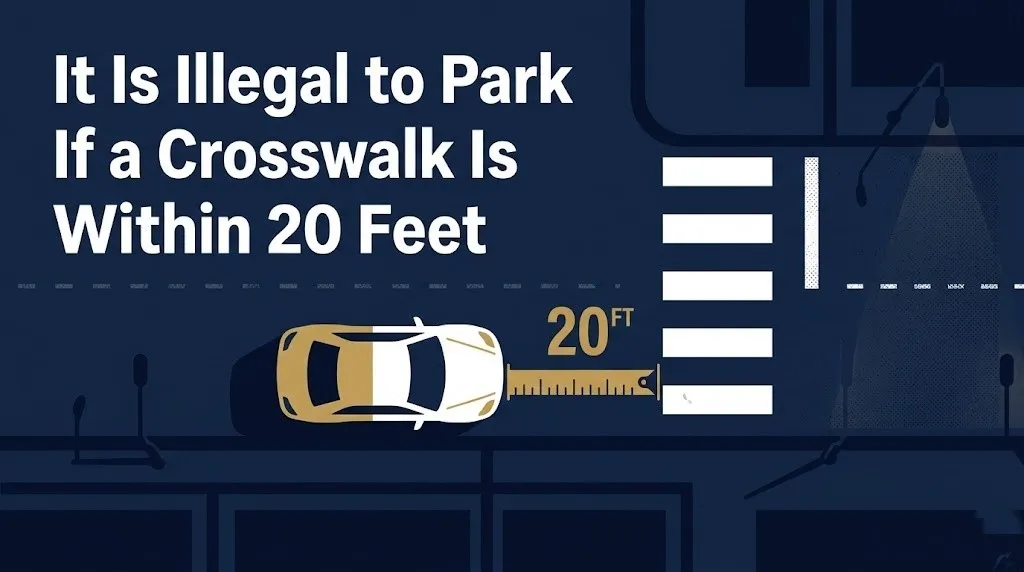
What 20 feet actually looks like in real life:
- Roughly the length of a mid-size SUV
- About four car-door widths along the curb
- Slightly shorter than most on-street parking spaces
Measuring from the crosswalk’s edge, not the center stripe, is important. The edge of the crosswalk is where pedestrians step off the curb. That is the point from which the 20-foot measurement begins.
If you park and your bumper sits 18 feet from that edge, you are in violation. If a parking officer writes a ticket and you contest it in traffic court, the burden shifts to proving the officer’s measurement was wrong.
Key Takeaway: Parking within 20 feet of a crosswalk is illegal in most U.S. states, and the measurement starts at the crosswalk edge, not the painted center line.
Is It Illegal to Park in Front of a Crosswalk
Yes, parking directly in front of a crosswalk, meaning your vehicle physically overlaps the crosswalk lines, is illegal in every U.S. state. This is a separate and more serious violation than simply parking too close.
Parking within 20 feet is one offense. Parking on top of the crosswalk itself is another. When your vehicle sits over the painted lines, you are obstructing a pedestrian right-of-way, which is treated more seriously than a standard parking distance violation in many jurisdictions.
In California, parking on a marked crosswalk can draw a ticket under California Vehicle Code 21970, which specifically prohibits stopping, standing, or parking on a crosswalk. Similar language exists in the vehicle codes of Texas, Florida, Illinois, and New York.
Key distinctions:
| Violation Type | Description | Typical Severity |
|---|---|---|
| Parking within 20 feet | Vehicle behind the crosswalk but too close | Standard parking fine |
| Parking on the crosswalk | Vehicle partially or fully over the stripes | Higher fine, sometimes tow |
| Blocking pedestrian ramp | Vehicle covers the curb cut | ADA violation possible |
Parking enforcement officers in most cities are trained to distinguish between these violation types. Being parked on the crosswalk rather than near it typically generates a larger fine and, in congested urban areas, can result in a tow.
How Close Can You Park to a Crosswalk Legally
The closest you can legally park to a crosswalk is 20 feet from its nearest edge in most states. Any distance shorter than that is a violation, even if your car is not touching the crosswalk lines.
This is where a lot of drivers get confused. They look at the crosswalk, see that their car is behind the lines, and assume they are fine. The law does not work that way. The 20-foot buffer begins at the crosswalk, not at the white paint.
Parking right behind the crosswalk stripe, with your bumper sitting 3 feet back, looks legal at a glance. But you are 17 feet short of the required clearance. That is a ticketable offense in California, New York, Florida, Texas, and most other states.
Practical measurement tip:
- Stand at the nearest crosswalk line
- Walk 20 paces straight back toward where you plan to park
- Your vehicle’s closest point to the crosswalk must be behind that mark
Some states allow parking closer if a posted sign specifically designates the space. Those signs override the default 20-foot rule only in the precise zone they cover.
Bold callout: In New York City, the NYPD has issued tens of thousands of crosswalk proximity tickets annually. The fine structure often starts at $65 and can go higher in school zones and bus stop areas.
Crosswalk Parking Laws by State
Crosswalk parking laws vary by state, but most fall within a narrow band of 20 to 30 feet from the crosswalk edge. No state allows parking closer than 20 feet to a marked crosswalk under normal conditions.
The Uniform Vehicle Code set 20 feet as the national model, and states adopted it at different times with slightly different language. Some states added stricter rules for school zones, bus stops, or fire stations. Others left local governments room to set their own distances through municipal code.
| State | Minimum Distance | Key Statute | Notes |
|---|---|---|---|
| California | 20 feet | CA Vehicle Code 21970 | Applies to marked crosswalks |
| Florida | 20 feet | FL Stat. 316.1945 | Additional school zone rules |
| New York | 20 feet | NY VTL 1202 | NYC adds enforcement layers |
| Texas | 20 feet | TX Transp. Code 545.302 | Applies statewide |
| Illinois | 20 feet | 625 ILCS 5/11-1303 | Chicago has stricter local rules |
| Washington | 20 feet | RCW 46.61.570 | School zones treated separately |
| Georgia | 20 feet | GA Code 40-6-203 | Local municipalities may vary |
| Colorado | 20 feet | CO Rev. Stat. 42-4-1205 | Applies to all crosswalk types |
Drivers moving between states should not assume they need to relearn the rules entirely. The 20-foot standard is nearly universal. What changes is the fine amount, the enforcement intensity, and any local additions that specific cities or counties have layered on top.
Crosswalk Parking Distance Law
Crosswalk parking distance law is the set of statutes that specify exactly how far a vehicle must be from a crosswalk before it can legally stop, stand, or park. The primary legal source is the state vehicle code, which each state has enacted independently.
Most state vehicle codes define two categories of crosswalk for parking purposes. A marked crosswalk has painted lines. An unmarked crosswalk is the logical extension of a sidewalk at an intersection, even without paint. Both types trigger the distance requirement in most states.
The 20-foot rule applies from the crosswalk boundary on each side. So if you are approaching an intersection, you cannot park within 20 feet of the crosswalk on your side of the street. The rule applies in the direction of travel and from behind the crosswalk as well.
Distance law components:
- Minimum distance: 20 feet in most states
- Measurement point: nearest edge of the crosswalk
- Applies to: stopping, standing, and parking (not just parking)
- Applies to: both sides of the crosswalk, both sides of the street
- Exemptions: authorized vehicles with specific permits in some jurisdictions
The phrase “stopping, standing, or parking” is important. In many states, even briefly stopping your car in that zone, such as pulling over to look at a map, technically violates the statute. Enforcement focuses on parked vehicles, but the legal prohibition is broader.
Key Takeaway: Crosswalk parking distance law in most states covers stopping and standing, not just parked vehicles, and applies to both marked and unmarked crosswalks.
Unmarked Crosswalk Parking Rules
Parking rules near an unmarked crosswalk are the same as those near a marked crosswalk in most states. The absence of paint does not remove the legal designation.
An unmarked crosswalk is defined as the area connecting sidewalks at an intersection, even when no lines have been painted on the road surface. Most state vehicle codes, including California, Florida, and New York, explicitly define crosswalks to include both marked and unmarked versions.
This surprises a lot of drivers. They park at a corner, see no white stripes, and assume they are clear. But if a sidewalk extends to the corner on both sides of the street, an unmarked crosswalk legally exists between them. The 20-foot parking prohibition applies.
Where unmarked crosswalks exist:
- Every T-intersection where a sidewalk meets the street
- Every four-way intersection where sidewalks run on at least one side
- Mid-block locations where a designated pedestrian path crosses the street without paint
- Any location where a local government has established a pedestrian crossing without marking it
Bold callout: In California, Vehicle Code Section 275 defines a crosswalk as including “the portion of a roadway included within the prolongation of the lateral lines of adjacent sidewalks,” whether marked or not. This is the unmarked crosswalk definition, and it carries full legal weight.
Faded crosswalks occupy a gray zone. Courts have generally found that if evidence of crosswalk markings still exists, the designation remains valid. If markings have been completely removed and not replaced, the location may revert to unmarked crosswalk status, which still triggers the parking prohibition at intersections.
Parking Near School Crosswalk Laws
Parking near a school crosswalk carries stricter rules and higher penalties than standard crosswalk violations in most states. School zones typically extend the baseline prohibition and add separate fine structures.
School crosswalk laws exist because the combination of low-visibility pedestrians, inexperienced young walkers, and distracted drivers creates a uniquely dangerous environment. States have responded by layering school-specific restrictions on top of ordinary crosswalk rules.
In California, parking violations within school zones during drop-off and pickup hours can draw enhanced fines. In Florida, parking that obstructs a school crosswalk can result in a fine nearly double the standard crosswalk violation amount. New York City applies automatic towing to vehicles blocking school crosswalks during school hours.
School crosswalk parking rules by state:
| State | Standard Crosswalk Fine | School Zone Enhancement | Notes |
|---|---|---|---|
| California | $50 to $100 | 1.5x to 2x base fine | School hours restrictions |
| Florida | $30 to $75 | Double fine zones active | Hours posted on signs |
| New York | $65 base | Towing possible | NYC school zone active enforcement |
| Texas | $50 to $100 | Specific school hours rules | District-level variation |
| Illinois | $50 to $150 | Enhanced in active hours | Chicago adds local rules |
School zone restrictions often apply only during specific hours, typically from 30 minutes before school starts to 30 minutes after it ends. Outside those windows, the standard crosswalk rules apply. Signs in school zones are required to post the hours of active restrictions.
Parking Near Intersection Crosswalk Rules
Parking near an intersection involves two overlapping sets of rules: the crosswalk distance requirement and the intersection distance requirement. Both apply at the same time, and you must satisfy whichever is stricter.
Most state vehicle codes prohibit parking within 20 feet of an intersection’s crosswalk and also prohibit parking within a certain distance of the intersection itself, usually 15 to 30 feet from the corner. At corners with crosswalks, these two rules often overlap, creating a larger combined no-parking zone than either rule creates alone.
Picture a standard four-way intersection. Each corner has a crosswalk. The no-parking zone on each approach is at least 20 feet back from the crosswalk. At the corner itself, the intersection clearance rule adds additional space. The total no-parking zone around a typical intersection corner can easily extend 30 to 50 feet back from the curb.
Intersection crosswalk parking quick rules:
- Apply the 20-foot crosswalk rule first
- Apply the intersection clearance rule second
- Use whichever distance is greater as your parking boundary
- Corner spots with no posted signs are still subject to both rules
- Delivery vehicles and authorized vehicles may have specific exemptions
Drivers often see empty curb space near a corner and assume it is available. That space is almost always within a no-parking zone created by the combination of the crosswalk distance rule and the intersection clearance rule. Enforcement officers know this pattern. They write many of their daily tickets right at intersections.
Key Takeaway: At intersections, both the crosswalk distance rule and the intersection clearance rule apply simultaneously, creating combined no-parking zones that can extend 30 to 50 feet from the corner.
Can You Park Blocking a Crosswalk
No, you cannot park blocking a crosswalk. Physically obstructing the crosswalk with your vehicle is a violation separate from and more serious than the 20-foot proximity rule.
Blocking a crosswalk means your vehicle sits over the painted lines, cutting off the pedestrian path. Even if only the front bumper overlaps the lines, the crosswalk is technically blocked. Enforcement officers write these tickets based on any portion of the vehicle entering the crosswalk zone.
This is not a technicality. A person using a wheelchair, a parent with a stroller, or a visually impaired pedestrian relying on a defined path cannot navigate around a car parked on the crosswalk. The safety impact is immediate and direct.
Consequences of blocking a crosswalk:
- Standard parking fine in most jurisdictions
- Higher fines than the proximity violation in many cities
- Possible towing in high-enforcement areas
- Potential ADA-related civil liability if a disabled person is impacted
- In rare cases, if an accident results from the obstruction, civil liability exposure
California Vehicle Code 21970 specifically addresses stopping on a crosswalk. New York Vehicle and Traffic Law 1202 prohibits standing or parking in a crosswalk. Florida Statute 316.1945(1)(a) bans parking on a crosswalk. These statutes are distinct from the 20-foot rule sections.
Crosswalk Parking ADA Rules
Blocking a crosswalk or the curb ramp adjacent to it can trigger ADA violations on top of standard traffic citations, creating a second layer of legal exposure that most drivers never consider.
The Americans with Disabilities Act requires that public pedestrian paths, including crosswalks and the curb cuts leading to them, remain unobstructed. When a vehicle parks on a crosswalk or over a curb cut, it can create an ADA access violation separate from any traffic law violation.
ADA enforcement in parking contexts typically comes through two channels. First, municipalities that receive federal transportation funding are required to maintain accessible pedestrian infrastructure. A crosswalk or curb ramp repeatedly blocked by illegally parked vehicles can trigger complaints to the Department of Transportation. Second, individual disability rights advocates and organizations can file ADA complaints when access routes are systematically obstructed.
ADA crosswalk interaction points:
- Curb cuts must remain clear at all times
- The connecting path from curb cut to crosswalk must be passable
- Parking that pushes a wheelchair user into traffic creates liability
- Federal Highway Administration guidelines reinforce crosswalk accessibility requirements
Bold callout: The ADA does not directly issue parking tickets. But a municipality that consistently fails to enforce crosswalk parking laws near curb cuts risks losing federal transportation funding under Section 504 of the Rehabilitation Act.
Private civil suits for ADA violations related to parking obstruction are less common but not unheard of. The combination of a traffic ticket and a disability rights complaint is a much bigger problem than a simple parking fine.
Penalty for Parking Near a Crosswalk
Penalties for parking near a crosswalk range from $30 to $250 or more for a first offense, depending on the state and the specific city. School zones and repeat violations push fines significantly higher.
Unlike moving violations, crosswalk parking tickets are generally non-moving violations, which means they do not add points to your driving record in most states. They are still fines that must be paid, and unpaid parking tickets accumulate penalties and can affect vehicle registration renewal.
| State or City | Base Fine | School Zone Fine | Towing Possible |
|---|---|---|---|
| New York City | $65 | $115+ | Yes |
| Los Angeles | $73 | Higher in active hours | Yes |
| Chicago | $60 to $100 | Double zones apply | Yes |
| Miami | $40 to $75 | Enhanced during hours | No, unless blocked |
| Houston | $50 | Additional school rules | Case by case |
| Seattle | $44 to $75 | School zone variation | Possible |
Towing is the escalated consequence. Cities with aggressive crosswalk enforcement, particularly New York, Chicago, Los Angeles, and San Francisco, do tow vehicles blocking crosswalks. Towing adds $150 to $400 in tow fees plus daily impound storage costs.
Unpaid crosswalk parking tickets roll into collections in most jurisdictions. After 90 to 120 days, many cities refer unpaid parking violations to collection agencies or restrict your ability to renew your vehicle registration until the fines are cleared.
Crosswalk Parking Exceptions
Crosswalk parking exceptions exist for specific authorized vehicles and circumstances, but they are narrow and do not apply to ordinary drivers.
The most common exceptions include emergency vehicles, law enforcement vehicles on duty, authorized public works vehicles performing maintenance, and vehicles with specific municipal permits for loading or unloading. In all cases, the exception applies only while the authorized activity is occurring, not while the vehicle is parked and unattended.
Disability placards do not create an exception to crosswalk parking rules. A disabled parking placard authorizes parking in designated accessible spaces. It does not authorize parking within 20 feet of a crosswalk or on a crosswalk itself.
Recognized exceptions to crosswalk parking rules:
- Police vehicles actively engaged in law enforcement operations
- Fire department and emergency medical vehicles responding to or staging for emergencies
- Public utility and maintenance vehicles actively performing roadway or infrastructure work
- Authorized transit vehicles at marked bus stops that overlap the 20-foot zone
- Delivery vehicles in specific jurisdictions with loading zone permits during approved hours
The loading zone delivery exception is the one most drivers try to invoke without actually qualifying for it. Having a package to deliver does not make your personal vehicle a commercial delivery vehicle with a loading zone permit. Enforcement officers are familiar with this argument and reject it consistently.
Bold callout: Using a disabled placard to justify parking within 20 feet of a crosswalk is a separate ticketable offense in states including California, New York, and Florida. The placard covers accessible space use, not crosswalk proximity.
Key Takeaway: Crosswalk parking exceptions apply to active authorized vehicles only, and a disabled parking placard does not override the 20-foot crosswalk distance rule in any state.
Frequently Asked Questions
How far from a crosswalk must you park legally?
You must park at least 20 feet from the nearest edge of a crosswalk in most U.S. states.
The measurement starts at the crosswalk boundary, not the center of the painted lines.
Some states and local municipalities require more than 20 feet, so posted signs in your area control when present.
No state allows parking closer than 20 feet to a marked crosswalk under ordinary conditions.
Can you get a ticket for parking in front of a crosswalk?
Yes, parking in front of or on a crosswalk results in a ticket in every U.S. state.
Parking within 20 feet of a crosswalk is one violation; parking directly on the crosswalk stripes is a separate and often larger fine.
In cities like New York, Chicago, and Los Angeles, vehicles blocking crosswalks are also subject to towing.
The crosswalk prohibition applies whether or not a no-parking sign is posted at that specific location.
Do crosswalk parking rules apply to unmarked crosswalks?
Yes, crosswalk parking rules apply to unmarked crosswalks in most states.
An unmarked crosswalk is the legal extension of a sidewalk across an intersection, even without painted lines.
California, Florida, New York, and Texas all define crosswalks to include unmarked versions at intersections.
The 20-foot parking prohibition applies to both types equally.
Is parking near a school crosswalk a separate offense?
Parking near a school crosswalk during active school hours is typically subject to enhanced fines compared to standard crosswalk violations.
Most states and cities apply school zone multipliers that can double or triple the base fine.
Some cities, including New York, authorize automatic towing for crosswalk blockage near schools during school hours.
The enhanced penalties apply only during posted school zone active hours, which are usually 30 minutes before and after school sessions.
Does blocking a crosswalk violate ADA law?
Blocking a crosswalk or its adjoining curb cut can create ADA-related liability on top of a standard parking ticket.
The ADA requires that pedestrian access routes remain unobstructed, which includes crosswalks and curb ramps.
Municipalities that repeatedly allow crosswalk obstruction near accessible curb cuts risk losing federal transportation funding.
Individual drivers generally face traffic fines for the violation, while the ADA exposure falls more heavily on the city for systemic non-enforcement.
Closing
The 20-foot crosswalk parking rule is one of those laws that almost everyone breaks without knowing they’re breaking it. Parking close to the stripes but not on them feels safe. The law says otherwise, and parking enforcement officers know exactly where to measure.
Bookmark this guide and check your state’s specific vehicle code if you regularly park near busy intersections or school zones. The rules are consistent across most states, but fine amounts and school zone hours vary enough that knowing your local specifics will keep tickets out of your windshield.






