
Crossing the Bering Strait is illegal for nearly all civilians because both the United States and Russia prohibit unauthorized border crossings at this location, and neither country has established any official civilian crossing point there. It is one of the most restricted stretches of water on Earth.
This matters more in 2026 than it did a decade ago. US-Russia relations have been severely strained, and border enforcement on both sides has tightened considerably. The legal and geopolitical barriers are very real.
Most people who search this question have seen viral videos of adventurers attempting the crossing or heard the claim that you can “see Russia from Alaska.” This article explains exactly why the crossing is banned, what laws apply on both sides, and what the actual consequences look like for anyone who tries.
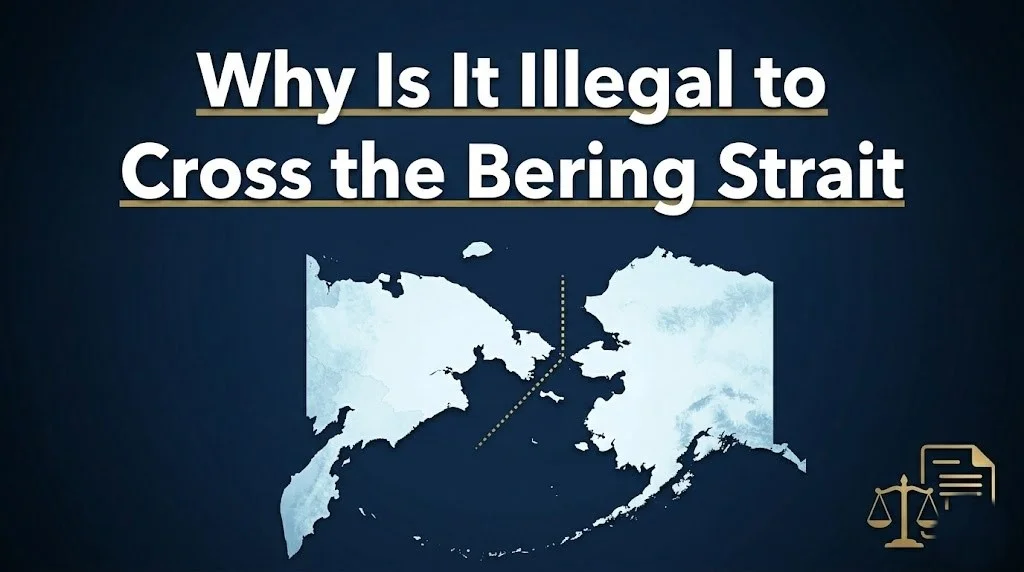
Why Is It Illegal to Cross the Bering Strait
Crossing the Bering Strait is illegal because no authorized port of entry exists there, making any crossing an unauthorized international border crossing under both US and Russian law. Both nations treat this stretch of water as a controlled international boundary, and neither has ever opened it to routine civilian travel.
On the US side, crossing into international waters and arriving in Russia without authorization violates US immigration law and Russian entry law simultaneously. On the Russian side, the entire coastal zone of Chukotka is designated a restricted border zone, which requires special permits even for Russian citizens to access.
The prohibition is not a single law. It is the combined effect of two countries’ border security frameworks, neither of which recognizes the Bering Strait as a legitimate crossing corridor. No treaty between the US and Russia has ever established a civilian transit agreement for this route.
Think of it like trying to walk through a country’s back door when every official entrance is hundreds of miles away. The door does not officially exist, and showing up at it is itself the violation.
Quick Facts:
- No official port of entry exists on either side of the Bering Strait
- Both US and Russian law prohibit unauthorized border crossings
- Russia’s Chukotka border zone requires special permits for any presence
- The US-Russia Maritime Boundary Agreement (1990) defines the maritime border but does not create a crossing corridor
- US-Russia diplomatic relations in 2026 make any new crossing agreement unlikely
Is It Illegal to Cross the Bering Strait
Yes, crossing the Bering Strait without authorization is illegal under both US federal law and Russian federal law. It is not a gray area. Both governments treat it as an illegal border crossing with serious consequences.
Under US law, specifically the Immigration and Nationality Act (8 U.S. Code), entering or attempting to enter the United States other than at a designated port of entry is a federal offense. Departing US territory toward Russia through an unauthorized route carries its own legal complications, particularly regarding passport control and departure documentation.
Russian law is even more direct. Russia’s Law on the State Border (Federal Law No. 4730-1) designates the entire border zone, including the coastal areas of Chukotka facing Alaska, as a restricted area. Entering this zone without a border zone permit is a criminal offense under Russian law, separate from the issue of entering Russia without a visa.
| Legal Framework | Country | Key Provision | Violation Type |
|---|---|---|---|
| Immigration and Nationality Act | USA | 8 U.S. Code Section 1325 | Federal misdemeanor (first offense) |
| Law on the State Border | Russia | Federal Law No. 4730-1 | Administrative and criminal offense |
| Russian Criminal Code | Russia | Article 322 | Illegal border crossing, up to 2 years |
| US CBP Unauthorized Departure | USA | 8 U.S. Code Section 1185 | Federal offense |
Can You Legally Cross the Bering Strait in 2026
No legal civilian crossing route across the Bering Strait exists in 2026. There is no ferry, no authorized boat crossing, no pedestrian route, and no official border checkpoint on either the US or Russian side of the strait.
The closest thing to a legal pathway would require obtaining a Russian visa in advance through standard diplomatic channels, then flying into Russia through an authorized international airport, such as Moscow or Vladivostok. No route through the Bering Strait itself has ever been officially sanctioned for civilian use.
In previous years, there were limited discussions between the US and Russia about establishing a crossing or ferry service. Those talks have gone nowhere, and as of 2026, the geopolitical environment makes any new agreement extremely unlikely. US State Department travel advisories also currently warn against all travel to Russia.
Key Takeaway: There is no legal way to cross the Bering Strait directly in 2026. Anyone seeking to travel between Alaska and Russia must use authorized international air routes through designated ports of entry in both countries.
Where Is the Bering Strait and Why Does It Matter
The Bering Strait is the narrow stretch of water that separates Alaska, United States, from Chukotka, Russia. At its narrowest point, the two landmasses are approximately 55 miles apart, making it the closest geographic point between the US and Russia on Earth.
The strait sits between the Bering Sea to the south and the Chukchi Sea to the north. It is part of the Arctic region and sits along the International Date Line, meaning the two sides of the strait are technically in different calendar days. This geographic quirk has made it a recurring subject of fascination in popular culture.
The strait matters legally because it represents one of the only places on Earth where two nuclear powers share a direct maritime border with zero civilian crossing infrastructure. That combination of geographic proximity and political distance makes it a uniquely restricted space.
| Geographic Feature | Detail |
|---|---|
| Narrowest point | Approximately 55 miles (88 km) |
| Depth | Averages 30 to 50 meters |
| Separates | Alaska (US) and Chukotka (Russia) |
| Located between | Bering Sea (south) and Chukchi Sea (north) |
| Crosses | International Date Line |
| Nearest landmasses | Little Diomede (US) and Big Diomede (Russia), 2.4 miles apart |
How Far Is the Bering Strait Crossing from Alaska to Russia
The Bering Strait crossing spans approximately 55 miles at its widest navigable point between mainland Alaska and mainland Russia. The shortest crossing point is between the two Diomede Islands, where Little Diomede (US) and Big Diomede (Russia) sit just 2.4 miles apart.
That 2.4-mile gap between the Diomede Islands is what makes the crossing feel theoretically possible to many people. On a clear day, you can see Big Diomede (Russia) from Little Diomede (US) with the naked eye. But geographic proximity does not create legal authorization.
The full mainland-to-mainland distance of 55 miles through open Arctic water is a very different physical challenge. Water temperatures average below freezing for much of the year, ice conditions are unpredictable, and weather in the Bering Strait can shift from manageable to life-threatening within hours.
Key Distance Facts:
- Mainland Alaska to mainland Russia: approximately 55 miles
- Little Diomede (US) to Big Diomede (Russia): 2.4 miles
- Nome, Alaska to Provideniya, Russia (nearest major towns): approximately 170 miles by air
- Water temperature: frequently at or below 0 degrees Celsius in winter months
- Ice cover: partial to complete in winter, unpredictable in other seasons
Diomede Islands and the Bering Strait Border
The Diomede Islands sit at the center of the Bering Strait border and represent the most vivid illustration of why crossing is so heavily restricted. Little Diomede belongs to the United States, specifically Alaska. Big Diomede belongs to Russia. They are separated by 2.4 miles of water and the International Date Line.
Big Diomede has been a Russian military installation since the Soviet era. No civilian population lives there. Russian military and border security personnel occupy the island, and it is closed to all foreign visitors without explicit government authorization that is essentially never granted.
Little Diomede has a small Native Alaskan community of roughly 80 to 100 residents. It is accessible by helicopter and, in winter when ice bridges form, by snowmobile from mainland Alaska. Even residents of Little Diomede cannot legally cross to Big Diomede. The border runs right through the strait between the two islands.
Key Takeaway: The Diomede Islands are the clearest physical representation of the Bering Strait border. Big Diomede is a Russian military installation, and the 2.4-mile gap between the islands is an internationally recognized, actively enforced boundary.
US Border Laws and Customs Rules at the Bering Strait
US border law at the Bering Strait is enforced primarily by US Customs and Border Protection (CBP) and the US Coast Guard. There is no CBP checkpoint in the Bering Strait itself, but CBP maintains facilities in Nome, Alaska, which serves as the closest designated port of entry to the strait.
Under 8 U.S. Code Section 1325, entering or attempting to enter the United States at any place other than a designated port of entry is a federal offense. This provision applies equally to departures that bypass official checkpoints. Leaving US territory through the Bering Strait without clearing CBP departure protocols would violate federal law.
The US Coast Guard patrols Arctic and Bering Sea waters and has authority to intercept vessels operating in these zones. Any vessel heading toward Russia through the Bering Strait without proper clearance is subject to interdiction. US CBP also coordinates with the State Department and intelligence agencies when unauthorized crossing attempts are detected.
US Legal Framework at the Bering Strait:
- 8 U.S. Code Section 1325: Improper entry or departure
- 8 U.S. Code Section 1185: Restrictions on travel
- US Coast Guard authority: Enforcement in US territorial and international waters
- Nearest official port of entry: Nome, Alaska
- CBP coordination: Joint operations with State Department and DoD in Arctic region
Russian Border Zone Regulations and Restricted Areas
Russia’s border zone regulations are among the strictest in the world, and the Chukotka region facing Alaska is one of the most heavily restricted areas in the entire Russian Federation. Russia’s Law on the State Border (Federal Law No. 4730-1) divides border areas into zones with increasingly strict access requirements.
The border zone along Chukotka’s coastline requires a special border zone permit (propusk) even for Russian citizens who do not live there. Foreigners cannot enter this zone under any normal circumstances. Entry without the required permit is an administrative offense, and unauthorized crossing of the actual state border is a criminal offense under Article 322 of the Russian Criminal Code.
Russia’s Federal Security Service (FSB) is the primary agency enforcing border zone regulations. The FSB maintains active surveillance and patrols throughout Chukotka’s border areas. Any vessel or individual detected approaching the Russian side of the Bering Strait without authorization faces immediate FSB response.
| Russian Zone | Access Requirement | Violation Consequence |
|---|---|---|
| Border zone (prigranichnaya zona) | Special FSB-issued permit | Administrative fine |
| Border strip (pogranichnaya polosa) | Stricter permit; essentially closed to foreigners | Criminal charge |
| Restricted military zones (Big Diomede) | Military authorization only | Criminal prosecution |
| Russian territorial waters | Diplomatic clearance required | Vessel seizure; detention |
What Happens If You Cross the Bering Strait Illegally
If you cross the Bering Strait illegally and reach Russian territory, you will be detained by Russia’s Federal Security Service and face criminal prosecution under Russian law. Article 322 of the Russian Criminal Code covers illegal crossing of the Russian state border, with penalties ranging from fines to up to two years in prison for a first offense, and up to four years if committed by an organized group.
Being a foreign national from a country with strained relations with Russia, specifically the United States in 2026, dramatically increases the likelihood of a severe outcome. American citizens detained in Russia on border violation charges face the very real risk of prolonged detention, minimal consular access, and the possibility of being charged with espionage-related offenses if authorities suspect any intelligence connection.
On the US side, if you depart US territory toward Russia without proper clearance, you violate federal law before you even hit the water. Upon return or capture, you face federal criminal charges, potential passport revocation, and permanent immigration consequences if you are not a US citizen.
Consequences of Illegal Bering Strait Crossing:
- Russian criminal prosecution under Article 322 (up to 2 years first offense)
- FSB detention, potentially in a remote Chukotka facility
- Deportation after serving sentence (for non-espionage cases)
- Severely limited US consular access due to current diplomatic relations
- US federal charges upon return under 8 U.S. Code Section 1325 and 1185
- Potential passport revocation by the US State Department
- Risk of additional charges if authorities suspect intelligence activity
Key Takeaway: An illegal Bering Strait crossing exposes you to criminal prosecution under two different countries’ legal systems simultaneously, with Russian detention carrying particularly serious risks for American citizens in 2026.
Penalties for Illegal Russia Border Crossing from Alaska
The penalties for illegally crossing into Russia from Alaska are serious on both the Russian and US sides of the law. Russia treats unauthorized border crossings as criminal matters, not just administrative violations.
Under Article 322 of the Russian Criminal Code, illegal crossing of the Russian state border carries a fine of up to 200,000 rubles, or imprisonment of up to two years. If the crossing is deemed organized or involves a group of people, the penalty increases to up to four years in prison. If Russian authorities decide to characterize the crossing as having intelligence or military implications, charges can escalate significantly beyond the base border violation.
The US side carries its own penalty structure. Improper departure from US territory under 8 U.S. Code Section 1325 is a federal misdemeanor on a first offense, punishable by up to six months in federal prison and fines. Subsequent offenses become felonies. Additionally, any vessel used in the crossing can be seized by US authorities.
| Offense | Country | Law | Maximum Penalty |
|---|---|---|---|
| Illegal border crossing (first offense) | Russia | Article 322, Russian Criminal Code | 2 years imprisonment or fine |
| Illegal border crossing (organized) | Russia | Article 322, Part 2 | 4 years imprisonment |
| Improper entry/exit (first offense) | USA | 8 U.S. Code Section 1325 | 6 months federal prison |
| Improper entry/exit (repeat offense) | USA | 8 U.S. Code Section 1325 | Up to 2 years federal prison |
| Vessel used in unauthorized crossing | USA | US Coast Guard authority | Vessel seizure |
Has Anyone Legally Crossed the Bering Strait
A very small number of people have crossed the Bering Strait legally, but those crossings required extraordinary diplomatic arrangements that are not available to ordinary travelers. None of these crossings used a standard civilian process.
The most notable legal crossing was accomplished by Lynne Cox in 1987, when she swam from Little Diomede (US) to Big Diomede (Russia) as part of a carefully orchestrated diplomatic event during the late Cold War era. Her crossing required direct negotiations between US and Soviet governments and was treated as a symbolic gesture of goodwill. It was not a repeatable process.
More recently, some organized expeditions have claimed to make partial crossings, but fully legal crossings of the entire strait that satisfy both US and Russian legal requirements have been essentially nonexistent for civilian travelers. In 2026, given current US-Russia relations, the diplomatic conditions that made the 1987 crossing possible do not exist.
Notable Bering Strait Crossing Events:
- 1987: Lynne Cox swam from US to USSR with diplomatic authorization
- 2006: Karl Bushby and Dimitri Kieffer crossed on foot on ice with partial authorization; faced significant Russian legal complications
- 2013: Various adventurers reported attempts; most were turned back or detained
- 2026: No authorized civilian crossing corridor exists
Bering Strait Crossing Attempts and What Happened
Numerous people have attempted unauthorized or partially authorized Bering Strait crossings over the decades, and the outcomes have consistently ranged from failure to serious legal jeopardy.
Karl Bushby and Dimitri Kieffer are perhaps the most documented case. In 2006, they crossed the Bering Strait on foot over ice as part of Bushby’s round-the-world walk. They entered Russian territory without proper authorization and were subsequently detained by Russian authorities in Chukotka. They faced potential criminal charges before being released after significant diplomatic intervention. Their crossing was widely reported but was not legal by Russian border standards.
Other attempts have resulted in rescue operations, death from hypothermia or drowning, or immediate detention upon reaching Russian territory. The combination of extreme physical conditions and the near-certainty of Russian FSB detection and response has made successful unauthorized crossings extraordinarily rare.
Key Takeaway: Every documented unauthorized Bering Strait crossing attempt has resulted in detention, rescue, legal consequences, or death. The crossing is physically dangerous and legally indefensible under both US and Russian law.
Why Is There No Ferry or Bridge Across the Bering Strait
There is no ferry or bridge across the Bering Strait because neither the United States nor Russia has agreed to build one, and the geopolitical relationship between the two countries has never been stable enough to sustain such a project.
Proposals for a Bering Strait bridge or tunnel have existed since the 19th century. The concept gained the most serious attention in the early 2000s, when Russian entrepreneur Viktor Vekselberg proposed an intercontinental railroad and tunnel project. The estimated cost was in the range of 65 billion dollars at the time. Neither government committed to it.
Beyond politics, the physical challenges are enormous. The strait’s depth, the Arctic climate, the seismic activity in the region, and the logistical complexity of connecting two nations with no existing land border checkpoint infrastructure all compound the difficulty. A bridge or tunnel would also require creating an official border crossing point, which would require a bilateral agreement that does not exist.
Why No Bridge or Ferry Exists:
- No bilateral agreement between the US and Russia to establish a crossing
- Estimated construction cost exceeds tens of billions of dollars
- Extreme Arctic conditions complicate engineering
- Seismic activity in the region poses structural risks
- No border checkpoint infrastructure on either side
- Current US-Russia diplomatic relations make cooperation impossible in 2026
Can You Get a Permit to Cross the Bering Strait
No permit system exists for civilians to cross the Bering Strait between the US and Russia. There is no application process, no authorized crossing organization, and no government program on either side that issues Bering Strait crossing permits to private individuals.
Russia does issue border zone permits (propusk) for travel within restricted Russian border areas, but these are only available to Russian citizens with legitimate regional business and are not accessible to foreign nationals. These permits also do not authorize crossing the actual state border.
On the US side, CBP manages departures from US territory, but there is no departure authorization pathway for crossing to Russia via the Bering Strait. Any departure to Russia must go through an authorized international airport with proper passport and visa documentation.
What You Actually Need to Travel Legally Between Alaska and Russia:
- A valid US passport
- A valid Russian visa obtained in advance from a Russian consulate
- Departure through a designated US port of entry (Nome for nearest, but air travel is the only practical option)
- Arrival into Russia through a designated Russian international port of entry (typically Moscow, St. Petersburg, or Vladivostok)
- No path through the Bering Strait qualifies under any of these requirements
Bering Strait in 2026: Geopolitical Situation and Travel Restrictions
The geopolitical situation in 2026 makes the Bering Strait more legally and diplomatically restricted than at almost any point since the Cold War. US-Russia relations have deteriorated significantly over the past several years, and this directly affects the legal environment surrounding any attempt to cross or approach the strait.
The US State Department maintains a Level 4 “Do Not Travel” advisory for Russia as of 2026. This is the highest warning level and reflects concerns about wrongful detention of US citizens by Russian authorities. Any American who enters Russian territory illegally, especially through a border zone as sensitive as Chukotka, faces an extremely high risk of being used as a bargaining chip in diplomatic disputes.
Russia has also expanded its FSB presence and surveillance capabilities in the Arctic region in recent years. The combination of advanced radar systems, increased naval patrols, and satellite monitoring means that any vessel or individual in the Bering Strait corridor is almost certainly visible to Russian border security before reaching Russian territorial waters.
2026 US-Russia Travel Status:
- US State Department: Level 4 Do Not Travel advisory for Russia
- US consular services in Russia: Severely limited
- Russian visa issuance to Americans: Extremely restricted
- Arctic military activity: Elevated on both sides
- Risk of wrongful detention: Documented and ongoing concern for US citizens
Key Takeaway: In 2026, the Bering Strait is effectively the most restricted civilian maritime border between two countries that share a land-proximate geography anywhere on Earth, with active enforcement on both sides and zero diplomatic pathway for civilian crossing.
Legal Ways to Travel from Alaska to Russia
The only legal way to travel from Alaska to Russia in 2026 is by air through authorized international airports, with a valid Russian visa obtained well in advance. No sea route, overland route, or Bering Strait crossing qualifies as a legal option.
From Alaska, travelers would fly from Anchorage or Fairbanks to a connecting hub such as Seattle, and from there to a Russian international entry point, typically Moscow Sheremetyevo Airport or another designated port of entry. Direct flights between the US and Russia have been suspended or severely restricted since 2022, making connecting routes through third countries the practical reality.
Obtaining a Russian visa as a US citizen in 2026 is significantly more difficult than it was in previous years. Russian consular services in the US have been reduced, and processing times and approval rates for American applicants have declined sharply. Travelers should check current US State Department guidance before making any plans involving travel to Russia.
Steps for Legal Alaska-to-Russia Travel in 2026:
- Apply for a Russian visa through a Russian consulate (availability very limited for US citizens)
- Book air travel through an authorized international routing with no Bering Strait crossing
- Depart through a US designated port of entry with full passport control processing
- Arrive in Russia through an authorized international airport
- Register with Russian authorities as required by Russian law for foreign visitors
- Monitor US State Department advisories throughout travel
Frequently Asked Questions
Why is it illegal to cross the Bering Strait?
Crossing the Bering Strait is illegal because neither the US nor Russia has established an authorized port of entry or civilian crossing corridor there.
Both countries’ border laws require all international crossings to occur at designated official checkpoints.
The combined effect of US immigration law and Russian border zone regulations makes any crossing without prior authorization a criminal offense in both countries.
How far is the Bering Strait from Alaska to Russia?
The mainland-to-mainland distance across the Bering Strait is approximately 55 miles.
The shortest crossing point is between Little Diomede (US) and Big Diomede (Russia), which are only 2.4 miles apart.
Despite this proximity, no legal crossing exists at any of these points.
What happens if you try to cross the Bering Strait illegally?
If you reach Russian territory, you will be detained by Russia’s Federal Security Service (FSB) and face criminal prosecution.
Russian law under Article 322 of the Criminal Code carries penalties of up to two years in prison for a first offense.
American citizens face additional risks in 2026 given current US-Russia diplomatic tensions, including severely limited consular access.
Has anyone ever successfully crossed the Bering Strait?
Yes, a very small number of people have completed Bering Strait crossings, but almost never fully legally.
The most notable legal crossing was swimmer Lynne Cox in 1987, which required direct US-Soviet diplomatic negotiations.
In 2006, Karl Bushby crossed on foot over ice but was detained by Russian authorities for unauthorized border crossing.
No civilian crossing corridor has ever been officially authorized by both governments simultaneously.
Is there any legal way to cross the Bering Strait in 2026?
No legal civilian crossing of the Bering Strait exists in 2026.
The only legal way to travel between Alaska and Russia is by air through authorized international airports with a valid Russian visa.
No ferry, bridge, permit system, or authorized boat crossing route has been established by either government.
The Bering Strait sits at the intersection of geography, law, and geopolitics in a way that almost no other place on Earth does. Two landmasses close enough to see each other across the water, separated by one of the most legally and physically impassable borders in the world.
Bookmark this page if you want a reliable reference on this topic, and share it with anyone who’s still convinced you can just paddle across. The reality in 2026 is that the legal walls here are just as solid as any physical ones.






