
Throwing away money is not a federal crime in the United States, but destroying it with fraudulent intent absolutely is. That single word, “intent,” is what separates a legal act from a federal offense under US currency law.
Most people asking this question have seen a viral video of someone burning cash or have old damaged bills they want to toss. The law on this is more specific than most people realize.
Federal statutes do prohibit defacing and mutilating currency, but those laws have a key requirement most competing articles skip right over. The act has to be connected to fraud or deception.
This article covers every major angle of US currency destruction law for 2026, from what the statutes actually say to how often enforcement happens in the real world.
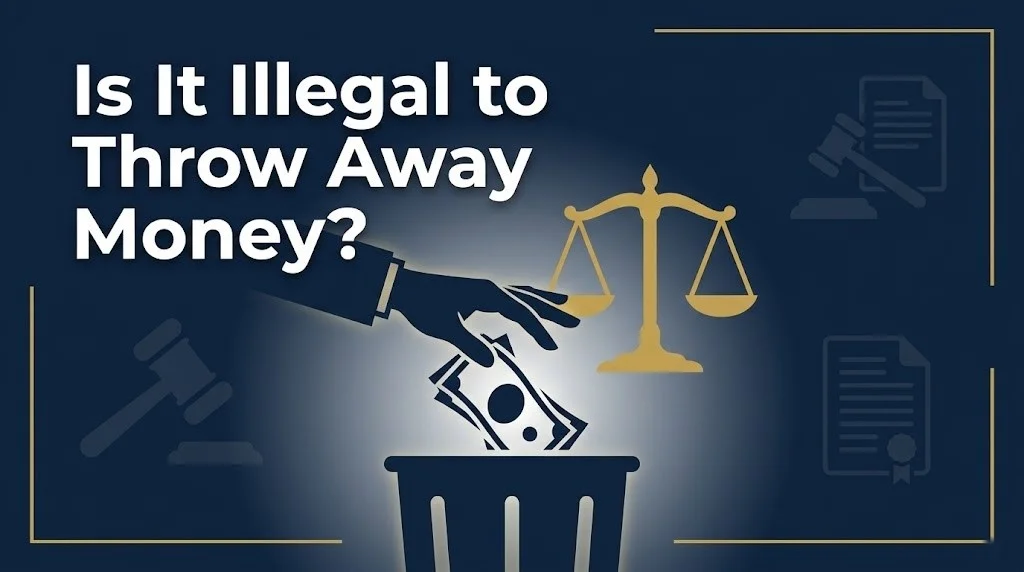
Is It Illegal to Throw Away Money
Throwing away money is not illegal under US federal law. There is no statute that criminalizes simply discarding cash in a trash can, flushing coins down a drain, or tossing bills into a dumpster.
The key legal concept here is that you own your money. As private property, you have the right to dispose of it however you choose. The government does not require you to keep, protect, or preserve currency you legally possess.
Where people get confused is by mixing up “throwing away” with “destroying.” Those words sound similar, but the law treats them very differently. Throwing away is disposal. Destroying money becomes a potential legal issue only when paired with fraudulent intent.
Quick Facts:
- No US law prohibits throwing money in the trash
- You cannot be arrested for discarding cash you legally own
- The act of disposal alone triggers no federal statute
- Fraudulent intent is the legal line that separates legal disposal from criminal conduct
Think of it like throwing away a check you received. The money value is gone, and no law requires you to cash it. Currency works the same way.
That said, the related questions of burning, shredding, stamping, or writing on money involve a different set of laws. Those are addressed in the sections below.
Is It Illegal to Destroy Money
Destroying US currency is potentially illegal, but only under specific conditions. The law does not criminalize every act of destruction. It targets destruction carried out to commit fraud.
Under 18 U.S.C. Section 333, it is a federal offense to mutilate, cut, deface, disfigure, or perforate US banknotes with the intent to render them unfit to be reissued. The word “intent” is doing heavy legal lifting in that sentence.
If you accidentally run paper money through the washing machine and it falls apart, that is not a federal crime. If you shred bills to use as confetti at a party, enforcement of this law against you is virtually nonexistent. The law was designed to catch fraud, not party planning.
Destruction: Legal vs. Potentially Illegal
| Act | Fraudulent Intent Present | Legal Status |
|---|---|---|
| Shredding bills for confetti | No | Not prosecuted |
| Burning cash in a bonfire | No | Not prosecuted |
| Altering bills to pass as higher denominations | Yes | Federal crime |
| Cutting corners off bills to use as change | Yes | Federal crime |
| Accidentally washing and destroying bills | No | Not a crime |
| Dissolving currency in acid for art | No | Not prosecuted |
The practical reality is that ordinary people who destroy money without fraud are not prosecuted. Federal prosecutors focus on cases where the destruction of currency was a step in a deceptive scheme.
The Bureau of Engraving and Printing actually operates a Mutilated Currency Division that replaces accidentally destroyed money for free. That program would not exist if accidental destruction were a crime.
Is It Illegal to Burn Money
Burning money is not specifically illegal under US federal law when done without fraudulent intent. No statute says “it is illegal to set fire to US currency” as a standalone act.
The relevant law, 18 U.S.C. Section 333, requires proof of intent to defraud or to render the currency unfit for reissue in a way that serves a fraudulent purpose. Burning cash in a backyard fire pit, in a protest, or in a viral social media video does not meet that standard.
This surprises a lot of people. The common belief is that burning money is automatically a federal crime. That belief is simply not supported by the actual text of the statute.
What Makes Burning Money Potentially Illegal:
- Burning bills to conceal evidence of a crime
- Burning currency as part of a money laundering scheme
- Burning marked bills to prevent identification in a fraud investigation
None of these situations describe someone who burns cash out of frustration or as a political statement. Public figures and artists have burned money as symbolic acts, and federal prosecutions for those acts do not appear in documented case records.
Bold Legal Fact: 18 U.S.C. Section 333 carries a maximum penalty of 6 months in prison and fines, but only applies when fraudulent intent can be proven by federal prosecutors.
The distinction between a campfire and a crime is intent. Without fraud in the picture, burning your own cash is legally closer to burning your own receipts.
Is It Illegal to Throw Money Away
Throwing money away, meaning physically discarding it as trash, is not illegal in the United States. No federal or state law requires you to spend, save, or deposit currency you own.
This question sometimes comes up in a different context: what if someone throws money into a crowd, off a building, or into a public space? That adds different legal considerations. Littering laws could technically apply if bills are left scattered on a street, depending on local ordinances. Disorderly conduct laws could apply if money-throwing creates a public disturbance.
But the act of putting money in the trash at home? Completely legal.
Scenarios and Their Legal Status:
| Scenario | Applicable Law | Legal Status |
|---|---|---|
| Throwing cash in home trash | None | Legal |
| Tossing bills off a balcony into a crowd | Local disorderly conduct | Potentially ticketable |
| Leaving bills scattered on a public street | Local littering laws | Possibly a minor violation |
| Dropping coins into a storm drain intentionally | Local ordinances vary | Varies by jurisdiction |
| Discarding old torn bills in household trash | None | Legal |
One thing worth knowing: if you throw away cash and someone else finds it, the finder may have a legal claim to it depending on state property law. Found property laws vary by state, but the person who threw it away generally loses any legal claim to it once it is discarded.
Is It Illegal to Deface Currency
Defacing currency is a federal offense under 18 U.S.C. Section 333, but again, enforcement depends on whether fraudulent intent exists. The word “deface” in the statute means altering the appearance of a note in a way that is tied to deception.
The law specifically covers mutilating, cutting, defacing, disfiguring, or perforating banknotes with the intent to render them unfit for reissue. Not every mark on a bill meets this threshold.
A stamp that says “WHERE’S GEORGE?” on a dollar bill, tracking its travels across the country, is technically a form of defacement. But federal prosecutors have never pursued those cases because there is no fraud attached.
Quick Facts on Currency Defacement:
- 18 U.S.C. Section 333 governs paper currency defacement
- Maximum penalty: 6 months in prison and fines
- Fraudulent intent is required for prosecution
- Artistic or protest-related defacement is not documented as prosecuted
The law was primarily written to prevent criminals from altering currency to pass lower-denomination bills as higher ones. That is the core mischief the statute targets.
Without fraud, defacement is a technical violation that carries virtually no enforcement risk for ordinary people. With fraud, it becomes a federal case quickly.
Key Takeaway: Throwing away money, destroying it, burning it, and defacing it are not automatically federal crimes. The law under 18 U.S.C. Section 333 requires fraudulent intent, and ordinary acts of disposal or destruction without fraud are not prosecuted.
Is Defacing Money Illegal
Defacing money is technically prohibited by federal statute, but the practical legal risk depends entirely on whether the defacement was intended to defraud someone. The law does not treat all defacement equally.
18 U.S.C. Section 333 has been on the books since the 19th century in various forms. Its modern version targets the intersection of currency alteration and fraud, not artistic expression or casual handling.
Courts have interpreted the “intent to render unfit” language narrowly. A court would need to find that the person who defaced the bill was attempting to pass it off in a deceptive way, not simply marking it.
Examples of Defacement and Legal Risk:
| Act | Fraudulent Intent | Enforcement Risk |
|---|---|---|
| Stamping a logo on a bill | No | Virtually zero |
| Drawing on a dollar bill | No | Virtually zero |
| Bleaching and reprinting a bill as higher denomination | Yes | High, federal crime |
| Writing a political slogan on a bill | No | Virtually zero |
| Altering serial numbers | Yes | High, federal crime |
The Federal Reserve itself acknowledges that worn, marked, or defaced bills are regularly accepted by banks and returned to circulation. That practice confirms that minor defacement without fraud is not treated as a serious legal problem at the institutional level.
Is It Illegal to Write on Money
Writing on money is not a federal crime under current enforcement standards in the United States. While 18 U.S.C. Section 333 technically covers marking currency, the fraudulent intent requirement means that writing a note, a name, or a slogan on a bill does not trigger prosecution.
Businesses sometimes stamp bills with their logo or address. Teachers write on play-money props. Artists create bill-based artwork. None of these practices result in federal cases because none involve an intent to defraud.
The popular “Where’s George” website has encouraged people to stamp their bills with the website URL for decades, producing millions of marked bills in circulation. No federal prosecution has resulted from this practice.
Quick Facts on Writing on Money:
- Writing on bills is technically covered by 18 U.S.C. Section 333
- Fraudulent intent is required for prosecution
- No documented federal cases exist for writing alone without fraud
- Businesses, artists, and trackers regularly mark currency without legal consequence
The practical line is clear: write on a bill for personal expression, art, or tracking purposes and nothing happens. Use that writing to deceive someone about the bill’s value or origin and you have crossed into federal crime territory.
Think of it like speeding on an empty highway at 3 a.m. The law technically applies, but enforcement requires the right context and the right circumstances.
Is It Illegal to Mutilate Coins
Mutilating coins is a separate federal offense covered by 18 U.S.C. Section 331, and it has a slightly different legal standard than the paper currency law. Section 331 prohibits fraudulently altering, defacing, mutilating, or imparing coins.
The word “fraudulently” appears directly in Section 331, making the fraudulent intent requirement explicit. Coins that are mutilated without fraud attached do not trigger prosecution under this statute.
One of the most common “coin mutilation” acts in America is the penny-squishing machine found at tourist attractions and zoos. These machines flatten and imprint pennies for souvenirs. They are legal because the US Mint has confirmed that these machines operate without fraudulent intent.
Coin Mutilation: Legal vs. Illegal
| Act | Legal Status | Statute Reference |
|---|---|---|
| Penny-squishing souvenir machines | Legal | US Mint approved |
| Shaving coins to pass as higher value | Illegal | 18 U.S.C. Section 331 |
| Drilling holes in coins for jewelry | Legal | No fraudulent intent |
| Altering date on a coin for resale fraud | Illegal | 18 U.S.C. Section 331 |
| Melting coins for metal value | See below | Separate regulation |
Melting pennies and nickels is actually addressed by a separate US Mint regulation from 2006, not by Section 331. That regulation prohibits melting one-cent and five-cent coins specifically because their metal value exceeded face value at the time.
Is It Illegal to Throw Away Coins
Throwing away coins is not a federal crime. Like paper currency, coins are private property once they are in your possession. You can legally discard them.
The caveat that applies to paper money applies here too. Throwing coins away is legal. Mutilating them with fraudulent intent before throwing them away could add a legal dimension. But simply tossing a jar of pennies in the trash is not going to bring federal investigators to your door.
Quick Facts:
- No federal law prohibits discarding coins
- Coins are personal property; disposal is legal
- Melting pennies and nickels is restricted by a 2006 US Mint regulation
- Throwing away dimes, quarters, or other coins has no regulatory restriction
The 2006 US Mint regulation on melting is worth knowing. It specifically bans the melting or exportation of pennies and nickels in large quantities, targeting commercial-scale melting operations. It does not target someone who throws coins in the trash.
For most people asking this question, the answer is simple: tossing a few coins means losing their monetary value. No law prevents it.
Key Takeaway: Mutilating coins is covered by 18 U.S.C. Section 331, but fraudulent intent is required for prosecution. Ordinary disposal or novelty use of coins is not illegal, and souvenir penny machines are fully legal under US Mint guidance.
Federal Law on Destroying Currency
Federal law on destroying currency is found in two primary statutes: 18 U.S.C. Section 333 for paper money and 18 U.S.C. Section 331 for coins. Both laws require fraudulent intent as a core element of any violation.
These laws are part of Title 18 of the United States Code, which covers federal crimes and criminal procedure. They sit alongside counterfeiting laws and other financial crime statutes, which signals their intended purpose: protecting the integrity of the currency system against fraud, not punishing people for accidents or personal decisions.
The laws date back to the National Currency Act era of the 1860s, when standardized federal currency was first introduced. They were designed to prevent widespread alteration schemes that could destabilize public trust in paper money.
Federal Currency Destruction Laws at a Glance:
| Statute | Covers | Key Requirement | Max Penalty |
|---|---|---|---|
| 18 U.S.C. Section 333 | Paper currency | Fraudulent intent | 6 months, fines |
| 18 U.S.C. Section 331 | Coins | Fraudulent alteration | 5 years, fines |
| 2006 US Mint Regulation | Penny/nickel melting | Commercial scale | Civil penalties |
Notice the penalty difference between the two statutes. Coin fraud under Section 331 carries up to 5 years in federal prison, significantly more than the 6-month maximum for paper currency defacement under Section 333. That disparity exists because coin fraud has historically been used in more systematic counterfeiting schemes.
Neither law has been used to prosecute ordinary people for accidental damage, artistic use, or personal disposal of their own money.
18 U.S.C. 333 Explained
18 U.S.C. Section 333 is the primary federal law governing the defacement and mutilation of US paper currency. It makes it a crime to mutilate, cut, deface, disfigure, or perforate, or unite or cement together any bank bill, draft, note, or other evidence of debt issued by a national banking association or Federal Reserve bank.
The full legal text also covers alterations that render notes unfit to be reissued. The phrase “unfit to be reissued” is significant because it tells you the law is about protecting the currency supply’s usability, not punishing symbolic acts.
The statute requires that the act be done with fraudulent intent. That element is not optional or implied. It is built into the law and must be proven by a federal prosecutor.
Breaking Down Section 333:
| Element | What It Means in Plain English |
|---|---|
| Mutilate, cut, deface | Physically alter the note in any way |
| Render unfit for reissue | Make the bill too damaged to put back in circulation |
| Fraudulent intent | The act was done to deceive someone or commit fraud |
| Federal Reserve notes covered | Applies to all modern US paper currency |
| National banking notes covered | Applies to older forms of US paper currency |
The maximum penalty under Section 333 is a fine and imprisonment of up to 6 months. This is a misdemeanor-level federal offense, not a felony.
Prosecutions under this statute are rare and almost exclusively involve cases where someone altered bills to pass them off as higher denominations. Standalone defacement without fraud is essentially never prosecuted.
What Is Fraudulent Intent in Currency Law
Fraudulent intent in currency law means the person who defaced, destroyed, or mutilated the currency did so for the purpose of deceiving another person or gaining something of value dishonestly. It is the dividing line between legal conduct and federal criminal liability.
Without fraudulent intent, the physical act of damaging a bill or coin does not meet the elements of either 18 U.S.C. Section 333 or Section 331. Federal courts have consistently required prosecutors to prove this mental state element beyond a reasonable doubt.
The clearest example of fraudulent intent in this context is “raised note” fraud. This is where someone chemically bleaches a $1 bill, then uses the same paper to print $100 bill imagery on top of it. The physical paper is genuine. The fraudulent intent to pass it as a $100 bill is what makes it a crime.
Examples of Fraudulent Intent vs. No Fraudulent Intent:
| Scenario | Fraudulent Intent | Legal Outcome |
|---|---|---|
| Burning bills in a protest | No | Not prosecuted |
| Bleaching bills to counterfeit higher denominations | Yes | Federal felony |
| Writing on bills for artistic expression | No | Not prosecuted |
| Shaving coin edges to collect metal | Yes | Federal misdemeanor/felony |
| Washing bills that dissolve in laundry | No | Accidental, not a crime |
| Altering bill serial numbers | Yes | Federal crime |
This distinction matters enormously for understanding the law accurately. Every headline that says “it is illegal to destroy money” is technically incomplete. The complete answer is: it is illegal to destroy money with fraudulent intent.
Key Takeaway: Fraudulent intent is the core legal requirement under both 18 U.S.C. Section 333 and Section 331. Without it, acts of currency destruction, defacement, or disposal are not prosecuted under federal law.
Penalty for Destroying US Currency
The penalty for destroying US currency depends on which statute applies and whether the destruction involved coins or paper money. Paper currency destruction under 18 U.S.C. Section 333 carries a maximum of 6 months in federal prison plus fines. Coin mutilation under 18 U.S.C. Section 331 is more serious, carrying up to 5 years in federal prison.
These penalties apply only when fraudulent intent is proven. They are not triggered by accidental damage, artistic expression, or casual disposal.
Federal sentencing also takes into account the amount of money involved, the sophistication of the scheme, and whether the act was part of a larger fraud. A one-time raised note scheme differs significantly from an organized operation producing thousands of altered bills.
Penalty Summary Table:
| Offense | Statute | Maximum Prison Time | Fine Possible |
|---|---|---|---|
| Paper currency defacement with fraud | 18 U.S.C. Section 333 | 6 months | Yes |
| Coin mutilation with fraud | 18 U.S.C. Section 331 | 5 years | Yes |
| Penny/nickel melting (commercial) | 2006 US Mint Regulation | Civil penalty only | Yes |
| Counterfeit currency production | 18 U.S.C. Section 471 | Up to 20 years | Yes |
It is important to separate currency destruction penalties from counterfeiting penalties. Making a fake bill from scratch under 18 U.S.C. Section 471 can result in up to 20 years in federal prison. That is a significantly more serious offense than defacement.
Most people who damage currency accidentally or artistically face zero legal consequences. The penalty structure is built for fraud, not clumsiness.
Secret Service and Currency Destruction
The US Secret Service is the federal agency responsible for investigating currency crimes in the United States, including counterfeiting and fraud-based currency destruction. It operates under the Department of Homeland Security and has jurisdiction over all federal currency offenses.
The Secret Service’s financial crimes division handles cases involving altered currency, raised notes, and systematic defacement operations. They do not investigate individuals who burn a dollar bill or throw cash in the trash.
Their resources are focused on organized currency fraud, large-scale counterfeiting operations, and schemes that threaten the integrity of the US financial system. A single instance of defacement without fraud is simply not on their radar.
What the Secret Service Investigates Related to Currency:
- Counterfeiting operations producing fake bills
- Raised note schemes altering real bills to higher denominations
- Organized rings distributing altered or defaced currency
- Digital and printed counterfeit attempts
- Large-scale coin fraud operations
What they do not investigate:
- Someone burning their own cash at home
- Artists creating works using defaced currency
- Businesses that stamp their logo on bills
- Individuals who accidentally destroy currency
The Bureau of Engraving and Printing works alongside the Secret Service. The BEP handles the production and replacement of currency. Its Mutilated Currency Division processes claims for accidentally damaged money, further confirming that accidental destruction is viewed as a customer service issue, not a crime.
Can You Legally Shred Money
Shredding money is legal in the United States. No federal statute prohibits running cash through a paper shredder, and the act of shredding does not meet the fraudulent intent requirement needed for a violation of 18 U.S.C. Section 333.
The Federal Reserve actually shreds billions of dollars in worn-out currency every year as part of its standard currency lifecycle management process. The BEP also shreds defective notes during production. These practices confirm that shredding is viewed as a normal and acceptable method of currency disposal.
Some novelty shops and tourist destinations even sell bags of shredded currency as souvenirs. The Federal Reserve has gifted shredded currency in promotional materials. None of this would be possible if shredding were illegal.
Shredded Currency Facts:
| Entity | Shredding Activity | Legal Status |
|---|---|---|
| Federal Reserve banks | Shred worn notes annually | Standard practice |
| Bureau of Engraving and Printing | Shred defective print runs | Standard practice |
| Private individuals | Shred personal cash | Legal |
| Tourist gift shops | Sell shredded currency as souvenirs | Legal |
If you accidentally shred money and want it replaced, the Bureau of Engraving and Printing’s Mutilated Currency Division will examine your claim. You need to send in the shredded remains with a written explanation. If at least 51% of each note is identifiable, the BEP will typically replace it.
Can You Throw Away Foreign Currency in the US
Throwing away foreign currency in the United States is legal. No US federal law requires you to exchange, preserve, or keep foreign coins or bills. Foreign currency is your personal property, and you can dispose of it as you choose.
Foreign currency is not subject to 18 U.S.C. Section 333 or Section 331. Those statutes apply specifically to US currency issued by Federal Reserve banks and the US Mint. A euro, a yen, or a British pound is outside their scope entirely.
The country that issued the foreign currency may have its own laws about destruction or defacement, but those laws do not apply inside the United States. US law does not enforce foreign nations’ currency protection statutes.
Quick Facts on Foreign Currency Disposal:
- US currency laws do not cover foreign money
- Throwing away foreign coins or bills is completely legal in the US
- The country that issued the currency has no enforcement reach inside the US
- Foreign currency in the US is treated as personal property under US law
One practical note: many airports, charities, and banks accept foreign currency donations or exchanges. If you have foreign currency you do not want, those are useful alternatives to disposal. But legally speaking, throwing it away is entirely your right.
Key Takeaway: Shredding US money is legal, and throwing away foreign currency in the US is also legal. Neither act violates any federal statute because neither involves fraudulent intent tied to US currency fraud.
Frequently Asked Questions
Is it actually illegal to throw away US currency?
No, throwing away US currency is not illegal under federal law.
There is no statute that prohibits discarding cash you own.
The laws that govern currency destruction require fraudulent intent, and simply throwing money away does not meet that standard.
You may lose the monetary value, but you will not face legal consequences.
What is the penalty for destroying US paper money?
The penalty for destroying paper money is up to 6 months in prison and fines under 18 U.S.C. Section 333.
That penalty only applies if the destruction was done with fraudulent intent.
Accidental destruction, artistic use, or casual disposal is not prosecuted.
The Bureau of Engraving and Printing will even replace accidentally destroyed money through its Mutilated Currency Division.
Can you go to jail for burning cash in the US?
Burning cash is not a prosecuted offense in the US when done without fraudulent intent.
18 U.S.C. Section 333 requires proof of intent to defraud, which a simple bonfire or protest burning does not establish.
Federal prosecutors have not documented cases of individuals being jailed solely for burning their own money without fraud.
The maximum possible penalty under Section 333 is 6 months, but it requires fraud to be proven first.
Is writing on a dollar bill illegal?
Writing on a dollar bill is technically covered by 18 U.S.C. Section 333, but it is not prosecuted when there is no fraudulent intent.
Millions of Americans have written on bills through programs like “Where’s George” without any legal consequence.
The law targets fraud, not casual markings.
Writing a note or signature on a bill is not a federal crime in practice.
What does the Secret Service do about destroyed currency?
The Secret Service investigates currency crimes, including fraud-based destruction, counterfeiting, and raised note schemes.
It does not investigate individuals who accidentally destroy or casually discard their own money.
The agency focuses on organized operations that threaten the integrity of the US currency system.
For accidentally destroyed currency, the Bureau of Engraving and Printing handles replacements through its Mutilated Currency Division, not law enforcement.
US currency law is more specific and narrower in scope than most people think. The line between legal and illegal is not whether you destroy money. It is whether you destroy it to commit fraud.
Bookmark this page if currency law questions come up again, whether for your own situation or to settle a debate with someone who swears burning a dollar bill is a federal offense. The actual law tells a different story than the myth does.






