
Changing lanes in an intersection is legal in most US states. There is no federal law prohibiting this maneuver, and only a handful of states have specific statutes banning it. The widespread belief that this is universally illegal is actually a myth.
That said, “legal” doesn’t always mean “safe” or “ticket-free.” Even in states without explicit intersection lane change bans, you can still get cited for unsafe lane change or failure to yield. Police officers have broad discretion when something goes wrong.
Here’s the surprising truth: most driving instructors teach students to avoid intersection lane changes, which has created a generation of drivers who assume it’s illegal everywhere. The reality is more complicated and varies significantly by state.
This guide covers the 2026 laws in every major state. You’ll learn where intersection lane changes are explicitly banned, where they’re technically legal but risky, and what happens when you get a ticket or cause an accident while making this maneuver.
Is It Illegal to Change Lanes in an Intersection
Changing lanes in an intersection is not illegal in the majority of US states. Only a small number of states have laws that specifically prohibit lane changes within the boundaries of an intersection.
The confusion stems from driving school teachings. Most instructors advise against intersection lane changes as a safety practice. Over time, many drivers internalized this guidance as actual law. It’s not.
| Legal Status | Number of States | Examples |
|---|---|---|
| Legal (no prohibition) | ~40 states | California, Texas, Florida, New York |
| Restricted or discouraged | ~7 states | Ohio, Arkansas, some local codes |
| Explicitly illegal | ~3 states | Specific jurisdictions vary |
In states where intersection lane changes are legal, you still must follow standard lane change rules. Signal your intent. Check mirrors and blind spots. Yield to other vehicles already in the target lane.
What can make a legal maneuver illegal:
- Crossing solid white or yellow lines
- Failing to signal properly
- Cutting off another vehicle
- Changing lanes unsafely during heavy traffic
The key distinction is between “there’s no law against it” and “you can do it without consequences.” Even legal lane changes become violations when executed unsafely.
Is It Legal to Change Lanes in an Intersection
Yes, it is legal to change lanes in an intersection in most states. The absence of a specific prohibition means the maneuver is permitted as long as you follow general safe driving rules.
States generally regulate lane changes through “unsafe lane change” statutes rather than location-specific bans. This approach gives officers flexibility to cite dangerous maneuvers without creating rigid geographic prohibitions.
States where intersection lane changes are clearly legal:
- California
- Texas
- Florida
- New York
- Illinois
- Pennsylvania
- Michigan
- Georgia
The California Vehicle Code, often cited as a reference, does not prohibit intersection lane changes. California Highway Patrol has confirmed that the maneuver itself is not illegal. The same applies in Texas under the Texas Transportation Code.
Legal doesn’t mean advisable. Intersections are high-risk areas. Cross traffic, pedestrians, and turning vehicles create unpredictable conditions. A lane change that would be routine on a straight road becomes more dangerous at intersections.
Think of it like jaywalking in some cities. Not technically illegal, but you accept increased risk. Insurance companies and courts may view intersection lane changes unfavorably even when no statute was violated.
Can You Change Lanes in an Intersection
You can change lanes in an intersection in most US jurisdictions. The specific answer depends on your state’s traffic code, local ordinances, and the road markings present at that particular intersection.
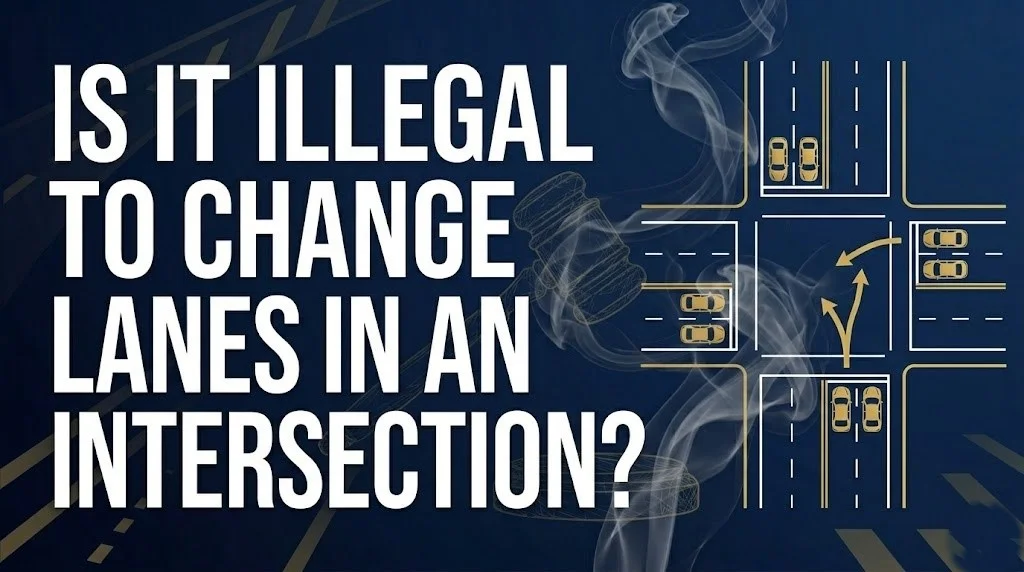
The practical answer involves three questions:
- Does your state ban intersection lane changes specifically?
- Are there solid lines prohibiting lane changes at this intersection?
- Can you execute the change safely given current traffic conditions?
How to determine if you can change lanes in your intersection:
First, check your state’s vehicle code for intersection-specific lane change restrictions. Most states have none. Second, look at the pavement markings. Solid white or yellow lines prohibit lane changes regardless of location. Third, assess traffic conditions. Even where legal, unsafe execution creates liability.
| Question | If Yes | If No |
|---|---|---|
| State ban exists | Do not change lanes | Proceed to next question |
| Solid lines present | Do not change lanes | Proceed to next question |
| Safe conditions exist | May proceed carefully | Wait for safer opportunity |
The physical reality of intersections makes lane changes more complex. Other drivers are focused on cross traffic, signals, and turns. They may not anticipate someone changing lanes mid-intersection. This is why many driving instructors discourage the practice even where legal.
Key Takeaway: Intersection lane changes are legal in about 40 states, but pavement markings, traffic conditions, and safety considerations can make a technically legal maneuver practically inadvisable.
States Where Changing Lanes in Intersection Is Illegal
Very few states have explicit laws making intersection lane changes illegal. Ohio is the most commonly cited example, with specific statutory language restricting lane changes at intersections.
Ohio Revised Code 4511.33 states that lane changes are prohibited “when approaching or traversing an intersection.” This makes Ohio one of the strictest states for this maneuver. Violations can result in traffic citations.
States with intersection lane change restrictions:
- Ohio (ORC 4511.33)
- Arkansas (local ordinances in some cities)
- Connecticut (some interpretations of unsafe operation)
| State | Statute | Restriction Level |
|---|---|---|
| Ohio | ORC 4511.33 | Explicit prohibition |
| Arkansas | Various local | City-specific bans |
| Most other states | None specific | General unsafe lane change applies |
The small number of states with specific bans surprises many drivers. The perception that intersection lane changes are universally illegal far exceeds the actual legal restrictions.
Even in states without explicit bans, local jurisdictions occasionally enact stricter rules. Some cities have traffic codes that go beyond state law. Always check both state and local regulations if you’re uncertain.
The takeaway: if you’re in Ohio, avoid intersection lane changes entirely. In most other states, the maneuver is technically permitted but subject to safe driving requirements.
Intersection Lane Change Laws by State
Lane change laws at intersections vary considerably by state. Most states have no specific intersection restriction but enforce general lane change safety statutes. A few states prohibit the maneuver outright.
| State | Intersection Lane Change | Key Statute |
|---|---|---|
| California | Legal | CVC 21658 (general) |
| Texas | Legal | TTC 545.060 (general) |
| Florida | Legal | FS 316.085 (general) |
| New York | Legal | VTL 1128 (general) |
| Ohio | Illegal | ORC 4511.33 |
| Illinois | Legal | 625 ILCS 5/11-709 |
| Pennsylvania | Legal | 75 Pa.C.S. 3309 |
| Michigan | Legal | MCL 257.642 |
| Georgia | Legal | OCGA 40-6-123 |
| Arizona | Legal | ARS 28-729 |
Common misconceptions about state laws:
- California does not ban intersection lane changes
- Texas has no specific intersection restriction
- Florida allows the maneuver with safe execution
- New York permits it outside of specific marked zones
The “general” designation means states rely on unsafe lane change statutes. These laws don’t specifically address intersections but can be applied when a lane change in any location is executed dangerously.
Officers in “legal” states can still cite you for improper lane change, failure to signal, or reckless driving. The absence of an intersection-specific law doesn’t create immunity from all traffic violations.
Changing Lanes in Intersection California
Changing lanes in an intersection is legal in California. The California Vehicle Code does not prohibit lane changes at intersections. This is one of the most commonly misunderstood traffic rules in the state.
California Highway Patrol has publicly clarified this point multiple times. CVC 21658 requires vehicles to stay within a single lane “as nearly as practicable” and prohibits unsafe lane changes. It says nothing about intersections specifically.
California lane change rules:
- Must signal intent before changing lanes
- Must ensure the move can be made safely
- Cannot change lanes across solid lines
- No specific intersection prohibition exists
| California Scenario | Legal Status |
|---|---|
| Intersection with dashed lines | Legal |
| Intersection with solid white line | Illegal (line violation) |
| Intersection with no line markings | Legal |
| Intersection causing conflict with other vehicle | Unsafe lane change citation possible |
Many California drivers learn in driving school that intersection lane changes are prohibited. This teaching stems from safety recommendations, not actual law. Instructors prioritize defensive driving over technical legality.
The practical advice for California drivers: intersection lane changes are permitted, but remain cautious. Signal early. Check thoroughly. If conditions seem risky, wait until you’re through the intersection.
Key Takeaway: California, Texas, and Florida all permit intersection lane changes under their vehicle codes; Ohio is the notable exception with an explicit statutory prohibition.
Changing Lanes in Intersection Texas
Changing lanes in an intersection is legal in Texas. The Texas Transportation Code does not contain any provision specifically prohibiting lane changes within intersections.
Texas law focuses on safe operation rather than location-specific restrictions. TTC 545.060 addresses lane changes generally, requiring signal use and safe execution. Intersections are not mentioned as prohibited zones.
Texas lane change requirements:
- Signal continuously for at least 100 feet before changing lanes
- Ensure the movement can be made safely
- Stay within marked lanes
- Yield to vehicles already in the target lane
| Texas Violation | Fine Range | Points |
|---|---|---|
| Unsafe lane change | $150-$200 | 2 points |
| Failure to signal | $150-$200 | 2 points |
| Improper lane change | $150-$200 | 2 points |
Texas police can still cite drivers for unsafe lane change even when the maneuver occurs in a legal location. The citation focuses on execution, not geography. An intersection lane change that cuts off another driver or causes a near-collision can result in a ticket.
Large Texas cities like Houston, Dallas, and San Antonio follow state law on this issue. No major Texas municipality has enacted local ordinances banning intersection lane changes.
For Texas drivers, the rule is simple: intersection lane changes are permitted, but carelessness will still earn citations.
Changing Lanes in Intersection Florida
Changing lanes in an intersection is legal in Florida. Florida Statutes Chapter 316 governs traffic rules but contains no prohibition on lane changes within intersections.
Florida law emphasizes lane change safety under FS 316.085. Drivers must signal, ensure the movement is safe, and yield to other traffic. Where the lane change occurs is not specified as a restriction.
Florida lane change basics:
- Must signal intent for at least 100 feet
- Cannot change lanes across solid lines
- Must ensure movement is safe
- No intersection-specific prohibition
| Florida Traffic Violation | Typical Fine | Points on License |
|---|---|---|
| Improper lane change | $158+ | 3 points |
| Failure to signal | $158+ | 3 points |
| Careless driving | $166+ | 3 points |
Florida’s points system adds 3 points for improper lane change violations. These points accumulate and can lead to license suspension if too many accrue within a specific period.
Miami, Orlando, Tampa, and Jacksonville all follow state law. Local police enforce general lane change safety rather than intersection-specific rules. However, Florida’s high traffic density means intersection lane changes carry elevated risk.
Florida drivers should understand that legal permission doesn’t equal safety endorsement. The state’s busy roads and frequent accidents make cautious driving essential.
Unsafe Lane Change in Intersection
An unsafe lane change in an intersection can result in a traffic citation even in states where intersection lane changes are legal. The key factor is how the maneuver was executed, not where it occurred.
Unsafe lane change statutes exist in every state. These laws give officers discretion to cite drivers whose lane changes create danger, regardless of technical legality of the location.
What makes a lane change unsafe:
- Cutting off another vehicle
- Failing to check blind spots
- Not using turn signals
- Changing lanes in heavy traffic without adequate space
- Surprising other drivers with sudden movement
| Unsafe Lane Change Factors | Result |
|---|---|
| Adequate signaling | Required for safety |
| Mirror and blind spot check | Required for safety |
| Sufficient gap in target lane | Required for safety |
| No conflict with other vehicles | Required for safety |
Intersections amplify the risks of lane changes. Other drivers are focused on signals, pedestrians, and cross traffic. Their attention is divided. A lane change they might easily notice on a straight road could surprise them mid-intersection.
The legal standard for unsafe lane change varies by state but generally focuses on whether a reasonable driver would consider the maneuver dangerous under the circumstances.
Think of it like walking across a basketball court during a game versus walking across an empty court. The action is the same, but the context makes one version much riskier.
Key Takeaway: Even in states where intersection lane changes are legal, unsafe execution can result in citations for improper lane change, failure to signal, or reckless operation.
Ticket for Changing Lanes in Intersection
You can receive a ticket for changing lanes in an intersection under several circumstances. The violation type depends on your state’s laws and how you executed the maneuver.
In states like Ohio where intersection lane changes are explicitly banned, the citation is straightforward. In other states, officers cite drivers under general unsafe lane change or improper lane change statutes.
| State Type | Possible Citation | Typical Fine |
|---|---|---|
| States with ban (Ohio) | Intersection lane change | $100-$150 |
| States without ban | Unsafe lane change | $100-$250 |
| Any state | Failure to signal | $75-$200 |
| Any state | Reckless operation | $150-$500 |
Reasons you might get ticketed:
- Crossing solid white or yellow lines
- Failing to signal the lane change
- Cutting off another vehicle
- Causing a near-accident or actual accident
- Executing during congested conditions
The officer’s discretion plays a significant role. A clean lane change with proper signaling in light traffic rarely draws attention. A sudden lane change that forces other drivers to brake will likely result in a stop.
Fine amounts vary by jurisdiction. Base fines typically range from $100 to $200 for lane change violations. Court costs and surcharges often double the actual amount paid.
Points on your license accompany most moving violations. Expect 2 to 4 points for lane change infractions depending on state policy.
Changing Lanes in an Intersection Accident
Accidents that occur during intersection lane changes often result in fault being assigned to the lane-changing driver. Even when the lane change itself was legal, the driver who initiated the maneuver typically bears responsibility.
Insurance companies apply a “last clear chance” analysis. The driver changing lanes had the last opportunity to avoid the collision. This principle often determines fault regardless of who technically had right of way.
How fault is typically determined:
- Did the lane-changing driver signal?
- Was there adequate space for the maneuver?
- Did other drivers have time to react?
- Were road conditions safe for lane changes?
| Accident Scenario | Likely Fault Assignment |
|---|---|
| Lane changer hits vehicle in target lane | Lane changer at fault |
| Vehicle in target lane rear-ends lane changer | Complex; often shared fault |
| Lane changer collides with turning vehicle | Often lane changer at fault |
| Both vehicles change into same lane | Shared fault possible |
Police reports significantly influence insurance decisions. If the officer cites the lane-changing driver, insurance companies usually follow that determination.
Intersection accidents are inherently more complicated than straight-road collisions. Multiple sight lines, turning traffic, and pedestrians create variables that benefit defendants who argue the lane changer should have waited.
The practical advice: even when legal, avoid intersection lane changes when possible. The risk of accident and fault assignment outweigh the few seconds saved.
Intersection Lane Change Fault
Fault for intersection lane change accidents typically falls on the driver who initiated the lane change. This holds true even in states where intersection lane changes are legal.
The legal principle is comparative negligence. Courts and insurance companies assess what percentage of fault each driver bears. The lane-changing driver starts with a presumption of greater responsibility.
Factors that affect fault determination:
- Signaling compliance
- Speed of the lane change
- Gap availability in target lane
- Visibility conditions
- Other driver’s speed and attention
| Fault Factor | Impact on Determination |
|---|---|
| No signal used | Strong indicator of fault |
| Signal used, but last-second | Moderate indicator |
| Proper signal, safe execution | Reduces fault percentage |
| Other driver speeding | May reduce fault percentage |
Insurance adjusters examine physical evidence. Damage patterns, skid marks, and vehicle positions reveal how the collision occurred. Lane change collisions leave distinctive damage signatures.
Witness statements carry significant weight. Other drivers and pedestrians can confirm whether signals were used and whether the maneuver appeared safe.
Even partial fault assignment affects insurance outcomes. A 40% fault finding means your claim payout is reduced by 40%. In at-fault scenarios, your own insurance covers damages, potentially raising premiums.
Key Takeaway: Fault for intersection lane change accidents usually falls on the lane changer; even legal maneuvers carry liability risk when accidents occur.
Solid White Line Intersection Lane Change
Crossing a solid white line to change lanes is illegal regardless of whether you’re in an intersection. Solid white lines indicate that lane changes are discouraged or prohibited in that specific area.
The Manual on Uniform Traffic Control Devices (MUTCD) establishes line marking standards. Solid white lines discourage lane changes. Double solid white lines prohibit them entirely.
Line marking meanings:
- Broken white line: Lane changes permitted
- Solid white line: Lane changes discouraged
- Double solid white line: Lane changes prohibited
- Solid yellow line: Separates opposing traffic
| Line Type | Lane Change Status | Typical Location |
|---|---|---|
| Broken white | Permitted | Most roadways |
| Solid white | Discouraged | Approach to intersections |
| Double solid white | Prohibited | HOV lanes, toll plazas |
| Solid yellow | Prohibited for same-direction | Center lines |
Many intersections have solid white lines painted on the approach. This design deliberately discourages lane changes close to the intersection. Crossing these lines can result in improper lane change citations.
The distinction between “discouraged” and “prohibited” varies by state interpretation. Some states treat solid white line crossing as a violation. Others cite it only when combined with unsafe operation.
When planning lane changes near intersections, make your move before reaching solid line sections. If you’ve passed into a solid line zone, wait until you’re through the intersection and lines become dashed again.
Lane Change Rules at Intersections
Lane change rules at intersections combine standard lane change requirements with heightened safety considerations. The intersection location doesn’t usually change legal requirements, but it intensifies practical risks.
Standard lane change requirements apply:
- Signal intent before changing lanes
- Check mirrors and blind spots
- Ensure adequate gap in target lane
- Yield to vehicles already established in target lane
- Maintain control throughout the maneuver
| Rule | Intersection Application |
|---|---|
| Signal 100 feet in advance | More important due to complexity |
| Check blind spots | Essential; other drivers distracted |
| Adequate gap | Harder to judge with cross traffic |
| Smooth execution | Sudden moves especially dangerous |
Intersections create unique challenges. Drivers in other lanes may be braking for lights, preparing to turn, or watching pedestrians. Their attention is divided in ways that don’t occur on straight road sections.
Best practices for intersection lane changes:
- Complete lane changes before entering intersection when possible
- If you must change mid-intersection, signal early
- Watch for turning vehicles entering from cross streets
- Be prepared for vehicles in target lane to brake unexpectedly
- Consider waiting until after the intersection
The safest approach is treating intersections as no-change zones even where legal. The few seconds saved rarely justify the added risk and potential liability.
Many experienced drivers adopt this personal policy. They complete lane changes before intersections or wait until afterwards. This practice reduces risk regardless of technical legality.
Frequently Asked Questions
Is it illegal to change lanes in an intersection in California?
No, changing lanes in an intersection is legal in California.
The California Vehicle Code has no provision banning intersection lane changes.
California Highway Patrol has confirmed this interpretation publicly.
You must still follow general safe lane change rules.
Can you get a ticket for changing lanes in an intersection?
Yes, you can get a ticket for unsafe lane change or improper lane change.
Even in states where intersection lane changes are legal, unsafe execution is citable.
Crossing solid white lines or failing to signal can result in citations.
Ohio and a few other states have explicit intersection lane change bans.
Who is at fault if an accident happens during an intersection lane change?
The lane-changing driver typically bears primary fault for intersection lane change accidents.
Insurance companies presume the lane changer had the last opportunity to avoid collision.
Partial fault may be assigned based on signaling, speed, and other factors.
Police reports heavily influence fault determination.
Does crossing a solid white line in an intersection count as illegal?
Yes, crossing a solid white line for a lane change is generally prohibited.
Solid white lines indicate lane changes are discouraged or banned in that area.
This violation is separate from any intersection-specific rule.
Double solid white lines definitively prohibit lane changes.
Are there any states where intersection lane changes are completely banned?
Ohio explicitly prohibits lane changes at intersections under ORC 4511.33.
A small number of other states and localities have similar restrictions.
Most states, including California, Texas, and Florida, have no specific ban.
Always check both state law and local ordinances for your area.
Understanding intersection lane change laws protects you from unnecessary tickets and liability. The rules vary by state, but safe execution matters everywhere.
Save this guide for reference when you’re unsure about your state’s rules. Whether you’re planning a road trip or just curious about local law, knowing where intersection lane changes are legal helps you drive more confidently.






