
Passing on the right is not automatically illegal in the United States, but it is heavily restricted in most states and outright banned in several specific situations. The answer depends on your state, the type of road you’re on, and exactly how you execute the pass.
Most drivers assume it is always illegal. That is a common misconception. The truth is more layered, and the difference between a legal pass and a traffic ticket often comes down to one detail: whether you stayed on the pavement.
This article breaks down the law in 16 states, explains when right-side passing is allowed, and tells you exactly what the exceptions are. If you have ever passed someone on the right and wondered whether you broke a law, you are in the right place.
Is It Illegal to Pass on the Right?
Passing on the right is not universally illegal, but it is illegal in most situations on most roads across the United States. Every state restricts when and how it can be done, and some conditions make it a criminal traffic violation regardless of the state.
The default rule in U.S. traffic law is that overtaking should happen on the left. This traces back to the Uniform Vehicle Code, a model law that most states have adopted in some form. Passing on the left puts the overtaking driver in the oncoming lane, where traffic conditions are more predictable.
Right-side passing becomes legal in specific, defined situations. Those exceptions exist in virtually every state’s vehicle code. But outside those exceptions, doing it is a moving violation.
| Road Type | Right-Side Passing Status |
|---|---|
| Two-lane undivided road | Generally illegal in almost all states |
| Multi-lane highway (same direction) | Legal in most states if done safely |
| One-way street | Legal in most states |
| Using the shoulder to pass | Illegal in all states |
| When vehicle ahead is turning left | Legal in most states |
Is It Legal to Pass on the Right?
Yes, passing on the right is legal in most U.S. states under specific conditions. The two most common legal exceptions are when the vehicle ahead is making a left turn, and when there are multiple lanes of traffic moving in the same direction.
On a four-lane highway with two lanes going your direction, moving into the right lane to pass a slower driver is typically legal. You are not crossing into oncoming traffic. You are using a lane that legally exists.
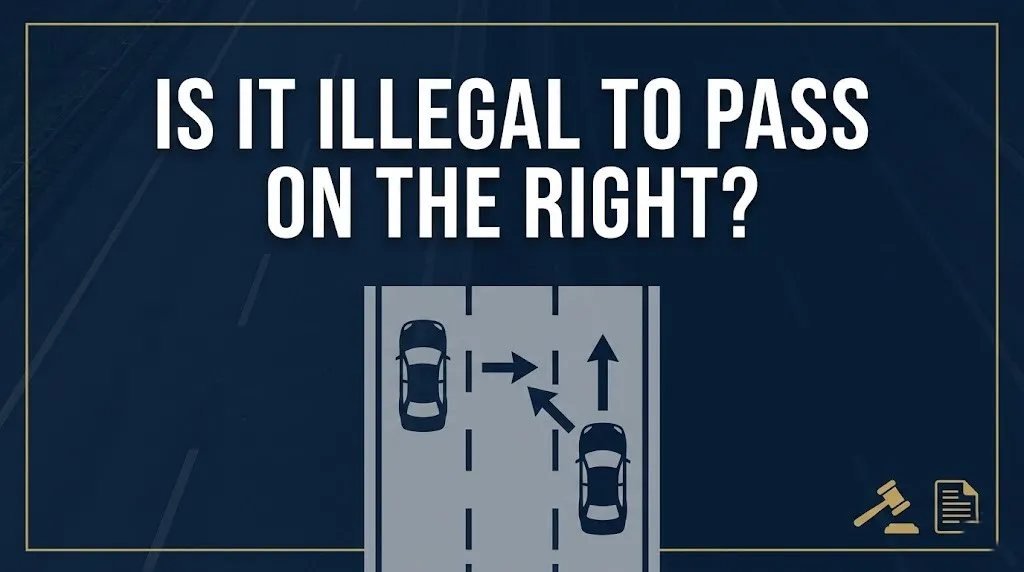
That said, even in states where it is permitted, the pass must be done safely. If you cause an accident while passing on the right, the fact that the maneuver was technically allowed in your state will not shield you from liability.
Key fact: Passing on the right is legal in at least 47 states under the right conditions. What varies is how strict those conditions are.
What States Is It Illegal to Pass on the Right?
No U.S. state makes all right-side passing illegal in every circumstance. However, several states are much stricter than others and prohibit it in situations where other states allow it. Connecticut, for example, limits passing on the right more aggressively than most states.
Texas takes a particularly restrictive approach compared to its reputation as a driving-friendly state. Under Texas Transportation Code Section 545.057, passing on the right is only allowed when the vehicle being passed is actively making or about to make a left turn, or when the road is wide enough for two or more marked lanes moving in the same direction.
States with stricter right-passing rules include Connecticut, New York, Massachusetts, and parts of Texas on two-lane roads. States generally more permissive on multi-lane roads include California, Oregon, Washington, and Indiana.
| State | Right Passing Permitted On Multi-Lane Roads | Statute |
|---|---|---|
| California | Yes | Vehicle Code 21755 |
| Texas | Yes, with conditions | Transportation Code 545.057 |
| New Jersey | Yes, safely | Statute 39:4-85 |
| Florida | Yes, with conditions | Statute 316.084 |
| Virginia | Yes, with conditions | Code 46.2-841 |
| Indiana | Yes, if safe | Code 9-21-8-6 |
| Illinois | Yes, with conditions | 625 ILCS 5/11-701 |
It Is Legal to Pass on the Right When…
Passing on the right becomes legal when one or more specific conditions are met. These conditions are consistent across most state vehicle codes, even though the exact wording varies.
The most widely recognized exception is when the vehicle in front is turning left. In this case, passing on the right keeps you out of the way of the turning car and is safer than stopping behind it. Nearly every state allows this.
The second exception applies to roads with multiple marked lanes in the same direction. On a three-lane interstate, for example, using the right lane to go around a slower car in the center lane is perfectly legal in most states. You are operating in a designated travel lane, not cutting around a vehicle by leaving the road.
The three main legal conditions in most states:
- The vehicle ahead is making or signaling a left turn
- The road has two or more marked lanes traveling in your direction
- You are on a one-way street with room for multiple vehicles side by side
All conditions require the pass to be executed safely. Speed, visibility, and distance all factor in. A technically legal pass done recklessly can still result in a citation for unsafe driving.
Is It Illegal to Pass in the Right Lane?
Using the right lane to pass is not illegal on multi-lane roads, but it is considered improper practice in many states when done excessively or aggressively. There is a difference between “passing in the right lane” and “camping in the right lane to pass everything.”
On a highway with three or more lanes, moving to the right lane to overtake a car in the center lane is legal and commonly done. However, you should not use the right lane as a dedicated passing lane the way the left lane is used. The right lane is typically the entry and exit lane, and weaving through it aggressively creates its own safety hazard.
Some states have specific rules about not using the far-right lane for continuous passing on highways with three or more lanes. Michigan, for example, has statutes that address lane discipline on roadways divided into four or more lanes under MCL 257.642.
Key Takeaway: Passing on the right is legal on multi-lane roads in most states, as long as you stay in a marked lane and the move can be made safely. Using the shoulder is never legal.
Is It Against the Law to Pass on the Right?
It is against the law to pass on the right in specific situations that apply in every state without exception. The clearest example is using the shoulder to pass a stopped or slow vehicle. Every state prohibits this, and it is one of the most commonly issued improper passing citations.
It is also against the law to pass on the right on an undivided two-lane road in most states. On a road with one lane in each direction, passing on the right means going off the pavement or into oncoming traffic on the wrong side, which is never legal.
Beyond those hard rules, whether it is “against the law” depends heavily on how the pass is executed. A pass that requires you to leave the traveled roadway is illegal everywhere. A pass that remains fully within a marked lane, performed safely, is legal in most states.
Is It Illegal to Pass on the Right in Florida?
Florida law does not make all right-side passing illegal, but it sets clear conditions under Florida Statute 316.084. Passing on the right in Florida is permitted when the vehicle ahead is making or about to make a left turn, or when the road is a multi-lane road with unobstructed pavement wide enough for two or more lanes of moving traffic.
The key line in Florida law is this: the pass must stay within a marked lane. You cannot use the shoulder, the unpaved edge of the road, or any area outside a designated traffic lane. Doing so turns a potentially legal maneuver into a traffic violation immediately.
Penalties in Florida for improper passing can include a fine, three points added to your license under Florida’s points system, and potential liability if an accident results. Florida’s Department of Highway Safety and Motor Vehicles also notes that multi-lane roads require drivers to stay in right-hand lanes except when passing, under Section 316.081(3).
Florida quick facts:
- Statute: Florida Statute 316.084
- Shoulder passing: Always illegal
- Penalty: Fine plus up to 3 points on license
- Left-lane rule: Section 316.081(3) requires right-lane travel on multi-lane roads
Is It Illegal to Pass on the Right in NJ?
New Jersey allows passing on the right under safe conditions, as stated in New Jersey Statute 39:4-85. The law specifies that a driver may overtake on the right only when conditions allow the movement to be made safely, and only in designated circumstances.
New Jersey law specifically allows right-side passing when vehicles ahead are in two or more substantially continuous lines moving in the same direction. This is the standard multi-lane highway scenario. It also allows passing on the right when the vehicle ahead is making or about to make a left turn.
New Jersey is often described as having stricter passing rules than neighboring states. While the statute does allow right passing with conditions, New Jersey courts have historically interpreted “safely” narrowly. An aggressive pass on the right that startles another driver, even if no collision occurs, could still result in a citation.
| Condition | Allowed in NJ? |
|---|---|
| Vehicle ahead turning left | Yes |
| Multi-lane traffic moving same direction | Yes |
| Passing on shoulder | No |
| Passing on single-lane undivided road | No |
| Passing unsafely in any condition | No |
Is It Legal to Pass on the Right in Texas?
Texas is more restrictive than most people expect. Under Texas Transportation Code Section 545.057, passing on the right is only permitted when the vehicle being passed is making or about to make a left turn, or when the road has unobstructed pavement wide enough for two or more lanes of traffic in each direction.
That second condition is significant. Texas requires pavement wide enough for two lanes “in each direction,” not just in your direction. This means many standard two-lane and three-lane roads do not qualify. On a typical two-lane road in Texas, passing on the right is effectively illegal except in the left-turn scenario.
Texas also explicitly prohibits passing on the right by leaving the main traveled portion of the roadway, as confirmed under Section 545.058. The Texas fine for left-lane violations (blocking traffic) can reach $200. Improper passing fines vary by court but generally fall in the $150 to $300 range depending on the county and circumstances.
Is It Illegal to Pass on the Right in California?
California allows passing on the right in more situations than many states. California Vehicle Code Sections 21754 and 21755 permit right-side passing under several conditions, including when the vehicle ahead is making a left turn, on roads within business or residential districts wide enough for two lines of moving vehicles, on highways with two or more marked lanes in the same direction, on one-way streets, and on divided highways.
The California DMV notes that even when passing on the right is technically allowed, the pass must be completed safely and within a marked lane. Passing by driving onto the shoulder or onto an unpaved surface is prohibited under Vehicle Code 21755.
Violation of California’s passing laws can result in a fine of up to $238 and one point added to your DMV driving record. Points under the California negligent operator program accumulate and can trigger license probation or suspension if enough are earned within a certain period.
California passing on the right is permitted:
- When vehicle ahead is turning left
- On multi-lane roads in business or residential districts
- On highways with two or more lanes in your direction
- On one-way streets
- On divided highways (certain restrictions apply)
Key Takeaway: California and Indiana are among the more permissive states for right-side passing on multi-lane roads. Texas and Connecticut are among the most restrictive.
Is It Illegal to Pass on the Right in Virginia?
Virginia Code Section 46.2-841 lays out the rules for overtaking on the right. Passing on the right is allowed in Virginia only when the vehicle being passed is making or about to make a left turn and has given the required signal, or when the pass is made on a roadway with unobstructed pavement wide enough for two or more lines of moving vehicles in the direction of travel.
Virginia law also includes a notable provision: any slow-moving or over-width vehicle must be removed from the roadway at the nearest suitable location when necessary to allow traffic to pass. This puts some responsibility on the slower driver as well.
Penalties for improper passing in Virginia are treated as moving violations, typically resulting in a fine and demerit points on the driver’s record. Three to four demerit points are common for improper passing, and accumulating 12 or more points in 12 months in Virginia can result in license suspension.
Is It Illegal to Pass on the Right in Indiana?
Indiana law permits right-side passing under safe conditions. Under Indiana Code Section 9-21-8-6, a driver on a roadway or highway with at least two lanes may lawfully overtake a slower vehicle on the right, provided the move can be made safely.
Indiana’s approach is one of the more permissive in the Midwest. The responsibility falls on the driver doing the passing to ensure the maneuver is safe. However, the left lane rule in Indiana also applies: under Indiana Code 9-21-5-9, drivers should stay right and use the left lane only for passing.
A driver who camps in the left lane in Indiana faces a Class C infraction with a fine of up to $500. This creates an interesting dynamic: the left-lane driver may actually be breaking the law first, but that does not give the right-lane passer a blank check to take risky maneuvers.
| Indiana Passing Rule | Details |
|---|---|
| Right-side passing on multi-lane road | Legal if safe |
| Left-lane camping fine | Up to $500 |
| Statute for right-side passing | Indiana Code 9-21-8-6 |
| Statute for left-lane use | Indiana Code 9-21-5-9 |
Is It Illegal to Pass on the Right in Illinois?
Illinois law under 625 ILCS 5/11-701 requires drivers to keep to the right on all roadways, with exceptions for passing, preparing for a left turn, or when the right side is closed for repairs. Passing on the right in Illinois is allowed on multi-lane roads when done within a marked lane and safely.
Violating Illinois lane-keeping rules can result in a fine of $120. Illinois also takes left-lane hogging seriously. Driving in the left lane when not passing or turning left is itself a violation in Illinois, which creates pressure on all drivers to maintain proper lane discipline.
For Illinois drivers on two-lane roads, the rules tighten significantly. On an undivided two-lane road, passing on the right requires crossing the shoulder or unpaved area in most situations, which is illegal. The left-turn exception applies here too: if the vehicle ahead is turning left and there is paved road to the right, passing is permitted.
Is It Illegal to Pass on the Right in Missouri?
Missouri Revised Statutes Section 304.015 requires drivers to stay on the right side of the road, with the usual exceptions for passing and left turns. Improper passing in Missouri can result in a fine of $80.50 as a base penalty, though total costs with court fees can be higher.
Missouri applies the general rule that passing on the right is allowed on multi-lane roads when done safely. On two-lane roads, the left-turn exception applies. Passing using the shoulder or leaving the traveled road surface is not permitted.
Missouri is considered a moderate state for passing rules, neither as permissive as Indiana or California nor as restrictive as Connecticut or parts of Texas. The key standard is safety: a pass that creates a hazard, even on a road where the maneuver would otherwise be allowed, can result in a citation for reckless driving rather than just improper passing.
Is It Illegal to Pass on the Right in Colorado?
Colorado Revised Statutes Section 42-4-1001 requires drivers to keep right unless passing or turning. Passing on the right in Colorado is allowed in multi-lane situations and when the vehicle ahead is turning left. Colorado also recently enacted stricter rules for commercial trucks in the left lane on I-70, with fines of $100 and CDL points for violations.
For regular passenger vehicles in Colorado, violating the keep-right rule can result in a fine of approximately $41.20. Colorado’s left-lane law is specifically enforced where the speed limit is 65 mph or higher. At lower speed limits on local roads, the rules are interpreted somewhat differently.
Colorado does not make right-side passing illegal on multi-lane roads when done properly. The maneuver must stay within a marked lane, must be done at safe speed, and must not require using the shoulder or road shoulder.
Colorado passing fines at a glance:
- Standard improper passing: approximately $41.20
- Commercial truck left-lane violation: $100
- Shoulder passing: treated as unsafe driving, higher penalties
Key Takeaway: Across the Midwest and Mountain West, the pattern is consistent: right-side passing on multi-lane roads is generally legal if safe. The moment you leave the pavement or marked lane, you are breaking the law.
Is It Legal to Pass on the Right in PA?
Pennsylvania allows passing on the right under the Pennsylvania Vehicle Code. The conditions mirror those in most other states: the vehicle ahead must be making or about to make a left turn, or the road must have sufficient lane width for two or more vehicles to travel in the same direction.
Pennsylvania is often grouped with stricter states by reputation, but its vehicle code is fairly standard on this point. Two-lane undivided roads in Pennsylvania follow the same general prohibition on right-side passing that applies elsewhere. Multi-lane roads allow it when done safely.
The Pennsylvania Vehicle Code requires that any pass, whether on the left or the right, be executed in a way that does not create a hazard for any other vehicle. This standard is broadly interpreted by Pennsylvania courts. A pass that was legal on paper can still become an unsafe passing violation if the execution was poor.
| Condition | Legal in PA? |
|---|---|
| Vehicle ahead turning left | Yes |
| Two or more lanes same direction | Yes |
| One-way street | Yes |
| Passing via shoulder | No |
| Passing on undivided two-lane road | No |
Frequently Asked Questions
Can you pass on the right if someone is blocking the left lane?
Yes, you generally can, but the rules still apply. If the left lane is blocked by a slow driver and the road has multiple lanes, you may pass on the right as long as you stay within a marked lane. This does not give you license to drive aggressively or unsafely. The driver blocking the left lane may themselves be breaking the law, but that does not suspend your obligation to pass safely.
Is passing on the right shoulder ever legal?
No, passing on the shoulder is never legal in any U.S. state. The shoulder is not a travel lane and is reserved for emergencies and disabled vehicles. Using it to pass another car is a traffic violation in all 50 states. Even if no police are present, causing an accident from a shoulder pass creates full liability for the passer.
What is the fine for passing on the right illegally?
Fines vary widely by state, from $41 in Colorado to $500 in Indiana for related lane violations. Florida and New Jersey typically issue fines in the $50 to $200 range for improper passing. California’s standard fine is around $238 before court fees, which can more than double the total cost. Missouri sets a base fine of $80.50 for improper passing, though court costs add more.
Does passing on the right affect your insurance?
Yes, a traffic ticket for improper or illegal passing is a moving violation and will likely increase your insurance premium. Most insurers review your driving record at renewal and rate you based on violations from the past three to five years. One moving violation can raise annual premiums by 10% to 25% depending on your insurer and state. Multiple violations in a short period can trigger policy cancellation.
Is it illegal to pass on the right on a one-way street?
No, passing on the right is generally legal on a one-way street in most states. One-way streets have traffic moving in one direction only, so passing on the right does not put you in the path of oncoming vehicles. Most state vehicle codes, including those in California, Virginia, Florida, and New Jersey, specifically list one-way streets as a legal exception for right-side passing. The pass must still be made safely and within the paved surface of the road.
Closing
Passing on the right is not a one-size-fits-all violation. The answer changes based on your state, your road type, and whether you stayed inside a marked lane. On a multi-lane highway, the maneuver is legal in most states. On a two-lane road or the shoulder, it is not.
Knowing these rules before you get a ticket is always better than learning them after. Bookmark this page the next time you are driving somewhere new and want to know what the local passing laws say.






