
Abortion is not illegal across the United States, but it is illegal to have an abortion in 13 states as of March 2026. There is no national ban. Where you live, or where you go, determines whether it is legal.
That changed in June 2022. The Supreme Court’s ruling in Dobbs v. Jackson Women’s Health Organization wiped out the federal right to abortion that had existed since Roe v. Wade in 1973. States got full authority to ban, restrict, or protect abortion. They have all made very different choices.
The legal picture keeps shifting. States are passing new laws, courts are issuing new rulings, and ballot measures are rewriting state constitutions. This article covers the legal status of abortion in every major state people ask about, what the actual penalties are, and what rights patients currently have.
Is It Illegal to Have an Abortion in the US?
Abortion is not federally illegal in the United States as of 2026. There is no national ban. Thirteen states have enacted total or near-total bans, while 25 states plus Washington, D.C. actively protect the right.
Before June 2022, the Supreme Court’s Roe v. Wade decision protected abortion as a constitutional right. The 2022 Dobbs ruling reversed that. States were handed full authority to decide their own policies.
Some states activated pre-written “trigger laws” that banned abortion automatically once Roe fell. Others passed new legislation. The result is a country where abortion access varies enormously depending on your ZIP code.
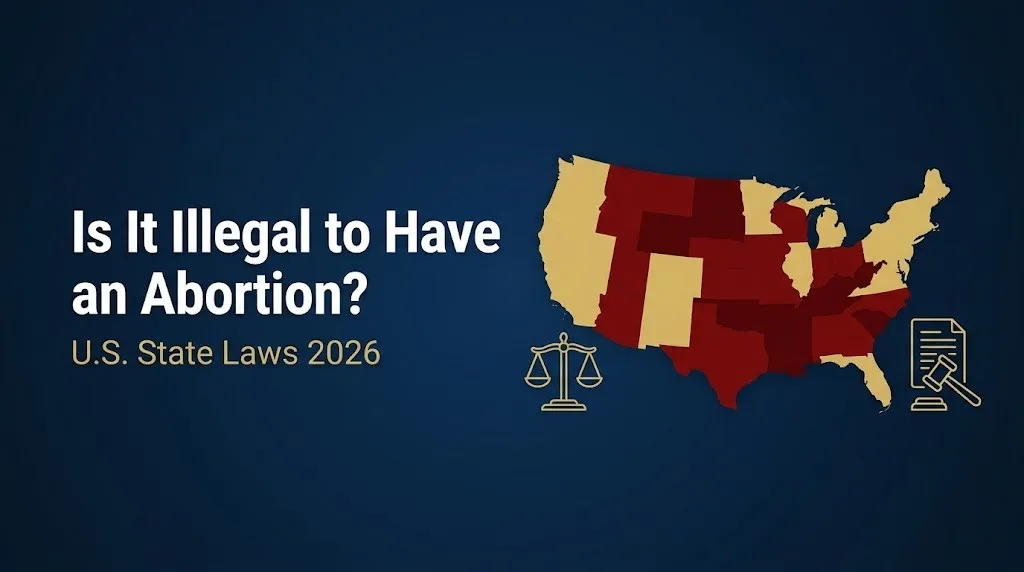
Quick National Facts (March 2026):
- 13 states have total or near-total abortion bans
- 4 states ban abortion at around 6 weeks of pregnancy
- 25 states plus D.C. protect abortion access by law
- No federal law currently bans or protects abortion nationwide
- Criminal penalties in ban states fall primarily on providers, not patients
What States Is It Illegal to Have an Abortion?
Abortion is illegal in 13 states, concentrated in the South and Midwest. These states have total or near-total bans with very limited exceptions. Most permit abortion only when the pregnant person’s life is in immediate danger.
Exceptions for rape and incest exist in some of these states, but they come with strict requirements. Survivors often must file a police report. There are tight time windows. In practice, these exceptions are rarely used.
Here is a breakdown of the states with total or near-total bans:
| State | Ban Type | Rape/Incest Exception | Provider Penalty |
|---|---|---|---|
| Alabama | Total ban | No | Class A felony, 10-99 years |
| Arkansas | Total ban | No | Up to 10 years, $100K fine |
| Idaho | Near-total | Yes (with restrictions) | 2-5 years prison |
| Indiana | Near-total | Yes (up to 10 weeks) | Level 5 felony, 1-6 years |
| Kentucky | Near-total | No | 1-5 years prison |
| Louisiana | Total ban | No | 1-10 years, $100K fine |
| Mississippi | Total ban | Yes (if reported) | 1-10 years prison |
| North Dakota | Total ban | Yes | Class C felony |
| Oklahoma | Total ban | No | 1 year to life in prison |
| South Dakota | Total ban | No | Up to 2 years prison |
| Tennessee | Near-total | No | Class C felony, 3-15 years |
| Texas | Total ban | No | Min. 5 years, up to life; $100K civil fine |
| West Virginia | Near-total | Yes (up to 14 weeks) | 3-10 years prison |
One important distinction every person should understand: in most of these states, criminal charges target providers, not patients. The pregnant person is currently shielded from criminal prosecution in all 13 states under existing law, though some states are actively working to change that.
Where Is It Legal to Have an Abortion in the US?
Abortion is legal in 25 states plus Washington, D.C. as of March 2026. Some allow it up to fetal viability, around 22 to 24 weeks. Others have no gestational limit at all.
States in the Northeast, West Coast, and upper Midwest tend to have the broadest protections. Several have written abortion rights directly into their state constitutions through voter-approved ballot measures. That makes banning abortion much harder through normal legislation.
Here is a breakdown of key states where abortion is legal:
| State | Legal Up To | Constitutional Protection |
|---|---|---|
| California | No limit | Yes (Prop 1, 2022) |
| Colorado | No limit | No |
| Illinois | No limit | No |
| New York | 24 weeks (life/health after) | Yes (2022 statute) |
| Pennsylvania | 24 weeks | No |
| Virginia | 26.6 weeks | No |
| Wisconsin | 22 weeks | No |
| Ohio | Until viability | Yes (Issue 1, 2023) |
| Arizona | Until viability | Yes (Prop 139, 2024) |
| Michigan | Until viability | Yes (Proposal 3, 2022) |
States with no gestational limit at all include Alaska, Colorado, New Mexico, Oregon, and Vermont. In those states, abortion is legal at any point in pregnancy.
Is It Illegal to Have an Abortion in Texas?
Yes, abortion is illegal in Texas with very limited exceptions. Texas has one of the strictest bans in the country. It covers all stages of pregnancy. There is no exception for rape or incest.
The only permitted exceptions are medical emergencies. Texas passed the Life of the Mother Act in 2025 to clarify that doctors do not have to wait until death is “imminent” before acting. Treating ectopic pregnancies and miscarriages remains legal. Those procedures are not classified as abortions under Texas law.
Providers who violate the ban face severe consequences. A performing physician can face a minimum of 5 years in prison, up to life imprisonment, and civil lawsuits of at least $100,000 per violation. The Texas Medical Board can also revoke a doctor’s license.
What Texas law currently does NOT do:
- It does not criminalize the patient. Texas law explicitly protects pregnant people from criminal and civil penalties for obtaining an abortion.
- It does not bar travel. Traveling to another state for a legal abortion is not a crime under Texas law. About 35,000 Texas women traveled out of state for abortions in 2023 alone.
- It does not exempt cities. Austin, Dallas, Houston, El Paso, and Denton have passed resolutions deprioritizing enforcement. The law still applies in those cities.
Texas House Bill 7 took effect in December 2025. It bans the manufacturing, distributing, or mailing of abortion medication into Texas. Anyone who provides abortion pills to Texas residents, other than the patient, faces civil fines of at least $100,000 per violation.
Is It Legal to Have an Abortion in Florida?
Florida does not have a total ban, but abortion is heavily restricted. A 6-week ban took effect in May 2024. At 6 weeks, most people do not yet know they are pregnant.
The 6-week rule replaced an earlier 15-week limit. Exceptions exist for life and health threats, fatal fetal conditions, and some cases of rape, incest, or human trafficking. Rape and incest exceptions require documentation.
Florida voters rejected a 2024 ballot amendment that would have enshrined abortion rights in the state constitution. That means the 6-week ban stays.
| Florida Abortion Rules | Details |
|---|---|
| Gestational limit | 6 weeks LMP |
| Life/health exception | Yes |
| Rape/incest exception | Yes, documentation required |
| Fatal fetal condition | Yes |
| Constitutional protection | No (voters rejected Amendment 4, 2024) |
| Provider penalty | Second-degree felony |
Providers in Florida face second-degree felony charges for performing abortions outside the permitted exceptions.
Key Takeaway: The United States has no national abortion law. Thirteen states ban it with felony-level penalties for providers, four more restrict it at roughly 6 weeks, and 25 states plus D.C. protect access. Your state determines your options.
Is It Legal to Have an Abortion in California?
Yes, abortion is fully legal in California with no gestational limit. California has some of the broadest abortion protections in the nation.
Voters passed Proposition 1 in November 2022, adding the right to abortion directly to the California state constitution. That protection makes abortion extremely difficult to ban or restrict through regular legislation. Medi-Cal, California’s Medicaid program, covers abortion costs for eligible patients.
California also has shield laws. These laws protect California-based doctors who use telemedicine to prescribe abortion medication to patients in states where it is banned. Out-of-state courts and law enforcement cannot easily reach California providers for legal actions taken within state law.
California Key Facts:
- No gestational limit
- State constitutional protection via Proposition 1 (Nov. 2022)
- No parental consent requirement
- Medi-Cal covers abortion
- Shield laws protect providers from out-of-state prosecution
- Major destination state for people traveling from ban states
California, along with New Mexico, Colorado, and Illinois, absorbs a large share of patients traveling from southern and midwestern ban states.
Is It Legal to Have an Abortion in Ohio?
Yes, abortion is legal in Ohio. Voters passed Issue 1 in November 2023, adding the right to abortion to the Ohio state constitution. The amendment protects abortion until fetal viability, generally around 22 to 24 weeks.
Before that vote, Ohio had a 6-week heartbeat ban that had been blocked by courts. Issue 1 rendered that ban permanently unenforceable. The constitutional amendment uses broad language covering the right to make and carry out reproductive decisions, including contraception and fertility treatment.
After viability, Ohio may regulate or restrict abortion, but must allow exceptions to protect the pregnant person’s life or health.
| Ohio Abortion Status | Details |
|---|---|
| Legal status | Legal until viability |
| Constitutional protection | Yes (Issue 1, Nov. 2023) |
| Viability limit | Approx. 22-24 weeks |
| Post-viability access | Allowed for life/health |
| Previous 6-week ban | Permanently unenforceable |
Ohio’s constitutional amendment was passed with about 57% of the vote. It represents one of the clearest voter mandates on abortion rights anywhere in the country.
Is It Illegal to Have an Abortion in Indiana?
Yes, abortion is illegal in Indiana under a near-total ban. The ban took effect in August 2022. It covers virtually all abortions across all stages of pregnancy.
Permitted exceptions include cases involving a serious risk to the life or health of the pregnant person, fatal fetal abnormalities incompatible with life, and pregnancies resulting from rape or incest up to 10 weeks. Providers who violate the ban face Level 5 felony charges under Indiana’s criminal code. KFF research notes that Indiana classifies this offense in the same criminal category as involuntary manslaughter.
Indiana law targets providers, not patients. The pregnant person cannot be criminally charged for obtaining an abortion under current law.
Key Penalty Facts for Indiana:
- Level 5 felony for providers: 1 to 6 years in prison
- License revocation for medical providers
- No criminal penalty for the patient
- Rape/incest exception requires documentation, capped at 10 weeks
In early 2025, Indiana was among 10 states where legislators introduced bills that could allow patients to be charged with homicide for obtaining an abortion. Those bills have not become law as of March 2026, according to the Center for Reproductive Rights, which is tracking the proposals.
Is It Illegal to Have an Abortion in Tennessee?
Yes, abortion is illegal in Tennessee under a near-total ban. The ban took effect in August 2022. Tennessee has no exception for rape or incest.
The permitted exception is a serious risk to the life or health of the pregnant person. Tennessee differs from Texas in that it does have a health exception, not just a life exception. A court in 2023 blocked the state from disciplining physicians who act on the health exception. Criminal enforcement of the ban was not blocked, however.
Tennessee classifies abortion violations as a Class C felony. That puts abortion in the same criminal category as aggravated assault under Tennessee’s criminal code, with a sentence range of 3 to 15 years.
| Tennessee Abortion Rules | Details |
|---|---|
| Ban type | Near-total |
| Effective date | August 2022 |
| Rape/incest exception | No |
| Life/health exception | Yes |
| Provider penalty | Class C felony, 3-15 years |
| Patient penalty | Currently none |
As of February 2026, Tennessee lawmakers introduced a proposed amendment that would classify abortion as homicide. The proposal could expose both providers and patients to the death penalty. It does not yet have enough Senate votes to pass. It represents the furthest-reaching legislative proposal on abortion currently active in any state.
Key Takeaway: Indiana, Tennessee, and Texas all enforce near-total bans with serious felony penalties for providers. Patients are currently protected from criminal charges in all three states under existing law, though that protection is being challenged through new legislation in several states.
Is It Legal to Have an Abortion in North Carolina?
Abortion is legal in North Carolina, but only up to 12 weeks of pregnancy. After 12 weeks, specific exceptions apply. North Carolina is not a ban state, but it is significantly more restricted than it was before 2023.
North Carolina passed Senate Bill 20 in 2023, reducing the standard gestational limit from 20 weeks to 12 weeks. Before that change, North Carolina was a major destination for patients traveling from southern ban states. It still has more access than neighboring ban states, but far less than before.
Exceptions beyond 12 weeks include rape or incest up to 20 weeks, fatal fetal conditions up to 24 weeks, and threats to the pregnant person’s life or health at any stage. A 72-hour waiting period applies in most cases. Parental consent is required for patients under 18.
| NC Gestational Exceptions | Limit |
|---|---|
| Standard elective abortion | 12 weeks |
| Rape or incest | Up to 20 weeks |
| Fatal fetal anomaly | Up to 24 weeks |
| Life/health of pregnant person | Any stage |
Providers who perform abortions outside the permitted parameters face Class I felony charges under North Carolina law.
Is It Legal to Have an Abortion in Pennsylvania?
Yes, abortion is legal in Pennsylvania up to 24 weeks of pregnancy. Pennsylvania has maintained the viability-based framework from Roe v. Wade without change. It remains one of the most accessible states in the mid-Atlantic region.
Pennsylvania does not have a constitutional protection for abortion rights. That means the legislature could restrict or ban abortion through standard legislation without requiring a constitutional amendment. As of March 2026, no such change has passed.
A 24-hour waiting period applies in most cases. Parental consent is required for patients under 18. State Medicaid does not cover abortion except in cases of rape, incest, or life endangerment.
Pennsylvania Key Facts:
- Legal up to 24 weeks
- No gestational constitutional protection
- 24-hour waiting period required
- Parental consent required (under 18)
- Medicaid covers: rape, incest, life-endangering situations only
- Private insurance must cover abortion
Pennsylvania’s lack of constitutional protection is a live concern. If the political makeup of the state legislature changes, the 24-week limit could be reduced through ordinary legislation.
Is It Illegal to Have an Abortion in Missouri?
Missouri’s abortion status is actively contested. Voters narrowly approved Amendment 3 in November 2024, adding abortion protections to the Missouri state constitution through viability. Before that vote, Missouri had a near-total ban in effect since 2022.
The 2024 amendment passed with a narrow majority. It protects abortion up to fetal viability. Litigation has created uncertainty about whether and how the amendment is being enforced. Missouri’s situation is a live legal dispute, not a settled question.
A competing ballot measure is expected on the 2026 Missouri ballot. It would reinstate the abortion ban and override Amendment 3. Until that measure is decided, Missouri’s legal status remains in flux.
| Missouri Abortion Timeline | Status |
|---|---|
| Pre-Dobbs | Legal with restrictions |
| August 2022 | Near-total ban triggered |
| November 2024 | Amendment 3 approved (viability protection) |
| 2025-2026 | Litigation, enforcement uncertainty |
| 2026 | Competing ballot measure expected |
Think of Missouri like a legal tug-of-war. Voters pulled in one direction; the state legislature is pulling back. The rope is still moving.
Key Takeaway: Missouri shows exactly how quickly abortion law can reverse. A state can have a total ban, then a voter-approved constitutional right, then face another attempt at a total ban, all within four years. The law at any given moment is not the permanent answer.
Is It Legal to Have an Abortion in Arizona?
Yes, abortion is legal in Arizona until fetal viability, generally around 22 to 24 weeks. Voters approved Proposition 139 in November 2024, adding abortion rights to the Arizona state constitution.
Before Prop 139, Arizona went through a dramatic legal struggle. A 1902 state law based on an 1864 territorial statute briefly came back into effect in 2024, threatening a near-total ban. The state legislature repealed that old law in May 2024. A 15-week ban from 2022 then took over. Prop 139 passed in November 2024 and replaced all previous restrictions with a viability-based constitutional right.
In 2026, a Maricopa County judge ruled that Prop 139’s language also voided existing bans on telemedicine prescriptions for abortion medication. That expanded access to the abortion pill in Arizona beyond what was permitted under prior law.
Arizona Abortion Key Facts:
- Legal until viability (approx. 22-24 weeks)
- Constitutional protection via Prop 139 (Nov. 2024)
- Telemedicine prescription restrictions voided (2026 court ruling)
- Old 1864-era and 1902 laws no longer apply
- Parental consent requirements vary; ongoing legal review
Is It Legal to Have an Abortion in Michigan?
Yes, abortion is legal in Michigan. Voters passed Proposal 3 in November 2022, adding reproductive rights to the Michigan state constitution. Abortion is protected until fetal viability.
Before that vote, a 1931 Michigan law banning abortion briefly threatened to take effect after Dobbs. Proposal 3 made that old law irrelevant. The constitutional amendment protects the right to make and carry out decisions about reproduction, including abortion, contraception, and fertility treatment.
After viability, Michigan allows abortion when a healthcare provider determines it is necessary to protect the pregnant person’s life or health. Parental consent is not required under the Proposal 3 framework.
| Michigan Abortion Status | Details |
|---|---|
| Legal status | Legal until viability |
| Constitutional protection | Yes (Proposal 3, Nov. 2022) |
| Approximate viability limit | 22-24 weeks |
| Post-viability access | Life/health exceptions |
| Parental consent | Not required (per Prop 3) |
| Old 1931 ban | Unenforceable |
Michigan’s Proposal 3 passed with about 57% of the vote. It was one of the first state constitutional amendments to protect abortion rights after Dobbs.
Is It Legal to Get an Abortion in Illinois?
Yes, abortion is legal in Illinois with no gestational limit. Illinois has the most permissive abortion laws in the Midwest and serves as a major access point for people traveling from neighboring ban states.
The Reproductive Health Act of 2019 removed all old restrictions on abortion. It eliminated gestational limits, waiting periods, and parental consent requirements. Illinois Medicaid and most insurance plans cover abortion costs.
Illinois borders Indiana, Missouri, and Wisconsin, all of which have had abortion bans or significant restrictions at various points since Dobbs. That geography makes Illinois a primary destination for patients from those states. Providers in Illinois have shield laws protecting them from prosecution by other states.
Illinois Key Facts:
- No gestational limit
- No waiting period
- No parental consent requirement
- Medicaid covers abortion
- Shield laws protect providers from out-of-state prosecution
- Reproductive Health Act (2019) is the governing statute
Illinois is often compared to New Mexico as one of the two most accessible abortion states in the central United States.
Is It Legal to Get an Abortion in Virginia?
Yes, abortion is legal in Virginia up to 26.6 weeks of pregnancy. That is the end of the second trimester. After that point, a physician must certify that the procedure is necessary to protect the pregnant person’s life or health.
Virginia removed multiple restrictions on abortion in 2020 and 2021. The state eliminated waiting periods, ultrasound viewing requirements, and the previous rule requiring multiple physicians to sign off on second-trimester procedures. Those changes made Virginia significantly more accessible than it was before.
Parental notification is not required for minors in Virginia. Medicaid covers abortion for low-income patients. Virginia does not have a constitutional amendment protecting abortion rights, leaving the law subject to future change through the legislature.
| Virginia Abortion Rules | Details |
|---|---|
| Legal limit | 26.6 weeks (end of second trimester) |
| Post-limit access | Life/health certification required |
| Waiting period | None |
| Parental consent | Not required |
| Medicaid coverage | Yes |
| Constitutional protection | No |
Virginia’s lack of constitutional protection is a distinction worth noting. The 26.6-week limit and current access level are protected only by statute, not by a voter-approved amendment.
Key Takeaway: Illinois, Michigan, California, Ohio, Arizona, Virginia, and Pennsylvania are among the states where abortion remains broadly legal. Several have constitutional protections via ballot measures. Others protect access only through statute, which can be changed by future legislatures.
Frequently Asked Questions
Is it illegal to get an abortion in America?
No, abortion is not illegal across all of America as of 2026. There is no federal law that bans or protects abortion. Thirteen states have near-total bans, but 25 states plus D.C. actively protect the right. Whether it is legal depends entirely on which state you are in.
What states is it legal to get an abortion?
Abortion is legal in 25 states plus Washington, D.C. as of March 2026. States with no gestational limit include California, Colorado, Alaska, New Mexico, Oregon, and Vermont. States that allow abortion until viability (about 22-24 weeks) include Ohio, Arizona, Michigan, New York, Illinois, and Wisconsin. Pennsylvania and Virginia allow abortion up to 24 and 26.6 weeks respectively.
Is it legal to travel to another state to get an abortion?
Traveling to another state to obtain a legal abortion is not federally illegal as of March 2026. No state currently enforces a law that successfully criminalizes a patient’s interstate travel for abortion care. Texas, for example, explicitly protects patients from prosecution for traveling to another state. Some states have introduced travel restriction bills, but none have been upheld in court.
What is the penalty for an illegal abortion in the US?
Penalties in ban states fall on providers, not patients, under current law. In Alabama, a provider faces a Class A felony with 10 to 99 years in prison. In Texas, providers face a minimum of 5 years in prison and civil fines of at least $100,000. In Arkansas, providers face up to 10 years in prison and fines up to $100,000.
Is the abortion pill illegal in the US?
Mifepristone remains FDA-approved and legal to prescribe in states that protect abortion. In ban states including Louisiana, possession of mifepristone or misoprostol without a valid prescription can be a criminal offense. Texas House Bill 7, effective December 2025, bans the distribution or mailing of abortion medication into Texas, with civil fines of at least $100,000 per violation for anyone other than the patient. Shield laws in states like California protect providers who prescribe the pill to patients in ban states via telemedicine.
Closing
The question of whether it is illegal to have an abortion in the US does not have one answer. It has 50. The legal picture is changing faster than it ever has. New court rulings, new ballot measures, and new state laws are reshaping the map every few months.
Bookmark this page. Share it with anyone who needs it. The next time this question comes up, the answer may be different in at least one state, and knowing which ones are shifting can make a real practical difference.






